How to record an inventory purchase in accounting

How to record an inventory purchase in accounting
When a business buys merchandise to resell, receiving the boxes at the warehouse and filing the supplier invoice does not close the process. The step that turns that operation into useful information is still missing: recording it in the accounting records with a journal entry. The purchase entry summarizes, with debits and credits, which merchandise came in, at what real cost, how much was paid or remains owed, and which part of the invoice is a sales tax that the business will be able to recover. Doing it correctly from the first day avoids mistakes that multiply later: a cost recorded wrongly today produces a profit calculated wrongly tomorrow, when that same merchandise is sold.
In this lesson of the accounting manual we will see why the cost of inventory is higher than the invoice price, what to do with the sales tax charged on the purchase, how to record a cash purchase and how to record a credit purchase. We will finish with a complete numerical example, with its journal entries shown in tables, so that you can repeat the procedure with your own figures.
Inventory cost is more than the invoice price
People who are just starting out usually believe that the cost of a product is only the value shown on the supplier invoice. That idea is incomplete. Accounting tries to record inventory at everything the business had to spend to have the merchandise in its warehouse, ready to be sold. As a general rule, the following items are part of the cost of inventory: the price paid to the supplier for the merchandise; the freight and hauling costs needed to bring it to the warehouse; the transport insurance contracted for that trip; and other costs directly required to leave the merchandise ready for sale, such as loading, unloading or initial handling when the supplier does not assume them.
For that reason, when you talk about the cost of a purchase it helps to think in four groups:
- the price of the merchandise according to the supplier invoice;
- freight, transport insurance and other costs needed to receive the merchandise;
- taxes that cannot be recovered and that, as a general rule, are added to the cost;
- deductible or recoverable taxes, which are not a cost but a right in favor of the business.
This is the general logic used in most countries, and you should confirm it with your accountant according to the local rules. The important idea for now is this: the cost of inventory is the total cost of making it ready for sale, not only the price shown on the invoice. When the merchandise is sold, that total cost is what will be compared against the revenue to calculate the profit of the sale.
What to do with the sales tax on the purchase
When a supplier invoices a purchase, the invoice often includes, besides the value of the merchandise, a sales tax. To decide how to record it there is one key question: can that tax be recovered or deducted? If the business is allowed to treat it as deductible or recoverable, then it is not a cost of the merchandise: it is a right that the company will be able to subtract from the taxes it must settle when it sells. That is why it is recorded in an asset account, for example sales tax recoverable or deductible input tax, and not inside the Inventory account.
If, on the contrary, the business cannot recover that tax, because it is not required to charge it, because the local rules do not allow it or because the purchase does not meet the requirements, then the tax becomes part of the cost of the merchandise and is debited to the Inventory account together with the price and the freight. In this lesson we do not mention rates or articles of any country: the percentages and requirements depend on local legislation, but the logic is always the same. What must be clear is that confusing a recoverable tax with a cost makes the inventory more expensive in the books and distorts the future profit.
Buying for cash or on credit
Another decision that affects the entry is how the purchase is paid. In a cash purchase, the business hands the money to the supplier when it receives the merchandise or very soon after; in the entry, the credit goes to the Cash or Bank account. In a credit purchase, the supplier delivers the merchandise today and the business will pay later, according to the agreed term; then an obligation is born that accounting recognizes in the Accounts Payable account.
It is important to understand that the payment method does not change the cost of the inventory: the merchandise costs the same whether it is paid today or in thirty days. What changes is the other side of the entry. If the purchase is for cash, the other side is an outflow of cash. If it is on credit, the other side is a liability with the supplier that will be paid off with each later payment. When the time comes to pay the credit invoice, you debit Accounts Payable and credit Cash or Bank, without touching the Inventory account, because the merchandise was already recorded at its cost on the day of the purchase.
Chart: how each item of the purchase is treated
Before building the entry, it helps to classify every value on the invoice and every expense related to the purchase. The following chart summarizes the treatment of the most frequent items: whether they add to the cost of inventory, whether they are an expense, or whether they are a right in favor of the business that will be recovered later.
| Item | Does it add to inventory cost? | Accounting treatment |
|---|---|---|
| Price of the merchandise according to the invoice | Yes | Debit to the Inventory account |
| Freight and hauling to the warehouse | Yes | Debit to the Inventory account |
| Insurance and other costs of receiving the merchandise | Yes | Debit to the Inventory account |
| Deductible or recoverable sales tax | No | Recoverable asset; it is not cost or expense |
| Tax that cannot be recovered, when local rules do not allow deducting it | Yes | Debit to the Inventory account |
| Discounts included in the supplier invoice | No: they reduce the cost | Subtracted from the debit to the Inventory account |
| Interest or surcharges for financing the purchase | No | Financial expense of the period |
The practical rule is simple: everything needed to leave the merchandise ready for sale adds to the cost of inventory; the tax that can be recovered is a right and does not add; and interest or surcharges for paying late are an expense of the period and do not add to the cost of the merchandise either.
The purchase entry, step by step
With those ideas clear, let us build the entry with a complete example. Suppose a business buys merchandise on credit for $4,000,000. The supplier invoice includes, besides the value of the merchandise, a deductible sales tax of $120,000. The supplier grants a payment term, so the total the business owes is $4,120,000. Separately, the business pays $150,000 in cash for freight so that the merchandise reaches the warehouse. We are not using rates or rules of any country: these are hypothetical figures used to show how the recording works.
The first entry records the credit purchase. The Inventory account is debited for the cost of the merchandise, the deductible tax account is debited for the value the business will be able to recover, and the Accounts Payable account is credited for the total still owed:
| Account | Debit | Credit |
|---|---|---|
| Inventory (cost of the merchandise) | $4,000,000 | |
| Deductible sales tax | $120,000 | |
| Accounts Payable | $4,120,000 | |
| Equal totals | $4,120,000 | $4,120,000 |
Notice that the deductible tax was not included in the cost of the merchandise: the $4,000,000 in the Inventory account are the cost of the merchandise, and the $120,000 remained in an asset account that the company will use later to deduct from its own taxes payable.
The second entry records the freight paid in cash, because that transportation is a cost needed to have the merchandise ready for sale and, therefore, adds to inventory:
| Account | Debit | Credit |
|---|---|---|
| Inventory (freight of the purchase) | $150,000 | |
| Cash | $150,000 | |
| Equal totals | $150,000 | $150,000 |
After these two entries, the Inventory account accumulates $4,150,000, which is the real cost of the merchandise: the $4,000,000 of the price plus the $150,000 of the freight. The business paid $150,000 right away for the freight and will pay $4,120,000 to the supplier within the agreed term.
If, instead of buying on credit, the business had paid everything in cash, the purchase and the freight would be recorded in a single entry: Inventory is debited for the total cost of $4,150,000, the deductible tax is debited for $120,000, and Cash is credited for the total amount paid of $4,270,000:
| Account | Debit | Credit |
|---|---|---|
| Inventory (merchandise and freight) | $4,150,000 | |
| Deductible sales tax | $120,000 | |
| Cash | $4,270,000 | |
| Equal totals | $4,270,000 | $4,270,000 |
Compare the three entries and you will see that the cost of the inventory does not change according to the payment method: it is always $4,150,000. The only thing that changes is the other side of the entry: Accounts Payable when the purchase is on credit, or Cash when everything is paid at once. And in the three cases, the deductible tax stays apart, as a right in favor of the business.
The Inventory account and the stock ledger work together
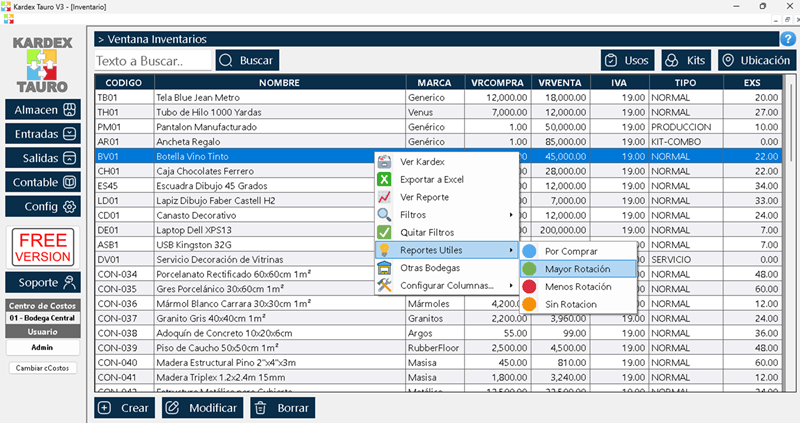
When these purchases are recorded, the Inventory account accumulates the total cost of the merchandise available. But a single account does not say how many units exist of each product or how much each unit cost. That information lives in the stock ledger: the detailed record, product by product, of entries, exits and balances, with their unit costs. The two tools coexist and complement each other: the stock ledger shows the detail that explains the value of the Inventory account, and the Inventory account shows the total that must match the sum of the stock ledger records of all products. A good system, such as Kardex Tauro, keeps that detail up to date and allows the accounting value of the inventory to be explained movement by movement.
In practice, every merchandise entry from a purchase is recorded twice in the business. In accounting, with the entry you just learned, so that the Inventory account reflects the cost. In the stock ledger, with the detailed entry by product, to know quantities and unit costs. When both records are made with the same basis, the supplier invoice, the freight paid and the deductible tax, the balance of the Inventory account and the sum of the stock ledger records match. If a difference appears, it is a warning sign that forces you to review the movements before the error grows.
Why recording the purchase correctly matters
The purchase entry may look like a formality, but it is the foundation of two very visible numbers of the business: the value of the inventory that is reported and the profit of every future sale. If the cost of the merchandise is recorded wrongly, for example if the freight is forgotten or if the deductible tax is included in the cost, the error does not stay on the day of the purchase: it travels with the merchandise. On the day that merchandise is sold, a profit will be calculated comparing the revenue against a wrong cost, and the result may show a gain that does not exist or hide a real loss.
Besides, an inventory that is overvalued or undervalued affects purchase decisions, tax calculations, loan requests and even the price at which the product is offered. That is why it is worth reviewing every purchase invoice before recording it: confirm the price, add the freight and the receiving costs, separate the deductible tax and verify that the total of the entry balances. Recording the purchase correctly is not paperwork: it is the way to make sure that the profit shown by the accounting records is the real profit of the business.
Downloadable template: Purchase book template in Excel — the Excel template that goes with this lesson.
This article is general educational material and does not constitute accounting, tax or legal advice. Rules and treatments may vary depending on the country and the type of business. Before applying these principles to your specific case, consult your accountant or trusted adviser.