Credit sales: the accounts receivable account and how to manage it

Credit sales: the accounts receivable account and how to manage it
Selling on credit is as natural for a neighborhood shop as selling for cash: the customer takes the merchandise today and promises to pay in eight, fifteen or thirty days. That trust sells more, builds customer loyalty, and lets a family buy what it needs even when the money is not in hand yet. But from an accounting point of view, a promise to pay is not a mental note that can be forgotten: it is a right of the business, an asset that must be recorded, measured and controlled with the same care used for the cash in the drawer or the merchandise on the shelf.
When the seller hands over the product and the buyer does not pay at that moment, the business gains the right to collect a future amount. That right has a precise accounting name: accounts receivable. Accounts receivable is not money the business already holds, but it is money the business expects to receive, and that is why it occupies a place among the business assets. The difference from a cash sale is exactly this: in a cash sale, cash comes into the till, while in a credit sale, a document or a commitment comes in, one that will later turn into cash when the customer pays.
This lesson reviews, with step-by-step journal entries and a complete numerical example, how the accounting records a credit sale, the customer's payment, and the advance that some customers hand over before receiving the merchandise. It also explains why it matters to know how long each balance has been owed and how to keep the customer statement for each account. By the end, the reader will be able to answer with numbers, not with memory, the three basic questions of credit: who was sold to, how much they owe, and since when.
Why credit creates an accounts receivable account and not cash income
The first idea to make clear is that a credit sale does not produce cash at the moment of the sale. The business hands over merchandise and receives a collection right in exchange, not banknotes. That is why the sale entry does not touch the Cash account: it touches the Accounts receivable account, which stands for exactly that right. Recording the money as if it had already come in would be a serious mistake, because the cash position would show cash that does not exist and the business would spend on the strength of money it has not yet received.
Accounting works on the accrual basis: revenue is recognized when the transaction takes place, that is, when the merchandise is delivered and collection is agreed, and not when the money arrives. That means a credit sale is indeed revenue of the period, even though the customer has not paid yet. What changes is not the moment of the revenue, but the place where the amount is recorded: instead of Cash going up, Accounts receivable goes up. The two effects of the transaction are an increase in assets through the collection right and an increase in revenue through the sale that was made.
Think of the difference with a personal loan. When a friend asks you to lend him money, you do not say you earned that money: you say you hold a right to collect it. The same happens with trade credit. The customer who takes merchandise without paying is not giving the business a gift of profit: he is creating an accounts receivable, an asset financed by the seller's effort. The profit from the sale will be known when the selling price is compared with the cost of the merchandise, but the right to collect the full price is born at the moment of the invoice.
Before granting credit, it is wise to set some minimum conditions, because an accounts receivable is only worth something if it can be collected later. The typical conditions of a small business are:
- Identify the customer properly: full name, document and address, even for a trusted customer from the neighborhood.
- Set a limit or ceiling: the maximum amount each customer may owe, based on their payment history.
- Fix the term: eight, fifteen or thirty days, stated in writing or on the sales note.
- Get a signature or a note: the customer signs the note or the voucher of the credit sale, so there is no doubt later about the amount or the date.
Accounting does not require the customer to be a big merchant or a formal contract to exist: it is enough that the transaction is real, measurable and documented. But the more orderly the customer identification is, the easier it will be to manage the receivable afterwards and to collect on the agreed date.
Recording the credit sale
When the business invoices a credit sale, two journal entries must be recorded together. The first recognizes the revenue and the collection right: debit Accounts receivable and credit Sales. The second removes the merchandise from inventory, with the same cost-of-sales treatment studied in lesson 12: debit Cost of sales and credit Inventory. The first entry says how much the customer owes; the second says how much the merchandise that already left the shelf cost the business.
Remember how accounts behave from earlier lessons: Accounts receivable is an asset and increases on the debit side; Sales is revenue and increases on the credit side. By debiting the receivable, the business recognizes that it now holds more collection rights; by crediting Sales, it recognizes that a revenue transaction took place. The accounting equation stays in balance, because the two sides of the entry offset each other: an asset goes up and equity goes up through revenue.
Let us look at the example that will accompany the whole lesson. A hardware store sells merchandise on credit to a known customer for $1,500,000, payable in thirty days, and the customer signs the sales note. The sale entry is this: debit Accounts receivable for $1,500,000 and credit Sales for $1,500,000. If the merchandise sold had cost the business $900,000, the second entry is this: debit Cost of sales for $900,000 and credit Inventory for $900,000.
It is important to understand that the receivable is born for the full amount of the invoice, that is, the $1,500,000 selling price, and not for the profit. The customer owes the full price he agreed to pay; the $600,000 profit, which is the difference between the selling price and the cost, is a result measured separately. If the business recorded the receivable only for the profit, it would not know later how much to charge the customer, which is precisely the most important figure of the whole process.
The customer's payment: cash comes in and the account goes down
When the customer arrives to pay, the business receives cash and the accounts receivable decreases. The entry is simple: debit Cash for the amount received and credit Accounts receivable for the same amount. Cash goes up because money came in; the receivable goes down because the collection right is being fulfilled. If the customer pays half, half is recorded; if he pays everything, the receivable reaches zero and the matter is closed.
A payment must never be recorded as a new sale. That is one of the most frequent confusions in small businesses and deserves attention: the sale was already recorded on the day the merchandise was delivered, and the revenue was already recognized at that moment. When the customer pays, the business is not earning again: it is converting a collection right into cash. If the payment were recorded as a sale, revenue would appear doubled, the business would believe it sells more than it really does, and the receivable would still show a pending balance that has already been paid.
In the hardware store example, the customer pays $800,000 in cash. The entry is: debit Cash for $800,000 and credit Accounts receivable for $800,000. The receivable, which came from $1,500,000, drops to $700,000 as a result of this payment. Later we will see how the balance ends up when the advance the customer had handed over before the sale is also applied.
The customer's advance: a liability applied to the sale
Some customers hand over money before receiving the merchandise, in part or in full, to reserve an order or to secure the purchase. That money arriving in advance is not yet revenue for the business, even though it is physically in the cash register. Until the merchandise is delivered or the sale is invoiced, the business has the obligation to return that money or to deliver the agreed products, and that obligation is a liability. The account that represents this liability is called customer advances or advances from customers.
The entry for the advance is: debit Cash for the amount received and credit Advances from customers for the same amount. Notice that the Advances from customers account behaves like a mirror of the accounts receivable account: in accounts receivable the business holds the right to receive money from the customer; in advances, the customer holds the right to receive merchandise or his money back from the business. That is why the advance is classified as a liability and not as revenue.
When the sale takes place and is invoiced, the advance must be applied, that is, it must become part of the payment of that sale. There are two ways to apply the advance depending on how the sale is invoiced. If the sale is invoiced for the full amount and the advance is deducted afterwards, the entry is: debit Advances from customers and credit Accounts receivable, which reduces the balance to be collected. If the advance covers the whole sale and no balance remains, it can be applied directly against the sale: debit Advances from customers and credit Sales. In both cases the liability is cancelled and the revenue is correctly recognized.
In the example, the customer handed over an advance of $500,000 before the hardware store invoiced the merchandise. When the invoice for $1,500,000 is issued and the advance is applied, the entry is: debit Advances from customers for $500,000 and credit Accounts receivable for $500,000. In this way, the customer's debt, which was born at $1,500,000, drops to $1,000,000 through the application of the advance. Then the $800,000 payment arrives and the final balance is $200,000, which is what the customer still owes.
The journal entries of the complete example
It is worth seeing all the movements of the example gathered in a single table, in the order in which they happened, to understand how the entries relate to each other and how each one affects a different account:
| Transaction | Debit (increases) | Credit (increases) | Amount |
|---|---|---|---|
| Customer's advance in cash | Cash | Advances from customers | $500,000 |
| Credit sale of the full invoice | Accounts receivable | Sales | $1,500,000 |
| Cost of the merchandise sold | Cost of sales | Inventory | $900,000 |
| Application of the advance to the invoice | Advances from customers | Accounts receivable | $500,000 |
| Customer's payment in cash | Cash | Accounts receivable | $800,000 |
The table shows a valuable practical rule: advances are received against a liability, credit sales are recorded against an accounts receivable account, and payments are received against that same accounts receivable account. Anyone who understands this logic can record any credit transaction without fear, because they all follow the same pattern: first the right or the obligation is born, then the money moves, and finally the balance ends at the correct value.
At the end of the movements, the balance of the customer's receivable is calculated this way: $1,500,000 from the sale, minus $500,000 from the applied advance, minus $800,000 from the payment, leaves $200,000 pending. Those $200,000 are the accounting answer to the question of how much the customer owes, and they must match exactly what the business expects to collect.
The customer's balance step by step
To manage credit it is not enough to record isolated entries: the business must be able to say, at any moment, how much each customer owes. The general accounts receivable account of the business rests on a subsidiary ledger per customer, and each customer's balance moves with every transaction. The following table shows the effect of each movement on the balance of the example customer:
| Transaction | Entry made | Effect on the customer's balance |
|---|---|---|
| Opening balance | No entry | The customer owes nothing: $0 |
| Advance in cash | Cash to Advances from customers | The customer holds $500,000 in credit, with no debt |
| Credit sale | Accounts receivable to Sales | The customer owes $1,500,000 |
| Application of the advance | Advances from customers to Accounts receivable | The debt drops to $1,000,000 |
| Payment in cash | Cash to Accounts receivable | The debt drops to $200,000 |
| Closing balance | No entry | The customer owes $200,000 |
The calculation of a customer's balance always follows the same formula: previous balance, plus new credit sales, minus payments received and minus advances applied, gives the current balance. If the business keeps that subsidiary ledger up to date, it does not need to ask anyone how much is owed to it: the record says it, and a customer who disputes a balance is settled by showing the transactions one by one.
The credit portfolio and its age
The set of all the accounts receivable of the business is called the credit portfolio or receivables portfolio. The portfolio is not an abstract list: it is sold money that has not yet returned to the cash register, and its size must be reviewed regularly. A very large portfolio compared with the month's sales may mean that credit is being given away; a portfolio that nobody watches ends up as losses that nobody foresaw.
Each receivable in the portfolio has an age, which is the time it has remained uncollected since its due date. Knowing how long an amount has been owed is as important as knowing how much is owed, because the chance of collecting a debt decreases as time passes. A customer who has owed for fifteen days will probably pay; a customer who has owed for six months is another problem. The age of the portfolio makes it possible to separate healthy balances from those that are beginning to be risky and to direct collection effort where it is most needed.
A simple way to watch the age is to group balances by ranges of days past due. The allowance for accounts that will probably never be collected is studied in lesson L21, but from now on it is worth classifying the portfolio to know how healthy it is. The following table shows a typical classification for a small business:
| Age of the balance | What it means | What to do |
|---|---|---|
| Current (0 to 30 days) | The balance is within the agreed term | Keep records up to date and collect politely at maturity |
| 31 to 60 days | The delay begins | Call or visit the customer and set a payment date |
| 61 to 90 days | Significant delay | Direct collection, demand payments and keep written evidence |
| More than 90 days | High risk of not collecting | Review the case with the owner and evaluate the allowance of lesson L21 |
Reviewing the age of the portfolio every week or every two weeks makes it possible to act before a balance becomes uncollectible. When the business knows which customers are falling behind, it can decide whether to keep selling to them on credit, whether to demand an advance, or whether to reduce their limit, instead of learning about the problem when it is already too late.
The customer statement of account
The statement of account is the summary the business gives the customer to show how the balance was built. It lists the previous balance, the transactions of the period, which include new credit sales, payments received, advances applied and any adjustments, and the current balance at the end of the period. It is, on a single sheet, the history of the customer's commercial relationship with the business.
Handing over the statement every month, or every two weeks when credit is frequent, has three practical advantages. First, the customer confirms that the balance matches what he remembers, and differences are settled while the transaction is still fresh. Second, a document showing the pending debt refreshes the commitment to pay and makes collection easier, because the customer can no longer say he did not know how much he owed. Third, the business itself is forced to keep the subsidiary ledger up to date, because it cannot hand over a statement that is not backed by its records.
When a customer says he already paid and the record shows otherwise, the statement settles the discussion: the recorded payments are reviewed, the date and the amount are confirmed, and it is clarified whether the payment was applied to the correct account. It is common for the problem not to be a lack of payment but a payment wrongly noted or applied to another customer, so it is always wise to write on each payment the customer's name and the invoice being paid.
Common mistakes in managing credit
Most problems with accounts receivable are not born from the malice of customers but from recording mistakes that repeat themselves without correction. These are the most frequent ones in small businesses:
- Recording the customer's payment as a new sale. The sale was already recorded when the merchandise was delivered; the payment only changes accounts receivable into cash. Recording it as a sale doubles revenue and leaves the customer's debt pending in the records.
- Not keeping track of who must be followed up. Selling on credit without writing down the customer's name, the date, the term and the amount turns the portfolio into fragile memory that fails when the business grows and customers multiply.
- Receiving advances and never applying them. If the advance stays in the liability account and is never applied to the invoice, the customer's balance does not go down, the liability grows without justification, and in the end nobody knows whether the customer paid or not.
- Recording the credit sale and forgetting the cost of sales. Without the second entry, inventory shows merchandise that already left and profit looks higher than it really is.
- Treating all balances the same way. Not reviewing the age of the portfolio makes it impossible to see in time the customers who are falling behind and lets problems grow in silence.
- Confusing the advance with revenue of the period. The advance is a liability until the merchandise is delivered or the sale is invoiced; declaring it as revenue before its time misleads about the true profit of the business.
If the business recognizes any of these mistakes in the way it works, the correction starts with the records: review the portfolio, identify the payments wrongly noted, and put every balance in the account that corresponds to it. Recording mistakes are corrected with more recording, never with less.
Day-to-day control of credit
To finish, a few practical rules that summarize the lesson. First, record at the moment: the credit sale is written down the same day the merchandise is delivered, not when it is remembered. Second, use a single place of record, whether a credit notebook or the business software, so there are no two versions of the truth. Third, review the portfolio often, looking both at the amounts and at the age of each balance. Fourth, reconcile the subsidiary ledger per customer with the general accounts receivable account at least once a month, to confirm that the numbers match.
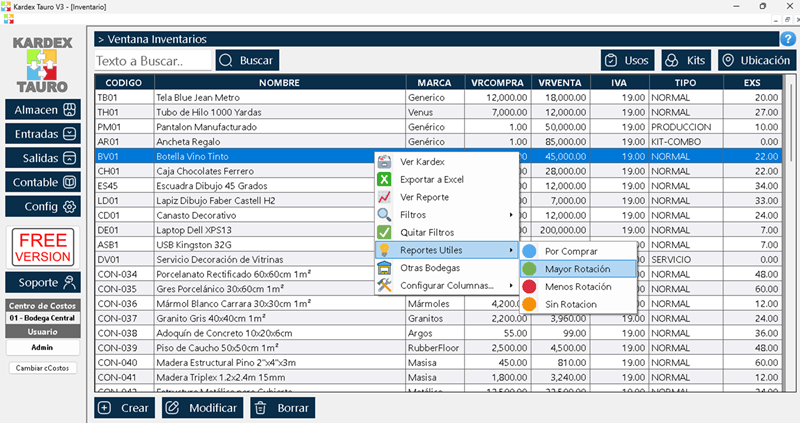
The Kardex Tauro program can support this work by keeping the subsidiary ledgers per customer, calculating the age of each balance and showing the statement of account ready to hand over, but it is worth understanding the entry behind every transaction: knowing why the receivable is debited when selling on credit and why it is credited when the customer pays. The program is a support for the records; the understanding of the records belongs to the business owner.
Selling on credit multiplies sales, but it turns every sale into an accounts receivable that demands management. With well-made entries, a subsidiary ledger per customer and a portfolio watched by age, the business always knows how much is owed to it, since when, and whom to collect from first, and credit stops being a fragile promise and becomes a well-managed asset.
Downloadable template: Aged receivables template in Excel — the Excel template that goes with this lesson.
