Sales discounts: trade, early-payment and promotional

Sales discounts: trade, early-payment and promotional
In the previous lessons of the accounting manual we learned how a sale is recorded: revenue arises for the agreed amount, inventory leaves the warehouse at its cost, and the difference between the two is the profit the business expects to earn. But in real life the full price is not always collected. A customer buys in large volume and asks for a quantity discount, another pays the invoice before the due date and expects a benefit, and from time to time the business gives away a free unit to boost sales. All of these situations are ways of selling below the list price, and each one has a different accounting treatment. In this lesson we will study the three types of discount that appear most often in a small business with inventory: the trade discount, the early-payment discount and promotional offers.
The question we are going to answer is always the same: when the customer pays less than the list price says, how much is recorded as revenue, what is done with the difference, and what happens to inventory? If these questions are not answered properly, the business statements show sales that never reached the cash register, incomplete costs and a stock record that does not match what is on the shelf. That is why it is worth making three rules clear from today: the sale is recorded at its net amount, the difference that arises after the invoice is recognized according to the policy defined by the accountant, and merchandise given away is never free for accounting purposes because it has a cost that must be recognized.
A background idea: a sale is worth what the customer actually pays
Before classifying discounts, let us set the principle that governs every case: in accounting, the revenue from a sale is the amount the business has the right to receive, and that amount is measured by what the customer really pays after all reductions are applied. If an item is marked at one hundred and sold at ninety, the business did not sell at one hundred and then spend ten: it sold at ninety. That way of thinking avoids the most common beginner mistake, which is recording the list price as if it were the revenue and treating the reduction as an expense. The reduction is not an expense: it is a decrease in the value of the sale.
In other words, accounting does not record catalogue prices; it records real transactions. When the transaction says the customer paid ninety, the revenue is ninety. When the transaction says the customer paid eighty, the revenue is eighty. This principle applies no matter the reason for the reduction, and it is the foundation of everything we will see in this lesson. The difference among the three cases we will study is not in the principle but in the moment the reduction arises and in the account that receives the difference: on the same invoice, after the invoice, or in the form of extra merchandise delivered free of charge.
1. Trade discount: the reduction that appears on the same invoice
The trade discount is the one negotiated before the sale is closed and it appears on the same invoice. Its reasons vary: a customer who buys in volume, a regular buyer who is rewarded for loyalty, a seasonal clearance or a specific agreement with a good customer. What matters is not the commercial reason but the form: the trade discount is known and accepted before the invoice is issued, so the invoice already comes out with the reduced price. The business never expects to collect the list price: from the very beginning it knows it will collect the net amount.
Let us look at a simple example. A business sells merchandise whose list price totals $1,000,000 and grants its customer a 10% trade discount for buying wholesale. Ten percent of $1,000,000 is $100,000, so the invoice is issued for $900,000. How much is recorded as revenue? Exactly $900,000, the net amount of the invoice. The accounts receivable is born at $900,000 and, when the customer pays, the cash account receives $900,000. At no point does a discount account, an expense or a separate reduction of revenue appear: the trade discount is never recorded because an amount of $1,000,000 was never collectible.
This point deserves to be repeated because it is where businesses that are starting to keep accounting records make the biggest mistake: the trade discount is not recorded as an expense. If the business recorded the sale at $1,000,000 and then created an expense of $100,000 for the discount, it would be inventing two things that do not exist: revenue that will never be received and an expense that was never incurred. The final result of that entry would be a profit lower than the real one, an inflated accounts receivable until someone corrects it, and an income statement that does not tell the truth about the business. The rule is simple: when the reduction is on the same invoice, only the net amount is recorded.
The trade discount does not create special movements in the inventory record either. The stock record works with costs, not with selling prices: what matters is how many units leave and at what unit cost they leave. The price at which merchandise is sold affects revenue, and the cost at which it was purchased affects the cost of sales; the trade discount reduces revenue but does not change the cost of the units sold. Therefore, in this case, accounting is limited to a sale at the net amount and to the exit of inventory at its usual cost.
2. Early-payment discount: paying sooner and paying less
The early-payment discount is different: it arises after the invoice and depends on when the customer pays. The mechanics are as follows. The business sells and invoices at the full amount, without any reduction, because at that moment it does not know whether the customer will pay quickly. The invoice includes a payment condition, for example "2% discount if paid within the 10 days following the invoice date". If the customer pays within the term, he is entitled to pay less than the invoiced amount; if he pays later, he owes the full amount. This condition is what makes the case interesting: the sale was recorded at the full amount and then, when collecting, it turns out that the customer pays less.
Let us use an example with the same values as the previous case. The invoice is issued for $1,000,000 with the condition of paying within ten days to obtain a 2% discount. The customer takes advantage of the condition and pays on the eighth day. Two percent of $1,000,000 is $20,000, so the customer hands over $980,000 and is fully paid up. The accounts receivable, which was born at $1,000,000, is completely settled. Where do the $20,000 that the business did not receive go? That difference is the essence of the accounting treatment of early payment.
There are two accepted criteria for recording those $20,000, and the business accountant must choose one, document it and always apply it in the same way. The first criterion, which is the simplest and the most used in small businesses, treats the difference as a reduction of revenue: the business recorded a sale of $1,000,000, but in reality its benefit from that transaction was $980,000, because the money arrived earlier and that has a cost. Under this criterion, an account such as Sales discounts or Early-payment allowance is created, which reduces the total sales of the period. The second criterion treats the difference as a financial expense: since the business preferred to receive the money quickly and therefore accepted collecting less, that difference is the price it pays for advancing its collections, and it is recorded in an account such as Financial expenses or Interest on receivables. Both criteria are accepted; what is not accepted is changing the criterion from one month to another or from one customer to another.
Which criterion does the business choose? This is where accounting policy comes in. The accountant defines the standard that best reflects the reality of the operation and writes it down. If the business wants to present the effect as a lower sale, it uses the sales discount account; if it prefers to show it as a cost of financing its receivables, it uses the financial expense. The essential point is that the difference never disappears from the records: it must always be clear that the invoice was issued for $1,000,000, that the cash account received $980,000 and that the remaining $20,000 are explained by the chosen account. A classic mistake is recording the sale at $1,000,000, receiving $980,000 and "forgiving" the $20,000 without recording them in any account; in that way the cash never matches the records and the business loses track of its own money.
It is also worth noting that the early-payment discount is granted on credit sales. If the sale is for cash, it makes no sense to offer a reward for paying quickly, because the payment is already immediate. That is why this discount is always associated with an accounts receivable: the sale is invoiced, the receivable is born at the full amount and, when the payment arrives within the term, the difference between the invoice amount and the money received is recognized according to the chosen policy. If the payment arrives after the term, the customer pays the full amount and there is no difference to record.
3. Promotions: two-for-one, bonus units and discount vouchers
Promotions are the third way of selling for less and probably the one that creates the most confusion, because they do not always reduce the price: sometimes they give merchandise away. The most common cases in a small business are the two-for-one offer, in which the customer pays for one unit and receives two; the bonus, in which for a certain quantity of units purchased additional units are delivered at no cost, such as buying five and receiving one extra; and the discount voucher, which is given to the customer to use on a future purchase. Here we are not going to analyze whether the promotion makes commercial sense: that decision is made separately, with its own studies. Our job is accounting: knowing how much is recorded as revenue, how much as cost and what happens to inventory.
The first rule of promotions is the same as the whole lesson: revenue is recorded for what the customer actually pays. In a two-for-one offer, if the item is worth $100,000 and the customer pays for one and receives two, the revenue is $100,000, not $200,000. In a five-plus-one bonus, if the customer pays for five units and receives six, the revenue is the value of the five. What the customer does not pay is not revenue, no matter how many units leave the warehouse. This rule seems obvious, but when there is a lot of volume and the cashier records items at the list price, the sales in the system can become inflated if the promotion is not handled properly at the point of sale.
The second rule is the one almost nobody remembers: merchandise given away is not free for accounting purposes. That extra unit left the warehouse and cost the business the same as the others: it has a purchase cost, it occupied space in the stock record and it must be recorded. When the business delivers a free unit, it is delivering real value, and that value must be recognized in the books. Depending on the policy defined by the accountant, the cost of the free units can be treated in two ways: as a higher cost of sales, added to the cost of the paid units, or as a promotion expense, in a separate account that shows how much it costs the business to promote its sales. Both paths are valid; what is not valid is recording nothing and letting the cost of the free unit disappear.
The discount voucher deserves a separate clarification. When the business hands out the voucher, it normally records nothing, because it still does not know whether the customer will use it or when. The voucher starts to affect the accounting when it is used: at that moment the customer buys and pays less, and the sale is recorded at the amount effectively collected, in the same way as an early-payment discount. If the voucher is never used and expires, nothing is recorded either, because there was never a real transaction. The key is not to record the voucher as an expense on the day it is delivered: on that day the business has delivered neither money nor merchandise, only a promise of a future reduction.
Summary: each discount and how it is recorded
The following table summarizes the three cases and serves as a quick guide whenever we have a reduction to record. The middle column says when each type of discount arises, and the last column indicates the account that receives the effect.
| Type of discount | When it is granted | How it is recorded |
|---|---|---|
| Trade discount | On the same sales invoice, for volume, loyalty or a previously negotiated agreement | The sale and the accounts receivable are recorded at the net amount, already reduced; no discount or expense account arises |
| Early-payment discount | After the invoice, if the customer pays before the agreed term (for example, 2% in 10 days) | The sale was recorded at the full amount; when collecting, the difference between the invoice and the money received is recorded as lower revenue (sales discount) or as a financial expense, according to the defined accounting policy |
| Promotion with extra merchandise (two-for-one, bonus) | At the moment of the sale, delivering free units | Revenue is recorded for what was actually collected; the cost of the free units is recognized as a higher cost of sales or as a promotion expense, depending on the policy, and inventory is reduced by all the units delivered |
| Discount voucher | When the customer uses the voucher on a later purchase | The sale is recorded at the amount collected after applying the voucher; the voucher amount reduces the revenue of that sale and creates no record on the day it is delivered |
As you can see, the difference among the cases is in the account that receives the reduction and in the moment of the record. In the trade discount there is no reduction to record, because the sale is born already reduced. In early payment the reduction is a difference between what was invoiced and what was collected, and it goes to an account of lower revenue or financial expense. In promotions the reduction takes the form of an additional cost for the merchandise given away. If we are clear about which of the three cases we are facing, the accounting record stops being a mystery.
Step-by-step numerical example: buy 3, pay for 2
To finish putting the rules into practice, let us work through a complete example with a very common promotion in neighborhood businesses: "buy 3, pay for 2". Suppose a product normally sells for $100,000 per unit and its unit cost is $60,000. The promotion offers three units for the price of two. The customer arrives, takes advantage of the offer and takes three units paying for only two. Let us look at the numbers in order: how much the customer pays, how much revenue is recorded, how many units leave the warehouse and how much the promotion costs.
| Item | Calculation | Amount |
|---|---|---|
| Units delivered to the customer | 3 units | 3 |
| Units the customer pays for | 2 units (buy 3, pay for 2) | 2 |
| Revenue recorded for the sale | 2 units x $100,000 | $200,000 |
| Unit cost of the merchandise | Purchase cost of each unit | $60,000 |
| Cost of all the merchandise delivered | 3 units x $60,000 | $180,000 |
| Cost of sales for the paid units | 2 units x $60,000 | $120,000 |
| Cost of the free unit, according to policy | 1 unit x $60,000, as a higher cost of sales or promotion expense | $60,000 |
Let us read the table carefully. The customer paid $200,000, so the revenue recorded is $200,000, even though three units left the warehouse and would normally sell for $300,000. The difference of $100,000 is not a lost revenue that should appear in the books: it simply never existed, because the promotion set the price of the transaction at $200,000. On the inventory side, the story is different: three units left the warehouse, not two. The cost of the three units is $180,000, and that cost must be recorded in full. The two paid units contribute $120,000 to the cost of sales, and the free unit contributes an additional $60,000 that, according to the accountant's policy, is added to the cost of sales or shown as a promotion expense.
If we wanted to see the journal entry of the example, we would have two parts. In the first part, the cash account receives $200,000 and the revenue is recognized: debit to Cash for $200,000 and credit to Sales for $200,000. In the second part, the inventory goes out: debit to Cost of sales for $120,000, debit to Promotion expense for $60,000 (or debit to Cost of sales for $180,000 if the policy is to add everything to cost) and credit to Inventory for $180,000. The important detail is the credit to Inventory for the three units: if the stock record only reduced two units because the customer paid for two, the system inventory would keep showing a phantom unit that is no longer on the shelf, and that error would repeat itself in every promotion until physical counts reveal the difference.
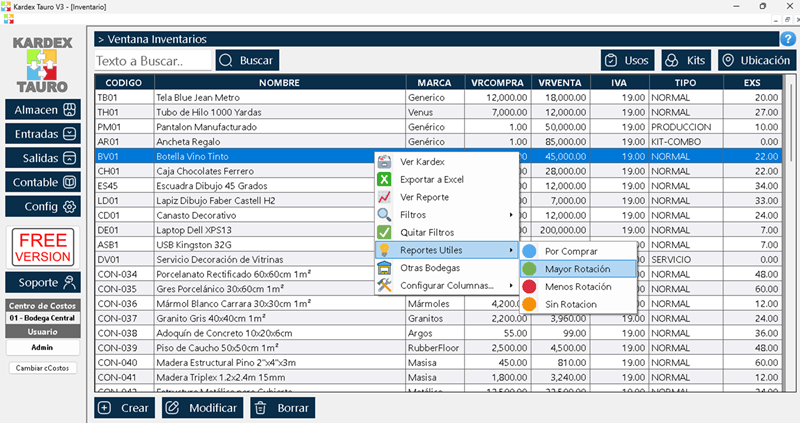
The business inventory tool helps precisely at this point. When the promotion is managed in the point-of-sale system and the stock record registers the exit of the three units at their cost, the accounting receives complete information and the previous entry is prepared without guesswork. An orderly stock record, like the one kept with the inventory module of Kardex Tauro, does not decide the accounting policy, but it guarantees that unit and cost data reach the accountant complete so that the promotion record is correct.
Common mistakes when recording discounts and promotions
To close the lesson, let us review the mistakes that appear most often in businesses that are starting to record reductions in their sales. Recognizing them in advance is the best way to avoid them.
- Recording the sale at the gross amount and treating the trade discount as an expense: it invents revenue that will never be collected and an expense that was never incurred, and it leaves the profit of the business miscalculated.
- "Forgiving" the early-payment discount without recording it in any account: the cash account receives less than the invoice says and the difference floats around, so the records never match the bank.
- Recording the promotion at the list price of all the units delivered: if the customer paid for two units and received three, the revenue is the value of the two; recording the value of the three inflates the sales of the period.
- Not reducing inventory for the free units: the extra unit left the warehouse and, if the stock record does not register it, the system balance shows merchandise that no longer exists.
- Forgetting that the free unit has a cost: merchandise delivered without charge is not free for the business, and its cost must be recognized as a higher cost of sales or as a promotion expense.
- Changing the early-payment criterion without a written policy: sometimes treating it as lower revenue and sometimes as a financial expense, depending on what is convenient at the moment, makes it impossible to compare results between periods.
To close
In this lesson we saw that discounts on sales are not a separate topic in accounting but an application of the most important principle of this part of the course: revenue is recorded for the amount the customer actually pays, and everything the business delivers has a cost that must be recognized. The trade discount is recorded at the net amount from the invoice onward, without expense accounts. The early-payment discount leaves a difference between what was invoiced and what was collected, recognized as lower revenue or as a financial expense, according to the policy the accountant defines and documents. And promotions require recording revenue for what was effectively collected and reducing inventory by all the units delivered, including the free ones, whose cost is recognized as a higher cost of sales or as a promotion expense.
If the business applies these rules consistently, its financial statements will show real sales, complete costs and inventory that matches reality. In the next lessons we will continue through the sales cycle and see what happens when merchandise that was already sold comes back to the business, but that will be a topic for another lesson. For now, the next time you see a sale sign in a store, you will know that behind every reduction there is a simple accounting decision: record the sale for what the customer pays and recognize everything the promotion costs.
Downloadable template: Sales book template in Excel: sales and due dates — the Excel template that goes with this lesson.