Cash and the cash account: recording, counting and differences
Cash and the cash account: recording, counting and differences
Cash flows in and out of a small business every single day: a customer pays for a purchase, the owner pays for the delivery of goods, an employee asks for change to serve the line, the shop buys bags and stationery, a customer who owes money makes a payment on account. Every one of those movements passes through the cash box, and accounting keeps track of them all with a single account: the cash account. This lesson explains what that account records, how cash receipts and cash payments are entered and what the owner should do when the cash is counted at the end of the day and there is more or less money than the books show. It is one of the most practical lessons in this manual, because cash can be touched, counted and mismatched: handling it in an orderly way is a skill used every day.
The course already includes a module that teaches how to record cash receipts and payments inside the software: which button to press, which fields to fill in and how the movement is stored. This lesson does not repeat that walkthrough. Here we study the accounting side of the cash account, which is the necessary complement: which account is debited and which is credited in each movement, why the cash balance must always match the physical cash on hand, how a cash count is performed and which journal entries are made when the count shows a difference. Whoever masters both parts, the operational one and the accounting one, has full control over the money of the business.
What the cash account records
The cash account is an asset account. It records all the cash that comes into and goes out of the business: the bills and coins kept at the premises, ready to be used in the daily operation. Cash comes in when there is a cash sale, when a customer makes a payment on account, when a used asset is sold or when the owner makes a contribution. Cash goes out when a minor expense is paid, when something is bought with cash, when a loan is made to an employee or when the owner takes money out for personal use. Because it is an asset account, its normal balance is a debit balance: cash is debited when money comes in and credited when money goes out.
The cash account does not record everything that looks like money. Checks, wire transfers and money deposited in the bank belong to the bank account, not to the cash account. Card payments, whether credit or debit, do not go through cash either: they are receivables that turn into money when the bank settles them. If the business mixed the cash in the till, the checks to be collected and the bank deposits in a single account, the balance would stop meaning anything and no cash count would be possible. That is why the first rule is one of order: only the physical cash of the business lives in the cash account.
The second rule is one of separation: the money of the business is not mixed with the money of the owner or with the money of the employees. When the owner takes cash from the till for a personal expense, that is not a silent little loan: it is a withdrawal that must be recorded, either as a receivable from the owner or as a reduction of the owner's equity, depending on what the business decides. When the owner puts personal money into the cash box to cover a shortage of funds, that is recorded too, as a contribution or as a loan from the owner. The cash box is not a personal pocket: it is an account that must always be explainable bill by bill.
Cash receipts and their journal entry
A small business has three common types of cash receipts. The first and most frequent is the cash sale: the customer pays and takes the goods or the service. The second is the customer's payment on account: someone who bought on credit hands over part of the balance they owe. The third groups all the other receipts: sale of a used piece of equipment, reimbursement of an expense the business paid, a loan received, a contribution from the owner or the recovery of money that had been given as an advance. All of them share one thing: cash comes into the till and, under double entry, something else must move on the other side of the journal entry.
The journal entry for a cash receipt always debits the cash account. The credit depends on where the money came from, because each source has its own counterpart. If the money comes from a cash sale, the credit goes to the sales revenue account: revenue is recognized at the very moment the cash comes in. If it comes from a customer's payment on account, the credit goes to the accounts receivable account, which goes down because the debt of that customer decreases. If it comes from selling a used asset, the credit goes to the account of the asset that was sold or to the account for income from the sale of assets. Recording the correct source is what makes it possible to know, at the end of the month, exactly where the money that came in came from.
Every cash receipt must have its supporting document. A cash sale is backed by the sales invoice or the sales ticket; a payment on account, by the cash receipt handed to the customer. Without support, a receipt cannot be proved, and in a review of the business there would be nothing to justify the money that was received. The order is simple: first the event happens, then the document exists and finally the journal entry is made.
Cash payments and their journal entry
Cash payments are the cash outflows of the business: paying a utility bill for the premises, buying stationery or cleaning supplies, moving goods, minor maintenance, paying a supplier who demands cash or the small expenses of the day. Most large payments are made through the bank, but every business still has a group of small payments made with the cash on hand, and all of them must be recorded so that the balance of the account stays true.
The journal entry for a cash payment is the mirror image of the one for a receipt: the cash account is credited, because the cash goes out, and the account that explains the destination of the money is debited. If a service is paid, the services expense account is debited. If stationery is bought, the stationery expense account or the corresponding asset account is debited. If a debt is paid, the payable account being settled is debited. The cash payment is supported by the cash disbursement voucher, signed by the person who receives the money and by the person who hands it over, together with the invoice or the receipt given by the payee.
Table 1: sample journal entries for a working day
| Transaction | Debit | Credit |
|---|---|---|
| Cash sale for $850,000 | Cash $850,000 | Sales revenue $850,000 |
| Cash payment of a service for $120,000 | Services expense $120,000 | Cash $120,000 |
| Cash shortage found in the cash count for $15,000 | Loss from cash shortage $15,000 | Cash $15,000 |
| Cash overage found in the cash count for $5,000 | Cash $5,000 | Cash overage $5,000 |
The first two entries in the table are the ordinary movements of the day: money comes in with the sale and goes out with the payment. The last two are the entries for the cash count differences, explained in the next sections. Notice that in all four cases double entry holds: what is debited always equals what is credited, and the cash account is always on the right side.
Counting the cash: the count that checks the balance
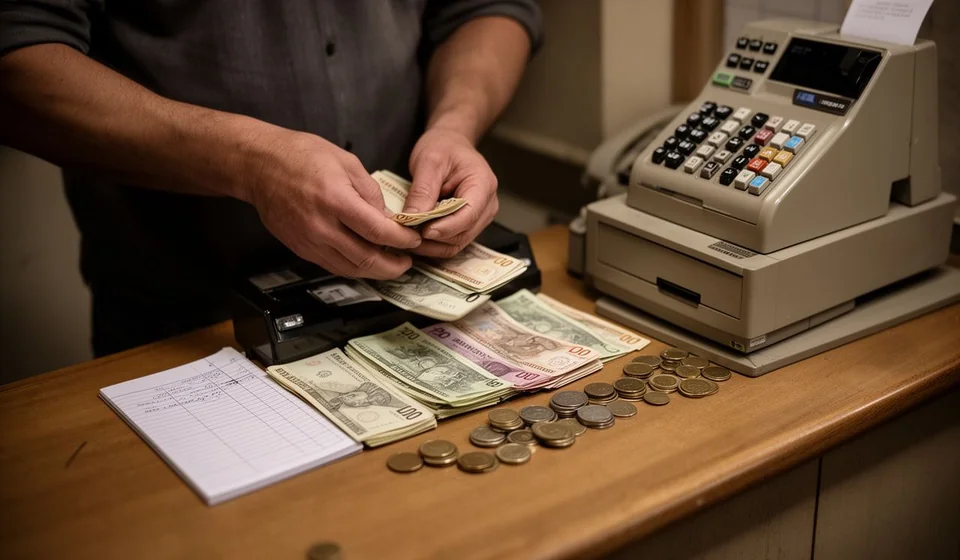
The cash count is the physical count of the cash in the till. It is done at closing time, when no more customers are coming in, or at any moment if an unannounced check is wanted. The goal is very simple: compare the money physically on hand with the balance shown by the records. If both match, the cash is in balance. If they do not match, there is a difference that must be investigated and recorded the same day; leaving it for later is the shortest way to lose track of the money.
The count follows five steps. First, the bills and coins are sorted by denomination. Second, the number of each denomination is counted. Third, the quantity is multiplied by the value of each denomination and the total is added up: that is the counted cash. Fourth, the book balance is checked, that is, the amount that should be in the till according to the record of the receipts and payments of the day. Fifth, the two amounts are compared and the difference, if any, is written on the cash count form, signed by the person who counted and by the person who reviewed. Ideally, one person does the counting and another person reviews it, so that the control does not depend on a single person.
Table 2: a cash count step by step, with numbers
| Denomination | Quantity | Value |
|---|---|---|
| Bills of $50,000 | 12 | $600,000 |
| Bills of $20,000 | 25 | $500,000 |
| Bills of $10,000 | 30 | $300,000 |
| Bills of $5,000 | 40 | $200,000 |
| Bills of $2,000 | 50 | $100,000 |
| Coins of $1,000 | 80 | $80,000 |
| Coins of $500 | 100 | $50,000 |
| Coins of $200 | 150 | $30,000 |
| Coins of $100 | 200 | $20,000 |
| Total counted cash | $1,880,000 | |
| Book balance | $1,890,000 | |
| Difference: cash shortage | $10,000 |
In the example, the person in charge counted $1,880,000, but the records say that the till should hold $1,890,000. There is a shortage of $10,000 that the sales of the day do not explain: it could be an error giving change, a wrongly typed entry or something more serious. The count does not tell the cause; it only says that a difference exists. The next step is to look for it and, in the meantime, bring the cash back into balance with the corresponding entry. If the counted cash had been higher than the book balance, the difference would be called an overage and treated as explained below.
Cash overages: when there is more money than expected
An overage appears when the counted cash is higher than the book balance: there is more money than the records say there should be. The first question is whose money it is. It may belong to a customer who paid too much and never received the change, to an error in recording a sale for less than its real value or to a receipt that was never entered. What it almost never is, without further examination, is a gift for the cashier or a sure gain for the business: the cause must be looked for first.
While the cause is being investigated, the overage is recorded as income, in an account that can be called Cash overage. The entry is simple: cash is debited, because the physical cash ended up above the book balance and the account must be balanced, and the overage account is credited. If the customer who paid too much later appears, the business returns the money and the entry is reversed. If nobody appears after a reasonable search, the overage stays as income of the business. In Table 1, the $5,000 overage was recorded exactly this way: Cash for $5,000 against Cash overage for $5,000.
Cash shortages: when money is missing
A shortage is the opposite case: the counted cash is lower than the book balance. Money is missing and the business needs to know why. The most frequent causes are mistakes giving change, wrong entries, payments that were made and never recorded and, in the worst case, misappropriation. The count detects the shortage but does not explain it: the investigation starts by reviewing the movements of the day, the supporting documents and the people who handled the till.
The accounting treatment of the shortage depends on what the investigation finds. If no responsible person is identified, the shortage is recorded as an expense or a loss of the business: an account such as Loss from cash shortage is debited and the cash account is credited. If the responsible person is identified, for example a cashier who admits giving the wrong change, the amount is not lost for the business: it becomes a receivable from the employee, which is debited, while the cash account is credited. When the employee pays the shortage or it is deducted from the paycheck, the cash account or the payroll account is debited and the receivable is credited. Before choosing between expense and receivable, it is wise to investigate calmly: recording as a loss a shortage that does have a responsible person makes the business lose money it could recover.
The petty cash fixed fund
Many businesses keep a petty cash fixed fund: a small amount of cash, always the same, meant for the minor expenses of the day, such as transport, coffee for a meeting, last-minute stationery or a delivery. The rule of the fund is that it is only used for minor expenses and that every expense must bring its receipt. When the fund runs low, it is replenished: the receipts of the expenses are added up and cash is handed over, or a transfer is made, for the total amount of those receipts. At that moment the expenses are recorded, debiting each corresponding expense account and crediting the account from which the replenishment money came. The fund itself never changes in value: it is always the same approved amount, and that is why it is called a fixed fund.
Common mistakes with cash
The experience of real businesses shows that problems with cash almost always come from the same mistakes, all of them avoidable:
- Using the till as a personal pocket. Paying personal expenses with the money of the business, without any record, or borrowing from the till and paying back later without leaving a trace. That money disappears from the records and the count never balances.
- Skipping cash counts. Without regular counts, small differences pile up for weeks, and when the problem is finally discovered there is no way to know when it started or who was involved.
- Recording expenses without support. An expense entered without its receipt cannot be proved and leaves the cash unexplained: at the count, nobody can say what happened to that money.
- Hiding the differences. Balancing the till by pushing the shortage of the day into the records of the next day, or keeping the overage to cover a future shortage, turns a small mistake into a big problem.
- Mixing the money. Taking personal payments in the till of the business, keeping the household change in the same drawer or using a single till for several businesses destroys the information that the cash account should provide.
Cash control, in short
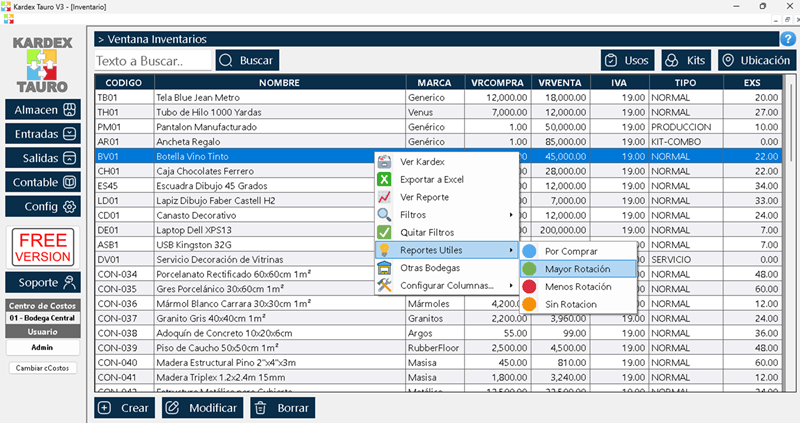
The cash account is an asset that moves every day through entries backed by supporting documents, and the cash count is the control that protects it: count, compare, investigate and record. Differences have a defined treatment: a shortage is an expense or a loss when there is no responsible person, and a receivable when there is one; an overage is income that stays in a separate account while its owner is being looked for. Keeping the records up to date, performing frequent cash counts and never mixing the money of the business with personal money are the three habits that keep cash healthy. Tools such as Kardex Tauro help record cash movements and know at any moment what the balance should be, so that the count at the end of the day is a quick and reliable check instead of a mystery dragged from one month to the next. With that routine, cash becomes the most transparent information of the business.
Downloadable template: Cash book template in Excel: receipts, payments and balance — the Excel template that goes with this lesson.