Closing the accounting period

Closing the accounting period
Closing the accounting period is the grand finale of the cycle studied in the first lessons of this manual: first the movements of each day are recorded, then they are organized in the general ledger and on the inventory cards of the stock record, later the trial balance is prepared and, at the end, the period is closed. Closing does not mean that the business is ending or that the books go into a drawer: it means drawing a clean line between what already happened and what is coming, so the owner knows how much the business earned or lost in that stretch and so the next period starts with accurate figures. This lesson explains that ending step by step, using the hardware store example that runs through the whole course.
Five moments of the closing are covered here: the final adjustments of the period, the calculation of the result, the transfer of that result to equity, the conversion of the ending inventory into the beginning inventory and the start of the new period with the income and expense accounts at zero. There is also a complete numerical example, a practical calendar for closing each month and each year, the role played by the stock cards and by up-to-date documents, and the most common mistakes to avoid. By the end, the reader will know exactly what happens in the books when a month ends and when a year ends.
One closing, two rhythms: monthly and annual
It helps to be clear from the start that a small business closes two kinds of periods with the same method: the month and the year. The monthly closing is light and has a control purpose: review the cash, compare the inventory with the stock cards, check whether the expenses are running away from the budget and confirm that all the records of the month are complete. The annual closing is the same process, but complete and final: every adjustment is made, the result of the year is calculated, that result is moved to equity and the accounts are prepared for the year ahead. Whoever learns to close a month well has already learned half of the annual closing, because the steps are the same and only the depth changes.
This manual uses the word period for both cases: every month is an accounting period and every year is one too. The monthly closing keeps the books up to date and prevents errors from piling up; the annual closing delivers the final figures that show how much the business earned in the year. The steps explained below work for both rhythms.
Step one: the final adjustments of the period
Before the result can be calculated, every account must reflect the reality of the business on the last day of the period. During the month the movements were recorded as they happened, but some figures are only known with certainty at the end: how much merchandise is really left in the storeroom, how much the furniture and the tools wore out or which expenses are still unpaid. The journal entries that correct those differences are called adjustments, and they are the first step of the closing.
The most important adjustment for a buying and selling business is the one for inventory. The stock card of each product says how many units should be in the storeroom, but reality is only confirmed by counting: the boxes, the bags and the units are counted, the totals are compared with the cards and the difference is written down. If there is less merchandise than recorded, the difference may have been lost, damaged, stolen or handed out by mistake, and it must leave the inventory as a shortage; if there is more, the surplus is recorded as well. The ending inventory of the period must be the result of the count, not the balance of the stock cards, because the count shows what really exists.
The second usual adjustment is the depreciation of the period. The furniture, the display case, the cash register, the delivery motorcycle and the tools are used every day and, with use, they lose value. Depreciation spreads that wear over the periods in which the asset provides service: every month a part of it is recognized as an expense. At the closing, the owner verifies that the depreciation of the month or of the year has been recorded, so the expense stays in the right period and the value of the assets in the books is reasonable.
The third adjustment is provisions. When it is known that a customer probably will not pay the debt, a provision for doubtful accounts is recognized; when there is a lawsuit, a claim or an uncertain obligation, the estimated amount is set aside. A provision is not a paid expense: it is an expense recognized out of caution, so the result of the period does not look better than it really is. At the closing, the owner reviews that the provisions of the period are complete.
Finally, the expenses that were left halfway are reviewed. A utility bill that arrived after the month was closed, or a salary paid in the first days of the following month, are expenses of the period that have not been paid yet: they are recognized as pending. In the other direction, an insurance policy or a rent paid in advance covers several months and should be spread among them instead of being charged all at once. These are simple adjustments, but forgetting them changes the result.
Step two: calculating the result of the period
With the adjustments made, every account tells the truth and the central moment of the closing arrives: determining how much the business earned or lost in the period. The income accounts and the expense accounts are temporary: they accumulate the values of a single period and, when the period ends, they must return to zero so they can receive the movements of the next one. That emptying is done by transferring their balances to a special account called the income summary, which gathers all the income on one side and all the expenses on the other.
The movement is simple: each income account delivers its balance to the result account and each expense account does the same. What remains in the account is the difference between what was earned and what was spent: if the income is greater than the expenses, there is a profit; if the expenses are greater than the income, there is a loss. When the transfer is finished, the sales, services, expense and cost of goods sold accounts are all at zero, ready to begin again.
The hardware store example shows this clearly. During the period the business sold merchandise for $17,500,000; the merchandise sold cost $10,000,000 and the expenses of the period totaled $5,000,000. To close the accounts, Sales is debited for $17,500,000 and the income summary account is credited for the same amount; then the income summary is debited for $15,000,000 and the cost of goods sold for $10,000,000 and the expenses for $5,000,000 are credited. At the end, the income summary account has a balance of $2,500,000 in favor of the business: that is the profit of the period.
That pair of entries is the closing entry of the result accounts, and it is worth understanding well because it is the machinery that restarts the game: sales, discounts, returns, cost of goods sold, salaries, utilities and the other temporary accounts return to zero, and the income summary holds a single figure, the profit or the loss of the period. If the business keeps its records up to date, this step becomes a few entries a year and can be checked against the trial balance, where the income and expense balances must match the totals that were transferred.
Step three: the result moves to equity
The profit of the period cannot float forever in a separate account: it belongs to the owner or to the partners, so the next step is to move it to equity, the part of the books where the value that really belongs to the owners is accumulated. If the period closed with a profit, equity increases; if it closed with a loss, equity decreases, because the business spent more than it generated and that shortfall eats part of the accumulated value.
In practice, the income summary delivers its balance to the retained earnings account or directly to the owner's capital account, depending on how the business is organized. If the owner withdraws money for personal expenses, that withdrawal is also reflected in equity at the end of the period. It helps to see equity as a whole: the contributions of the owner, the profits that have been left in the business over time and the withdrawals that have been made. A well-done closing updates that complete picture.
This step connects the closing with what was studied about equity in earlier lessons: the equity accounts are permanent, like the asset and liability accounts, and for that reason they are not emptied when the period closes. The only thing that changes with the closing is their value: it goes up with a profit and down with a loss or a withdrawal. The income summary is, then, the bridge between the temporary accounts, which are emptied, and the permanent accounts, which continue.
Step four: the ending inventory becomes the beginning inventory of the next period
Inventory has a special privilege in the closing: its ending value does not disappear and does not restart, it becomes the starting point of the next period. The merchandise left in the storeroom on the last day of the year is exactly the same merchandise that is there on the first day of the new year, so the ending inventory of this period is carried over as the beginning inventory of the new period. That value is the first figure of the cost of goods sold for the period that starts: the amount on hand at the beginning plus the purchases minus whatever remains at the end.
That is why the inventory adjustment of step one matters so much: if the count is not done or the difference is not recorded, the error is carried into the following period and the cost of goods sold of the new period is born wrong. The stock cards start again with the beginning inventory as the first entry of each product, and from there receipts and issues are recorded as always. Closing one period well is the best way to open the next one well.
Step five: the new period starts with the result accounts at zero
With the result moved to equity, the books are ready for the new period. The balance sheet accounts, that is, the asset, liability and equity accounts, keep their balances: the cash on hand, what the customers owe, what is owed to the suppliers, the merchandise in the storeroom and the equity of the business still exist and cannot disappear from the books. The result accounts, instead, begin the new period at zero: nothing has been sold yet, nothing has been spent yet, and the income summary of the previous year has already done its job.
When the calendar marks the first day of the new period, the accounting cycle starts over exactly as it was studied in the first lessons: the first sale arrives, the first expense is recorded, the inventory cards of the stock record are updated and the story is written again. The difference is that now the books start with verified figures and a known result, and that gives the owner a solid base for decisions: how much was earned, how much the inventory is worth and how much must be collected or paid.
The steps of the closing in a table
| Step of the closing | What is done | What ends at zero |
|---|---|---|
| Final adjustments | The inventory is counted and compared with the stock cards; depreciation, provisions and pending or prepaid expenses are recorded. | No account: adjustments correct balances. |
| Income summary | Income and expense accounts deliver their balances to the income summary account. | Sales, cost of goods sold and every expense account. |
| Transfer to equity | The profit or the loss is moved to retained earnings or to the owner's account. | The income summary account. |
| Beginning inventory | The ending inventory of the count becomes the beginning inventory of the next period. | None: inventory continues. |
| New period | Balance sheet accounts keep their balances and result accounts start empty. | All the result accounts. |
A practical calendar for the closing
The closing is not done only in December: an organized business closes its accounts every month and does a bigger review every year. The difference is in the depth, not in the method. The following calendar summarizes what should be reviewed month by month and what is left for the annual closing, so that no account reaches the end of the year with surprises piled up.
| Frequency | What to review | Why it matters |
|---|---|---|
| Every month | Cash and banks, accounts receivable and payable, inventory against the stock cards, the expenses of the month and the comparison with the budget. | Errors are corrected while they are small and the annual closing becomes fast. |
| Every month | The depreciation and the provisions of the month, pending expenses and prepaid payments that affect this period. | The monthly result reflects only the month and does not mix periods. |
| Every year | General inventory count, full review of doubtful debts, major adjustments and verification of every balance sheet account. | The final figures of the year must be exact, because the result and the equity come from them. |
| Every year | Transfer of the result to equity, closing of the result accounts and opening of the new period with the beginning inventory. | This way the new year starts at zero for income and expenses, with a verified balance sheet. |
The role of the software and of up-to-date documents
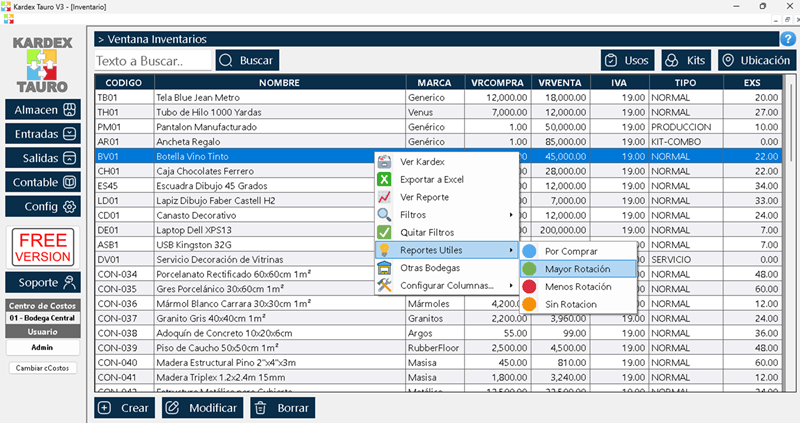
The closing is done with the papers of the business: sales invoices, purchase receipts, payment vouchers, bank statements and inventory cards. If those documents are up to date and each one was recorded when it happened, the closing becomes a quick review instead of a reconstruction of lost months. A system like Kardex Tauro helps keep that information organized and available, because the movements are recorded once and can then be consulted by period, by account or by product.
This is not about inventing magic functions: the software does not do the closing by itself, but it does make it faster and with fewer errors. If the stock cards of the merchandise are updated, the inventory count is compared in minutes; if the expenses were recorded with their supporting documents, the total of the period comes from a report instead of adding loose receipts; if the accounts receivable are up to date, the provision is calculated on reliable data. The role of the tool, like Kardex Tauro in this course, is to free up time so the accountant or the owner can focus on the review and on the decisions, which are the part that no program can do for them.
Common mistakes when closing the period
The experience of small businesses shows that the closing almost always fails because of the same oversights. These are the most frequent:
- Closing without adjusting the inventory. If the merchandise is not counted or the difference is not recorded, the cost of goods sold, the result and the beginning inventory of the following period are born with an error.
- Skipping the monthly closing. A business that only closes in December piles up months of errors and spends the first months of the year reconstructing what should have been reviewed month by month.
- Forgetting pending or prepaid expenses. A bill that arrives late or an insurance policy paid in advance, placed in the wrong period, inflates or reduces the result of the wrong month.
- Mixing the accounts of the business with the personal accounts of the owner. Family expenses paid from the cash of the business dirty the result and the equity if they are not separated and recorded properly.
- Not reviewing the trial balance before closing. If the total of the debits does not match the total of the credits, the error is discovered at the closing, when it is harder to trace.
Closing the accounting period is, in the end, an act of order: it sets a cutoff date for the story of the business, says how much was earned, leaves the inventory measured and opens the next period with clean accounts. The owner who closes every month always knows where the business stands, and the one who closes every year knows how much the effort is worth. With records up to date, with the inventory counted and with the hardware store example in hand, the grand finale of the accounting cycle stops being an end-of-year mystery and becomes a clear routine repeated period after period.
Downloadable template: Year-end closing entries template in Excel — the Excel template that goes with this lesson.