How an inventory program feeds your accounting
How an inventory program feeds your accounting
This accounting manual ends where the real life of a business begins: in the daily recording of purchases, sales, and of merchandise coming in and going out. In the previous lessons you covered the logic that supports all that work: the accounting equation, double-entry bookkeeping, recording purchases and sales, controlling cash, building the financial statements, and closing the period. In this final lesson we will connect that knowledge with the tool many businesses use every day to keep their inventory in order: the Kardex Tauro program. The question we will answer is a practical one: what does the system do for you every day, and what part of the work remains the responsibility of the accountant?
It is worth making this clear from the start so nobody builds the wrong expectations: an inventory program records and organizes daily operations, but it does not replace the formal accounting of the business. The system is an ally of daily record keeping, not a substitute for accounting judgment. Understanding where what the program does ends and where what the accountant does begins lets you work with confidence: you know which information you can take from the system as a working base, and which calculations, decisions, and formal documents you must prepare yourself with professional judgment.
What the system records on its own
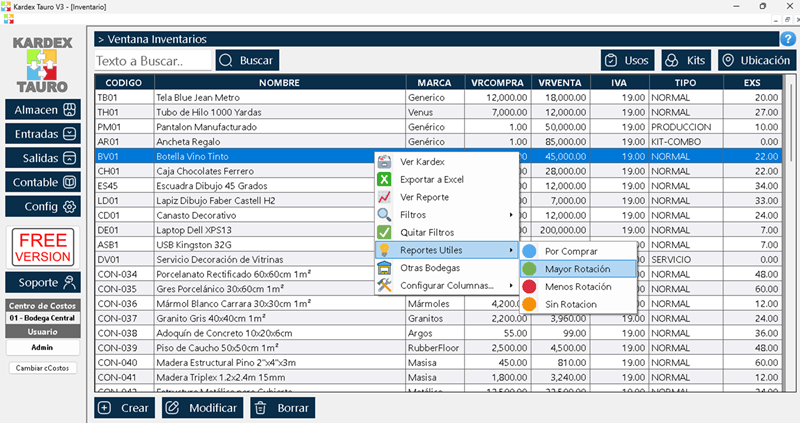
To know what is left for the accountant, you first have to know what the system does without any help. An inventory program such as the one we have described throughout this set of lessons is built around the documents of the operation: every purchase and every sale is recorded with its third party, meaning the customer or the supplier involved in it, and is kept with the date, the products, the quantities, the prices, and the values of the operation, including the tax charged on the document. That collection of documents is the raw material that later feeds the accounting.
The heart of the system is the stock ledger: the per-product record that tracks the cost and the stock of each item. When merchandise bought with a purchase order is received, the receipt is checked against the order and the stock ledger stock increases with its cost; when a sale happens, the stock decreases and the stock ledger stands as evidence of the cost of what was sold. Transfers between warehouses move stock from one place to another, and losses and adjustments correct the record when there are shortages, surpluses, or differences. All of that is recorded without anyone having to do the work twice.
- Purchase and sale documents with their third parties, dates, quantities, prices, and values including the tax charged.
- The per-product stock ledger, which keeps the cost and the stock of every item at all times.
- The receipt of merchandise against purchase orders, which checks what was ordered against what actually arrives.
- Transfers between warehouses, which move stock from one location of the business to another.
- Losses and adjustments, which correct the stock and leave a record of shortages and differences.
- The basic financial effects of those operations, which the system generates automatically.
The accounting module of the program: basic control, not formal accounting
The program's own help file says it honestly: Kardex Tauro is not accounting software and does not intend to replace a professional accounting system. What it includes is a minimal accounting module, designed to control the financial aspects that arise naturally from daily work with the inventory. That module groups four submodules, each with a clear role inside the operation.
- Accounts Payable: it controls the debts with suppliers. When a purchase invoice is finalized with a partial payment or on credit, the system automatically creates the supplier's outstanding balance; the module lets you view that balance, record payments, reconcile them with the invoices, and generate reports of pending debts.
- Accounts Receivable: it controls the balances pending from customers. When a sales invoice is finalized and the cash received is less than the total, the system automatically creates the customer's receivable balance; there you record payments on account, reconcile them with the invoices, and check the aging of the balances.
- Cash: it controls the cash. Every cash entry from a cash sale and every cash outflow from a payment is reflected in the cash module, which lets you know the balance in real time, perform cash counts, and review the movements.
- Third Parties: it manages the information of customers, suppliers, employees, carriers, and other people the business interacts with, including their classification and their transaction history.
To make the bridge between the operation and the accountant clear, nothing works better than an example: each operation of the day leaves a trace in the system that the accountant later turns into an accounting record.
| Operation of the day | What the system left | What the accountant uses |
|---|---|---|
| Cash sale | Sales invoice, merchandise outflow in the stock ledger, and cash entry in the cash module. | The income record, the validation of the inventory outflow, and the reconciliation of the cash received. |
| Credit sale | Sales invoice, outflow in the stock ledger, and an automatic balance in the customer's accounts receivable. | The income record, the control of the receivables, and the follow-up of the payments on account. |
| Purchase with a purchase order | Receipt of the merchandise against the order and entry in the stock ledger with its cost. | The recognition of the inventory and of the account payable to the supplier. |
| Credit purchase | Purchase invoice, entry in the stock ledger, and an automatic balance in the supplier's accounts payable. | The control of the debt, the scheduling of the payment, and its accounting record. |
| Transfer or loss | Movement in the stock ledger that adjusts the stock between warehouses or because of losses. | The validation of the movement and the analysis of its effect on the cost of the inventory. |
It is also worth knowing what the accounting module does not do, because that boundary defines the accountant's work. The program's help file says it without hesitation: it does not generate complete journal entries of debits and credits according to a formal chart of accounts, it does not produce financial statements such as the balance sheet or the income statement, it does not handle accrual accounting because it records cash flows and balances, it does not generate formal accounting reports for regulatory bodies, and it does not replace professional accounting software. The module is excellent for the operational control of the business; turning that information into formal accounting is, precisely, the accountant's job.
What is left for the accountant
Everything the system records well saves the accountant work, but it does not take the work away. On top of the documents, the stock ledger records, and the balances left by the program, the accountant applies professional judgment and carries out the tasks that no inventory system can do for him or her.
- Classifying and validating: reviewing the documents in the system, checking that the third parties, the values, and the taxes are correct, and that the stock ledger stock matches the physical count in the warehouse.
- Computing taxes: the system keeps the values with the tax included in each document, but calculating, declaring, and paying the taxes of the period is an accountant's responsibility, applying the rules in force.
- Making provisions: doubtful receivables, labor obligations, obsolete or slow-moving inventory, and the other estimates that accounting requires.
- Recording the depreciation of the business's fixed assets, which does not come from a sales invoice or from an inventory movement.
- Applying accounting standards: the accountant decides, according to the accounting rules applicable in each country, how to recognize, measure, and disclose every item.
- Preparing the formal closing of the period and the financial statements, with the adjustments and the closing entries you studied in the lessons of this manual devoted to those topics.
Those tasks are outside the reach of the program by design. Since the accounting module does not prepare complete entries or financial statements, whoever prepares them is the accountant, relying on the documents and the balances that the system delivers in an organized way. That division of labor is not a limitation of the business: it is the correct way to combine the efficiency of daily recording with the rigor of formal accounting.
How the system and the accountant connect
The connection between the two worlds is information. Every document in the system leaves a complete trace: who recorded the operation, when it was done, with which third party, and with which values, including the tax charged. The accountant does not need to retype any of that: the documents, the stock ledger records, and the balances can be consulted directly in the program or exported to be incorporated into the accounting work. The value of the inventory comes out of the stock ledger: the stock valued at its cost feeds the cost of sales of the period and the value of the ending inventory that appears on the balance sheet, as you studied in the lessons devoted to the cost of sales and to the financial statements.
For that connection to work well, the program's help file offers advice worth repeating here. Do not manually record movements that the system already generated automatically from sales and purchases: that only creates duplicates and differences. Reconcile accounts payable and receivable periodically to make sure the balances match reality, and perform frequent cash counts to detect differences in time. If the business has an external accountant or accounting software, export the information from these modules periodically so it can be incorporated into the formal accounting. And remember that not every user should have access to every module: properly configured permissions protect the information. The accountant does not replace the system in daily recording, and the system does not replace the accountant in formal accounting: each one does its part over the same database.
| Function | What the system does | What the accountant does |
|---|---|---|
| Recording daily operations | Invoices, inflows, outflows, and cash movements are recorded at the moment of the operation. | Validates the documents, solves differences, and approves the information that will serve as the base. |
| Inventory costing | The stock ledger keeps the cost and the stock of every product at all times. | Analyzes the cost of sales, reviews the losses, and determines the value of the ending inventory. |
| Receivables and suppliers | The balances of accounts receivable and payable are generated on their own with every invoice. | Makes provisions, manages collections, schedules payments, and reconciles the balances. |
| Cash | The cash module records inflows and outflows and allows knowing the balance and performing counts. | Reconciles the cash, records its accounting effect, and explains any difference. |
| Taxes | The documents keep the values with the tax included. | Computes, declares, and pays the taxes of the period according to the rules in force. |
| Closing and financial statements | It does not produce closing entries or financial statements. | Prepares the closing entries and adjustments and builds the financial statements of the period. |
The closing of the course
If you look back, this whole manual was a single thread. We started with the accounting equation and double-entry bookkeeping, the two ideas that support any record; we continued with purchases and sales, the tax that moves with them, and the control of cash; then you learned to build and read the financial statements and to close the period in an orderly way. Each lesson added one piece, and the final piece is this one: the daily record of the operation is the raw material of all accounting, and a good inventory system makes sure that raw material is complete, organized, and available.
That is why the program and the accountant do not compete: they complement each other. Kardex Tauro takes care of the daily recording of documents, the stock ledger, and the balances, so the business does not waste time retyping or living with recording errors; the accountant brings the judgment, the standards, and the signature over that information to turn it into well-computed taxes, reliable financial statements, and informed decisions. If you apply what you learned in this course and use the program for what it is, an ally of daily record keeping and not a replacement for the accountant, your business will have controlled inventories and accounting that truly serves decision making.
Downloadable template: Inventory and ledger reconciliation template in Excel — the Excel template that goes with this lesson.
