Job description template for Word (free download)
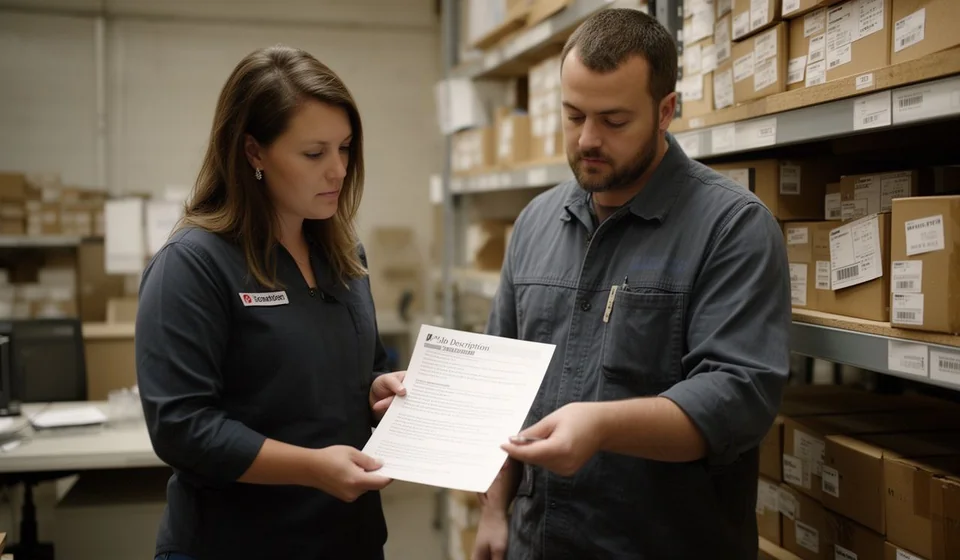
Job description template for Word (free download)
There is a scene that repeats itself in almost every small and mid-sized company: a new worker arrives, someone explains the job from memory in half an hour, and two weeks later nobody remembers exactly what that person was supposed to do, who they reported to, or which equipment was in their care. The problems that surface afterwards are not attitude problems; they are information problems. A job description exists precisely to close that gap before it turns into a conflict.
Also called a role profile or a duties sheet, it is the page that puts a position in writing: who the role reports to, why it exists, which duties are essential, what education and experience it requires, what safety and health responsibilities it carries, and how the work will be measured. It does not replace an employment contract and it does not substitute any legal obligation: it is an internal management tool that keeps the daily operation in order.
In this article you will find a template ready to use in Word, an explanation of each of its sections, the mistakes that come up most often when filling it in, and some practical criteria for knowing when paper is no longer enough and a system starts to pay off.
⬇ Download job description (.docx)What is a job description?
It is a short document, one or two pages long, that answers a very simple question: what does the company expect from whoever holds this position? It is written in the present tense, in the third person and without proper names, because it describes the role and not the person currently in it. That detail looks minor and it is decisive: if the document says that “Pedro drives the forklift”, it stops being useful the day Pedro leaves; if it says that “whoever holds the role drives the forklift and checks the load at the start of the shift”, it stays valid for years and works for anyone who arrives at the position.
It is not an isolated piece either. In daily practice it sits beside other documents it is often confused with, and it is worth being clear about the differences.
| Document | What it answers | When it is used |
|---|---|---|
| Job description | What the role is and what is expected from whoever holds it | When a role is created, updated, or its duties or equipment change |
| Selection profile | What characteristics the candidate being sought should have | During a hiring process, for one specific vacancy |
| Employment contract | What relationship is created between company and worker | When a person is hired, with the agreed conditions |
| Job handover record | What was physically handed over, and in what condition | When someone leaves the role or moves to another area |
| Performance review | How the work went during a given period | In the regular performance reviews |
When the job description is well written, the other pieces lean on it: the vacancy is posted with the requirements listed there, the interview focuses on the real duties, the performance review compares the work against written duties, and the handover record checks what the role had in its care. The result is a coherent chain of documents, and that shows when someone is absent, resigns or moves to another area.
What it is for
A useful job description works on several fronts at once, and none of them is theoretical. These are the uses that come up most often in small and mid-sized companies:
- Better hiring: the vacancy is posted with duties and requirements already defined, and the interview stops revolving around personal impressions.
- Clarity for the worker: from day one the person knows what is expected, who they report to and which resources they are responsible for.
- Training with a purpose: the gap between what the role demands and what the person knows becomes a concrete training plan.
- Reviewing with criteria: the performance review compares work against written duties, not against the shift supervisor's memory.
- Ordering the internal scale: comparing roles by their content and not only by their title helps keep the internal scale coherent; any figure used belongs in the editable field and is confirmed with the company's labour advisor.
- Spotting gaps and overlaps: placing the roles side by side reveals repeated duties, tasks nobody took on, and responsibilities concentrated in a single person.
What the template includes
The template follows the classic structure of a job description and comes with the sections already labelled, so you only have to fill them in. These are the sections exactly as they appear in the Word file:
| Section | What goes there |
|---|---|
| 1. Role identification | Exact role title, area, immediate supervisor, staff reporting to the role, site or location, document version, and the date it was written or updated. |
| 2. Purpose of the role | A single sentence summarising why the position exists in the operation: the result the company expects from whoever holds it. |
| 3. Essential duties | A numbered list of six duties, each written with an action verb and with the result that must be delivered. |
| 4. Requirements | A concept/detail table with education, experience, technical knowledge, competencies, and any other requirement the company decides to ask for. |
| 5. Safety and health responsibilities | Three concrete responsibilities of the role in self-care, use of protective equipment, and reporting unsafe conditions. |
| 6. Indicators | An indicator/target/frequency/source table: how the role's performance is measured and where the data for each measurement comes from. |
| Signatures | The person describing the role, Human Resources, and the space for the employee's acknowledgement signature. |
The file also includes the company letterhead, the centred title, the control table with the document code and version, a copy for the employee's file, and a closing note about keeping it up to date. The purpose and the duties are written in the present tense and describe the position, never a particular person.
How to use it, step by step
- Replace the company details in the letterhead. Open the file in Word, type your company name in the header and, if the document will circulate outside the area, remove the coloured notes that come with the template.
- Assign the control code. In the control table write a code made of the area initial and a sequence number, for example a letter followed by a number; that way you can cite it when the role changes or is reviewed.
- Fill in the role identification. Exact role title, area, immediate supervisor, staff reporting to the role, site, version and date. If the same role exists at two sites with different duties, write one document for each.
- Write the purpose in one sentence. Start with a verb and end with the expected result: it is not a task list, it is the reason the position exists.
- Write the six essential duties. Use action verbs, order them from most to least important, and never mix two responsibilities into one bullet.
- Complete the requirements and the indicators. In requirements, write only what the role genuinely needs; in indicators, make sure every target has a real data source and a measurement frequency. If you are going to mention a figure, leave it in the editable field and confirm it with your labour advisor.
- Review, sign and file it. Read it aloud as if you were explaining it to someone starting tomorrow, and correct anything that sounds like an opinion. Then it is signed by the person describing the role, Human Resources and the employee, and a copy is filed in the personnel record.
Common mistakes before signing
Most job descriptions that end up filed away and unused share the same defects. It is worth checking them before signing:
- Naming people instead of the role. Proper names, nicknames or phrases like “the one replacing ...” leave the document obsolete within months.
- Listing loose tasks with no result. A duty makes sense when you know what has to be finished, not only which movement happens during the day.
- Copying descriptions from other companies. Requirements that do not match the real operation create impossible expectations and wrong ideas from day one.
- Confusing the description with the contract. This format does not set employment terms and does not replace any legal document; that ground is reviewed with the labour advisor or under the law in force in your country.
- Leaving indicators without a source. A target nobody knows how to extract is never measured, and it wears down the credibility of the whole document.
- Never updating it when duties or equipment change. If the role has changed and the paper has not, the description becomes an obstacle. Give it a review date and respect it.
When it pays to move to a system
The template works as long as the number of roles, warehouses and movements can be taken in at a glance. Past a certain point the Word document is still necessary but no longer sufficient: when a role manages a warehouse, the indicator that measures its work comes from data someone has to consolidate by hand, and that effort is lost every time things get busy. A system such as Kardex Tauro helps keep the job description from becoming a decorative document: counts, receipts, issues and adjustments are recorded with user and date, and the role's indicator is calculated from the system rather than from a parallel spreadsheet.
There are more concrete signs that it is time: when the role's indicator depends on counting stock, when the count is done on a separate sheet and the result is copied by hand, or when nobody can say with certainty who moved a product last week. In those cases the document is still needed, but it needs a reliable data source behind it.
This model is a general guide for internal use: review it with your labour advisor and adapt it to your company before signing it.
⬇ Download job description (.docx)