Employment contracts in Colombia: types, probation period and clauses

Employment contracts in Colombia: types, probation period and clauses
An employment contract is signed in twenty minutes and argued about for years. When a labor claim arrives, the fight is almost never about the dismissal itself: it is about what the contract did not say. Whether subordination existed, what the real salary was, which probation period was agreed, who was supposed to enroll the worker in social security. The signed document — or the one that was never signed — ends up being the central evidence.
This article lays out what a small-business owner, an HR manager or an accountant needs to have clear: the three elements that turn an agreement into a labor relationship, the five types of contract and their effects, the probation period, the clauses that help and those that do not, and a full example of a six-month fixed-term contract with its day count. It is not legal advice: it is a map for asking the right questions before signing.
The three elements that turn an agreement into an employment contract
Every employment contract rests on three elements: personal work, subordination and salary. If one is missing, there is no labor relationship, however many documents the parties sign under another name.
- Personal work. The person hired performs the work with their own effort. They cannot send a replacement to do the task or share it with third parties without authorization.
- Subordination. The company gives orders, sets schedules, controls how and when the work is done, and can impose disciplinary sanctions. This is the element most argued in a lawsuit, because it does not appear on paper: it appears in daily operations.
- Salary. There is a payment as direct compensation for the service, whether monthly, daily, hourly or by the piece.
The name of the contract decides nothing. A document titled “services agreement” does not make a relationship civil when there are schedules, orders and a fixed monthly payment. What counts is how the work is actually performed: emails, attendance records, bank transfers and witnesses.
The five types and what each one is for
Colombian law recognizes five forms of employment contract. Choosing the wrong type is not a matter of form: it changes duration, the way the contract ends and the cost of an early exit.
- Indefinite term. It has no end date and is the default when no term is agreed. It provides stability and obliges the company to keep the position over time.
- Fixed term. It has a set period, with a maximum of three years, and can be renewed. It suits temporary replacements, projects with a closing date and seasonal demand.
- By work or task. It lasts until the contracted work or task is finished: an installation, a construction job, an implementation, a harvest. The end is not a calendar date but a verifiable fact.
- Apprenticeship. It combines training and practice, with its own rules that differ from an ordinary contract. It is used for apprentices enrolled in a program.
- Occasional or temporary. It covers work lasting less than one month, for activities that are not part of the company's usual business.
The services agreement is not on this list because it is not labor law: it is civil. We treat it separately because it is the border where the most cases are lost.
| Type | Duration | Compensation on termination | Probation period | Typical use |
|---|---|---|---|---|
| Indefinite | No end date | Yes, if terminated without just cause | 2 months | Permanent operational positions |
| Fixed term | Set period, maximum 3 years, renewable | Not at expiry; yes if ended early without just cause | One fifth of the term, not exceeding 2 months | Replacements, dated projects, seasonal demand |
| By work or task | Until the work or task is finished | Not when the work ends; yes if ended early without just cause | Agreed in writing; confirm the applicable limit | Construction, installations, implementations |
| Apprenticeship | The length of the training program | Not at the end of the program; earlier, depending on the case | The general rules do not apply | Apprentices in training |
| Occasional or temporary | Less than one month | Not when the work ends | Not used in practice | Activities outside the usual business |
Two warnings. The compensation column describes the normal effect of each type, not an automatic rule. And a probation period exists only if it was put in writing: if the contract does not mention it, it cannot be invoked later.
Services agreements: the border that produces the most disputes
A services agreement is civil. It is used for a specific result, with a contractor who organizes their own time, works with their own tools and carries their own risk. There is no subordination and no salary there: there are fees, and the contractor is responsible for their own contributions.
The problem appears when practice contradicts the paper. The person signs as a contractor but keeps office hours, takes direct orders, reports weekly to a manager, uses the company computer and bills the same amount every month. In those cases a judge can declare that a labor relationship existed, even if the document says otherwise.
The consequence is not symbolic: the ruling drags in unpaid benefits, compensation and social security contributions calculated over the entire time worked. What was saved each month becomes a liability with interest. The evidence is not in the contract but in the operation: schedules, emails with instructions, leave approvals, uniforms. If that evidence exists, the civil label does not hold.
Probation period: how long it lasts and what it really changes
The probation period has two rules on duration and one formality that cannot be skipped.
- In an indefinite-term contract: 2 months.
- In a fixed-term contract: one fifth of the agreed term, not exceeding 2 months.
- It must be in writing.
During that window either party may end the contract without compensation. But “without compensation” does not mean “without rights”: salary for days worked, benefits accrued proportionally and pending vacation are still paid. The probation period does not suspend social security enrollment.
If the contract sets a probation period, it should state a start date and an end date, not a loose phrase. When the period ends and the person keeps working, the contract continues on its normal course and any later exit follows the rules on dismissal.
What the contract should say, even when it is verbal
An employment contract can be verbal and still be valid. The problem is proof: in a dispute over salary or working hours, whoever has nothing in writing is at a disadvantage. A written contract, even a simple one, settles five minimum points.
- Salary. Amount, payment method and frequency. If there are commissions or bonuses, the rule for calculating them.
- Working hours. Hours per day and per week, rest days and how shifts are handled.
- Duties. What the person does and where their responsibility ends. This is the clause that prevents arguments about improvised tasks.
- Workplace. Office, city or remote arrangement, and what happens if the company needs mobility.
- Duration. Indefinite, a fixed term with an end date, or until the work is finished.
Add the parties' details, the start date and a reference to social security enrollment. If the contract is verbal, it is worth keeping at least one written communication with these conditions, filed together with the enrollment documents.
Clauses that help and clauses that do not
A good clause does not only protect the company: it makes clear what is expected of each side, so that a conflict is settled by the text and not by interpretation. These are the ones that add value.
| Clause | What it settles | Watch out for |
|---|---|---|
| Duties and scope | Defines tasks, decision level and reporting line | It must describe the real job, not an ideal one |
| Working hours and availability | Sets schedules, shifts and overtime | It cannot go below legal minimums |
| Workplace | Prevents disputes over transfers | It should state whether mobility applies and on what terms |
| Confidentiality | Protects client information, prices and processes | Define what is confidential and for how long |
| Intellectual property | Clarifies who owns developments and content created | It must cover work done during the relationship |
| Exclusivity | Limits simultaneous work for third parties | It may be illegal if it restricts freedom to work without compensation |
| Termination | Organizes notice, handover and final settlement | It cannot remove statutory compensation |
| Personal data | Explains what the worker's information is used for | It must respect consent and purpose |
On the other side are the clauses that protect no one. Clauses that waive established rights, such as benefits or compensation, are not valid, nor are those that impose fines on the worker. It is also useless to sign away social security or to state that salary already includes everything the law requires separately: those clauses do not prevent the claim, they confirm it.
Exclusivity deserves its own paragraph: it is legitimate when it protects a real interest and comes with clear compensation, and it is a problem when it prevents someone from working in their trade without paying anything for that restriction. When in doubt, review it with a lawyer before putting it into a template applied to the whole payroll.
Working hours, salary and enrollment from day one
There are three minimums the contract cannot lower by agreement between the parties: working hours, salary and social security.
The agreed hours must respect legal limits and mandatory rest. Salary must cover at least the current minimum, under any payment method. That minimum and the transport allowance change every year: they are not set from memory, you check the value for the year of signing.
Enrollment runs from the start date, not from the second month or from the signing of the written contract. The company registers the worker in the payroll filing (planilla) and enrolls them in health (EPS), pension, work-risk insurance (ARL) and the family compensation fund (caja). An unenrolled worker is not a saving: it is a liability with interest and an immediate risk if there is an accident.
Example: a six-month fixed-term contract with a probation period
A company hires someone on March 1 under a six-month fixed-term contract. The contract expires on August 31. Here is the calendar and the effect of each milestone.
| Date or milestone | What happens | Practical effect |
|---|---|---|
| March 1 | Start date and signing of the fixed-term contract | Enrollment in EPS, pension, ARL and caja, and registration in the planilla from that day |
| From March 1 | 36-day probation period, agreed in writing | One fifth of the 6 months, below the 2-month cap |
| April 15 | The company decides to end the contract | If the exit falls inside the probation period there is no compensation; accrued rights are paid. If the period has already expired, the rules on dismissal without just cause apply |
| August 31 | Expiry of the agreed term | Final settlement and, if there is no renewal, 30 days' notice |
The arithmetic works like this: six months divided by five gives 1.2 months, equivalent to 36 days. Since 36 is less than 2 months, the agreement respects the cap. Had the term been twelve months, one fifth would be 72 days, and there the limit rules: you agree 2 months, not 72 days.
There is a calendar detail that goes unnoticed: 36 days counted from March 1 land in the first days of April. A termination on April 15 is therefore probably already outside the probation period, and the analysis changes: just cause, compensation and proof of dismissal come into play. That is why the closing date should be written with day, month and year.
At expiry, the final settlement includes days worked, severance (cesantías) and its interest, proportional service bonus (prima), pending vacation and contributions. If the company does not renew, it must give 30 days' notice; if notice arrives late, the discussion about an implied renewal stays open.
How each type of contract ends
The causes are similar across types, but the economic effect changes with the modality.
- Mutual agreement. Both parties decide to end it. It is worth documenting in writing with the settlement accepted.
- Resignation. The worker decides to leave. There is notice and settlement of accrued rights.
- Just cause. The company ends it for a proven offense, with a disciplinary process and evidence. Without proven cause, the exit becomes a dismissal with compensation.
- Without just cause. The company ends it with no legal ground. It generates compensation on top of the settlement.
- Expiry of the term. Specific to fixed-term contracts. When the date arrives, the contract ends without compensation if notice was respected.
- End of the work or task. Specific to task-based contracts. It ends when the contracted work is done, not when the budget runs out.
- During the probation period. Either party ends it without compensation, with accrued rights paid.
With fixed-term contracts one discussion repeats: renewal. The contract can be renewed, and it is renewed when the parties keep performing it. The problem appears when the same position is covered by fixed-term contracts one after another for years: the question of whether the relationship was indefinite opens on its own, and it becomes hard to explain why a permanent position never became indefinite.
Mistakes that turn a civil contract into a labor one
These are the mistakes seen most often in daily operations.
| Signal in the operation | What it shows | Likely consequence |
|---|---|---|
| Imposed fixed schedule and clock-in control | Subordination | Labor relationship declared |
| Identical monthly payment, no invoice per result | Disguised salary | Benefits calculated on those payments |
| Exclusivity with no compensation | Economic dependence | Clause challenged and labor relationship found |
| Company equipment, software and email | The worker provides no tools | Reinforces subordination |
| Direct orders and weekly reports to a manager | Managerial authority | Documentary evidence in emails |
| Approved vacation and performance reviews | Control typical of an employee | Accumulated indicators |
| Uniform, ID badge and internal rules applied | Integration into the organization | Hard to sustain the civil contract |
The underlying mistake is treating hiring as a formatting issue. Changing the name of the document does not change the nature of the relationship; changing the operation does. If someone must be available on a schedule, receives instructions and is paid the same every month, the right path is an employment contract with enrollment. The second mistake is not documenting: without a written contract, duties and enrollment records, any claim is settled with the version of whoever files it.
What to ask before signing
Before signing a contract, or reusing last year's template, check six points.
- Does the contract type match the real position? A permanent role should not be covered by a chain of fixed-term contracts.
- Is the probation period in writing, with start and end dates, and within the 2-month cap?
- Does the salary meet the current minimum for the year and is it separated from allowances and bonuses?
- Do the agreed hours respect legal limits and rest days?
- Are the duties described the ones the person will actually perform?
- Was enrollment in EPS, pension, ARL and caja registered in the planilla from day one?
If any answer is “no” or “we'll fix it later”, the contract is not ready. Fixing it before signing is cheaper than explaining it in a settlement hearing.
An honest close before you decide
This article does not replace a labor lawyer or your accountant. The nuances depend on the case: mobile duties, several locations, a chain of fixed-term contracts running for years, or a contractor who in practice keeps office hours. In those scenarios a downloaded template is not the answer: the correction carries costs that pile up backwards.
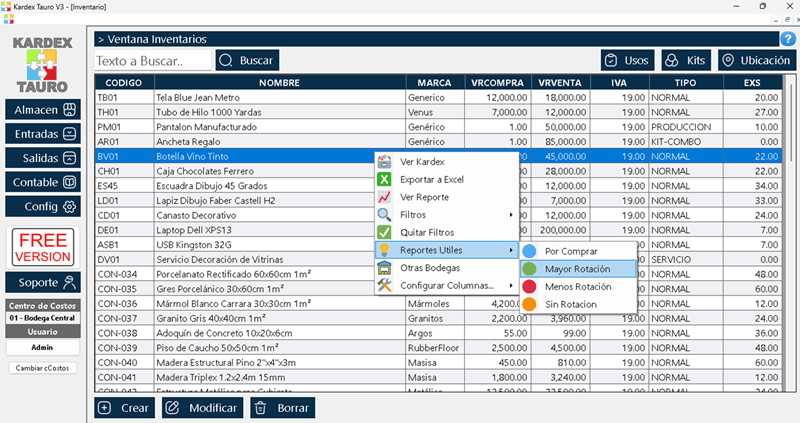
What can be done today is to organize the basics: review current contracts, check that the probation period is written with dates, confirm that every person is enrolled from their first day, and separate the real cost of each position in the accounts. When a company handles several contract types and contributions, an administrative and accounting management system keeps that information from getting lost in scattered spreadsheets; Kardex Tauro is one of the tools that covers that control. The legal decision, on the other hand, is discussed with whoever is accountable for it.