Corporate income tax in Colombia: how taxable income is calculated
Corporate income tax in Colombia: how taxable income is calculated
Taxable income is not the profit shown on the income statement. It is the result of adjusting revenue, subtracting returns and discounts, subtracting costs and the deductions tax rules accept, and reversing what accounting recorded but tax law rejects. When the two figures do not match there is no system error: there is a tax reconciliation that someone has to prepare, explain and keep.
The problem appears when the accountant hands over the income statement, the manager calculates 35 % on profit and, months later, the draft return arrives with a different figure. That gap eats into next year's cash flow. What follows is the full path: how the computation is built, where deductions get lost, how the gap is documented and what provision to leave before signing.
Why accounting profit and taxable income do not match
Accounting and tax rules pursue different objectives on the same facts. Accounting aims to show the economic situation of the business for a period; tax rules aim to determine how much is owed. That difference in purpose produces two legitimate and different results for the same year.
An expense can be real, properly paid, fully documented and still not deductible. A provision can be prudent from an accounting standpoint and not accepted as a deduction. The reverse also happens: revenue may have reached the bank account and still not belong in the tax base. Neither figure is wrong; they measure different things.
Differences fall into two families. Permanent ones come from items the law never accepts: they do not reverse, they stay outside the base forever. Temporary ones come from timing: accounting and tax rules place the item in different years, so the gap closes later.
| Type of difference | What causes it | How it behaves | Typical examples |
|---|---|---|---|
| Permanent | Expense or revenue the law never accepts | Does not reverse; stays outside the base every year | Fines and penalties, expenses without a valid invoice |
| Temporary | Different year of recognition | Reverses in later periods | Depreciation over different useful lives, receivables provisions |
| Line | Sign | What it includes | Support you must show |
|---|---|---|---|
| Revenue for the period | Add | Operating and non-operating revenue accrued in the year | Invoices, vouchers, bank statements |
| Returns and discounts | Subtract | Credit notes and discounts granted | Credit note with a documented reason |
| Costs | Subtract | Cost of goods sold or of services rendered | Inventory, purchases, production records |
| Deductions | Subtract | Necessary expenses accepted under the rules | Valid invoice, payment, link to the activity |
| Taxable income | Result | Base before benefits and offsets | Reconciliation to accounting profit |
| Tax exemptions | Subtract | Only those the law recognises and the company proves | Document supporting the benefit |
| Loss offsets | Subtract | Prior-year tax losses, within their limits | Prior returns and balance control |
| Net taxable income | Result | Base the rate is applied to | Signed working paper on file |
Three figures should never be mixed in a management meeting: taxable income, net taxable income and tax payable. The first comes out of the computation; the second is what remains after benefits and offsets; the third applies the rate, before credits and advance payments. When someone says the company paid a given percentage on profit, they are usually mixing all three.
Revenue: what comes in and what is subtracted first
The first line is not gross billing. It is billing minus returns, minus discounts and minus rebates granted to the customer. It sounds obvious and still derails often: the invoiced amount is reported and the December credit note is forgotten, even though it reduces the year's revenue and gets recorded in January.
The underlying criterion is accrual: revenue enters the year in which it is earned, not the year it is collected. An invoice issued and still unpaid already belongs to the period. A customer advance, by contrast, is not revenue until the goods are delivered or the service is provided, and treating it as revenue inflates the base for no reason.
Some revenue is not taxable income or occasional gain. That is not a prize: these are items the law excludes by nature, and the company must prove why they qualify. Recording them as taxable means overpaying; excluding them without support means underpaying and opening the door to a penalty. In both cases what is missing is the working paper that explains the decision.
Deductible costs: support decides
Cost of sales is the largest deduction for many companies and the least reviewed, because it is assumed to come out of inventory correctly. It is deductible to the extent that it matches goods or services actually sold in the period, is supported, and has not already been deducted.
The classic errors sit at the edges of inventory. A poorly executed physical count leaves cost in the asset and raises profit; an inflated closing inventory brings cost forward and lowers the base. Neither looks like a tax matter and both end up being one in a review.
The other front is cost without a valid invoice. Purchases from informal suppliers, services paid without a document, freight without support: the disbursement exists and the bank account shows it, but the deduction does not hold. The consequence is not only paying more tax; the expense stays in accounting and is rejected in the return, and that gap has to be explained in the reconciliation.
Deductions: causality, proportionality and limits
A deduction is not earned by paying. It is earned by meeting three conditions at once: the expense must be necessary for the activity, there must be a causal link to the operation that produces the revenue, and it must be proportional to what the company handles. On top of that sits a requirement that is not negotiable: support.
Causality asks what the expense was for. Proportionality asks whether the amount makes sense for the size and nature of the operation. Necessity asks whether it was reasonably indispensable, not merely convenient. The same expense can pass one test and fail another, and that is where disputes start.
Payments without a valid invoice are not deductible, even when they are banked and backed by a contract. The invoice is not paperwork: it identifies the good or service, the supplier and the related tax. Without it the expense drops out of the base and the amount goes straight back into taxable income.
Tax exemptions, loss offsets and tax credits
Tax exemptions are subtracted from taxable income, but they are neither automatic nor universal. Every benefit has its own rule, its validity period and its documentation requirements. Applying an exemption because a colleague used it, without checking that the operation fits the case, is one of the most expensive ways to save tax.
Fiscal losses cannot be subtracted freely either. They are offset under rules and limits set by law, and the balance must be supported by prior returns. A loss that was never reported, or reported incorrectly, does not become an available credit just because time passes.
Tax credits work differently: they do not reduce the base, they reduce the tax. Some taxes paid, such as the ICA (industry and commerce tax), may be taken as a credit instead of a deduction, depending on what the rules provide and on the specific case. The difference is not semantic: deducting reduces the base and saves the rate; crediting reduces the tax directly.
The 35 % rate and the surcharges headlines miss
The general corporate income tax rate is 35 %. It is the starting point for calculating tax on net taxable income, not the effective rate the company ends up paying on its accounting profit.
Special rates and surcharges exist for certain sectors, such as financial institutions. If the company operates in one of them, or has activities with differentiated treatment, the general rate is not the right reference and the specific case must be verified before projecting the tax.
For management, the useful figure is not the nominal rate but the projected tax on budgeted profit. That projection is built from the estimated computation for the year, not from 35 % applied to accounting profit. The difference between the two is, almost always, the size of the April shock.
Tax reconciliation: the document that explains the gap
Companies that keep accounting records must prepare and retain the reconciliation between accounting profit and taxable income. In Colombian tax practice it is filed in Form 2516, and its purpose is exactly what the name suggests: to explain, item by item, why the tax base is not equal to the profit on the income statement.
It is not a decorative annex. It is the document that lets a third party rebuild the calculation without guessing. If the reconciliation is well built, a review is settled by reading; if it is built from memory, every question opens a new investigation.
There is a less obvious benefit: the reconciliation forces a look at the whole year. Building it surfaces purchases without invoices, rejected provisions, misclassified revenue and duplicated expenses. It is the best internal control the tax close produces, and it comes free if done in the right order.
The advance payment: tax paid ahead of time
The income tax return does not only settle the tax for the year. It also settles the advance payment for the following year, and that amount is paid with the same return. For cash purposes it is a double burden in the same month: the balance for the year ending and the advance for the year starting.
That is why the advance must be provisioned during the year, not discovered at signature time. A company that sets aside a portion of projected tax every month reaches the due date with the money; one that does not ends up financing the advance with debt or working capital.
The calculation depends on the rules in force and on the applicable base, so it should not be taken from an example from prior years. What is stable is the effect: it reduces available cash next year and must enter the budget before any investment is committed.
A useful exercise for the board: on the year's tax, provision scenarios at 25 %, 50 % and 75 % as a sensitivity reference. These are not legal rates, they are working assumptions to size the cash need. With the highest scenario covered, the company can sign without surprises.
Full example: from accounting profit to tax
A trading company closes the year with revenue of $1,200,000,000, returns and discounts of $20,000,000, cost of sales of $780,000,000 and operating expenses of $280,000,000. Accounting profit before tax is $120,000,000. The calculation checks out: 1,200,000,000 minus 20,000,000 equals 1,180,000,000; minus 780,000,000 equals 400,000,000; minus 280,000,000 equals 120,000,000.
Reviewing the year turns up three items that accounting recorded and the tax rules treat differently. A fine of $5,000,000, a real expense but not deductible. A receivables provision of $8,000,000, which the rules do not accept as a deduction in this case. And non-taxable income of $3,000,000, which accounting added to revenue and the rules exclude from the base.
The computation is then: $120,000,000 plus $5,000,000 plus $8,000,000 minus $3,000,000, equal to $130,000,000 of taxable income. In this exercise there are no exemptions and no losses to offset, so net taxable income is the same figure. Tax at 35 % is $45,500,000.
| Item | Amount | Effect on the base |
|---|---|---|
| Accounting profit before tax | $120,000,000 | Starting point |
| Plus: non-deductible fine | $5,000,000 | Increases the base |
| Plus: rejected receivables provision | $8,000,000 | Increases the base |
| Less: non-taxable income | $3,000,000 | Reduces the base |
| Taxable income | $130,000,000 | Result of the computation |
| Less: tax exemptions | $0 | Not applicable here |
| Less: loss offsets | $0 | Not applicable here |
| Net taxable income | $130,000,000 | Tax base |
| Tax at 35 % | $45,500,000 | Tax payable |
The management reading is what matters. Accounting profit was $120,000,000 and tax was $45,500,000: against the income statement profit that is slightly above 37 %. The gap versus 35 % is not a rate error, it is the effect of the non-deductible items. That is the number to explain in the board meeting, not the 35 % in the headline.
Frequent errors that cost money
Income tax errors are rarely arithmetic. They are errors of classification, of support and of timing. These show up again and again in reviews, with their symptom and their consequence.
| Error | Symptom you see | Consequence | Fix |
|---|---|---|---|
| Reporting accounting profit as the base | The base matches the income statement exactly | Wrong tax and no reconciliation at all | Adjust item by item and document each adjustment |
| Deducting expenses without a valid invoice | Banked expenses with no document | Deduction rejected and higher base | Classify purchases by support every month |
| Not reversing temporary differences | Provisions and depreciation never adjusted | Duplicated adjustments or inflated bases | Track the balance still pending reversal |
| Offsetting losses without checking limits | The full prior-year balance is subtracted | Offset rejected and penalty | Review rules and support in prior returns |
| Forgetting the advance in the budget | Cash shortfall at the due date | Borrowing or late payment | Monthly provision with sensitivity scenarios |
| Filing without a tax reconciliation | No Form 2516 working paper exists | No way to explain the gap in a review | Build the reconciliation before signing |
There is a procedural error that also costs money: filing late. The return is filed on Form 110 and the due date depends on the last digit of the tax ID (NIT), according to that year's calendar. If that date is not in the accounting calendar from January, filing becomes a race and the adjustments get made in a hurry.
An honest closing note before filing
This text explains the mechanism; it does not replace the accountant. The computation depends on each company's specific facts: which expenses have support, which provisions apply, which benefits can be proven and which rate is due. None of that is settled by a general guide.
Before signing, check four things. That the reconciliation between accounting profit and taxable income exists, is complete and carries the balance of temporary differences still pending. That every non-deductible item is identified and quantified. That offset losses are supported by prior returns. And that the advance is provisioned in cash, not just calculated on paper.
It also helps to accept a limit: sometimes the correct answer is to pay more. An expense without support is not fixed by creative reclassification, and a wrongly applied exemption comes back with interest. The healthy discussion is about interpreting a documented fact, not about making a document disappear.
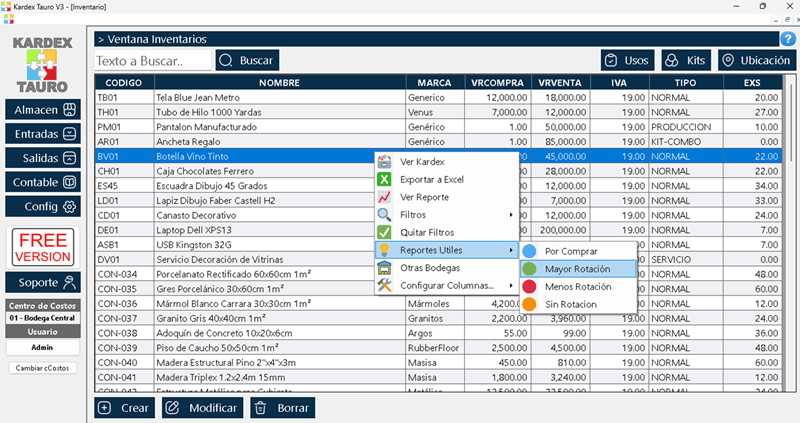
If inventory, billing and accounting live in the same system, the reconciliation is built from data that already exists instead of December reconstructions. That is where a tool such as Kardex Tauro earns its place: cost of sales comes straight from the inventory ledger and the computation stops being archaeology.
Keep reading
- Colombia's simplified tax regime: what it is, who qualifies and how to file
- Advance income tax in Colombia: who pays it and how it is calculated