Advance income tax in Colombia: who pays it and how it is calculated
Advance income tax in Colombia: who pays it and how it is calculated
This year's income tax return carries two lines that many people confuse. One is the tax the company owes for the year it is declaring. The other is the advance payment: a prepayment of next year's tax, calculated today, with today's figures and paid with today's cash. It is not a new tax, but it is a real cash outflow that many small and mid-sized companies fail to provide for, and it lands exactly when cash flow is tight. Here is what it is, who pays it, what it is calculated on, how withholding is deducted, a full example with its cash impact, and the mistakes that cost the most. The figures in the example are worked numbers, not market data.
What the advance payment is and why the government collects it up front
Advance income tax is a prepayment of next year's tax that is settled in the current year's return. A single return carries two different obligations: the balance of the tax for the period being declared, and the advance calculated on that same period but credited to the following one.
The reason it exists is collection, not taxation. The government does not want to wait twelve months for the company to file before it starts receiving the tax; it collects part of it up front, using the year that just closed as the reference. For the taxpayer, the practical effect is that income tax is paid in two moments: part during the following year through the advance, and the balance when the return is filed.
That is where the first confusion comes from. The advance has no triggering event of its own and no separate rate. It is the same income tax, collected earlier. That is why it is not added to the year's tax expense: it is recorded as a payment on account that is later offset against the actual obligation.
Who pays it and who does not
Not every filer pays it. The general rule reaches legal entities, and individuals only when they meet certain conditions set by the law. An individual who files is not automatically required to pay an advance; a legal entity that files almost always is. That asymmetry is why two taxpayers with the same profit can end up with very different returns.
The specific conditions change with the rules and depend on wealth, income and the regime the taxpayer belongs to. They should not be taken from a summary of previous years or from hallway advice. Before calculating, confirm in the current year's rules whether your case is covered by the obligation.
| Type of taxpayer | Pays the advance? | What to check |
|---|---|---|
| Legal entity required to file | As a rule, yes | The year's base and the withholding deducted |
| Individual filer | Only if the conditions in the rules are met | Wealth, income and applicable regime |
| Taxpayer not required to file | No | There is no return in which to settle it |
| Regime with its own rules | Depends on its rules | Confirm with the accountant before providing for it |
What it is calculated on: net income tax, not profit
The base for the advance is the period's net income tax, not accounting profit and not revenue. It is the line that results after applying the rate and subtracting tax discounts; the advance is calculated on that number, not on the pre-tax profit shown in the income statement.
The difference is not theoretical. A company can close with high accounting profit and low net income tax, because it had exempt income, offset losses or applied deductions. In that case the advance drops even though profit looks large. Conversely, a company with moderate accounting profit and few tax benefits can carry a proportionally much heavier advance.
That is why the calculation is done on the return form, not on the income statement. The figure that matters is the one on the net tax line, after every adjustment.
The percentage: whatever the current rules set, and why it pays to check
The advance is calculated by applying to net income tax the percentage set by the rules in force. That percentage has changed several times, which is why this article does not present it as a fixed number: the applicable value is the one for the year you are declaring and it must be confirmed before doing the math.
An arithmetic example helps explain the mechanism, as long as it is clear that it is an example and not a rate. If a 75% rate were applied, marked here only as a calculation assumption, net income tax of 150 million would produce a gross advance of 112.5 million. The figure shows the proportion; it is not a statement about the rate that applies to your company or about the rate in force this year.
Using last year's rate because "that is how it came out last time" is one of the most expensive mistakes: it changes the result, changes the balance payable and, if the difference is large, ends in an amended return with interest.
The withholding that is deducted: the advance is not the bare percentage
The calculation does not stop at the percentage. Withholding that the company expects to suffer the following year is deducted from the gross advance, following the rules of the form. It is an estimate: you project what customers and other withholding agents will deduct during the coming year, and that amount reduces the cash to be paid with the return.
The estimate cuts both ways. If you understate withholding, you pay more advance than necessary and are left with a credit balance that is only settled in the following return. If you overstate it, you pay less now, but the difference shows up later as a balance payable. In neither case is the error lost: it moves to the next year and distorts the cash flow of a period that has not even started.
To estimate sensibly, look at the withholding history of the last twelve months, adjust for customers coming in and going out, and separate income tax withholding from withholding on other items. The form has its own rules on which amounts are deducted and under what conditions.
Full example: from 150 million to the advance actually paid
A company closes the year with net income tax of COP 150,000,000. At the 75% rate used only as an example, the gross advance would be COP 112,500,000. If the withholding it expects to suffer the following year is estimated at COP 30,000,000, the advance payable with the return comes to COP 82,500,000. The full calculation, step by step, is this:
| Step | Item | Amount |
|---|---|---|
| 1 | Net income tax for the year | COP 150,000,000 |
| 2 | Example rate applied | 75% |
| 3 | Gross advance (step 1 × step 2) | COP 112,500,000 |
| 4 | Less estimated withholding for the following year | (COP 30,000,000) |
| 5 | Advance payable with the return (step 3 − step 4) | COP 82,500,000 |
Step 4 is the one most often forgotten. Without it, the company would pay 112.5 million and lend the government 30 million for a year for no reason. With it, the cash outflow is 82.5 million and the difference keeps working in the business.
There is a second reading, just as important: the 82.5 million is not a new expense. It is a payment on account of next year's tax. When that return is filed, it will be subtracted from the actual obligation, and if too much was paid, a credit balance remains. The money does not disappear; it changes timing.
The cash impact: the good year pays for the bad one
Suppose that the following year profit falls 30% and net income tax drops from COP 150,000,000 to COP 105,000,000. The company has already paid 82.5 million in advance and suffered 30 million in withholding: 112.5 million in credits against an obligation of 105 million. The result is a credit balance of 7.5 million.
| Item | Year 1 | Year 2 (profit −30%) |
|---|---|---|
| Net income tax | COP 150,000,000 | COP 105,000,000 |
| Gross advance settled | — | COP 112,500,000 |
| Estimated withholding deducted | — | (COP 30,000,000) |
| Advance paid with the return | — | COP 82,500,000 |
| Total credits against year 2 tax | — | COP 112,500,000 |
| Credit balance at the close of year 2 | — | COP 7,500,000 |
The credit balance is small; the problem is timing. The 82.5 million left during a year in which profit was falling 30%, and the excess is only offset in the following return. In cash terms, the advance behaves like a loan to the government: it is paid at the top of the cycle and recovered at the bottom.
Compare that with the company that did not provide for it. The same business, with 82.5 million to pay and no reserve, has to finance it. At an assumed 2% monthly financing cost, used only to size the effect, three months of debt cost close to 4.95 million. That cost appears nowhere on the return, but it comes out of profit.
High advance, weak year: how the excess is recovered
The excess is not lost, but it does not come back quickly either. The advance is credited in the following year's return; if crediting the payments against the tax due leaves a credit balance, that balance is applied in the next return or handled through whatever mechanism applies to your case. In practice, the money can take more than a year to return.
Hence the golden rule of planning: the advance is provided for when profit is known, not when the return arrives. A company that knows in October it will close with high profit has three months to set money aside. One that discovers it in April of the following year has two options: debt or default.
If the coming year looks weak, the analysis changes. An advance calculated on an exceptional year becomes a burden on a normal one, and the company ends up financing the government exactly when it most needs working capital. That is the scenario in which it is worth reviewing with the accountant whether any adjustment or treatment applies, before filing and not after.
How it is recorded: current tax payable, not next year's expense
The advance is recorded as current tax payable, that is, as a liability, or as an asset when a credit balance remains. It is not an expense of the following period. Tax expense corresponds to the tax accrued for the year; the advance is a prepayment of that future expense.
The difference matters because it changes the income statement. If the advance is charged to expenses, the year in which it is paid carries an expense that does not belong to it, and the following year shows inflated profit, because the real tax had already been recognised. Two distorted years from a single bad entry, and a profitability analysis that stops being useful.
The full path has four moments. Settling the advance creates a current tax liability; paying it reduces cash and cancels that liability; tax expense appears the following year when it accrues, and there the advance already paid is offset; if an excess remains, an asset for the credit balance is recognised and applied or processed later. At no point does the advance touch the result of the year in which it is paid.
If the accounting system does not separate the advance from tax expense, the cash flow statement loses precision: the outflow exists but is not read as a prepayment. It is worth reviewing how that account is set up before closing.
How to plan during the year, not in the last week
Planning the advance is part of annual tax planning, not a last-week formality. It is enough to project the year's net income tax, apply the rate in force and subtract estimated withholding. What cannot be done is leaving the provision for December.
The review calendar is simple. Each month, provide one twelfth: 82,500,000 divided by 12 gives 6,875,000. Each quarter, update the projection of net tax and of the withholding actually suffered. In October, fine-tune with the projected close and the confirmed rate. And before filing, verify base, rate, withholding and the cash available.
A monthly provision of 6,875,000 looks like a minor detail, but it is the difference between having the money and going out to look for it. Twelve months of provisioning produce 82.5 million without surprises; three months of haste produce a loan application and a financing cost nobody budgeted for.
And there is one decision that is genuinely in the taxpayer's hands: estimating withholding well. Every peso of withholding correctly projected is one peso less of advance leaving today. That is not evasion or a trick: it is applying the form's rule as written, with support that survives a review.
Deferring or adjusting: when it is allowed and when it is not
The advance can be deferred or adjusted only in the cases the rules allow. It is not a free decision by the taxpayer. There is no option to skip it because the coming year looks weak: the rules do not work that way, and a pessimistic forecast does not replace the legal requirement.
What can be done is arriving at the calculation with the numbers in place: correct base, current rate, withholding estimated with judgement and documentary support. A badly calculated advance is corrected in the following return, with interest if there is a difference.
Before signing, ask three questions. Is the base net income tax rather than profit? Is the rate the one for the year I am declaring? Is the withholding I deducted what I will actually suffer? If any answer is "I think so", you are not ready to file.
Common mistakes and what each one costs
Advance payment mistakes are almost never arithmetic; they are conceptual. The table is not a list of good intentions: each row shows the symptom the problem appears with and the consequence it leaves in cash or on the return.
| Mistake | Symptom | Consequence |
|---|---|---|
| Calculating on accounting profit | The advance does not match the form | Unexpected balance payable or credit the following year |
| Using a previous year's rate | A difference nobody can explain | Amendment with interest if the difference favours the tax authority |
| Not deducting withholding | More cash is paid than necessary | Working capital tied up for a year |
| Not providing during the year | The return arrives with no cash available | Short-term debt and unbudgeted financing cost |
| Recording it as an expense | The following year's result looks inflated | Financial statements distorted across two periods |
| Leaving it for the last week | No time to review base or withholding | Errors that carry over and get corrected a year later |
Note the pattern: almost every mistake is paid for a year later, which makes them hard to detect and easy to repeat. The practical defence is a working paper with base, rate, withholding and the support for each figure, archived with the return.
An honest close before you file
This text explains the mechanism; it is not tax advice and does not replace a review by an accountant. Your case may have its own rules: an individual with high wealth, a company in its first year, a taxpayer under a special regime or a company with offsettable losses are not settled the same way. Confirm the rate in force, the base and the conditions in the rules for the year you are declaring, not in someone else's summary.
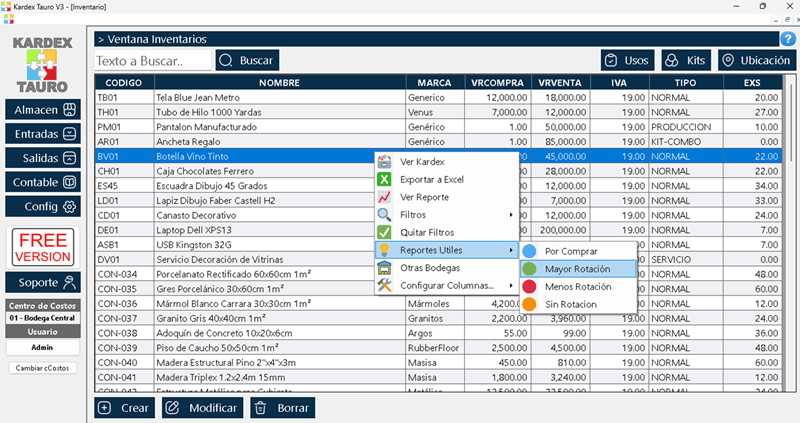
If the numbers add up after reading this, the next step is not filing: it is providing. Divide the advance across the months you have left and treat it as what it is, a commitment already made. When inventory control, invoicing and accounting live in the same system, as in Kardex Tauro, current tax and the advance are read in the same statement and the provision stops being a separate spreadsheet.
If the number does not add up, check the base first and then the withholding: differences usually sit there, not in the rate. After that, talk to your accountant with the three figures on the table: net income tax, rate applied and estimated withholding.