Social security contributions for self-employed workers in Colombia: how they are calculated

Social security contributions for self-employed workers in Colombia: how they are calculated
A self-employed worker issues an invoice, gets paid, and weeks later finds out that part of that money should have been set aside for health and pensions. Nobody withheld it: there is no employer to do it. Contributions for self-employed workers are calculated on 40 % of gross monthly income, not on the full invoice, and from that base come two fixed percentages: 12.5 % for health and 16 % for pensions. That is the whole calculation. What goes wrong, almost every time, is the base.
What follows is enough to run the numbers without depending on anyone: who counts as self-employed, where the 40 % comes from, how the floor and the ceiling in minimum wages work, how health, pensions and work-risk insurance are settled, what happens when there are several clients, how payment is made, what can be deducted from income tax, and what it costs not to contribute. At the end there is a worked example with three income levels and a list of the mistakes behind most discrepancies. Every figure here is an exercise: values expressed in minimum wages change every year and the current one must be checked.
Who counts as self-employed for social security
It does not depend on what the contract is called or on how the activity is registered. The working rule: if you provide services or run your own business, without an employment contract, and nobody pays you benefits or withholds contributions from a payroll, you are self-employed for contribution purposes. The client buys a service; it does not employ you.
That covers the professional who invoices for services, the shopkeeper who tends their own premises and the consultant who spreads the month across several clients. It also covers someone who is just starting and still invoices little: the obligation does not begin when income becomes comfortable, it begins with the activity.
One case that confuses people: the self-employed worker who has employees. If you hire staff, you add a second obligation —the payroll contributions for your workers— without ceasing to be self-employed for your own contribution. They are two separate fronts, settled separately.
The base is not the invoice: it is 40 % of what comes in
The costliest mistake is multiplying the full invoice by 12.5 % and by 16 %. The rule does not take the total: it takes 40 % of gross monthly income, and that amount is called the IBC, the contribution base income. The percentages are applied to the IBC.
That 40 % is not a discount or a relief: it is a presumption. Part of gross income is assumed to be what must support the contribution, and the rest covers the cost of operating. That is why a self-employed worker who invoices $6,000,000 does not contribute on $6,000,000, but on $2,400,000.
| Step | Operation | With $6,000,000 invoiced |
|---|---|---|
| Gross income for the month | Total invoiced in the period | $6,000,000 |
| IBC | Gross income × 40 % | $2,400,000 |
| Health | IBC × 12.5 % | $300,000 |
| Pensions | IBC × 16 % | $384,000 |
| Mandatory total | Health + pensions | $684,000 |
The last figure is the one that matters for cash flow: $684,000, not $1,710,000. Anyone who applies the rates to the full invoice ends up paying two and a half times what they owed.
Which income goes into that 40 %
What is invoiced for the activity in the month goes in, before costs are subtracted. If you have several clients, you add up every invoice for the month: the base is yours and it is a single one. Nobody will consolidate that for you, neither the big client nor the contribution operator.
Income that does not come from the activity, months with no invoicing, and irregular income are treated differently. That is where it pays to confirm with your accountant before deciding the base: it is the point where people get it wrong most often, and where the gap shows up when the DIAN cross-checks information.
Floor and ceiling: the two limits that change the result
The IBC has a floor of 1 SMMLV (the legal monthly minimum wage) and a ceiling of 25 SMMLV. The floor exists so that nobody contributes on a symbolic minimum base; the ceiling, so that the contribution does not grow without limit at high incomes. Both are expressed in minimum wages, so both move every year: check the current value for the year before you settle.
| Limit | When it applies | Effect on the calculation |
|---|---|---|
| Floor: 1 SMMLV | 40 % of income falls below one minimum wage | The IBC rises to 1 SMMLV and contributions are calculated on that amount |
| Middle range | 40 % sits between 1 and 25 SMMLV | The IBC is exactly 40 % of income |
| Ceiling: 25 SMMLV | 40 % of income exceeds 25 minimum wages | The IBC stops at 25 SMMLV and does not keep growing |
Both limits produce the same kind of surprise, in opposite directions. In a slow month, the floor forces you to pay more than income suggests. In a good month, the ceiling keeps you from paying on income that is no longer the base. Ignoring them explains half of all badly settled contribution forms.
Health 12.5 % and pensions 16 %: two multiplications and one sum
Both rates apply to the same IBC. Health: 12.5 %. Pensions: 16 %. Together they add up to 28.5 %, which is the figure for a fast calculation: IBC × 28.5 % is the mandatory total for the month.
In the $6,000,000 case: IBC $2,400,000, health $300,000, pensions $384,000, total $684,000. That money is not a tax. It goes toward your pension record and your health coverage —which is exactly why it can later be deducted from income tax.
The two obligations travel together: you cannot choose to contribute only to health because the month was bad, or only to pensions because retirement is far away. They are a package, and the form settles them in the same period.
Work-risk insurance is voluntary and calculated on the same IBC
Health and pensions are mandatory. Work-risk insurance —ARL— is voluntary for the self-employed worker, and whether it is worth it depends on the risk of the activity: a desk is not the same as a workshop, a building site or a delivery route.
If you take it, it is settled on the same IBC, at the rate for the risk level that corresponds to the activity. Because those rates depend on the level and are updated, there is no single percentage that works for everyone; the mechanism, however, is always the same: IBC × rate for the level.
The decision is not made by looking at the monthly cost, but at the opposite scenario: what happens if the accident occurs with no coverage. For low-risk activities the ARL is a small expense; for high-risk activities it is the difference between an incident and a business that closes.
Several clients, one month: you consolidate
With three clients there are not three contributions: there is one. The self-employed worker adds up gross monthly income from all contracts and calculates a single IBC. If you invoice $2,000,000 to one client, $3,000,000 to another and $1,000,000 to a third, the base is calculated on $6,000,000, not on each invoice separately.
This brings order to the operation: one form a month, one payment, one receipt. And it explains why a small invoice does not exempt you: the floor applies to the consolidated amount, not to each contract. If a month brought no income at all, that is a case to review with your accountant before deciding not to pay.
How payment is made and how often
Payment is monthly and is made through the integrated contribution form (planilla). The period being settled and the deadline depend on the operator you are registered with and on the calendar: there is no single date for everyone. The practical consequence is simple: the date is confirmed every month, not assumed.
Two habits prevent surprises. First, set the money aside the day you get paid, not the day the payment is due. Second, keep the receipt for every form: it is the document you will be asked for when a client, an auditor or the DIAN wants to verify.
The first habit solves cash flow; the second, proof. A self-employed worker can be fully paid up and still lose a contract for not being able to show it, and that is fixed with a folder ordered by month.
The client is not your employer, but can ask for receipts
Whoever hires a self-employed worker does not have to enrol them or pay them benefits. They are not an employer. What they can do —where the law allows it— is require proof of contribution payment before signing the contract or approving payment of the invoice.
That practice is common in contracts with companies that run audits and in supplier selection processes, and it is not a whim: if the client does not verify, it takes on a risk that is not its own. For the self-employed worker, keeping the form up to date stops being paperwork and becomes a commercial requirement. A supplier who cannot show proof loses the invoice, even after doing the work well.
What you pay is deductible from income tax, within limits
Mandatory health and pension contributions are deductible on the income tax return, within the limits set by the rules for the year. It is not a discount on the contribution: it is a deduction from the tax base. The difference matters for cash flow, because the form is paid first and the relief arrives later, on the return.
That is why it pays to track what was paid month by month. Without that record the deduction is lost for lack of proof, not for lack of entitlement. Work-risk insurance and voluntary contributions have their own treatment; confirm with your accountant which apply in your case and up to what limit.
Full example with three income levels
Three self-employed workers, the same month, the same rule. Income changes and the result changes, especially at the extremes.
| Income invoiced | 40 % of income | IBC applied | Health 12.5 % | Pensions 16 % | Total |
|---|---|---|---|---|---|
| $800,000 | $320,000 | 1 SMMLV (floor) | 12.5 % of 1 SMMLV | 16 % of 1 SMMLV | 28.5 % of 1 SMMLV |
| $6,000,000 | $2,400,000 | $2,400,000 | $300,000 | $384,000 | $684,000 |
| $20,000,000 | $8,000,000 | $8,000,000 | $1,000,000 | $1,280,000 | $2,280,000 |
First case: $800,000 invoiced. Forty percent is $320,000, below the floor. The IBC rises to one SMMLV and contributions are calculated on that minimum wage: 28.5 % of one SMMLV, not 28.5 % of $320,000. Here the contribution weighs more, proportionally, than at any other level: it is the typical case of someone starting out who has not yet reached a stable income.
Second case: $6,000,000. Forty percent is $2,400,000, inside both limits. Health $300,000, pensions $384,000, total $684,000. That total is 11.4 % of what was invoiced, not 28.5 %. The whole difference between one figure and the other lies in applying the rate to the IBC and not to the invoice.
Third case: $20,000,000. Forty percent is $8,000,000, still below the 25 SMMLV ceiling. Health $1,000,000, pensions $1,280,000, total $2,280,000. Again 11.4 % of invoicing: as long as income stays between floor and ceiling, the proportional burden does not change.
The business reading is this. Between floor and ceiling, every peso invoiced carries 11.4 % in contributions, and that is the percentage that belongs in your price. Below the floor, the burden is fixed and proportionally higher. Above the ceiling, the burden becomes fixed in pesos and the percentage falls as income rises.
What happens if you do not contribute
A month that is not paid leaves weeks that do not count. They do not disappear: they pile up as a gap in the pension record and in coverage. The effect is not felt the following month; it is felt when you claim a pension, when you need health care, or when an accident happens and there is no ARL.
There is a second, more immediate effect. The gap between what was invoiced and what was contributed is exactly what surfaces when the DIAN cross-checks information, and contributing below 40 % of income is one of the most common causes of those discrepancies. The adjustment arrives later, with the outstanding payment and the risk of a penalty, and it almost always costs more than paying on time.
Common mistakes behind the discrepancies
| Mistake | Why it happens | Consequence |
|---|---|---|
| Calculating on the full invoice | Base is confused with income | 28.5 % is paid instead of 11.4 %: overpayment month after month |
| Calculating 40 % of each invoice instead of the consolidated total | Several clients, several accounts, no total | Base below the real one; discrepancy when the DIAN cross-checks |
| Ignoring the floor in slow months | 40 % is applied to a low income | Contribution below the minimum and badly counted weeks |
| Ignoring the ceiling in strong months | 40 % is applied to a high income without comparing to 25 SMMLV | Paying more than corresponds |
| Leaving the form until the client pays | The date depends on the operator, not on collection | Late payment and months that do not count |
None of these mistakes is bad faith. They come from haste: the contribution is calculated once a month and almost nobody checks it against actual invoicing. One simple control —add up the month's invoices, calculate 40 %, compare with what was paid— prevents all five.
An honest closing note before you invoice
This is not labour or tax advice, and it does not replace your accountant. The mechanics are stable —40 %, floor and ceiling in SMMLV, 12.5 % and 16 %—, but the values expressed in minimum wages change every year, and edge cases are more numerous than they look: months with no income, irregular income, risky activity, several contracts at once, staff on the payroll.
Before invoicing, answer three questions: how much am I receiving this month in total, what IBC applies to me after the floor and the ceiling, and when is the form due with my operator. With those three answers the provision falls into place, and stops being an end-of-month calculation to become a pricing decision.
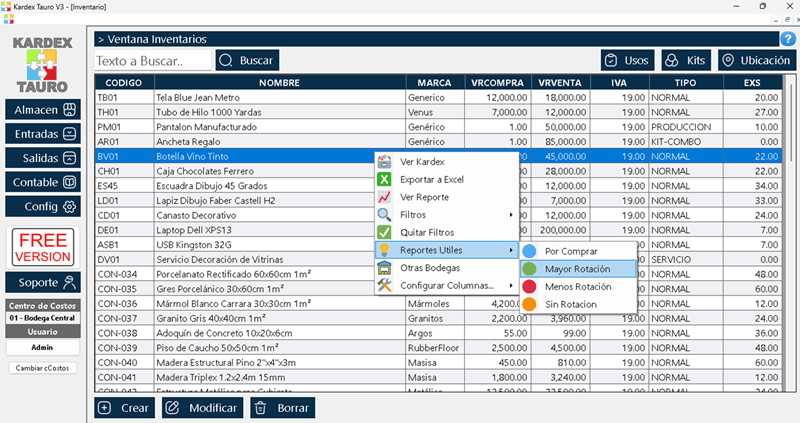
If invoicing control and receivables live in the same place, the 40 % stops being a separate task: it comes out of the month's income report. Kardex Tauro lets you see that consolidated figure by period and use it as the basis for the provision. The rest —the form, the dates, the deduction— is still your accountant's work.