Accounting policies: how to define and document them

Accounting policies: how to define and document them
Two people record the same purchase and the month's margin changes. One charges freight to expense; the other adds it to inventory cost. Neither is wrong by their own standard, and yet the statements are no longer comparable. That is what an accounting policy settles: the written decision on how the company applies the framework to its own facts, made before the fact occurs.
It is not a photocopy of the standard. It is the documented choice among the options the framework allows, with criteria, an owner and a date. What follows is the full method, with an inventory example using real arithmetic and the same structure applied to property, plant and equipment.
An accounting policy is a decision, not a summary of the standard
Accounting policies are the principles, bases, conventions, rules and procedures a company adopts to measure and disclose its transactions. The word that matters is "adopts". Someone has to decide, and that decision has to be written down with a name and a date.
Two companies with identical operations can choose different inventory costing methods and both be right. What cannot happen is that the same company changes criteria without saying so, or that two people inside it measure differently. A policy does not seek uniformity across companies: it seeks uniformity within one, period after period.
That gives the three requirements of any review: consistent with the framework, workable in the real operation, and documented. Consistent means it does not contradict the standard; workable means it describes what the company can actually do with its people and its systems; documented means it exists in an approved text and not only in the accountant's head. Without that, every close is measured with whoever's criteria is on duty, and the history stops being useful for comparing two years.
Where the framework lets you choose, and where it does not
The framework sets limits and, inside them, opens options. A policy only makes sense where there is an option. If the standard allows a single answer, that is not a policy: it is compliance.
- Inventory costing method. More than one method is valid. Choosing weighted average or first-in cost changes the month's cost of sales.
- Property, plant and equipment. Cost model or revaluation model: two valid ways to measure the same asset, with different effects on equity.
- Useful life of assets. The company defines the years it expects to use each class of asset. It is not written in the standard: it is a decision that must be supported.
- Level of disclosure detail. Materiality allows summarising; it does not allow omitting the criterion chosen.
Outside that margin sit the recognition criteria, the duty to disclose and consistency across periods. There is no choice there. Confusing the two grounds explains many failed manuals: pages that repeat the standard and never say what the company decided.
The five elements every policy must answer
Every policy answers five questions in this order. If one is left unanswered, someone will fill it in on their own.
- What it recognises. The operating definition of the item: the one the team uses to decide whether something goes in or stays out.
- When. The recognition moment and the document that supports it. Invoice, warehouse receipt or transfer of control: pick one and hold it.
- How it measures. The initial and the subsequent basis. The decision lives here, and so do almost all differences between companies.
- How it presents. Which line it appears in and at what level of detail.
- What it discloses. What goes into the notes, how often, and what effect it had in the period.
The order is not decorative. A policy that starts with disclosure usually describes a result the system does not produce. And one that sets measurement without setting the recognition moment leaves the door open to creative month-end cutoffs.
Policy, estimate and informal practice are not the same thing
The most frequent argument at a close is whether something "changed policy". Before answering, locate the concept: a policy is a method, an estimate is an amount, and an informal practice is a habit nobody approved.
| Concept | What it is | How it changes | Effect on comparability |
|---|---|---|---|
| Accounting policy | Principle, basis, convention, rule or procedure adopted to measure and disclose | Only if the standard requires it, if it improves the relevance of the information, or if the framework changes | Applied retrospectively and disclosed |
| Accounting estimate | An amount approximated with the information available: useful life, impairment, expected loss | Changes when new information appears; applied prospectively | The past is not restated: the effect is recognised in the period |
| Informal practice | What the team does because it has always been done that way, with no document and no approval | It should not exist as a source of criteria | It breaks uniformity and leaves no trail to explain it |
The third row is the most expensive. It cannot be audited, cannot be taught to a new employee and cannot be defended in a request for information. When someone says "we have always done it this way", what they are saying is that the policy exists but is not written down.
Change of policy versus change of estimate
A change of policy has three causes and no more: the standard requires it, it improves the relevance of the information, or the accounting framework changes. A shift in management mood or the wish to show a better margin does not count.
With a valid cause, the effect is applied retrospectively and disclosed. Retrospective means presenting prior periods as if the new policy had always been applied, so the series stays comparable. It is uncomfortable work, and that is why the change should have a reason that fits in two lines.
A change of estimate runs the other way. It is not a new method, it is new information: the asset lasts less than expected, receivables deteriorate faster, inventory lost value. It is applied prospectively, because the past was measured with what was known then.
To tell them apart, ask what is changing. If the how of measurement changes, it is a policy; if the how much changes, it is an estimate. Moving inventory costing from weighted average to first-in cost is a policy. Adjusting the impairment of one reference because the market cooled is an estimate. Calling a change of method an estimate to avoid restatement gets spotted quickly: the new method shows up with no cause and no note, and the problem stops being accounting.
Materiality: not everything deserves three pages
Materiality guides the level of detail. An item that can change a reader's decision deserves a full policy, an example and a note. A small, stable item with no real options deserves two lines.
Without that filter the manual grows until it is useless. Hundreds of items on the same template produce a document nobody reads and that describes practices the company does not follow. A copied manual is not a policy system: it is a statement of intentions that contradicts the operation.
A criterion that works: classify before writing. Full policy for what has options, volume and an effect on results; a short sheet for what has options but little amount; a simple procedure for what has no options. The threshold between levels is itself a decision, and it should be documented.
How it is documented: the policy sheet
A useful policy fits on one or two pages. What makes it operable is not the prose, it is the structure. Every sheet should carry these fields, always in the same order:
- Code and version. So it can be cited and you know which one is in force.
- Scope. Which items, sites and operations it covers, and what it leaves out.
- The rule in one sentence. If it does not fit in one sentence, it is not decided yet.
- The operating how. Who executes, at what point in the cycle, with what supporting document, and in which system field it is recorded.
- Exceptions. Who authorises them and how the authorisation is documented.
- Related disclosure. The note text that corresponds to that policy.
- Date and owner. Without these, the sheet is a draft.
The field most often left out is the operating one, and it is the one that decides whether the policy is followed. Saying inventory is measured at the lower of cost and net realisable value is correct and useless for operating. Saying who performs the assessment, with which report, on which closing date and where the adjustment is recorded is what works.
Who approves it and how the person who records learns about it
Approval is not signed by whoever wrote the document. It is signed by the legal representative or the body the company has defined, with a date. That signature turns good intentions into a binding criterion.
Then comes the part almost nobody does: circulating it. The policy has to sit where recording happens, not in the accountant's folder. That means configuring the system when the decision can be configured, adding it to the closing checklist and explaining it to whoever will enter the data.
If the accountant ignores them, they do not exist. A policy only management knows about is a document; one the person recording knows about is a control. With staff turnover, the written version is the only thing that survives.
How it is disclosed in the notes
Policies are summarised in the notes to the financial statements. Keeping them in a filing cabinet is not enough: the outside reader has to understand the criteria behind the figures they are looking at.
A good note answers three things: what was chosen, on what criteria, and what effect it had. The test is reconstructive: take the note and the balance, and ask whether a third party could rebuild the figure. If the answer is no, the note describes the standard but not the company.
Worked example: inventory policy for a trading company
The full skeleton applied to one item. The company buys and resells without transforming, and documented six points. The third column turns the decision into something executable on closing day.
| Element | Documented decision | How it is applied |
|---|---|---|
| Recognition | Goods held for sale in the ordinary course of business are recognised as inventory | On receipt at the warehouse, with a receiving report, even if the invoice arrives later |
| Initial measurement | Acquisition cost: price, freight and duties, less discounts | Taken from the supplier invoice and the transport and customs documents |
| Costing | Weighted average | The system recalculates unit cost on every receipt; manual cost is not allowed |
| Subsequent measurement | The lower of cost and net realisable value | Assessed at closing, reference by reference |
| Impairment | Assessed by reference, turnover and expiry | Turnover report and expiry list; adjustment approved by the warehouse manager and the accountant |
| Disclosure | The policy and the impairment amount for the period are disclosed | Inventory note, with gross balance, accumulated impairment and net balance |
Now the month, in round figures. The company buys 1,000 units at $10,000, pays $400,000 in freight and receives a $300,000 volume discount. Acquisition cost: $10,000,000 + $400,000 − $300,000 = $10,100,000, that is $10,100 per unit. In the same month it buys 500 units at $12,000, with no freight or discount, for $6,000,000.
Inventory available comes to 1,500 units and $16,100,000. Weighted average: $16,100,000 ÷ 1,500 = $10,733.33 per unit. It sells 1,200 units at $18,000, invoices $21,600,000 and records cost of sales of 1,200 × $10,733.33 = $12,880,000. Closing balance: 300 units at $3,220,000.
At closing, 120 of those 300 units belong to a seasonal reference. Estimated selling price $11,000, costs to complete and sell $1,600: net realisable value $9,400. Against a cost of $10,733.33 there is an impairment of $1,333.33 per unit, or $160,000 in total. The entry is impairment expense against accumulated inventory impairment for $160,000, and inventory is presented at $3,220,000 − $160,000 = $3,060,000.
If the price recovers in March, the reversal is recognised as income and cannot carry inventory above its original cost. That detail belongs in the policy too: it is the one that gets forgotten when the following year improves.
The same structure applied to property, plant and equipment
The skeleton does not change when the item changes. The six elements are the same; what changes is the decision. If your team can fill this table without inventing new fields, the policy is well formed.
| Element | Documented decision | How it is applied |
|---|---|---|
| Recognition | Assets for own use with an expected life of more than one year | On receiving the asset installed and ready to operate, with a handover report |
| Initial measurement | Cost, including transport, installation and necessary adaptations | Training and start-up costs that add no capacity are excluded |
| Subsequent measurement | Cost model; the company does not revalue | Balance at cost less accumulated depreciation and accumulated impairment |
| Depreciation | Straight line, useful life by asset class, residual value reviewed at closing | Monthly depreciation on the depreciable amount; a change of useful life is an estimate |
| Impairment | Assessed when there are signs the asset no longer generates the expected benefits | Annual review and on events such as damage, obsolescence or falling use |
| Retirements | Removed from the asset when sold or retired with no recoverable value | Retirement report, gain or loss calculation, recorded in the same period |
Note the depreciation row: useful life is a policy when first defined and an estimate when later corrected. That dual nature justifies writing into the sheet, in so many words, that the review of useful lives is a change of estimate. It saves an argument every December.
Frequent mistakes and what they reveal
The same six mistakes show up in almost every review. Each has a visible symptom and a consequence paid later.
| Mistake | Symptom | Consequence |
|---|---|---|
| Copying a generic manual | The text describes practices the company does not perform | The policy becomes a risk: it documents non-compliance in writing |
| Confusing policy with a summary of the standard | Pages that repeat definitions and contain no decision | It does not resolve the specific case; every close is debated again |
| Writing it without the operating process | It does not say who records, when or with what support | It is followed only when the accountant remembers it |
| Calling a change of method an estimate | A new method with no cause and no note | A non-comparable series and lost credibility with third parties |
| Setting detail without materiality | Hundreds of identical sheets, none of them read | High maintenance cost and little real control |
| Not disclosing the criterion in the notes | The reader cannot rebuild the figure | The statements lose usefulness for the bank, the partner or the investor |
There is a seventh mistake that is not technical: approving the policy and never looking at it again. Policies are reviewed every period, and that review must be recorded even when the conclusion is that nothing changed.
An honest close before writing the manual
This is not accounting advice and does not replace your accountant. It sets out the method and the skeleton; applying it to a specific case depends on the framework the company applies, the sector, the size and the decisions already taken.
If your company is small, with two or three relevant items, you do not need a two-hundred-page manual: you need three well-made sheets, approved and configured. If it has several sites, consignment inventory or long-term contracts, review the applicable framework with your accountant before writing the first line, because a badly chosen policy drags on for years.
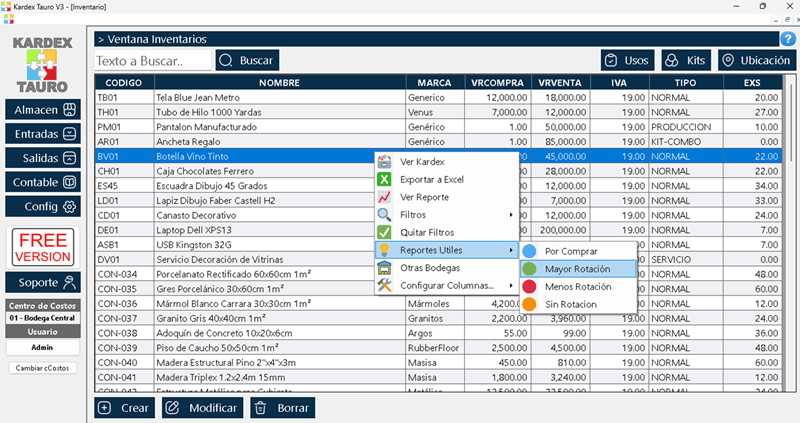
The order that works: identify where the framework allows a choice, decide with criteria and evidence, write the sheet with the operating how, approve it with a date, disclose it in the notes and review it every period. If that cycle holds, the policy stops being a document and becomes the normal way of measuring. Tools such as Kardex Tauro help with the mechanical part: a weighted average the system recalculates on its own keeps the policy from depending on whoever is typing. The decision is still yours.