IFRS for SMEs in Colombia: what it is and who must apply it

IFRS for SMEs in Colombia: what it is and who must apply it
IFRS for SMEs is the accounting framework that Colombia requires of companies that do not issue securities or raise funds from the public and that, because of their size, were classified in Group 2. It is adopted through Law 1314 of 2009 and compiled in Decree 2420 of 2015, together with the rest of the accounting and financial reporting standards. It is not a trimmed-down version of full IFRS: it is a separate standard, with its own rules, fewer alternatives and a clear purpose.
The question most readers bring is more concrete: is my company required to apply it or not? That is not settled by intuition or by the size a business "feels" it has. It is settled by the group the company was classified into, and that group determines which financial statements it must present, how many notes it must write and what compliance costs. This article covers the three groups, the classification criteria, the content of the complete set of statements, the structure of the standard, the real cost of adopting it, a worked example with figures and the mistakes that cost the most. Thresholds that change every year are explained as a mechanism, so you can verify the value in force.
What IFRS for SMEs is and what it is not
The IASB issued IFRS for SMEs as a stand-alone standard for entities without public accountability. The idea was not to cut full IFRS down, but to write a complete body of rules that solved the same problems — how to measure inventory, when to recognize revenue, how to treat a lease — with fewer alternatives and fewer disclosures. It is a self-sufficient framework: whoever applies it is not "doing IFRS halfway" or sitting in a gray zone.
The practical consequence is comparability: two companies of the same size in the same sector must measure their inventory the same way and disclose the same things. That is the point of one standard per group.
What it is not. It is not a tax regime: the framework says how to measure and disclose, not how much income tax to pay; the tax reconciliation is a separate exercise, with different rules and a different authority. It is not a checkbox in the accounting software: no system turns old statements into IFRS for SMEs statements on its own. And it is not optional for a company placed in Group 2: the framework sets the classification, not the comfort of the team.
The three groups of the Colombian framework
The Colombian framework does not have a single standard: it has three sets, and each company applies one. Group 1 works with full IFRS, Group 2 with IFRS for SMEs and Group 3 with a simplified accounting framework for micro-enterprises. The logic is proportionality: the greater the public interest and the larger the size, the more demanding the measurement, comparability and disclosure requirements.
Classification is not an academic label: it drives the number of statements, the detail of the notes and the way assets are measured. A company can keep tidy books, pay its taxes and still present statements under the wrong framework.
| Group | Framework applied | Who falls there | What it involves |
|---|---|---|---|
| Group 1 | Full IFRS | Securities issuers and entities of public interest | Full measurement and disclosure, at the highest level of demand |
| Group 2 | IFRS for SMEs | Companies without public accountability that exceed the Group 3 thresholds | Complete set of statements, comparatives and notes with policies and judgments |
| Group 3 | Simplified accounting | Micro-enterprises that meet the criteria of the simplified framework | Fewer disclosures and a simpler measurement scheme |
How the group is decided: the criteria that actually count
There are two families of criteria, and they should not be mixed. The first is qualitative: being a securities issuer or an entity of public interest puts the company in Group 1 regardless of size. A small company that lists, or that raises funds from the public, does not escape full IFRS because it has few employees.
The second family is quantitative and uses three measures: assets, revenue and headcount. Those measures are not compared in raw pesos; they are expressed in SMMLV (minimum monthly wage) or in UVT (tax value unit). The mechanism makes sense: because the minimum wage and the UVT are adjusted every year, the thresholds move with the economy and not with the table's own inflation. If the caps were fixed in pesos, every high-inflation year would move thousands of companies into another group without any of them growing.
In practice: take your assets, revenue and headcount for the year the standard indicates, convert each figure to SMMLV or UVT at the value in force and compare it with that year's table. Using last year's thresholds is the most common and the quietest mistake.
Two warnings. First, you do not pick the group that suits you best: classification follows from the criteria, and forcing it downward leaves statements that will not survive a review by a shareholder, a bank or an authority. Second, the criteria are not averaged or offset against each other; the framework's rule states how they combine, and that detail is worth confirming with your accountant.
What a Group 2 company must deliver
The framework requires a complete set of financial statements, not a stand-alone balance sheet. That set has five pieces and a package of notes that explains them. All of them are presented with comparative figures: each balance for the period sits next to the prior period's balance, so the reader sees the movement and not just the final snapshot.
| Statement | What it answers | What it is compared against |
|---|---|---|
| Statement of financial position | What the company owns and owes on a given date | The prior period's closing balance |
| Statement of comprehensive income | How much it earned or lost, and what other results affected equity | The same period of the previous year |
| Statement of changes in equity | What moved equity: contributions, dividends, results | The opening balance of the period |
| Statement of cash flows | Where cash came from and where it went | The opening and closing cash of the period |
| Notes | Which policies were applied, which judgments were made and how the figures break down | The prior period's policies, explaining any changes |
In the first year of adoption one more piece appears: the opening statement of financial position, at the transition date. That is where the opening balances, already adjusted to the new framework, are shown, and it is the real test of the whole process. If opening balances were built by copying the previous balance sheet without revisiting measurement, the following years carry the error forward.
The notes: where the argument is won or lost
The notes are not a decorative annex: they are where the company explains its accounting policies, the judgments it applied and the breakdown of figures the reader cannot derive from the statements. A bank assessing a loan, a shareholder who wants out or an auditor read the notes first, because that is where you see whether the number has support.
Every useful note answers three questions: which policy was applied, why that one and how much the effect is worth. A note saying "inventory is measured at cost" explains nothing unless it states which cost formula was used, how obsolescence was treated and what carrying amount remained. The same goes for the useful life of machinery, impairment of receivables or revenue recognition on contracts that span two years.
The framework requires disclosure of policies, judgments and breakdowns. Judgments are the delicate part: they are decisions the standard does not resolve on its own and that the company must document. Changing the useful life of a machine, deciding when a receivable is uncollectible or defining the moment revenue is recognized are all judgments, and each one needs written support, not a verbal explanation at the closing meeting.
How the standard is organized: sections, not separate standards
IFRS for SMEs is organized in sections, one per topic, rather than in separate standards by subject. That architecture helps daily work: a policy manual can be built by walking through the sections and writing, for each one, the company's decision. The manual stops being a generic document and becomes a map of how this company measures.
| Block | What it covers | Sections included |
|---|---|---|
| Presentation | How the statements are built and explained | Financial statements and accounting policies |
| Assets | What is recognized, how it is measured and when it is impaired | Inventories and property, plant and equipment |
| Liabilities and estimates | Certain obligations and those that depend on a future event | Provisions and financial instruments |
| Revenue and contracts | When revenue arises and how it is spread over time | Revenue and leases |
| Taxes | What separates accounting profit from taxable profit | Income tax |
The standard offers fewer options than full IFRS, and that is an advantage for a mid-sized company: fewer alternatives means less internal debate and more comparability with the neighbor in the same sector. But it still requires judgment. A short section does not mean the decision is obvious.
What changes against traditional accounting
The most visible change is not in the chart of accounts but in the logic of measurement. Under the previous framework it was enough to record cost and let time do its work. Under IFRS for SMEs you have to ask whether the asset is still worth what the books say, whether the obligation truly exists and whether the revenue has been earned.
That touches inventory on two fronts: the cost formula and the recognition of losses from obsolescence. It touches property, plant and equipment through component depreciation and the review of useful lives. It touches leases, which stop being an invisible monthly expense and start showing the right of use and the related obligation. It touches financial instruments, where a long-term receivable is no longer measured the same way as a cash sale.
The other change is documentary discipline. Before, a decision could live in the accountant's head. Now it has to sit in a written policy, applied consistently and disclosed. That is the work nobody sees in the financial statements, and it is what sustains the reliability of the number.
What it actually costs to adopt
The cost conversation starts with the software and that is almost never where the bill is. Adopting the framework requires prior work, team time and, almost always, outside support. These are the fronts to budget for:
- Diagnosis: reviewing what is measured today, on what basis and where the gaps are against the framework that applies.
- Accounting policies: writing the company's decision for each section that affects it, with support for the case.
- Opening balances: rebuilding the opening statement of financial position at the transition date.
- Transition adjustments: recording the differences that appear when the measurement basis changes and explaining them.
- Disclosures: building notes with policies, judgments and breakdowns, not with copied text.
- Training: making sure whoever records daily transactions understands why measurement changed.
- Audit, where applicable: if another rule or a third party requires it, that cost is added and paid every year.
- Upkeep: updating policies, reviewing judgments and keeping notes current at every close.
The most common budgeting mistake is comparing licenses only. A poorly planned adoption is paid for twice: at the first close and, more expensively, when the bank asks about figures nobody documented.
What happens when the company grows and changes group
Classification is not permanent. A company that grows may move from one group to another, and that move has accounting and disclosure effects. It is not a one-afternoon formality: measurements must be redone, comparatives reviewed and the reason for the change explained in the notes.
The practical approach is to watch the three criteria during the year, not in December. If revenue or assets approach the threshold, simulate the close in advance and estimate the impact: which assets change value, which lease contracts appear on the balance sheet, which new disclosures are needed. It is also worth telling the bank before rather than after, especially if there are debt covenants tied to accounting figures.
Changing group does not erase history: comparatives remain mandatory and the company must be able to explain how it moved from one set of figures to another. A poorly documented change leaves two years of statements that cannot be read in sequence.
Example: two companies, two frameworks
Suppose a distribution company with assets of COP 4,000,000,000, annual revenue of COP 6,000,000,000 and 80 employees. With the illustrative thresholds in the table in force, all three measures place it above the cut for the simplified scheme: IFRS for SMEs applies, Group 2. It is not a matter of taste: it is the consequence of the criteria.
Now compare a micro-enterprise in the same city: assets of COP 400,000,000, revenue of COP 400,000,000 and 6 employees. Its assets equal 10 % of the first company's (400 ÷ 4,000), its revenue 6.7 % (400 ÷ 6,000) and its headcount 7.5 % (6 ÷ 80). With those figures it could fall in Group 3 and apply the simplified framework, with fewer disclosures. "Could" is the right word: classification is confirmed with the table in force for the year and with the rule on how criteria combine.
| Criterion | Company A | Micro-enterprise B | Reading |
|---|---|---|---|
| Assets | COP 4,000,000,000 | COP 400,000,000 | B holds 10 % of A's assets |
| Annual revenue | COP 6,000,000,000 | COP 400,000,000 | B bills 6.7 % of A's revenue |
| Employees | 80 | 6 | B has 7.5 % of A's headcount |
| Revenue per employee | COP 75,000,000 | COP 66,666,667 | Similar productivity, very different scale |
Both companies can be equally profitable per employee and still sit under different frameworks. The framework does not measure how well the business is run; it measures how much information must be given to the market. That is why the 80-employee company needs a complete set with comparatives and notes, while the micro-enterprise can comply with a lighter scheme.
Frequent mistakes that cost dearly
- Classifying with last year's thresholds. Symptom: nobody looked at the table again. Consequence: the company files statements under a framework that no longer applies to it.
- Thinking adoption means configuring the software. Symptom: the system changes and measurement stays the same. Consequence: opening balances have no support and the first close collapses.
- Copying another company's policies. Symptom: the manual talks about plants and warehouses the company does not have. Consequence: the policy does not describe the real operation and cannot serve as support.
- Omitting comparatives. Symptom: only the current year's column is presented. Consequence: the statement does not comply with the framework and the reader cannot see the trend.
- Generic notes. Symptom: text identical to last year's, with no figures. Consequence: any external review finds missing disclosures.
- Leaving a group change for December. Symptom: the decision is made with the close already underway. Consequence: rushed adjustments, badly built comparatives and awkward conversations with the bank.
An honest closing before you adopt
This article does not replace your accountant and does not decide your company's case. Classification depends on the table in force, on the rule for combining criteria and on facts only you know: whether you issue securities, whether you raise funds from the public, how revenue behaved in the reference year. If your company is a micro-enterprise or sits in Group 1 as an issuer, this walkthrough does not resolve your case.
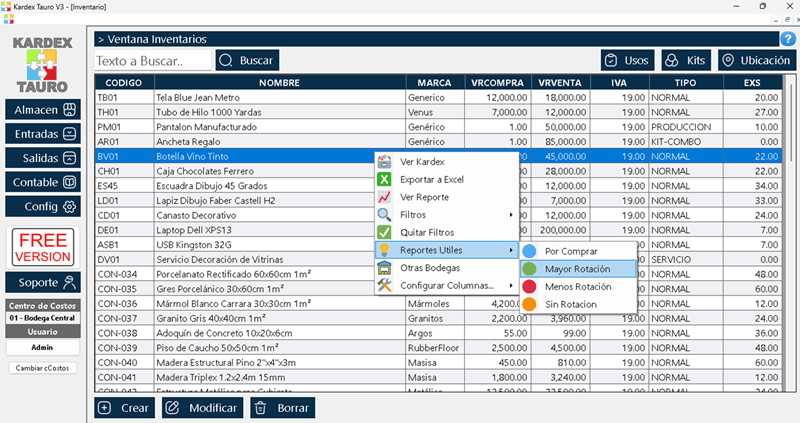
What is worth doing, in any group, is putting the base in order: reliable inventory, receivables classified by age, assets with documented useful lives and a close you can explain. Without that, no accounting policy holds up. If inventory and statements have to come from the same base, Kardex Tauro lets you run stock records, invoicing and accounting on a single record; the decision on the applicable framework, in any case, remains your accountant's.