Statement of cash flows: direct and indirect methods
Statement of cash flows: direct and indirect methods
The company closed the year with a profit and still could not cover January payroll. The owner looks at the income statement, sees a gain, and cannot understand why the bank rejected the check. That contradiction has a name and a fix: the statement of cash flows. This document answers a different question than the income statement does: where the money came from and where it went during the period. Here you will find the three activities that make it up, how it is built under the direct and the indirect method, how the cash balance is reconciled against the balance sheet, the treatment of interest, dividends and non-cash transactions, and a full numerical example you can replicate in your own company.
What this statement answers and what it does not
The statement of cash flows measures cash, not profit. That difference is the key to everything that follows. A sale invoiced on credit raises revenue and raises receivables, but it does not put a single peso in the bank until the customer pays. Equipment bought on credit increases assets and debt without moving cash on the day the contract is signed. The income statement records those events; the cash flow statement records the moment the money entered or left.
That is why a company can show a profit and a negative cash flow at the same time. It is not an accounting error or an automatic sign of fraud: it is the normal consequence of selling on credit, building up inventory, or investing in fixed assets during a period of growth.
What this statement does not do: it does not explain the profitability of the business, it does not value the company, it does not replace the income statement, and it does not say whether an expense was necessary or excessive. It only orders cash movements. If you use it to judge profit, you will misread the business.
The three activities: operating, investing and financing
Every cash movement falls into one of three baskets. The classification is not a matter of form: it is what lets you see whether the business sustains itself from its own operation or depends on someone lending it money or injecting capital every year.
| Activity | What it includes | What it tells the reader |
|---|---|---|
| Operating | Collections from customers, payments to suppliers and employees, taxes | Whether the business generates cash from its day-to-day work, without outside help |
| Investing | Purchase and sale of property, plant and equipment, intangibles and investments | How much cash is being committed to future capacity |
| Financing | Loans received and repaid, capital contributions, dividends | Where the money the operation does not produce comes from |
A positive and growing operating flow, with reasonable investing and moderate financing, describes a business that pays for itself. A negative operating flow covered with loans describes something else, even if profit looks healthy on paper.
Why profit and cash drift so far apart
There are two families of reasons. The first is made up of items that reduce profit without taking a peso out of the bank: depreciation is the classic case, because it spreads the cost of an asset over time and does not represent a cash outflow in the period. The second is movement in working capital: receivables, inventory and suppliers. Every peso sitting in receivables or in the warehouse is a peso that is not available; every peso that takes longer to pay a supplier is cash held onto for a while.
Understanding these two families is what makes the indirect method readable. There is no formula to memorize: you have to know whether the movement of the period released or consumed cash.
Direct method: gross collections and payments, nothing hidden
The direct method shows gross collections and payments. Instead of starting from profit, it presents the real inflows and outflows: what was collected from customers, what was paid to suppliers, what was paid to employees, the taxes paid. The result is a document any partner or commercial manager can read without accounting training, because it talks about money that came in and money that went out.
Its advantage is readability. Its cost is the information it demands: to present it well you must be able to trace collections and payments, not just revenues and expenses. Many small companies lack that separate traceability and end up building it by hand, with the risk of double counting. If your system does not distinguish between an invoice issued and money received, the direct method becomes a handcrafted reconstruction.
One detail is often missed: the direct method does not change the operating flow, only the way it is displayed. The total must be the same one the indirect method would produce. If the two methods give different figures, the problem is not presentation: there is a classification error or an unrecorded item. Comparing both results is, in fact, a good internal consistency test.
Choose the direct method when the people reading the document are business people: a board, an investor partner, a bank's credit committee. There, the detail of collections and payments answers specific questions that a list of adjustments does not.
Indirect method, step by step
The indirect method starts from the result for the period and adjusts it until it becomes cash. The order is always the same and should be respected, because one adjustment with the wrong sign throws off the whole statement.
| Step | What you do | Effect on cash |
|---|---|---|
| 1 | Start from the result for the period | Starting point |
| 2 | Add non-cash items such as depreciation | Increases |
| 3 | Adjust the increase in receivables | Decreases |
| 4 | Adjust the increase in inventory | Decreases |
| 5 | Adjust the increase in suppliers | Increases |
| 6 | Add the result of investing and financing | Net flow for the period |
The sign rule that prevents 80 % of the errors: an increase in an operating asset consumes cash; an increase in an operating liability releases cash. If receivables rise, subtract. If suppliers rise, add. The reverse when the items fall.
How to read a negative operating flow
Not every negative operating flow is an alarm, but none of them is neutral. If the negative comes from a sharp rise in receivables because a lot was sold on credit to large customers, the problem is collection and it can be fixed. If it comes from inventory piled up because too much was bought expecting a better price, the problem is purchasing. If it comes from paying suppliers faster to earn discounts, that may be a good decision and it still has to be explained.
What does not hold up is a negative operating flow repeated over several periods and covered with new debt. There the business is not being financed: it is being kept alive on air. The comparative prior period is what reveals the pattern; a single isolated year does not show it.
Cash reconciliation: the tie-out that is not negotiable
The statement of cash flows does not end with the net flow. It ends with a reconciliation between opening and closing cash for the period, and that closing balance must match the cash balance on the balance sheet. If it does not match, the statement is wrong, with no room for discussion.
The reconciliation reads in three lines: opening cash, plus or minus the net flow for the period, equals closing cash. That last figure is verified against the balance sheet at the same cut-off. When it does not tie, there are almost always one of three causes: an account that is not cash was included (for example, a restricted short-term investment), an internal transfer between the company's own accounts was omitted, or a movement that was recorded was classified in the wrong activity.
Leave the reconciliation visible in the document, not as a hidden annex. It is the proof that the statement is consistent, and it is the first thing an auditor reviews.
A habit that saves weeks: do the reconciliation every month, not every year. A December discrepancy drags twelve months of movements behind it and turns into an investigation; a discrepancy in the current month is resolved by looking at two bank statements. The monthly reconciliation also shows the cash pattern before it becomes a liquidity problem.
Interest and dividends: the decision must be disclosed
Interest paid and dividends can be classified in more than one activity, depending on the policy the company adopts. What the standard does not allow is changing the criterion from one period to the next without explanation, or leaving it implicit.
They must be classified consistently and the decision disclosed. If interest paid is presented as financing, the reader understands it is the cost of borrowed money; if it is presented as operating, the operating flow takes a bigger hit. Neither is wrong on its own: what is wrong is making the reader guess which one was used, or changing the criterion in the very year the result improves. Dividends paid usually go under financing, because they are a withdrawal of capital by the owners, and that reading should be explicit.
In a small company with heavy bank debt, this decision changes how the business reads. An operating flow that looks solid because interest was pushed to financing is not the same business as one that already deducted it from operations. Before comparing two companies or two years, check where interest sits; if it is not in the same place, the comparison is worthless.
Non-cash transactions: out of the statement, into the notes
An asset purchase financed with debt does not move cash on the day of the transaction. It does not go into the cash flow statement, and yet it is a large economic event the reader needs to know about. The answer is twofold: it is excluded from the statement and disclosed in the notes.
The classic mistake is counting it twice: recording it as investing for the asset purchase and again as financing for the loan, which inflates the net flow without a peso having come in. The other side of the same mistake is omitting it entirely and leaving the reader with no explanation of why debt rose and installed capacity rose with it.
A complete example, with the reconciliation at the end
Suppose a company with a result for the period of $58,500,000, depreciation of $25,000,000, an increase in receivables of $15,000,000, an increase in inventory of $10,000,000 and an increase in suppliers of $8,000,000. The operating section is built like this:
58,500,000 + 25,000,000 − 15,000,000 − 10,000,000 + 8,000,000 = 66,500,000
Depreciation is added because it reduced profit without taking cash out. Receivables and inventory are subtracted because they consumed cash. Suppliers are added because they financed part of that operation. The result is an operating flow of $66,500,000, higher than profit: in this case the business turned its gain into cash and then some.
| Item | Amount | Activity |
|---|---|---|
| Result for the period | 58,500,000 | Operating |
| (+) Depreciation | 25,000,000 | Operating |
| (−) Increase in receivables | −15,000,000 | Operating |
| (−) Increase in inventory | −10,000,000 | Operating |
| (+) Increase in suppliers | 8,000,000 | Operating |
| Net operating flow | 66,500,000 | Operating |
| (−) Purchase of equipment | −40,000,000 | Investing |
| (+) Loan received | 20,000,000 | Financing |
| (−) Dividends paid | −10,000,000 | Financing |
| Net flow for the period | 36,500,000 | Total |
| Opening cash | 30,000,000 | Reconciliation |
| Closing cash | 66,500,000 | Reconciliation |
Investing: −$40,000,000 for the equipment purchase. Financing: $20,000,000 of loan minus $10,000,000 of dividends, that is +$10,000,000. Net flow: 66,500,000 − 40,000,000 + 10,000,000 = $36,500,000. With opening cash of $30,000,000, closing cash is $66,500,000.
Now the verification that cannot be skipped: that $66,500,000 has to be the same cash balance shown on the balance sheet at closing. If the balance sheet says something else, you do not adjust the statement to make it fit: you look for the difference. It may be a misclassified account, an internal transfer recorded twice, or a movement that was never booked.
Note the underlying reading as well: operations generated $66,500,000, investing consumed $40,000,000 and financing contributed $10,000,000. The business funded its equipment from its own cash and still paid dividends. That is what the income statement alone would never have shown.
Common mistakes that throw the statement off
| Mistake | Symptom | Consequence |
|---|---|---|
| Reversing the sign of a working capital change | The operating flow does not resemble the real change in cash | Collection and purchasing decisions made on false data |
| Including a restricted investment as cash | The closing balance does not match the balance sheet | Reconciliation impossible and an observation in review |
| Counting a financed purchase twice | The net flow is inflated with no real money in | Liquidity for the period is overstated |
| Changing the interest criterion without disclosing it | The operating flow improves year over year with no explanation | Broken comparability and lost credibility |
| Presenting only the current year | There is no pattern to analyze | A one-off event is mistaken for a trend |
None of these mistakes requires a sophisticated system to prevent. They require a checklist and someone who signs it.
The comparative prior period is presented too
The statement is presented with the prior period alongside, not only the current year. This is not decoration: without the comparative column you cannot distinguish a one-off decision from a trend, or know whether the operating flow improved because the business improved or because suppliers stopped being paid.
In practice, the prior column is where the uncomfortable questions surface: why receivables grew so much, why inventory doubled, why new debt coincided with the dividend payout. A statement without a comparative is a photograph; with one, it is a film, and decisions are made watching the film.
An honest close before you present
This document does not replace your accountant or your statutory auditor. It is a guide to understanding what you are looking at and what to ask, not an opinion on the financial situation of a specific company. The classification of certain items depends on the business, the sector and the accounting policy adopted, and it should be confirmed with whoever signs the financial statements.
Before presenting, three checks: that the cash reconciliation ties against the balance sheet, that the interest and dividend criterion is disclosed and is the same as the prior period, and that non-cash transactions are excluded from the statement and explained in the notes. If all three pass, the document will survive a meeting with the bank.
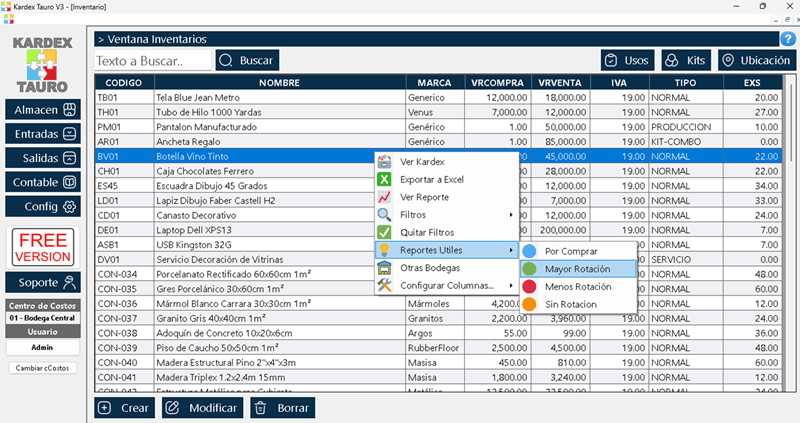
If you keep inventory, receivables and treasury under control in one system, building this statement stops being an end-of-year reconstruction; in Kardex Tauro, for example, movements stay recorded and the reconciliation becomes a review, not a hunt.