Supplier management: how to choose, evaluate and negotiate

Supplier management: how to choose, evaluate and negotiate
The supplier offering the lowest price is almost never the cheapest one. Between the quote and the invoice come freight, defective units, waiting days and cash tied up in inventory. This article shows how to choose with criteria, how to score suppliers without letting price crush everything else, what to ask for beyond a discount, and how to measure every month whether the relationship still works, with a contingency plan and the mistakes that repeat most in small businesses.
Why purchasing is a strategic decision, not an administrative one
In many companies purchasing happens in the back room: someone calls the usual supplier, asks for what is missing and files the invoice. That call sets next month's margin. Material that arrives late stops production, a defective batch forces rework, and a badly negotiated cash payment leaves no room for payroll.
Purchasing is strategic for three measurable reasons. First: in distribution and manufacturing, the cost of goods is usually the largest slice of spending, and one point of improvement there is worth more than cutting rent. Second: the supplier controls what the buyer does not, such as batch quality and dispatch date. Third: the relationship ends up on the balance sheet, as inventory, accounts payable and working capital.
Treating purchasing as paperwork has a silent cost: it does not show in a single month, but it accumulates. Treating it as a decision requires three habits: compare before buying, put what was agreed in writing, and review compliance with numbers. None of that needs a purchasing department; it needs method.
Selection criteria: price, quality, lead time, backing and risk
Five criteria are enough to order any purchasing decision, as long as they are defined before quotes are requested. If they are defined afterwards, the list bends toward the supplier you already had in mind.
- Price: not the unit price, but the total monthly cost, including freight, taxes, volume discounts and the cost of rework.
- Quality: technical specification, accepted tolerance, historical percentage of defective units and the certificates your end customer may demand.
- Lead time: days between order and delivery, performance on the last ten orders and capacity for an urgent dispatch.
- Backing: verifiable legal existence, matching business activity, trade references, written warranty and spare parts on hand.
- Risk: how concentrated purchasing is on that supplier, its financial situation and how far it sits from your operation.
Weights are not universal. Material that stops the plant weighs more on lead time and quality; low-value, fast-moving material weighs more on price. Set the weights in writing before opening the envelopes and do not move them afterwards.
| Criterion | Weight | What it measures | How to verify it |
|---|---|---|---|
| Total price | 40 % | Cost per unit landed in the warehouse, with freight and rework | Closed quote and past invoices |
| Lead time | 25 % | Delivery days and performance on recent orders | Your own purchase order history |
| Quality | 20 % | Percentage of defective or returned units | Samples and return log |
| Payment terms | 15 % | Credit days and early payment discount | Supplier's written proposal |
| Backing and risk | Screening | Legal existence, references, concentration and solvency | Tax registry, trade references and a site visit |
How to read a quote before comparing
A quote is not comparable until it answers the same questions in the same order. Before placing two offers side by side, check six points:
- Whether the price includes Colombian VAT and whether freight is inside it or charged separately.
- The real unit of measure: box, kilo, metre or unit, and how many units the pack contains.
- How long the price holds. A price with no validity is a promise, not an offer.
- The delivery days counted from when: the order, the payment or the supplier's confirmation.
- What happens with a defective item: replacement, credit note or deduction from the next invoice.
- Whether there is a volume discount and from what quantity it applies.
When a quote leaves a point unclear, do not assume it: ask in writing and keep the answer. On small purchases, that email is the real contract.
How to score suppliers so the cheapest does not always win
Scoring does two things: it compares offers that are not identical, and it leaves a record of why you chose whom you chose. The method fits in a spreadsheet.
- Give each criterion a score from 0 to 100 using a conversion table defined in advance. For price, 100 goes to the lowest total cost and the rest by proportion; for lead time, 100 if delivery is three days or less, falling as it stretches; for quality, 100 with no defects and lower according to the percentage; for payment, 100 to the longest credit period.
- Multiply each score by the weight of the criterion and divide by 100.
- Add the results. The highest total wins, but only among suppliers that passed the backing screening.
The key is the conversion table: defined before the offers are seen, nobody can adjust it later to favour an acquaintance.
| Supplier | Price 40 % | Lead time 25 % | Quality 20 % | Payment 15 % | Total |
|---|---|---|---|---|---|
| A | 88 → 35.2 | 72 → 18.0 | 80 → 16.0 | 85 → 12.8 | 82 |
| B | 82 → 32.8 | 92 → 23.0 | 92 → 18.4 | 92 → 13.8 | 88 |
| C | 100 → 40.0 | 48 → 12.0 | 65 → 13.0 | 40 → 6.0 | 71 |
B does not win on price and still comes first: it delivers in two days, has half the defects of A and grants fifteen more days of credit. With tight cash, those fifteen days are worth more than the price difference.
Total cost of purchase: the calculation that decides
Scoring orders the options; the owner does the math. Exercise values for an item bought at 1,000 units a month, where each defective unit costs 3,000 pesos in rework.
| Item | Supplier A | Supplier B | Supplier C |
|---|---|---|---|
| Unit price | 12,000 | 12,600 | 11,400 |
| Monthly purchase (1,000 u) | 12,000,000 | 12,600,000 | 11,400,000 |
| Freight | 400,000 | Included | 800,000 |
| Defective units | 0.5 % = 5 u | 0.2 % = 2 u | 2 % = 20 u |
| Rework cost | 15,000 | 6,000 | 60,000 |
| Total monthly cost | 12,415,000 | 12,606,000 | 12,260,000 |
| Delivery days | 5 | 2 | 15 |
| Payment terms | 30 days | 45 days | Cash |
A's math: 1,000 times 12,000 is 12,000,000, plus 400,000 freight, plus 5 defective units at 3,000, which is 15,000. Total: 12,415,000. B's: 12,600,000 with no freight, plus 6,000 rework. Total: 12,606,000. C's: 11,400,000, plus 800,000 freight, plus 20 defective units at 3,000, which is 60,000. Total: 12,260,000.
C wins the math by 155,000 against A and by 346,000 against B. But C delivers in fifteen days and charges cash. With sales of 1,000 units a month, fifteen days of lead time force a safety stock of 500 units: 500 times 11,400 is 5,700,000 of capital tied up. If that money costs 2 % a month, an exercise value worth confirming with your accountant, the tied-up stock costs 114,000 a month. C's advantage over A falls to 41,000 pesos and disappears the first day a delivery arrives late. Against B, the advantage shrinks to a little over 200,000 and carries the same risk.
One line is missing from almost every worksheet: the cost of a sale lost for lack of stock. If the item runs out because the fifteen-day delivery did not arrive, the margin forgone is several times the saving.
Single-supplier dependency and how to measure it
A single supplier is no problem while it performs. It becomes a problem the day it fails, because there is nobody else to call. Dependency is measured with two numbers you can calculate today.
- Share: what percentage of an item's volume is bought from that supplier. Above 60 % on a critical item there is real exposure, even if the supplier is excellent.
- Cost of switching: what it costs to qualify a replacement. If the answer is three months and a test batch, dependency is high even when the share is low.
It pays to look at dependency the other way around too: what percentage of the supplier's revenue your company represents. A supplier for whom you are 40 % of production has an incentive to respond; one for whom you are 1 % does not, and not out of ill will but arithmetic.
The signals show up before the shortage: response times stretch, terms change without notice, advances are requested, packaging quality drops. Any of them deserves a conversation and, in parallel, a search for an alternative.
Negotiation: what to ask for beyond price
Price is the most visible variable and the least durable. A discount is won once; a term repeats every month. Before you negotiate, know the total cost of the other option: without a credible alternative there is no negotiation, only pleading.
- Payment terms: moving from 30 to 45 days frees cash without touching the price.
- Freight: who pays it and with which carrier. Freight included is worth more than an equivalent discount, because it does not consume cash.
- Returns: what percentage is recognised, in how long and how it is credited.
- Price stability: a fixed price for three or six months protects the margin from increases.
- Delivery frequency: weekly instead of monthly deliveries cut inventory and free warehouse space.
- Volume tiers: a different price from a certain quantity, with the number in writing.
- Stock at the supplier's warehouse: goods ready for immediate dispatch, at no cost to you.
Negotiate with data. Saying a competitor offers a better price closes doors; showing that total cost with the other offer is 12,260,000 because of freight opens a conversation about freight.
Contract and purchase order: what must be in writing
What is not written does not exist. You do not need a twenty-page contract: you need a complete purchase order and a framework agreement for recurring purchases.
These minimums belong in writing on every relevant purchase:
- Specification of the product or service, with reference, measure and tolerance.
- Unit price, currency, whether VAT is included and how long the price holds.
- Quantity, place and date of delivery, and who covers unloading.
- Payment method and credit days, with a clear accrual date.
- Warranty, replacement period and return procedure.
- Penalty or compensation for late delivery, when the item is critical.
- Termination conditions and what happens with what was already delivered.
Two practices prevent most arguments: never receive goods without an approved purchase order, and never pay without a signed acceptance report. The order also separates three functions: purchasing issues it, the warehouse receives, accounting pays. When one person does all three, error stops being the exception and becomes the system.
Periodic evaluation: compliance indicators
Evaluating once and never looking again is not evaluating. Four monthly indicators show the health of the relationship without complicated dashboards.
- Delivery performance: percentage of complete, on-time orders over the period total. It is the most important indicator and the easiest to measure.
- Quality: defective or returned units over units received.
- Actual lead time: average days between order and delivery, compared with what was promised.
- Responsiveness: hours taken to answer a quote or resolve a claim.
A simple traffic light beats an extensive dashboard: green if it meets the target, yellow if it is within five points, red below that. Two consecutive red months force a meeting with the supplier; three, the contingency plan.
Evaluation also works the other way: recognise the supplier that performs. A supplier that feels measured and valued answers better in an emergency, and that answer cannot be bought with a discount.
Contingency plan: what to do when the supplier fails
Every supplier fails at some point. The difference is whether the company has a plan or improvises on a Tuesday at five in the afternoon. The plan fits on one page and is reviewed every six months.
- Identify the critical items: the ones that stop the operation if they are missing.
- Qualify a second supplier for each, even if you rarely buy from it. Qualifying means testing the product, not just requesting a quote.
- Set safety stock in days of consumption, not in pesos, so the figure still works when the price changes.
- Keep the technical sheet and the exact item name in two places, so a third party can be asked without relying on one person's memory.
- Define the trigger: what event starts the plan, who decides and within how many hours.
In practice, almost every plan is triggered by the same thing: the usual supplier did not answer the phone on a Friday.
When to change suppliers and when not to
Switching has a cost that never appears in the quote: testing, product adjustments, a learning curve and the risk that the new supplier fails just as it starts. That is why you do not switch for a small difference in price.
Three cases justify a change even at a cost: repeated failure on a critical item, quality deterioration that already reaches the end customer, and payment terms that strangle cash. In all three the problem is not price but risk.
When the only motive is price, negotiate first. If the current supplier matches the offer, you win with no switching cost. If not, at least it is clear how much you were paying for comfort.
Common mistakes
Purchasing mistakes are rarely malicious; they are usually rushed. These are the ones that cost most.
| Mistake | Symptom | Consequence | Correction |
|---|---|---|---|
| Comparing unit price only | The lowest offer is chosen without adding freight or defects | The real monthly cost rises and nobody knows why | Always compare total landed cost in the warehouse |
| One supplier for a critical item | Nobody remembers the last time another was used | A single supplier failure stops the whole operation | Qualify a second supplier in writing |
| Negotiating price only | A discount is won but credit days are lost | Margin goes up and cash goes down the same month | Negotiate terms, freight and returns at the same table |
| Not documenting what was agreed | The deal lives in a call or a stray message | Arguments on every invoice and lost terms | Purchase order with full conditions |
| Evaluating only once | The evaluation was done the year the supplier joined | Deterioration is discovered once the customer is affected | Monthly review with four indicators |
| Paying cash for nothing in return | Payment is made in advance with no counterpart | Tight cash and no discount to offset it | Trade cash for a discount or freight included |
None of these is fixed by buying software. They are fixed with a written rule, someone to review it and the habit of comparing before signing.
When this method is not enough and what to check before deciding
This method replaces neither the accountant nor the lawyer. If the item is regulated, if the purchase is an import or if the contract exceeds a certain amount, professional review is worth it before signing. And if the company buys once a year, the full evaluation apparatus is overkill: comparing two offers with the total cost calculation is enough.
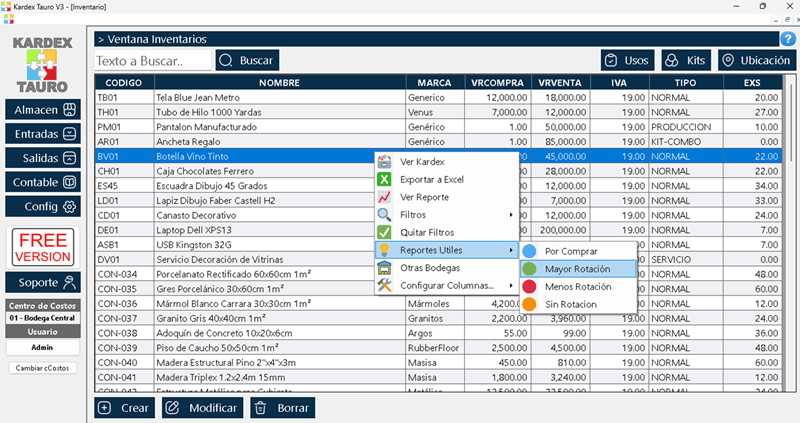
What applies at any size is the underlying idea: measure the supplier the way you measure a customer. Compliance, responsiveness and total cost. A supplier that delivers on time, answers fast and costs what it should is worth more than a discount that does not repeat. That is where an inventory and purchasing system stops being an invoice archive: Kardex Tauro lets you record the purchase order, compare actual cost with the quoted one and see each supplier's history in the same place where inventory moves.