Expense control: how to cut costs without slowing the operation
Expense control: how to cut costs without slowing the operation
When profit falls short, the usual reaction is to cut what is visible: staff, maintenance, marketing. That is almost never where the leak is. The money that escapes a small business sits scattered in small repeated purchases nobody adds up, in licences that renew themselves and in overtime paid with no written approval. Cutting for the sake of cutting breaks the operation and leaves the underlying problem untouched. What follows is how to separate the spending that sustains from the spending that leaks, how to measure it over a year rather than a month, and how to lower costs without lowering service.
Spending is not the problem: spending that sustains versus spending that leaks
Some expenses produce revenue or prevent a risk, and some exist only because nobody has reviewed them. Preventive maintenance on the machine that ships most of the orders is not a cost: it is the insurance policy against a three-day stoppage. The subscription nobody has opened in two years sustains nothing.
The test is done out loud, with the area owner in the room. First question: if we remove it today, what stops selling or what risk appears? Second: who uses it, and how often? Third: does it have an owner with a name? An expense that fails all three does not need a defence; it needs an explanation.
Before cutting, measure: spend by category against sales and against operating profit for the same period last year. A category growing faster than sales deserves an explanation, not necessarily a pair of scissors. It may be a supplier increase, higher volume — which is healthy — or a leak.
How to classify expenses so you can decide
The chart of accounts is for filing, not for deciding. It groups by nature — services, professional fees, rent — and that is fine for reporting, but it does not say what can move. Managing requires a second classification, by behaviour: the spending that sustains, the spending that grows with sales, and the spending that can be avoided.
| Type of expense | Typical examples | How it behaves | Question asked of it | Real room to act |
|---|---|---|---|---|
| Sustains the operation | Warehouse payroll, preventive maintenance, insurance, accountant, power | Fixed in the short term; does not fall when sales fall | What stops, or what risk appears, if I remove it? | Low. It is optimised, not eliminated |
| Grows with sales | Packaging, freight, direct material, sales commission | Variable; rises and falls with volume | Is it growing faster than sales? | Medium. Negotiate price and cut waste |
| Can be avoided | Unused licences, stationery, deliveries, coffee, taxis | Discretionary, repetitive, no clear owner | Who uses it, and since when? | High. Control it or cancel it |
| Duplicated or invisible | Two tools for the same job, same input at two prices, petty cash with no receipts | Scattered; it appears in no consolidated report | How many times do we pay for the same thing? | High. Consolidate into one record |
Without a cost centre and an owner, the expense report is an orphan list: nobody answers for the variance and the monthly meeting becomes a reading of balances. Assigning responsibility is not bureaucracy; it is the only way someone looks at the category before the invoice arrives.
Small-ticket spending: invisible in the meeting, visible in the margin
Small-ticket spending has three traits that make it invisible: every purchase is small, it repeats every month, and it passes no approval because it sits below any threshold. Coffee, stationery, deliveries, taxis, minor hardware: no single invoice justifies a board meeting, and all of them together explain the margin that disappeared.
The way to see it is to annualise: 45,000 pesos a day looks like a detail until it is multiplied by working days. The figures in this exercise are round and are meant to be replicated with your own numbers.
| Item | Unit value | Frequency | Monthly average | Annual total |
|---|---|---|---|---|
| Coffee and tea | 45,000 per day | 250 working days | 937,500 | 11,250,000 |
| Stationery and consumables | 380,000 per month | 12 months | 380,000 | 4,560,000 |
| Deliveries and small courier jobs | 260,000 per month | 12 months | 260,000 | 3,120,000 |
| Total small-ticket spending | — | — | 1,577,500 | 18,930,000 |
On sales of 600,000,000 a year, that 18,930,000 is 3.2%. It sounds minor until it is set against operating profit of 30,000,000: the small-ticket spending equals 63% of profit.
The answer is not to take away the coffee or ban deliveries: that hits the team and fixes nothing. The answer is to buy with judgement: a contracted dispenser on a monthly allowance, one owner per category, a visible cap and a single person authorising the order. With that discipline, a 35% reduction is achievable. That 35% is an assumption for this exercise, not an industry standard.
Purchasing: supplier concentration, negotiation and contract
Money is lost in purchasing in three ways: through concentration, through a lack of negotiation and through the absence of a contract. Concentration is comfortable and dangerous. When a single supplier accounts for most of a critical category, the other side sets the prices and one delivery failure stops the operation. The answer is not to change supplier every month; it is to have a second one, qualified and tested.
Negotiation is prepared or it does not happen. Arriving with annual volume, the current price and two comparable quotes changes the conversation. Freight, payment terms, warranty, returns and lead time all belong on the table, not just the unit price. A 3% discount that forces cash payment can cost more if the company needs that cash.
And the contract. Without a signed document, the price is a suggestion and the deadline an intention: term, indexation formula, delivery times, minimum quality, what happens if it fails and how it ends. That last point is almost never written, and it is the one you need most the day the relationship breaks.
Staff costs and overtime: the cost that grows without an invoice
Overtime does not arrive as an invoice. It arrives as payroll at the end of the month, when there is nothing left to decide. It is approved verbally in the corridor and it piles up with nobody looking at it by area. The real cost is not the base hour: it is the hour with its premium — night, Sunday, public holiday — plus the social security and payroll contributions calculated on it, with rates that change by law: check the current year's value.
Control starts with prior written approval, a monthly cap per area, and a weekly cut instead of a month-end close. One question orders everything: is this overtime a real peak or a scheduling problem? If the peak repeats every month, it is not a peak: it is a capacity gap, and shifts or process fix it.
There is a cost that appears in no category and is paid anyway: turnover. Recruiting, inducting and waiting out a replacement's learning curve costs money and costs sales. Before cutting staff, measure sales per person and units shipped per hour, and compare them with six months ago.
Services, subscriptions and licences: the annual review almost nobody does
Subscriptions have a dangerous virtue: they work on their own. They are bought with a card, renewed by automatic charge, and nobody looks at them again. Many small businesses pay for software, cloud storage, hosting, domains, monitoring, messaging, insurance, telephony, internet, cleaning and security in parallel, each with its own date and a vague owner.
The annual review is one table: service, supplier, annual cost, licences paid, active users, last provable use, owner and exit clause. The two columns that matter are paid versus active. The difference is money renewed every month without producing anything.
In the example there are 14 software licences and 4 have been unused for six months: 760,000 a month, 9,120,000 a year. Before cancelling, check whether a lower tier fits, because many tools charge by level. And every renewal goes in the calendar 60 days ahead, because negotiating after the contract has renewed is useless.
Expense policy: who approves, with what support and up to what amount
An expense policy is not a 40-page manual. It is one sheet that answers four things: who approves, up to what amount, with what supporting document and with what cost centre. If the company cannot answer that in one sentence, it does not have a policy: it has a habit. Thresholds are better expressed in UVT, the tax unit updated every year; check the current value.
The supporting document is defined too. For a deductible expense, the electronic invoice valid before the DIAN is the document, not the payment receipt. For travel advances and petty cash, it is the receipt with date, purpose and signature. Petty cash needs a fixed amount, one responsible person, replenishment only against receipts and a monthly count: without the count, control of everything else is lost.
- Every expense carries a cost centre or area; without it, it is not recorded.
- Every expense has an owner who explains the variance at the monthly meeting.
- Nobody approves their own expense without a second signature.
- Travel advances are settled within a defined period; no new advance until the previous one is settled.
- New subscriptions require an owner, a review date and a written justification.
How to measure savings without destroying service
Savings are not what you stopped spending. Savings are what you stopped spending without losing sales or quality. The difference sounds semantic and is not: cutting maintenance and losing a machine for three days produces a negative accounting saving that shows up two months later, when nobody links it to the decision.
Measurement runs against an explicit base: the same period last year, or the average of the last three months adjusted for volume. Comparing this month with last month says nothing if sales moved. Work with ratios: spend per peso sold, spend per unit shipped, administrative spend over sales.
On the other side of the scale go on-time delivery, rejected orders, returns and complaints. If savings rise and complaints rise with them, there were no savings: the cost moved to the customer. One honesty test remains: measure at 90 days. A cut that does not survive the quarter is deferred spending with a bigger invoice at the end.
Worked example: 15,745,500 in savings and 52% more profit
The company in this exercise sells 600,000,000 a year and leaves operating profit of 30,000,000: 5% of sales, a thin margin typical of distribution and retail. There is no expansion plan and no new investment. Two fronts are attacked, the small-ticket spending and the unused licences. No staff is touched, service is not lowered, no critical supplier is changed.
| Front | Annual base spend | Action | Annual saving | Cash freed per month |
|---|---|---|---|---|
| Small-ticket spending | 18,930,000 | Control 35% with an allowance, an owner and a cap; without removing the benefit | 6,625,500 | 552,125 |
| Unused licences | 9,120,000 | Cancel or reassign 4 of 14 licences | 9,120,000 | 760,000 |
| Total | 28,050,000 | — | 15,745,500 | 1,312,125 |
The arithmetic reads like this: 18,930,000 times 0.35 gives 6,625,500. The four licences at 190,000 are 760,000 a month, which times 12 is 9,120,000. The sum is 15,745,500. Operating profit moves from 30,000,000 to 45,745,500, 52.5% more, without selling a single extra unit or opening one new customer.
The commercial comparison is what convinces a sales team. At a 25% margin, producing the same effect would require selling 62,982,000 more a year: 15,745,500 divided by 0.25. There is no need to go out and find 63 million in new revenue; there is a need to stop paying for what nobody uses.
Two clarifications so nobody oversells it. The 45,745,500 is before tax: at a 35% rate, the net effect is 15,745,500 times 0.65, or 10,234,575. Cash, on the other hand, rises by the full amount from the first month.
Common mistakes
Expense control mistakes repeat with almost mechanical precision. They are not failures of analysis: they are failures of order. These are the six that show up in almost every review, with the symptom seen in the meeting and the consequence that appears months later.
| Mistake | How it looks | What it costs | Correction |
|---|---|---|---|
| Cutting first what is visible | Hiring freezes and maintenance is postponed while subscriptions carry on unchanged | Capacity is lost and the leak continues untouched | Measure by category against sales before deciding |
| Measuring savings by the month | One good month is celebrated as a structural result | Spending returns within the quarter and nobody understands why | Compare the year to date against the prior base |
| Negotiating with one supplier out of fatigue | The contract renews without comparison because it never failed | You overpay every month and lose bargaining power | Three documented quotes and a second qualified supplier |
| Paying for subscriptions nobody uses | Automatic charges that appear in no meeting | In the example, 9,120,000 a year on four licences | Annual inventory of paid licences against active users |
| Approving expenses with no receipt or cost centre | Petty cash with no count and invoices arriving after the close | Non-deductible expense and lost traceability | A one-sheet policy with amounts, documents and owners |
| Lowering quality to save | Fewer dispatch staff, cheaper packaging, more delays | Customers lost for more than the amount saved | Measure service and spend on the same dashboard |
The last one is the most expensive, because the saving shows in the income statement the same month and the loss of customers shows three months later, when it can no longer be traced to the decision. Any cut that touches the customer experience should go through a 90-day test with service indicators in hand.
The three-indicator dashboard and the 30-minute meeting
Control does not need an expensive system; it needs one file everyone looks at. Four blocks are enough: spend by category against budget and against last year; the ten largest suppliers with their price change; contracts and licences expiring within 90 days; overtime by area. It is updated on the same day every month.
The meeting lasts 30 minutes and has one rule: every variance is explained by the category owner, not the accountant. The accountant says how much; the owner says why. If nobody can explain a variance, that category goes to review with a task and an owner. It is not a tribunal: it is where you decide what to adjust and what to keep.
The start-up takes three months: inventory and owners first, then the baseline of the last twelve months by category and area, then the first decisions.
An honest close: control is a monthly habit, not a campaign
This does not replace the accountant. They classify, clean up and file; you decide which expense sustains and which one is cut. And there are cases where the approach does not apply: if the company is in a cash crisis, savings arrive too late. There you renegotiate supplier terms, speed up collection and protect the cash flow first.
What it takes is modest: someone with two hours a month assigned, one file, a one-sheet policy and the patience to compare against a real base. It requires consistency, which is what rarely holds: the January campaign cuts the coffee and the licences, and by March everything is back because nobody kept looking.
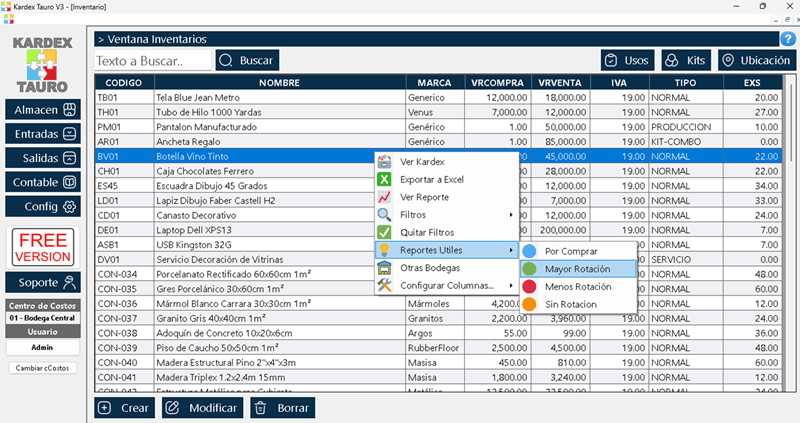
The rule that sums up the article is simple: spending that produces no revenue and prevents no risk is controlled every month, not once a year. If the volume of purchases and expenses no longer fits in a spreadsheet, a system such as Kardex Tauro lets you record each expense with its cost centre and see the year's accumulated total without building the report by hand. With or without a tool, the result depends on the same 30-minute meeting, on the same day, every month.