Importing into Colombia: the process step by step
Importing into Colombia: the process step by step
Importing into Colombia is decided at three moments: before you buy, when the goods reach the port, and when the declaration is filed with customs. The supplier's price only covers the first one. Whoever fails to plan the other two discovers the real cost weeks later, with the cargo sitting in the yard and a tax assessment that was never in the budget.
Here is the full process, from tariff subheading to unit cost in the warehouse, with a worked example you can replicate.
What importing formally means and when you are formal
Importing formally means bringing goods into the national customs territory with three conditions at once: a declaration filed and accepted, customs duties paid, and the release authorising you to take the goods. Buying abroad and receiving the box is not the same as having imported.
The line between formal and simplified depends on the value of the operation and the route of entry. Below certain thresholds goods may enter through postal traffic or express shipments with a reduced procedure; above them, or when the cargo is commercial, the formal regime applies. Those thresholds change and are expressed in dollars or in UVT, the Colombian tax value unit: check the current year's figure.
The simplified route is not illegal, but it does not let you offset the VAT paid, gives no solid cost support in an audit, and does not work for sustained distribution. If you are going to sell that product repeatedly, formality stops being paperwork and becomes the structure of the business.
The tariff subheading decides almost everything that follows
The subheading is the ten-digit code that classifies the goods: the first digits are international, the next are Andean, the last are national. It is not a customs formality: it is the key that opens or closes the rest of the process.
The duty rate, the VAT rate, whether the product needs a sanitary registration, permit or approval from another agency, whether a quota applies and whether a trade agreement gives preference all depend on it. One digit can move the cost by hundreds of thousands of pesos per container, or leave the cargo held for a permit nobody requested.
The importer answers for the classification. The customs broker advises and signs, but in a review the company that imported must defend the code; if customs finds it wrong it can reclassify, assess the difference and impose a penalty. "The supplier told me" is no defence: the foreign supplier classifies under its own country's nomenclature.
Before you buy, request the candidate code, check the description in the current nomenclature and confirm whether approvals are needed. Each reference is classified separately.
The prior requirements: RUT, electronic signature and responsibilities
None of the prior requirements is settled in a day. The RUT, the Colombian tax registry, must be up to date, with the right economic activity and the importer condition recorded among the responsibilities; if it is not, the system will not let the declaration advance.
Then come the electronic signature for acting in the customs computer services and registration with the foreign-exchange intermediary that will handle the payment abroad. Without a valid signature there is no declaration, even if everything else is ready.
In the regimes that require it, a guarantee is added: a bond or deposit backing the suspended duties. And there is a requirement that never appears on the lists: knowing who inside the company answers. The penalty is assessed against the tax ID, not against a department.
Who can import: in their own name or through a mandate
Any individual or company can import if identified, registered and acting on their own behalf or through an attorney. There is no special licence to be an importer; there are requirements and a responsibility to take on.
In their own name, the company appears as importer on the declaration, pays the duties, receives the goods and books them into inventory. Under a mandate, a third party imports for another: the mandatary appears on the declaration and then transfers the goods and the invoicing to the principal.
A mandate is not a technicality. If your company buys abroad but the declaration is issued in a third party's name, before customs the goods belong to that third party, and the VAT paid is not offsettable for you without the documentary chain.
The other decision is operational: declare through a customs broker or get licensed to do it yourself. The broker knows the nomenclature and how the authority behaves at your port; on a first import that is almost always cheaper than learning the hard way.
Documents that travel with the goods and those produced here
Documentation splits in two: what the operation produces abroad and travels with the cargo, and what is produced here to clear it. The mistake is treating the second as an afterthought: it is built from the first, and if the invoice and the transport document do not match, the declaration does not add up.
On the company side: RUT, certificate of incorporation and legal representation, electronic signature, mandate and foreign-exchange registration, prepared once. On the operation side: commercial invoice, packing list, transport document, certificate of origin, sanitary certificates and insurance policy.
Each proves something. The invoice proves value; the transport document proves freight and quantity; the certificate of origin proves the preference. If one is missing, duty is assessed without the benefit or the cargo cannot be inspected. Produced here: the import declaration, the Andean value declaration, the inspection report and the release.
| Document | Issued by | What it proves | When it is needed |
|---|---|---|---|
| Commercial invoice | Foreign supplier | Value, incoterm, description and quantity | Always |
| Packing list | Foreign supplier | Packages, weights and contents per package | Always |
| Transport document | Shipping line, airline or carrier | That the cargo exists and who receives it | Always |
| Certificate of origin | Supplier or authorised body | That the origin rule of the agreement is met | Only when claiming preference |
| Sanitary or phytosanitary certificate | Authority in the country of origin | That the product meets entry requirements | Food, plants and animals |
| Registration, permit or approval | Competent Colombian agency | That the product is authorised | Depending on the subheading |
| Insurance policy | Insurer | Insured value of the journey | Always advisable |
| RUT | Tax authority | Identification and responsibilities | Always |
| Mandate | Importer and mandatary | Who acts for whom | When importing for another party |
| Import declaration | Importer or customs broker | Subheading, value, duties and regime | Always in the formal regime |
| Release | Customs authority | Authorisation to remove the goods | Always |
One detail that causes delays: the names. Invoice, transport document, RUT and declaration must all refer to the same party. An abbreviated company name or a wrong check digit stops the operation at the port, where every day costs money.
The import declaration and the release
The declaration is the document where the importer states what is coming, how it is classified, what it is worth and what is paid. It is filed through the computer services, accepted, assessed and paid. Only then does the road to release begin.
Release is the act authorising removal of the goods from the warehouse. Before it, the cargo is not yours in customs terms and storage runs at your expense: the cost clock starts when the goods are unloaded, not when the ship arrives.
An error is corrected with a penalty; goods that arrived without a declaration are legalised with duties and a penalty; if they are not claimed within the legal term they can be declared abandoned. After release two tasks remain: recording the final cost and filing the dossier.
Customs duties: what is paid and on what base
A formal import pays three things, each on its own base. Duty is assessed on the customs value. The customs service fee is assessed on the FOB value, with a minimum expressed in UVT. VAT is assessed on the customs value plus duty and the other customs taxes. Confusing the bases explains much of what turns up in a review.
In Colombian practice the customs value is the CIF value: goods plus freight plus insurance to the port of entry. It is not the invoice price. Under FOB you add freight and insurance; under EXW you also add inland transport at origin. Customs may challenge the value if it looks low against references for the same product.
Duty depends on the subheading and can be zero with a trade agreement and a valid certificate of origin; without that certificate the general rate applies. There are also specific duties, assessed per unit of weight or measure rather than as a percentage. Rates are read in the current nomenclature: they are not memorised.
Import VAT is not sales VAT: it is paid on the declaration and, if the goods go to taxable operations, offset in the period's return. Duties paid, except that offsettable VAT, become part of cost. A classification difference changes not only duty but cost, margin and income tax.
Regimes: ordinary, temporary, franchise and re-importation
Not every import is cleared for home use. The rules provide regimes that suspend duties, reduce them or tie them to later use. Choosing the wrong one costs more than choosing the wrong supplier, because the consequences surface months later.
The ordinary regime clears the goods and leaves them freely available. The temporary regime suspends duties against a guarantee: short term for event equipment, samples or goods under repair; long term for processing, assembly or construction machinery to be re-exported. Both have a deadline to close.
Franchise covers goods entering duty-free by operation of law, such as household effects, donations and cooperation shipments, with a procedure, recognition and conditions of use. Re-importation in the same state lets Colombian goods return untransformed, recognising what was already paid.
| Regime | What happens to duties | When it fits | Obligation it leaves |
|---|---|---|---|
| Ordinary | Paid in full | Goods for sale or definitive use | Record the cost and file the dossier |
| Temporary, short term | Suspended against a guarantee | Trade fairs, events, samples, repairs | Re-export within the term and close |
| Temporary, long term | Suspended against a guarantee | Processing, assembly, construction machinery | Complete the plan and close the regime |
| With franchise | Not paid, by operation of law | Household effects, donations, cooperation | Do not dispose of the goods without authorisation |
| Re-importation in the same state | Not paid a second time | Repairs, warranty, returnable packaging | Prove it is the same goods |
| Customs transit | Not triggered | Passing through the country or between warehouses | Reach the destination within the term |
Customs inspection: when it happens and what triggers it
Inspection is neither a punishment nor a pure lottery: it is a risk filter. The authority cross-checks the declaration against the importer's history, the subheading, origin, value and supplier. When something does not add up, the system selects the cargo.
It can be documentary, non-intrusive with a scanner, or physical. The usual triggers are a first import, a subheading with a history of under-invoicing, a value far below references, weights that do not match, and sensitive goods such as textiles, footwear, liquor or electronics.
You cannot avoid it, but you can reduce the chance that it comes with a finding: precise description, exact weights, coherent papers and a defensible classification. If fewer units than declared are found, a report is drawn up and the goods may be seized.
From FOB to warehouse cost: the full example
Incoterms define how far the supplier pays. Under FOB it delivers at origin and the importer pays freight and insurance; under CIF it covers both to destination; under EXW the importer pays everything. The real cost changes even when the price of the goods does not.
One thousand units on a FOB invoice of USD 20,000, freight of USD 2,000 and insurance of USD 300. The customs value is the sum: USD 22,300, and duty is assessed on that base. For this exercise a 10% rate is assumed, giving USD 2,230. The VAT base is 22,300 + 2,230 = USD 24,530; with an assumed 19% VAT that is USD 4,660.70. Total duties in the exercise: USD 6,890.70.
The percentages are exercise assumptions, not current rates. The real rate depends on the subheading, the applicable agreement and the year's value; confirm it before quoting.
At an example exchange rate of 4,000 pesos per dollar: goods 80,000,000; freight 8,000,000; insurance 1,200,000; duties 27,562,800. Cost before local expenses: 116,762,800. Add 4,500,000 for broker, transport and warehousing and the landed cost is 121,262,800; across a thousand units, 121,263 each.
| Item | Calculation | USD | COP |
|---|---|---|---|
| Goods, FOB | Supplier invoice | 20,000.00 | 80,000,000 |
| International freight | Transport document | 2,000.00 | 8,000,000 |
| Insurance | Policy | 300.00 | 1,200,000 |
| Customs value (CIF) | 20,000 + 2,000 + 300 | 22,300.00 | 89,200,000 |
| Duty assumed 10% | 22,300 x 10% | 2,230.00 | 8,920,000 |
| VAT base | 22,300 + 2,230 | 24,530.00 | 98,120,000 |
| VAT assumed 19% | 24,530 x 19% | 4,660.70 | 18,642,800 |
| Total duties | 2,230 + 4,660.70 | 6,890.70 | 27,562,800 |
| Cost before local expenses | 89,200,000 + 27,562,800 | 29,190.70 | 116,762,800 |
| Local expenses | Broker, transport and warehousing | - | 4,500,000 |
| Landed cost in warehouse | Sum of the above | - | 121,262,800 |
| Unit cost | 121,262,800 / 1,000 | - | 121,263 |
The invoice price per unit was 80,000. The real cost is 41,263 pesos higher, close to 52% above. If the margin was calculated on 80,000, the operation may be selling at a loss without anyone noticing until month end.
Common mistakes and how they show up
Import mistakes are not visible when they are made: they show up in the assessment, in the delay, or in a review two years later. These are the expensive ones.
The costliest is declaring a lower value to pay less duty. That is not optimisation: it is under-invoicing, penalised with seizure, a fine and, in serious cases, criminal consequences. Customs holds value references by subheading.
The most common is quoting on the FOB price and calling it cost. Next is not checking whether the product needs a registration or approval: it surfaces at the port, with the cargo held, when the procedure no longer fits the schedule.
| Mistake | Symptom | Consequence | Correction |
|---|---|---|---|
| Quoting on the FOB price | The margin disappears at month end | Selling below cost | Cost with customs value, duties and local expenses |
| Declaring a lower value | Value far below the references | Seizure, fine and loss of the cargo | Declare the real value and support it |
| Not checking prior permits | Cargo held at the port | Delay, storage and possible re-export | Check the subheading before buying |
| Classifying with the supplier's code | The code does not match the description | Duty difference and penalty | Classify here and validate with the broker |
| Not separating import VAT | VAT ends up inside the cost | The offset is lost and the margin is distorted | Record VAT as offsettable |
| Setting the price before release | Quoting without the final cost | Selling at a loss or renegotiating late | Close the cost with the accepted declaration |
One left that is not a calculation error but a filing error: not keeping the dossier. When the review arrives, the difference between a penalty and an explanation is usually a document that existed and was not saved.
An honest close before you decide
The cost of an import is not known when the order is placed: it is known at release, with the declaration accepted and local expenses invoiced. What comes before is an estimate and should be treated as one in the budget.
This does not replace the customs broker or the accountant. If your product is food, medicine, cosmetics, medical equipment, used machinery or textiles, prior requirements can decide whether the business works before price does. On a first import, do it with support.
The highest-yield check is also the cheapest: confirm the subheading before buying, using the real description of the product rather than the supplier's catalogue. Duty, VAT, permits and the chance of inspection all follow from it.
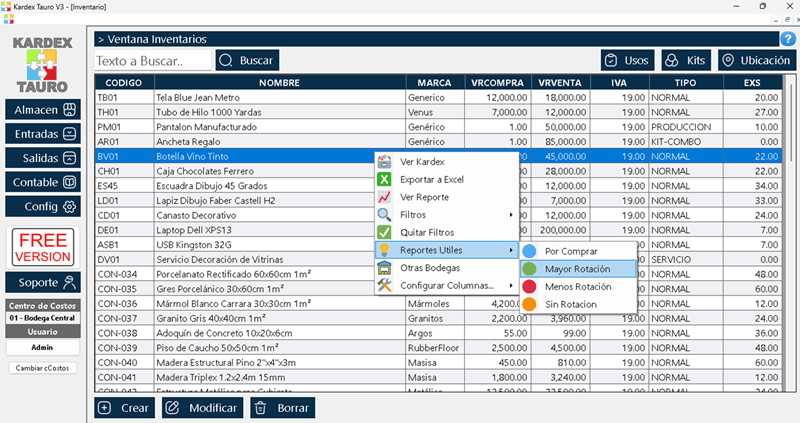
One task remains that almost nobody does: closing the loop in inventory. When the landed cost enters the stock ledger with its duties and expenses, the margin the system shows is the real one. Tools such as Kardex Tauro let you record that cost and follow the product from declaration to sale.