Incoterms 2020: what each rule requires and how to choose
Incoterms 2020: what each rule requires and how to choose
The Incoterm in a contract is not a formality: it decides who pays the freight, who insures the cargo and at what point the goods stop being the seller's problem. This article covers what each of the eleven current rules requires, why risk under the C terms passes long before the invoice reaches its destination, how to choose by mode of transport, and which mistakes keep repeating in Colombian operations.
What the Incoterms are and what they do not regulate
They are International Chamber of Commerce rules for interpreting eleven three-letter expressions in the sale of goods; the current version is the 2020 edition. They are not law and do not apply on their own: they enter the contract when the parties cite them. A contract that says "CIF Buenaventura" with no year leaves open which version governs, and with it who insures and under what cover.
What they cover matters as much as what they leave out. An Incoterm does not set the price, does not say how payment is made, does not transfer ownership, does not choose the applicable law or the arbitrator, does not answer for quality, does not cover breach or force majeure, and does not resolve trade sanctions.
Nor does it decide the duty. That depends on the tariff subheading and the origin of the goods. Moving from FOB to CIF does not shift a single peso of tax: it only changes who contracts the transport and when risk passes.
The three questions each rule answers: cost, risk and paperwork
Every rule answers three things, and they are best kept apart, because disputes are born from mixing them. Who pays each leg, from loading at the warehouse to final delivery. At what exact point risk passes to the buyer. And who handles export, import and transit formalities.
All eleven rules share one structure: ten seller obligations, A1 to A10, and ten buyer obligations, B1 to B10, covering delivery, risk, carriage, insurance, documents, clearance, packing and costs.
The four groups: E, F, C and D
They are ordered by how much the seller takes on. Group E has one rule, EXW, where the seller barely does anything. Group F: the seller delivers to a carrier named by the buyer and does not pay the main freight; FCA, FAS and FOB. Group C: the seller contracts and pays carriage to destination but does not carry the risk of the journey; CFR, CIF, CPT and CIP. Group D: the seller reaches the destination; DAP, DPU and DDP.
Four rules work only for sea or inland waterway carriage, because delivery is tied to the vessel: FAS, FOB, CFR and CIF. The other seven work for any mode.
| Rule | Mode | Point of delivery and risk | Pays freight | Compulsory insurance |
|---|---|---|---|---|
| EXW | Any | Seller's premises, not loaded | Buyer | No |
| FCA | Any | To the buyer's carrier | Buyer | No |
| FAS | Sea | Alongside the vessel, at origin | Buyer | No |
| FOB | Sea | On board, at origin | Buyer | No |
| CFR | Sea | On board, at origin | Seller, to destination | No |
| CIF | Sea | On board, at origin | Seller, to destination | Yes, minimum cover |
| CPT | Any | To the first carrier | Seller, to destination | No |
| CIP | Any | To the first carrier | Seller, to destination | Yes, broad cover |
| DAP | Any | Destination, not unloaded | Seller | No |
| DPU | Any | Destination, unloaded | Seller | No |
| DDP | Any | Destination, import cleared | Seller | No |
EXW and FCA: delivering at the factory or to the carrier
EXW is the smallest possible obligation: the goods are placed at the seller's disposal, not loaded, with export clearance outside the seller's duties. It sounds convenient and it is the rule that causes the most trouble, because it leaves export formalities in the hands of a company that is not in the country of origin.
In Colombia that clashes with how the operation actually works: the exporter that files with DIAN is a resident company with its own tax registration (RUT), and a foreign buyer cannot handle that filing with the same ease. The local seller ends up solving it anyway, but without a contractual duty, and if the cargo sits at the port because of an incomplete document, the Incoterm says the cost is the buyer's while the commercial relationship says otherwise.
FCA closes that gap: the seller delivers to the carrier named by the buyer, already cleared for export. If the agreed point is its own premises, delivery happens when the goods are loaded onto the vehicle; if it is another place, when they arrive there ready for unloading. The 2020 version added something useful for letters of credit: where the contract requires an on-board bill of lading, the parties may agree that the buyer instructs the carrier to issue it to the seller after loading.
FAS and FOB: the ship's rail and its consequences
FAS delivers alongside the vessel. Risk passes before the cargo goes up, which is why it is used for bulk or where the buyer handles loading. In a modern terminal that line is blurred: if the operator charges for internal movements, the argument starts quickly.
FOB delivers on board. From that moment risk is the buyer's; the seller covers loading, export and costs up to placing the goods on the vessel, and the buyer names the vessel, pays freight and insures if it wants to. Because the buyer nominates the vessel, the seller is exposed to a ship that does not arrive: storage then runs on ground the contract must define, since the seller does not control that transport.
FOB has two limits that get ignored. It exists only for sea or inland waterway carriage: there is no ship's board in air freight, so air and land use FCA. And with containerised cargo the seller leaves the goods at the terminal days before loading and loses control without having transferred risk; FCA or CPT work better there.
CFR, CIF, CPT and CIP: paying freight is not carrying the risk
Here is the confusion that costs the most. Under group C the seller contracts and pays main carriage, and in two rules also insurance, but risk does not travel with it: risk passes at origin, at the same point as its group F equivalent. The seller buys a service; it does not take on the journey.
CFR and CIF are maritime and risk passes on board. CPT and CIP work for any mode and risk passes when the goods are handed to the first carrier, which may be a truck picking up at the warehouse, hundreds of kilometres from the port: under CIP the buyer may hold the risk before the cargo reaches the quay.
| Rule | Risk passes | Seller's cost reaches | If the cargo is damaged in transit |
|---|---|---|---|
| CFR | On board, at origin | Port of destination | The buyer pays the invoice and claims against the carrier or its own policy |
| CIF | On board, at origin | Port of destination, with minimum cover | The buyer pays the invoice and claims on the seller's policy |
| CPT | To the first carrier | Agreed place of destination | The buyer bears the loss and claims under the carriage contract |
| CIP | To the first carrier | Place of destination, with broad cover | The buyer claims on a policy that covers more than CIF's since 2020 |
The consequence is counterintuitive: under CIF, cargo that sinks in open sea is the buyer's problem, since it pays the invoice and has only the insurance as consolation; the seller performed if it shipped what was agreed and handed over the documents. If the buyer believed CIF meant "the seller is liable until it arrives", the rule will not help.
And the place must be precise: "CIF Buenaventura" names the port of destination for freight, not the point of delivery, and in "CPT Bogotá" it is worth writing the exact address, because who pays for unloading changes with the site.
DAP, DPU and DDP: delivering at destination and the customs problem
DAP delivers at the agreed place, on the incoming vehicle and ready for unloading; the buyer unloads and imports. It is clean for selling to someone who knows how to import: the seller controls the whole carriage without stepping into a foreign customs office.
DPU is the only one of the eleven that requires the seller to unload; it replaced the former DAT in 2020. Before using it, check whether the delivery point has a forklift, a ramp or staff, and whether the seller can answer for that manoeuvre. It is attractive to the buyer and risky for a seller with no operation of its own at destination.
DDP is the extreme: delivery at destination with import cleared and duties and taxes paid, and the buyer does not deal with customs. It sounds ideal and it is the term most often promised without being deliverable. Clearing an import in Colombia requires being an importer before DIAN, with a RUT, or acting through a customs broker; a foreign seller with no local presence rarely can, and if it tries, the cargo sits in the primary zone accruing storage.
There is a subtle trap: DDP includes import taxes, VAT among them. Many contracts write "DDP excluding VAT" because the buyer deducts it as input tax. That is legitimate, but it is no longer plain DDP and must be written out in full.
Insurance: what CIF covers and what CIP requires
Only CIF and CIP require the seller to insure. The other nine create no obligation: if the buyer wants protection it buys it, and if the seller wants to cover its interest before delivery, it does the same.
The difference lies in the level of cover, and it is one of the 2020 changes. CIF requires the minimum cover of the cargo clauses, a package that leaves several risks out; CIP requires the broadest. Until 2019 they asked for the same: today CIP gives a better policy, paid for inside the price.
In both cases the insurance must cover at least the invoice value plus the margin the rule sets, in the currency of the contract, from delivery to destination. More cover can be agreed; less cannot while still calling it CIF. Two warnings: the policy is taken out at origin but the party exposed is the buyer, so require endorsement or that the buyer appears as insured; and it does not cover bad packing, inherent vice or delay.
How to choose by mode of transport and experience
The first rule is mechanical: if the cargo does not travel by water, the four maritime rules are out. Neither FAS, nor FOB, nor CFR, nor CIF makes sense by air or road. The second is about control: the term goes to whoever runs each leg best. Whoever has competitive rates and an agent at destination controls the carriage; whoever does not, pays for it. An exporter selling to Mexico for the first time should not promise DDP.
- Containers: FCA or CPT. The seller delivers at the terminal and does not carry a risk it no longer controls.
- Bulk or general cargo: FAS, FOB, CFR or CIF, depending on who contracts freight.
- Air: FCA at origin, CPT or CIP if the seller pays freight, DAP or DDP if it reaches the door.
- International road: FCA, DAP or DDP. Own trucks count too: the 2020 version allows own means of transport.
- First export without a trade team: FCA or CIF with a freight forwarder running the chain, never DDP.
- Buyer that imports daily: EXW or FCA, on a clean rate.
Working capital remains: if the seller pays the freight, it finances that money for the whole transit; if the buyer pays, the seller collects sooner.
The same shipment under three rules: the full arithmetic
An exercise with round figures explains more than any definition. Take 500 kg, goods worth USD 30,000, international freight of USD 3,500, insurance of USD 250 and destination costs — agent, warehouse and local transport — of USD 900: exercise assumptions, not a quotation.
| Item | EXW | CIF | DDP |
|---|---|---|---|
| Seller's invoice | 30,000 | 33,750 (goods, freight and insurance) | 34,650 plus duties and taxes |
| International freight | Buyer: 3,500 | Seller, inside the invoice | Seller, inside the invoice |
| Insurance | Buyer: 250 | Seller, inside the invoice | Seller, inside the invoice |
| Destination costs | Buyer: 900 | Buyer: 900 | Seller, inside the invoice |
| Export clearance | Buyer | Seller | Seller |
| Import clearance and duties | Buyer | Buyer | Seller |
| Buyer's total outlay | 34,650 | 34,650 | 34,650 plus duties and taxes |
| Risk passes | At the seller's yard | On loading at origin | On delivery at destination |
The three totals match, which is disconcerting. The difference is who puts the money down and when: under EXW the buyer makes four separate payments and handles export; under CIF it makes two; under DDP, one. And where the risk sits: under CIF the buyer is exposed from the port of origin; under DDP the seller carries everything to the door.
The matching total only holds in an exercise with no margin. In real life the seller paying freight and insurance folds them into the price with its financing cost and margin, so the same shipment under CIF usually costs a little more than under EXW: the table explains the split, it does not price the deal. And one detail decides claims: if the cargo is damaged at sea, under CIF the buyer pays the invoice and claims on the policy; under DDP the problem is the seller's until the door.
Common mistakes
Almost none of them show up in the negotiation: they appear when there is already a storage invoice or a damaged cargo. Reviewing them before signing costs one conversation.
| Mistake | Symptom | Consequence | Fix |
|---|---|---|---|
| Believing CIF covers until the goods arrive | The buyer claims against the seller for damage at sea | A dispute with no contractual basis and a damaged relationship | State in writing that risk passes on board and claims go to the policy |
| Using FOB for air or road transport | The contract has no "on board" to point to | Nobody knows when risk passed or who pays loading | Switch to FCA, which exists for any mode |
| Offering DDP without being able to clear at destination | The cargo sits in the primary zone | Storage, delays and an uncosted expense | Confirm with a customs broker before quoting, or use DAP |
| Not stating the version in the contract | The contract says only "CIF" or "FOB" | Each side argues the version that suits it, with different insurance | Write the rule, the year and the exact place |
| Confusing delivery with destination | Parties agree "CIF Bogotá" or "FOB airport" | The rule is misapplied and freight covers less than expected | Name the port, terminal or warehouse, with an address |
| Leaving insurance undefined | Nobody knows who took out the policy when a loss occurs | The loss falls on whoever can least bear it | Settle it with CIF or CIP, or agree express cover |
Two further mistakes are operational rather than editorial. Signing the Incoterm without checking that the price supports it: a CIF quoted on a freight rate from three months ago leaves the seller paying the difference. And treating the rule as if it solved credit risk: the buyer bearing risk from origin does not mean it will pay; that is built with a letter of credit, an advance or export credit insurance.
Before signing: what the Incoterm does not solve
The Incoterm orders costs, risks and paperwork, and that is already a lot. It does not replace a well-drafted contract, does not vet the customer and does not secure payment. If your counterparty does not pay, the chosen term changes nothing.
It is not mandatory either: in a domestic operation it is enough to agree delivery, freight and liability in the contract. And if the customer proposes a term your operation cannot sustain, the honest answer is to change it before signing, not to discover it with the cargo at the port. On questions of duties or classification, confirm with your accountant and your customs broker: they see the subheading and the value in force for the year.
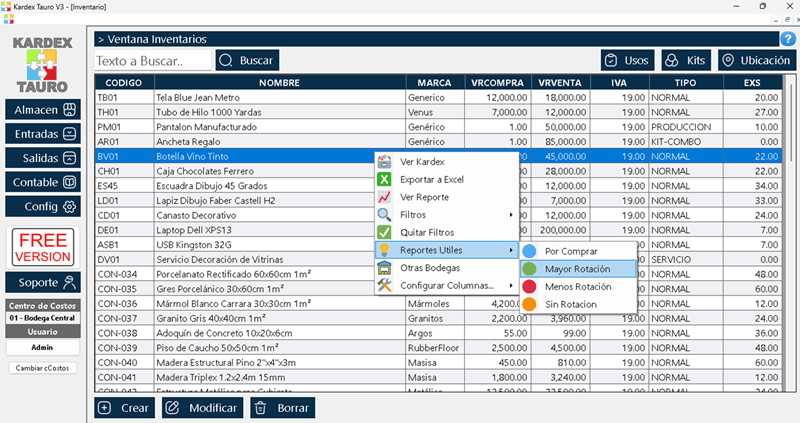
One detail worth closing: the cost of imported goods does not end with the supplier's invoice. Freight, insurance, destination costs and duties go into inventory cost, and if they are recorded badly, the margin calculated later is false. That is where Kardex Tauro helps keep every peso of the transit on the product record instead of in a lost email.