Importing from China: process, risks and quality control
Importing from China: process, risks and quality control
Buying from China rarely fails because of distance. It fails because you pay up front, buy without seeing, and discover the defect once the cargo has crossed the ocean: by then the freight is paid, the supplier has been paid, and the negotiation reopens from a weak position. Quality control happens before shipment or it does not happen.
This guide covers the whole operation, from verifying the supplier to landing the goods in your warehouse, with a numerical example you can replicate in a spreadsheet.
Why the China operation looks little like buying locally
Buying in your own city lets you see the product, pay on delivery and complain in person. Importing breaks all three: the order is defined on a catalog, the money leaves before the batch exists, and the legal backing sits in another jurisdiction and another language.
The cycle is also long. Negotiation, production, ocean transit, customs clearance and delivery add up to months, and during that time the inventory is paid for but unsellable. That financial cost never appears in the supplier's quote, and it decides whether the deal was good or merely cheap.
The third difference is the costliest: the supplier builds what you wrote, not what you imagined. If the spec says "stainless steel" with no grade, you get the grade that suits the factory. The written specification is the only technical contract that exists.
Finding and verifying a supplier: what to look at beyond the catalog
A catalog shows photos and prices; it does not tell you whether there is a factory, a trading company or a desk with a phone behind it. All three can sell to you, but only the factory controls the process, the schedule and the corrections. A trading company adds a middleman between your claim and the person who can solve it.
The first thing to verify is not the product: it is the company. The beneficiary on the transfer must match the business license and the invoice. If they ask you to pay an individual, an account in another city or a third party, you are paying someone who is not your supplier and does not answer for the batch.
Then come the capacity tests: a video call walking the plant, photos of the line with a visible date, two previous customers as references, and the product's tariff code. A real exporter knows its subheading; an improvised one looks it up on the spot.
| Warning sign | Why it matters | How to confirm it |
|---|---|---|
| Price far below the category average | Usually a different reference, a different quality, or bait to change the order later | Ask for a data sheet with material, weight and tolerance; compare the same specification, not the same title |
| Bank account in the name of a person or another company | The payment has no contractual backing and no trail for a claim | Require beneficiary, business license and invoice to match; if they do not, do not wire |
| Catalog photos only, no plant video | May be a reseller with no quality control of its own | Video call walking the line; a plant photo with a visible date |
| Generic PDF certificates with no company name | A certificate issued to someone else does not cover your batch | Request the report issued to the manufacturer, for the exact model |
| Does not know the tariff code or the port of departure | Inexperienced exporter: document errors and delays | Ask for a proforma invoice with Incoterm, port and subheading |
| Insists on full payment up front and refuses inspection | Moves all the risk onto you | Negotiate a deposit and balance against an inspection report |
Samples: when they are worth it and what they must include
The sample is the first time you touch the product and the only time before paying for the batch. It is worth it when the specification can be measured (weight, thickness, tolerance, power, composition) or when packaging is part of the sale. If the order is a trial and the product is generic, you must assume the risk in writing.
Ask for a production sample, not a lab sample. Many suppliers hand-build a perfect piece for the photo and then run a different mold. The sample must come off the line that will make your order, with its packaging, label and manual.
When you approve it, record photos, measurements and date, and ask for a sealed counter-sample kept at the factory. That is the reference the batch is compared against. Without it, the argument about "we always do it this way" has no referee.
| Stage | Decision taken | Document that backs it | Risk it closes |
|---|---|---|---|
| Production sample | Whether the product meets the measured spec | Signed data sheet and photos with measurements | Product different from what was offered |
| Approval and counter-sample | What counts as "conforming" for the batch | Sample sealed at the factory and an approval record | A claim with no reference point |
| Pre-shipment inspection | Whether the batch ships or is corrected | Report with sampling, photos and non-conformities | Paying freight on a defective batch |
| Shipment and documents | Who controls the cargo and under what terms it travels | Bill of lading, invoice and packing list | Losing the cargo or receiving it short |
Negotiation: price, MOQ, packaging and payment terms
Unit price only means something next to three facts: minimum quantity, what the packaging includes, and which Incoterm the quote uses. The same product costs differently if the packaging is a bag or a printed box, if the minimum is one thousand or five thousand units, and if the price is ex-works or free on board.
For a small company, the most useful reference Incoterm is FOB: the supplier delivers the cargo on board and you contract freight and insurance. That way you see the real transport cost, you choose your consolidation, and you do not discover a hidden margin inside freight you never quoted. Terms that put freight in the supplier's hands sound convenient and are usually the most expensive.
Packaging gets the same seriousness as the product: carton, units per box, marking and stacking strength. An order that arrives with crushed boxes is not a transport problem: it is a packaging specification nobody wrote.
Negotiate payment in stages and tie each stage to a verifiable fact: deposit against the order, balance against inspection. If the supplier only accepts the full amount up front with no inspection, it is not negotiating: it is moving all the risk onto you.
Pre-shipment inspection: what is checked and how it is documented
Inspection is the last chance to stop a defective batch before freight makes it expensive. It happens at the factory, with the order finished and packed. Checking during production helps you correct; checking at the end helps you decide whether to ship.
The standard method is acceptance sampling: how many units are checked and how many defects are tolerated, defined in writing on the purchase order. The inspector needs a criterion, not an adjective: "good quality" cannot be measured; "no stains on the visible face" can.
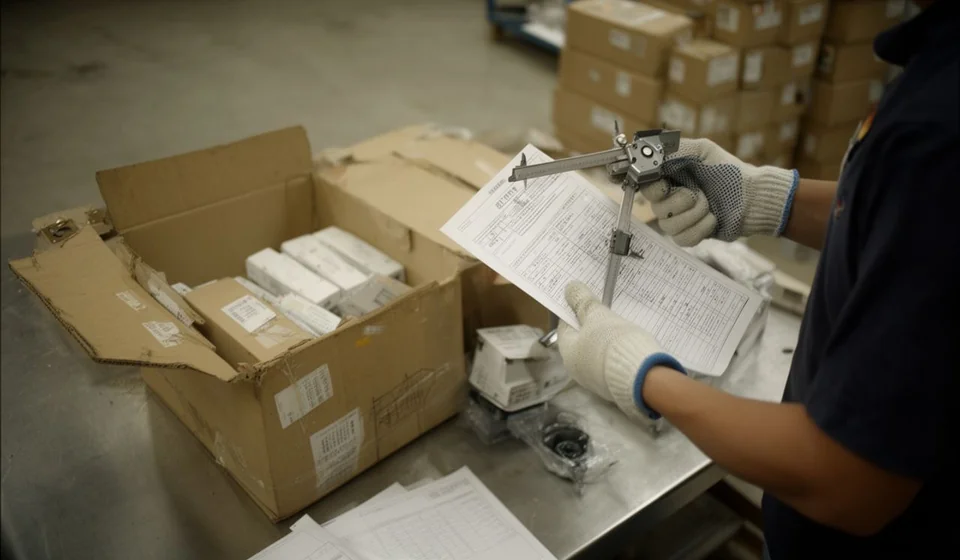
What gets checked: quantity against invoice, measurements and weight against the approved sample, a powered sub-sample in operation, packaging strength, labeling and a readable barcode, a manual in Spanish where required, and complete accessories. All with dated photos numbered by carton.
The report must arrive before the balance is paid: whoever pays first loses the ability to demand. With the report in hand you decide to ship, correct or reject, and that decision is made at the factory, not in your warehouse.
Shipping: consolidator, LCL or FCL and their costs
There are two ways to move cargo. In less-than-container load, your order shares a container with others and is charged by volume or weight, whichever is greater. In full container load, you pay for the whole box, full or not. The first is flexible; the second is efficient only when it is full.
LCL carries costs that never show in the freight quote: receiving at the consolidator's warehouse, handling loose cargo, more transfers and more risk of impact or shortage. It also takes longer, because it waits for other shippers to fill the box.
A 20-foot container has volume and weight limits, and a 40-foot does not double capacity by weight. Compare logistics cost per unit, not total freight: a full container can look expensive and still beat a small LCL per unit.
Worked example: LCL versus FCL on the same order
Exercise assumptions, in dollars, for an order of 1,200 units at USD 8 each: FOB value USD 9,600. Freight and charges are round working figures, not current rates.
LCL: freight USD 1,900, consolidation charges USD 350 and insurance USD 96. Total logistics USD 2,346, equal to 24.4% of FOB and USD 1.96 per unit. Full 20-foot container, with room for about 4,000 units of this product: freight USD 3,200 and insurance USD 96, no consolidation.
The detail that decides it: with only 1,200 units inside the full container, logistics cost rises to USD 2.75 per unit (34.3% of FOB) and LCL wins. If the container is filled with 4,000 units, FOB rises to USD 32,000 and logistics cost drops to USD 0.82 per unit, 10.3% of FOB. A container is not better because it is a container: it is better when it is full.
| Item | LCL, 1,200 units | 20' container, 1,200 units | 20' container full, 4,000 units |
|---|---|---|---|
| Units | 1,200 | 1,200 | 4,000 |
| FOB value | USD 9,600 | USD 9,600 | USD 32,000 |
| Freight | USD 1,900 | USD 3,200 | USD 3,200 |
| Consolidation | USD 350 | USD 0 | USD 0 |
| Insurance | USD 96 | USD 96 | USD 96 |
| Total logistics | USD 2,346 | USD 3,296 | USD 3,296 |
| Logistics as % of FOB | 24.4% | 34.3% | 10.3% |
| Logistics cost per unit | USD 1.96 | USD 2.75 | USD 0.82 |
| Landed cost per unit | USD 9.96 | USD 10.75 | USD 8.82 |
Now inspection. It costs USD 300 plus the inspector's travel. Replacing a defective batch means return freight, new production and about 90 days of delay: for this order it is estimated at USD 6,000, twenty times the inspection. Put another way, the inspection pays for itself if it prevents one defective batch in twenty.
Typical risks: different product, unmet standard, spare parts
The most common risk is a different product: same shape, another material, fewer accessories, another power rating. It usually comes from an ambiguous specification rather than bad faith, which is why it is prevented by writing, not arguing.
The second is an unmet standard. A product that does not meet the destination's requirements cannot be cleared or sold: it becomes inventory sitting in a warehouse generating storage costs. Depending on the category, certificates, registrations or prior approvals from the relevant Colombian authority may be required, and that process starts before production, not when the container arrives. Confirm with your customs broker what applies to your subheading and your product.
The third is spare parts. Equipment that fails at six months with no parts available is a total loss. Negotiate it into the order: critical components, a parts list, a manual in Spanish, a written warranty and parts availability for a defined period. For Colombia, also check voltage and frequency before production.
Payment protection: what you can demand and what you cannot
You can demand staged payment, balance against inspection, and documents issued to the order of the bank or the freight forwarder, so the cargo is not released without the original. On large orders, a letter of credit ties payment to conforming documents.
You cannot demand a total quality guarantee thirteen thousand kilometers away, recover a deposit quickly in another jurisdiction, or sue a trading company that dissolves and reappears under another name. Real protection is built before paying: stages, documents and a third party who inspects.
A letter of credit is not free: it needs a bank, fees, exact documents and deadlines. On a small first order it usually costs more than the risk it covers; on large orders with a new supplier it is the cleanest way to make payment depend on facts rather than promises.
Hidden costs that surface on the first shipment
The first shipment almost always costs more, and not because of freight but because of what surrounds it. These are the charges that show up on the settlement and that nobody quoted at the negotiating table.
- Terminal and port handling charges, separate from ocean freight.
- Bill of lading issuance and amendments for typing errors.
- Storage and demurrage if clearance is delayed or a document is missing.
- Customs broker, plus the financing cost of paying import duties before you sell.
- Inland transport from port to warehouse, which in Colombia can be a large share of the total.
- Relabeling or manual translation to meet local requirements.
- Shrinkage and shortages: what was damaged or never arrived, already paid for.
Before closing the order, ask your customs broker for an estimated clearance calculation with the correct subheading. With that number, landed cost stops being a surprise and becomes a decision.
Documents and procedures you cannot improvise
The tariff subheading is defined before you buy, not after. Duties, prior requirements and even the viability of the product depend on it. Changing the subheading to pay less is a misclassification, with consequences for the importer later on.
The importer must be registered with the customs authority and current on tax filings. The operation travels with a commercial invoice, packing list, bill of lading, certificate of origin where applicable, insurance policy and the permits the product requires. One mistyped document stops the cargo and creates overruns nobody budgeted for.
Check the current duty rates and requirements for your subheading with your accountant or customs broker for the year in progress: rates and caps change, and this article does not replace that consultation.
Common mistakes
| Mistake | Symptom | Consequence | Correction |
|---|---|---|---|
| Paying 100% up front to a new supplier | The supplier insists and offers a discount for full payment | No leverage if the batch goes wrong | Deposit and balance against inspection |
| Buying without an approved sample | Approval happens by photo and chat | Different product and no reference for a claim | Production sample and sealed counter-sample |
| Treating the catalog photo as the specification | The purchase order has no measurements or materials | The supplier builds what it interpreted | Data sheet attached to the order |
| Not checking labeling or destination certificates | Discovered at customs clearance | Cargo held, storage costs, product unsellable | Check requirements before production |
| Costing without consolidation or destination charges | Margin disappears on the settlement | Selling below real cost | Full calculation before setting a price |
| Not asking for spare parts or a warranty plan | The equipment fails and there are no parts | Useless product and a lost customer | Parts and warranty in the purchase order |
None of these is exotic: they are the six that repeat on almost every small company's first import, and all of them are avoided with documents, not with trust.
An honest closing before you decide
Importing is not for everyone. If your volume is low, if the standard demands costly certifications, or if you have no capital to carry months of paid inventory, the local supplier may end up cheaper even at twice the unit price. And it is not a one-shot game: the first shipment teaches, the second one is the one that works.
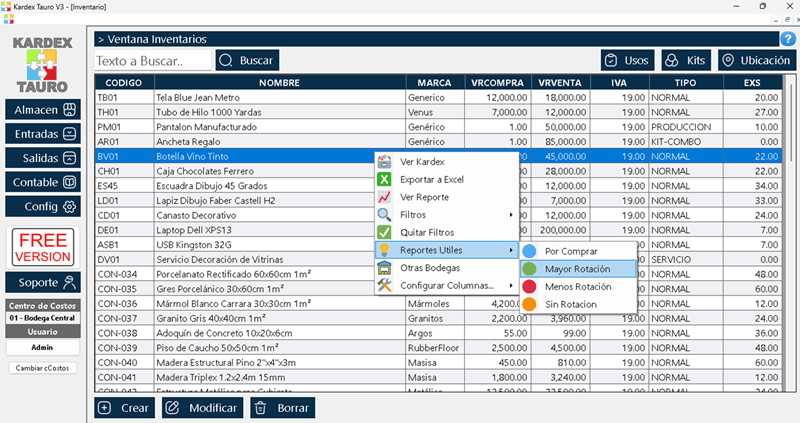
Nor does it replace your accountant or customs broker. Classification, duties and requirements depend on current rules and on the specific case; this text explains the mechanism, not the rate of the day. What you can do without waiting for anyone is put the control in order: a purchase order with a specification, a counter-sample, an inspection report and a landed cost calculated before wiring the deposit. In Kardex Tauro that cost and the inventory entry are recorded together, so the margin on the order is visible before you sell it and not after the period closes.