International payments: wires, letters of credit and currency risk

International payments: wires, letters of credit and currency risk
In an import deal, the price is negotiated cent by cent and the payment method is accepted as it comes. That is backwards. The same USD 50,000 invoice can be settled with a direct wire, a documentary collection or a letter of credit, and each route changes three things at once: who carries the risk that the other party fails, what the operation costs and how many days pass before the goods leave.
What follows is meant for deciding with numbers: how risk is split in each instrument, which fees appear once there is no way back, how dollar exposure is measured and which documents a bank rejects. Every fee and percentage here is a working assumption, not a market rate. Real rates are requested in writing before signing.
Who carries the risk: buyer, seller or bank
Every transaction carries two different risks. One is the goods: damaged, lost or simply not what was agreed. The other is payment: the buyer does not pay, or the seller collects and never ships. Incoterms allocate the first with precision and say nothing about the second. A well-negotiated FOB term does not protect anyone from a supplier who takes the advance and disappears.
Payment risk is allocated by the instrument. At one end sits the advance payment: the buyer pays before the goods exist and carries everything. At the other end, open account credit: the seller ships and waits. Documentary collections and letters of credit sit in between, moving part of the risk to a bank. And whoever takes on risk charges for taking it.
Direct wire or transfer: cheap and unsecured
The direct wire — international transfer or open account payment — is the most used and cheapest instrument. The seller ships, sends the documents on its own and the buyer transfers against the invoice, at sight or at a term. No bank guarantees anything: a bank simply moves the money. If the supplier performs, the deal runs smoothly.
Its visible cost is a transfer fee plus correspondent bank charges, usually deducted from the amount. The invisible cost is the exchange spread: the gap between the rate you are sold and the market rate. On small amounts the spread weighs more than the fee, so ask for both separately. It suits suppliers with a track record, samples and spare parts; it does not suit the first order from a new supplier far away.
Documentary collection: the bank as courier
The seller's bank receives the shipping documents and sends them to the buyer's bank with one instruction: release them only against payment, or only against acceptance of a bill of exchange. Under documents against payment, the buyer does not see the papers until paying. Under documents against acceptance, the buyer signs the bill, takes the documents and pays at maturity.
The difference from a letter of credit fits in one sentence: in a collection the bank is a courier, not a guarantor. It does not review the substance of the deal, does not promise to pay and does not answer if the buyer refuses. For the buyer it is a real improvement, because no money leaves before there is evidence of shipment. Acceptance is the most comfortable option for the buyer and the most dangerous for the seller: the goods are already gone.
Letter of credit: how it works and when it earns its cost
A letter of credit replaces the buyer's promise with a bank's promise. The buyer instructs its bank, the bank issues the credit in favour of the exporter and has it delivered through an advising bank. The exporter ships, presents the required documents and the bank pays against documents that comply, not against goods that exist. Nobody opens a container: paper is checked against paper.
It earns its cost when the amount is large relative to cash flow, when the supplier is new, when the country of origin has currency restrictions or when the seller accepts nothing else. It does not pay off when the relationship is proven and the amount is small: the opening fee and fixed charges eat the benefit. Nor when there is urgency, because issuing, advising and checking take days. Credits follow the private rules of the International Chamber of Commerce, the UCP in force.
Confirmed, irrevocable and at sight: what the words mean
Irrevocable means the credit cannot be amended or cancelled without agreement from all parties. It is not decoration: a revocable credit is useless as security because it can vanish before shipment. Confirmed means a second bank, usually a prime bank in the exporter's country, adds its own promise to pay. There are two promises instead of one, and confirmation is charged as a percentage of the value.
At sight means the bank pays when complying documents are presented. The alternative is a term credit — 30, 60 or 90 days — which gives the buyer room but forces the seller to finance the wait, and that financing ends up in the price. Other variants change the scope: a transferable credit can be passed to a supplier, a revolving one renews itself. Every adjective added is a fee added.
Fees and timelines: what nobody quotes
The supplier quotes a unit price; the bank quotes an opening fee and sometimes nothing else. The full bill has more lines: opening, confirmation if any, negotiation or payment, advice, international courier, amendments, correspondent charges and a discrepancy fee, charged even when the bank eventually pays. None of these appear in the supplier's quote and all of them land in the landed cost.
Timelines cost too. Issuing and advising take business days; checking documents takes a few more, and a discrepancy stops the clock until it is corrected. That time has a price: goods wait at the port, the warehouse waits for the order and the credit line stays occupied. Ask the bank, before signing, for a written projection of fees and days per stage.
| Instrument | Who carries default risk | When the money leaves | Typical cost (assumption) |
|---|---|---|---|
| 100% advance payment | The buyer, entirely | Before shipment | Minor bank fee plus opportunity cost |
| Direct wire or transfer | The seller, entirely | Against invoice | Transfer fee plus spread |
| Collection against payment | The seller, documents held in custody | On presentation | Collection and courier; no guarantee |
| Collection against acceptance | The seller, with a signed bill | At bill maturity | Same, plus bill risk |
| Unconfirmed letter of credit | The issuing bank | Against complying documents | Opening and courier |
| Confirmed letter of credit | Issuing and confirming banks | Against complying documents | Opening, confirmation and courier |
Currency risk: exposure, hedging and cost
If the debt is in dollars and revenue is in pesos, the company carries currency exposure even if no report mentions it. It is measured with two figures: the amount in foreign currency and the time left to pay it. A USD 50,000 payable due in 90 days at an exchange rate of 4,000 leaves 200,000,000 exposed to whatever happens in three months. If the rate rises, the debt grows in pesos without anyone buying anything else.
Invoicing in pesos does not remove the risk: it moves it to the supplier, who charges for it in the price or refuses. Hedging has several routes. A forward fixes today the future dollar price and settles as the difference between the spot and agreed rates. Options set a ceiling for an upfront premium. A dollar account provides natural hedging, the cheapest of all. The classic mistake is not hedging expensively: it is hedging with an instrument that matures before the debt does.
Documents the bank reviews and why it rejects them
The bank does not judge the goods; it compares documents against what the credit requires, word by word. That is why it rejects commercially perfect deals. A misspelled name on the invoice, a description reading "plastic parts" when the credit says "polypropylene parts", a different port, an unsigned certificate, a shipment that left one day late: any of these is a discrepancy, and with a discrepancy the bank does not pay.
The review is formal by design: if the bank decided which difference is serious, the credit would stop being a guarantee and become an opinion. Hence the only useful defence: check the documents before shipment, credit in hand, and ask the supplier to quote against the exact text. An amendment in time costs a fee; a discrepancy with the container at the port costs storage and a sale.
| Document | What the bank checks | Typical error |
|---|---|---|
| Commercial invoice | Name, description, amount and currency | Different legal name or abbreviated description |
| Transport document | Ports, shipment date, consignee | Late shipment or unauthorised transhipment |
| Packing list | Quantities and weights against the invoice | Packages that do not match the transport document |
| Certificate of origin | Country of origin and exporter details | Different country or blank field |
| Insurance certificate | Insured amount and required cover | Lower cover or policy dated after shipment |
| Inspection certificate | Issued by the designated body | Issued by a firm the credit does not authorise |
Full example: three payment methods on the same invoice
An import of USD 50,000 at a working exchange rate of 4,000 equals 200,000,000. The supplier offers three routes and the company compares cost through day 90, with an assumed opportunity cost of 1% per month on money tied up.
100% advance. Pays 200,000,000 on day zero, with no relevant bank fee. The money is tied up three months: 200,000,000 × 1% × 3 = 6,000,000. Currency exposure is zero because it already paid, but commercial risk is total.
Letter of credit at sight. Assumed 1.2% fee: USD 600, or 2,400,000. Opening and courier: 600,000. Explicit total 3,000,000, 1.5% of the invoice. It pays against documents around day 30, so money is tied up two months: 200,000,000 × 1% × 2 = 4,000,000. Total 7,000,000, with payment guaranteed.
Payment at 90 days. No credit fee, but the supplier finances and charges for it. At an assumed 4% premium: 50,000 × 4% = USD 2,000, or 8,000,000. No cash is tied up because payment falls on day 90, and in exchange currency exposure lasts the full three months.
The lesson is not that the advance is cheapest: it is cheapest in money and most expensive in risk. The term payment, which looks free, turns out the costliest because the supplier prices its financing generously. The letter of credit sits in the middle, and its advantage is not price but that it buys a guarantee for 3,000,000.
| Payment method | Explicit cost | Opportunity cost | Currency exposure | Estimated total |
|---|---|---|---|---|
| 100% advance | 0 | 6,000,000 | None: paid upfront | 6,000,000, full commercial risk |
| Letter of credit at sight | 3,000,000 | 4,000,000 | About 30 days | 7,000,000, guaranteed |
| Payment at 90 days | 8,000,000 | 0 | Full 90 days | 8,000,000, unsecured |
One line is missing. If the exchange rate rises 8% over those three months, it moves from 4,000 to 4,320 and the debt is worth 216,000,000: 16,000,000 more than budgeted. A forward at an assumed 2% of the covered amount costs 4,000,000 and fixes the price. You pay 4,000,000 to avoid risking 16,000,000. On the advance that hedge is unnecessary; on the 90-day payment it is the difference between a known cost and a bet.
Common mistakes
These mistakes do not show up in the month's books: they surface when the goods are already at sea or when the bank returns the documents. Almost all share one root, which is choosing the instrument out of habit rather than by risk.
| Mistake | Symptom | Consequence | Fix |
|---|---|---|---|
| Choosing payment without the full cost | Comparing the bank fee, not the unit price | Paying a premium nobody negotiated | Ask for two prices: sight and term |
| Accepting credits with impossible documents | The credit demands a certificate nobody issues | Certain discrepancy and frozen payment | Negotiate the text before issuance |
| Not checking discrepancies before shipment | Documents are first seen at the bank | Storage, delay and a lost sale | Pre-check against the credit text |
| Being exposed to the dollar unknowingly | Invoicing in pesos, paying in dollars | The supplier raises the price or the debt grows | Measure exposure and decide on hedging |
| Hedging with an instrument that ends first | The hedge expires while the debt lives on | Uncovered at the worst moment | Align hedge and debt maturities |
| Forgetting fees as import cost | Landed cost does not match profit | Wrong margin and wrong selling price | Load fees and spread into cost |
How to choose well: three questions before signing
The first is how much is lost if the other side fails, and not in the abstract: in pesos. If the figure can be absorbed, the direct wire is enough and the letter of credit is an unnecessary expense. If it threatens the year's operation, the guarantee stops being a luxury. The second is how much cash there is and at what cost: a 90-day payment looks cheap until the supplier's premium is compared with the rate at which the company borrows.
The third is which currency the revenue comes in. A company that sells in pesos and buys in dollars has a structural exposure that is not solved deal by deal, but with a policy. That policy fits on one page: what share of purchases is hedged, with which instrument, over what horizon and who authorises exceptions. Without it, every import is decided on the day's exchange rate.
An honest closing before deciding
None of this replaces your accountant or your foreign trade officer. Fees change by bank, amount, country and relationship with the institution; documentary requirements change by product and origin. Before signing, get in writing the bank's projection of fees and timelines, the supplier's price under both payment methods and the accounting treatment of the exchange difference. If your operation is small and repetitive with a long-standing supplier, the letter of credit probably is not justified.
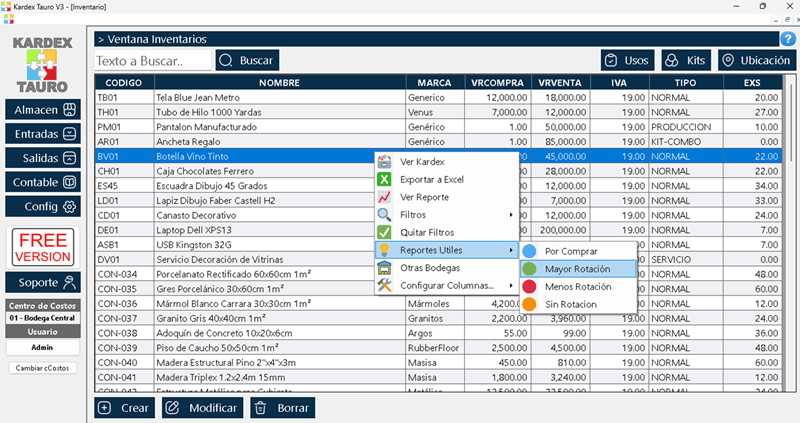
The instrument is chosen by risk and by cash flow, not by habit. And since bank fees and exchange differences end up inside the cost of the goods, that cost should be recorded where the inventory lives, so that profit per product is not calculated on an incomplete base. In Kardex Tauro the import cost can be loaded onto the goods and stays tied to inventory and accounting, which is the step where many companies lose track of what they actually paid.