Free trade zones and special regimes: when they are actually worth it
Free trade zones and special regimes: when they are actually worth it
A free trade zone is not a discount and it is not a tax-free territory. It is a customs and tax regime that requires prior authorization, committed investment and permanent control. The question that decides the matter is not how much you save, but whether your operation fits the logic of the regime and whether the company can carry the cost of compliance every year.
This guide covers what a free zone is and is not, who can become a user, what activates each benefit, how goods move to the rest of the country and when the regime costs more than it saves.
What a free trade zone is and what it is not
It is a defined area inside national territory, authorized by the government, where goods are subject to a special customs regime: they enter without prior payment of customs duties and remain under control while they stay inside. Everything else — benefits, conditions, penalties — hangs from that definition.
It is not foreign territory. The customs authority (DIAN) has full jurisdiction and the user takes on registration, inventory, reporting and audit obligations. Nor is it an automatic benefit for renting a warehouse: you need authorization, an approved business plan and commitments that are later verified.
The costliest confusion is believing that whatever enters stays tax-free forever. Taxes are deferred while the goods are inside and are settled when they leave for the rest of the country. What changes is the timing of the payment, the calculation base and the conditions.
The types of user and what each one may do
Each figure has different permissions. Choosing the wrong user type is a design error that is paid for with penalties or, worse, with a business model that was never viable.
| User type | What it does inside the zone | What it may not do | Who it suits |
|---|---|---|---|
| Zone operator | Runs the zone, provides shared services and answers to the authority for the area. | Use the zone as its own warehouse for its own trade, where the rules forbid it. | The investor who builds and operates the park. |
| Industrial user of goods and services | Brings goods in to transform them: production, assembly, manufacturing, repair. | Send the goods to a purpose other than the declared one without authorization. | The manufacturer that imports inputs and exports finished goods. |
| Commercial user | Stores, preserves, handles, distributes and performs packing or repacking. | Transform the goods or turn them into a different product. | The regional distributor and the consolidation center. |
| Service user | Provides logistics, technology or value-added support to the other users. | Carry out industrial or commercial activity on its own account. | The logistics operator and the shared services center. |
The difference between industrial and commercial is not paperwork: it defines what can be done with the goods and which benefit applies. Anyone mixing, bottling and labeling imported product must check which box they fall into, because packing may or may not count as transformation.
The real benefits: duties, VAT and income tax
There are three, and each has a condition that activates it. None is a general exemption: they are treatments tied to the destination of the goods and to compliance with the approved plan.
| Tax | How it behaves in a free zone | Condition that activates it | If it is not met |
|---|---|---|---|
| Customs duties (tariff) | Not paid on entry; deferred until the goods leave for national territory. | Entry with the corresponding declaration and an authorized destination. | Settled at extraction, with interest and penalties. |
| VAT on goods entering | Not triggered on entry: it is suspended while the goods remain in the zone. | Entry under the free zone regime with the required inventory control. | Triggered on extraction, at the base and rate in force. |
| VAT on domestic sales into the zone | Treated as an export, with a right to deduction or refund. | Invoicing an authorized user and meeting the documentary requirements. | The treatment is lost and VAT is invoiced as a domestic sale. |
| Income tax | The industrial user gains access to a preferential rate, conditioned on the plan. | Executing the project as approved and keeping the authorization. | The benefit is lost and the return is reassessed; the rate is confirmed in that year's rules. |
| Municipal business tax | Not part of the free zone regime: governed by the municipality where the area sits. | Does not apply: these are local taxes. | Paid as in any industrial or commercial activity. |
Duties are the benefit most felt in cash flow, but only on the share that does not return to the domestic market. If the product is exported, the input never pays duties. If it is sold in Colombia, duties are paid at extraction on the goods leaving — the finished product, with its own tariff line and customs value — not on the input that came in.
VAT works in a similar way, with a nuance almost nobody models. Under the ordinary regime it is paid at import and later offset against output VAT or claimed as a refund: that cycle has a financial cost and paperwork. In a free zone it is simply not triggered on entry.
Income tax is the most publicized benefit and the most fragile. The preferential rate is tied to compliance with the plan and is not inherited along with the plant. Read the rules in force before putting it into a model: the rate changes with the law.
What must be met: investment, plan and control
Authorization is granted for a project, not for a company. The plan describes what will be produced, with what investment, how many jobs are created, which markets are targeted and how goods will move. It then becomes the yardstick the authority uses to measure compliance.
The minimum investment is set in the rules and varies with the type of zone and the size of the project. Do not take it from a blog or a sales deck: confirm it against the rules in force before signing. The same goes for employment figures and deadlines.
Beyond the plan there is a workload that is not negotiable: guarantees and bonds, periodic reports, a compliance program, internal audit and a foreign trade officer. That cost is fixed and is paid even when sales fall.
Inventory control is the real test
The whole regime rests on one question: where is each unit and under which regime. If inventory is mixed, the company cannot prove it. For the authority, goods without traceability are goods with no declared regime, and the burden of proof shifts against the user.
In practice this requires identification by regime, a ledger by location, traceability of transformation — how much input each unit of product consumes — and control of shrinkage and by-products. It also requires reconciling system and physical count as often as volume demands.
A typical case: the system shows 10,000 units and the count shows 9,870. Under the ordinary regime that is an adjustment of 130 units. In a free zone it is a difference that must be explained with documents. Inventory errors here are not a warehouse issue: they are a customs issue.
Goods in the zone and sales to national territory
Selling to the rest of the country is not forbidden: it is taxed. The operation is called extraction and is formalized with an import declaration. There, customs duties are settled on the customs value of the goods leaving, which includes the value added inside the zone.
That is where the arithmetic trap appears. The input entered duty-free, but at extraction the finished product is taxed under its own tariff line. If the finished product carries a higher duty, or if the added value is large, the base grows and the advantage shrinks. A project approved with an assumed 8% may end up paying more on the domestic share.
Sector requirements do not change either: sanitary registrations, prior authorizations, clearances and technical standards remain mandatory. The zone does not exempt you from compliance; it only changes the customs and tax treatment.
The most common planning error is budgeting a market mix that is never met. A project approved with 80% exports that ends up selling 50% in Colombia does not always lose its authorization, but it does lose the saving that justified the investment.
Single-project zones and the manufacturing case
The single-project free zone is authorized for one industrial project, usually outside existing parks, when the operation needs to be close to its raw material, its port or its own infrastructure. It is the figure large plants use when they do not want to move into someone else's park.
The logic is the same at a different scale: the investment and employment commitment is stricter and oversight is proportional. Temporary zones serve trade fairs and events with goods that stay for a few days: their benefit is speed.
The profile that fits best is the manufacturer that imports inputs with a high effective duty, actually transforms them and exports a significant share. If the input already enters duty-free under a trade agreement, the benefit disappears even if the structure remains.
Compared with importing under the ordinary regime
The ordinary regime is not the enemy. It is simple, familiar and requires no business plan or permanent audit. Duties are paid at import, VAT is offset or refunded, and goods are free to be sold through any channel without extra paperwork.
Exporters have other routes worth comparing: special import-export systems allow inputs to be imported with suspended taxes against an export commitment, without moving into a free zone. For those who import and re-export without transforming, a bonded warehouse or temporary import may be enough.
An honest comparison uses five variables: effective duty on the input, share of output exported, value added, time goods stay immobilized and the company's tolerance for control. If the effective duty is low, no free zone structure pays for itself.
The full example: the same plant inside and outside the zone
Assumptions for the exercise, all round and flagged as assumptions: a plant imports USD 2,000,000 of inputs a year, with an assumed 8% duty and an assumed 19% VAT. It sells 60% of output abroad and 40% in Colombia. The percentages belong to the exercise, not to the law.
| Item | Ordinary regime | Free zone | Difference |
|---|---|---|---|
| Inputs imported during the year | USD 2,000,000 | USD 2,000,000 | — |
| Duty paid on import (assumed 8%) | USD 160,000 | USD 0 on entry | Deferred |
| Duty paid on extraction of the 40% domestic share | Already paid | USD 64,000 | — |
| Duty on the 60% exported | USD 96,000 paid, never recovered | USD 0 | USD 96,000 in favor |
| Import VAT (assumed 19%) | USD 410,400 on entry | USD 380,000 suspended; USD 152,000 on extraction | Cash effect only |
| Annual cost of keeping the regime | USD 0 | USD 45,000 | Against |
| Result for the year | Benchmark | Net saving of USD 51,000 | USD 51,000 in favor |
The math, step by step. Total duty under the ordinary regime: 2,000,000 × 8% = USD 160,000. The share corresponding to exported output is 160,000 × 60% = USD 96,000, and it is lost, because the input already paid on entry. The domestic share is 160,000 × 40% = USD 64,000, which in a free zone is paid at extraction instead.
Gross saving is therefore USD 96,000 a year. The cost of operating in a free zone — fit-out, committed investment, audit, control software and dedicated staff — is estimated at USD 45,000 a year. Net saving: 96,000 − 45,000 = USD 51,000, or 2.5% of the value of the inputs.
The break-even point is the figure worth memorizing: 45,000 ÷ 160,000 = 28.1%. Below that export share, the regime costs more than it saves. If only 25% were exported, the duty avoided would be 160,000 × 25% = USD 40,000 and the result would be negative by USD 5,000: 40,000 − 45,000 = −5,000.
One effect is missing from the table and works in favor: deferred VAT. The USD 228,000 of VAT on the exported share (380,000 × 60%) would have been paid at import and recovered months later; financing it at 1.2% a month for four months costs about USD 10,900. It is not added because it depends on each company's rate and actual timing.
Where the saving disappears: costs missing from the proposal
The USD 45,000 in the example is not a market figure: it is an assumption made so the math closes. Every project must build its own, and the first version almost always falls short.
What is usually missing: operator fees — rent, utilities, energy —, fitting out the warehouse, bonds, control software by regime, foreign trade staff and management time in committees.
There is also a cost that only appears at the end: leaving the regime, by nationalizing or re-exporting whatever goods remain. And there is the cost of getting it wrong: penalties, customs appraisals, suspension of the authorization and, in the worst case, loss of the benefit with reassessment of prior years.
When it is NOT worth it
There are situations where the regime is a bad decision, and recognizing them early is worth more than any optimistic projection.
- Little or no export. With 80% of output sold in Colombia, almost all the duty is paid at extraction and the fixed cost is never recovered.
- Low effective duty on the input. With a zero duty under a trade agreement there is nothing to defer.
- Short cash cycle. If VAT is recovered in weeks, suspending it is worth little.
- Retail or end-consumer sales. Unit sales do not fit inventory control by regime or the formality of every extraction.
- No volume for the fixed cost. Audit, software, staff and bonds cost about the same with USD 2 million or USD 20 million in sales.
- The product moves to a tariff line with a higher duty. The input enters free and the finished good leaves taxed higher: the advantage reverses.
Common mistakes
These are the mistakes that keep reappearing in projects already in operation. Each has a symptom, a consequence and a fix.
| Mistake | Symptom | Consequence | Fix |
|---|---|---|---|
| Entering only for the tax benefit | The plan was built to justify the decision. | Fixed cost exceeds the saving in year one. | Model the cash flow with a break-even point before applying. |
| Underestimating investment and plan | The commitment was signed with optimistic sales and hiring. | Non-compliance and risk of losing the authorization. | Take figures from the rules in force and leave slack in the schedule. |
| Not separating inventory by regime | One warehouse and one ledger for domestic and foreign goods. | Unexplainable differences, penalties, reassessment. | A system with locations, statuses and traceability from day one. |
| Selling domestically without settling on exit | An invoice issued with no extraction declaration. | Omitted taxes, interest and investigation. | Block the exit of goods until the declaration is approved. |
| Missing the plan and losing the benefit | The promised investment or jobs never materialized. | Loss of the preferential rate and reassessment. | Quarterly tracking with indicators and documented corrective action. |
| Believing the zone removes all VAT | Selling domestically without providing for the tax. | Cash shortfall and mispriced goods. | Treat every extraction as an import and provide for the VAT. |
One mistake does not fit the table because it is about expectations: believing a free zone is a way to pay no taxes. The regime was designed to produce and export, and its entire control architecture points that way.
An honest close: the regime is chosen with numbers and reviewed every year
This analysis does not replace your accountant or a foreign trade specialist. If the company does not export steadily, if the effective duty is low or if there is no structure to sustain control, the answer is probably no, and that is also a good decision.
If the numbers work, the decision is not permanent. Every year, review the real export share, the effective duty on the tariff line, the operator's fees and regulatory changes. A regime that saved USD 51,000 at 60% exports stops saving when that share falls.
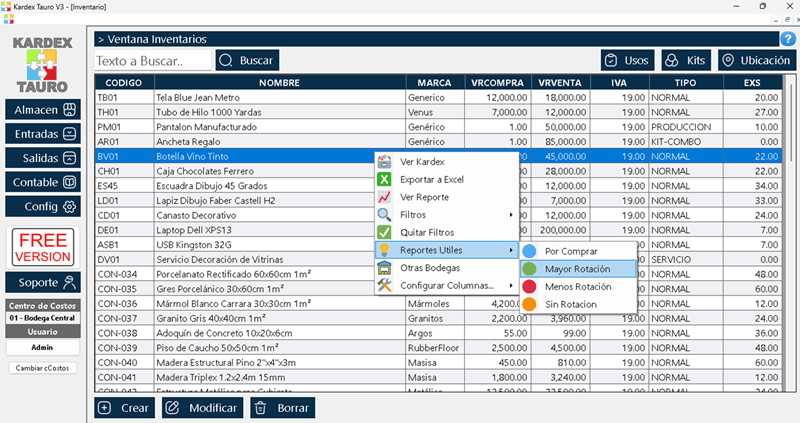
At Kardex Tauro, separating warehouses, statuses and regimes with movement-level traceability is exactly the control this regime demands. If your operation is already in a free zone or is evaluating one, that is where to look at the system and not only at the financial model.