Journal and general ledger: what they are and how to keep them
Journal and general ledger: what they are and how to keep them
Almost no small company loses track of money because it does not know what an accounting entry is. It loses track because the journal and the ledger are kept halfway: the invoice is written on a sheet, the payment leaves through the bank, and at month end a difference appears that nobody can explain. The journal tells the story in order; the general ledger sorts it by account. Without both, the balance sheet is a number that holds up until someone asks where it came from. Here is how to keep them, how to move from one to the other, and how to find an imbalance without redoing the month.
One clarification up front: bookkeeping is not optional for a company that is required to keep accounts, and the journal plus the ledger is the standard way to meet that requirement, whether on paper, in a spreadsheet or in software.
What each book records and why you need both
The journal is chronological. Each transaction goes in once, in the order it happened, with its date, its accounts, the amount and the document that supports it. If the rent was paid on 14 March, the entry dated 14 March says so and shows which account the money came out of.
The general ledger is analytical by account. It takes every line of the journal and accumulates it in the account it belongs to, until a balance remains: how much cash is in the bank, how much is owed to suppliers, how much went to payroll during the month.
The comparison that works: the journal is the film, in order; the ledger is each character's album, with all their appearances together. With the journal alone you can rebuild everything, but nobody wants to add four hundred lines to learn the bank balance. With the ledger alone you know the balance and have lost the ability to explain what happened on the 14th.
| Criterion | Journal | General ledger |
|---|---|---|
| What it holds | Each transaction, in the order it happened | Movements grouped by account |
| Unit of record | The complete entry, with all its lines | The line, posted to the account it belongs to |
| Question it answers | What happened, when, and with what document | How much there is or how much is owed today |
| When you consult it | When recording the transaction and when auditing | At closing and whenever a balance is requested |
| What reveals an error | Debits that do not equal credits | A balance on the wrong side of the account |
If the ledger exists without the journal, what you have is a summary: the balances may be right and not one figure can be supported. If the journal exists without the ledger, every management question gets answered with a manual sum.
Double entry in one sentence and one example
Everything that comes in comes from somewhere. That is the whole rule: in every transaction, total debits equal total credits. It is not a decorative convention; it is what makes the balance sheet balance by construction instead of by last-minute adjustment.
A minimal example. An office chair is bought for 1,200,000 pesos and paid by transfer. The entry: debit furniture and equipment 1,200,000, credit bank 1,200,000. The company has the same equity as before, but the shape of the asset changed: less money, more furniture. If the record were made only in the bank account, the expense would appear where it does not belong and the asset would be understated.
Two vocabulary warnings. In Colombia people say cargar or debitar and abonar or acreditar; they mean debit and credit. And debit does not mean good, nor credit mean debt: they are sides of an account. A debit to bank increases the money; a credit to bank decreases it.
How to write an entry: date, accounts, debit, credit and support
An entry that can be audited has eight elements, and none is optional:
- Date of the transaction, not the date it was typed.
- Sequential number within the period.
- Short description starting with a verb: rent paid March, not several.
- Debit account, with its chart-of-accounts code.
- Credit account, with its code.
- Amount in pesos, with no cents nobody can explain.
- Support: invoice, payment voucher, minutes or bank statement.
- Who recorded it and who reviewed it.
Support is where most companies fail. An entry without an invoice, a voucher or minutes is a statement without proof. When the DIAN, Colombia's tax authority, or a reviewer asks about a figure, the answer is not the entry: it is the document behind it. If the document does not exist, the entry falls, and the tax return that included it falls with it.
From journal to ledger: the step almost nobody does by hand
Moving from the journal to the ledger is called posting. It means taking each line of the entry and carrying it to the corresponding T-account, in the column it belongs to, writing down the number of the entry that originated it.
That last detail is the one people forget. If the ledger does not say which entry each amount comes from, the balance exists but cannot be traced. When a 350,000-peso difference shows up in suppliers, the entry number is the clue that gets you to the document in two minutes instead of two hours.
In accounting software the posting is automatic. In a spreadsheet it breaks, because the ledger total depends on every row being classified correctly and on nobody inserting a row in the middle of a range. On paper the risk is transcription: an extra zero, an amount in the wrong column.
A control test that takes ten minutes a month: compare total debits in the journal for the period with total debit movements across all ledger accounts. They must be identical. If they are not, the problem is in the posting, not in the bookkeeping.
T-accounts, balances and the normal side of each account
The T-account is the simplest way to see a movement: the name on top, debits on the left, credits on the right. Add the two columns and the difference is the balance: a debit balance if the left side is larger, a credit balance if the right side is.
Every account type has a normal side: the side on which it increases. Assets and expenses increase with a debit; liabilities, equity and revenue increase with a credit. Understanding this settles most beginner doubts, because the typical mistake is not in the arithmetic but in the side.
| Account type | Increases with | Decreases with | Normal balance |
|---|---|---|---|
| Asset | Debit | Credit | Debit |
| Liability | Credit | Debit | Credit |
| Equity | Credit | Debit | Credit |
| Revenue | Credit | Debit | Credit |
| Expense | Debit | Credit | Debit |
| Cost of sales | Debit | Credit | Debit |
| VAT receivable | Debit | Credit | Debit |
| VAT payable | Credit | Debit | Credit |
A balance on the wrong side is not creativity: it is a signal. A credit balance in the bank account means more was withdrawn than was there, or that a deposit was never recorded. A debit balance in suppliers can be normal if advances were paid, but if there were none, a payment was applied to the wrong invoice.
Watch out for mixed accounts: sundry debtors, loans to shareholders or advances move on both sides and confuse anyone reviewing them. The fix is not to move them elsewhere but to break them down by third party and look at the net balance with the detail beside it.
How entries are numbered and filed
Numbering is the thread that holds everything above together. One sequence per period, no gaps, no repeated numbers, and never reuse the number of a voided entry. If the system does not generate the sequence, you generate it and you respect it.
The golden rule of the file: an entry is never deleted, it is reversed. If the same invoice was recorded twice, the second entry is cancelled with an opposite entry that says why. Deleting leaves a gap in the numbering and a gap in the story; a reviewer will find it.
The file is organised two ways at once: chronologically and by sequence number. The month's folder holds the documents in the order of the entries, and each document carries the number it belongs to.
If several locations or users are entering data, define separate series per location and write the rule down: two sequences without a rule produce two invoices with the same number. On retention periods for books and documents, check the rule in force for the year and confirm it with your accountant.
Manual books, spreadsheets or software: what changes
All three work, and all three fail for the same reason: someone chooses the wrong account. The tool does not pick the chart of accounts for anyone.
Manual, in bound books or numbered sheets: it forces understanding, because every line is written twice. It is slow, the transcription risk is high, and the month-end close depends on one person who knows where everything is.
Spreadsheet: fast and flexible, and dangerous for exactly that reason. It has no integrity control, it does not stop a debit without a credit, and it leaves no trace of who changed what. It works if there is a fixed chart of accounts, a single version of the file and a monthly reconciliation. If there are three files called final, final2 and final_good, there is no bookkeeping: there are drafts.
Accounting software: the ledger builds itself, the sequence is controlled and documents are attached. What does not change is the input: if an expense is typed as an asset, the report comes out fast and wrong.
The deciding criterion: if monthly volume passes a hundred entries, or if there is inventory, a warehouse or several locations, manual handling stops being viable. Not because of the effort, but because control becomes impossible.
How to find an imbalance without redoing the month
An imbalance is not hunted at random. It is hunted in order, from the cheapest check to the most expensive:
- Total debits against total credits in the journal for the period. If they do not match, the error is in one entry.
- Journal total against total ledger movements. If they differ, the error is in the posting.
- Balances on the wrong side of the account.
- Entries with no number, repeated numbers or dates outside the period.
- VAT cross-check: the receivable must match taxed purchases and the payable must match taxed sales.
- Duplicates: same invoice, same amount, same supplier, two dates close together.
Two shortcuts that save hours. If the difference is a multiple of 9, it is almost always a transposed pair of digits: 1,230,000 typed as 1,320,000 leaves 90,000, and 90,000 is divisible by 9. If the difference is exactly 10, 100 or 1,000, it is a decimal position error.
And one rule that is not negotiable: never balance by pushing the difference into sundry or adjustments. That entry hides the symptom and leaves the error inside. This month's imbalance becomes next quarter's.
A full month: six transactions, from entry to ledger
A company starting operations on the first of the month. Six transactions, 19 percent Colombian VAT, round figures so the arithmetic can be followed by hand.
| No. | Transaction | Debit | Credit |
|---|---|---|---|
| 1 | Capital contribution to the bank | Bank 50,000,000 | Capital 50,000,000 |
| 2 | Merchandise bought on credit plus VAT | Inventory 20,000,000; VAT receivable 3,800,000 | Suppliers 23,800,000 |
| 3 | Cash sale plus VAT | Bank 35,700,000 | Revenue 30,000,000; VAT payable 5,700,000 |
| 3 | Cost of the goods sold | Cost of sales 18,000,000 | Inventory 18,000,000 |
| 4 | Payment to a supplier | Suppliers 5,000,000 | Bank 5,000,000 |
| 5 | Rent for the month | Rent expense 3,000,000 | Bank 3,000,000 |
| 6 | Payroll for the month | Payroll expense 6,000,000 | Bank 6,000,000 |
| Totals | 141,500,000 | 141,500,000 |
Equal totals are the first test: debits of 141,500,000 and credits of 141,500,000. Now the ledger, with the closing balance of each account:
- Bank: 71,700,000 debit.
- Inventory: 2,000,000 debit.
- VAT receivable: 3,800,000 debit.
- Suppliers: 18,800,000 credit.
- Capital: 50,000,000 credit.
- Revenue: 30,000,000 credit.
- VAT payable: 5,700,000 credit.
- Cost of sales: 18,000,000 debit.
- Rent expense: 3,000,000 debit.
- Payroll expense: 6,000,000 debit.
The balance sheet is built from those balances and it closes: assets of 77,500,000 (bank 71,700,000, inventory 2,000,000 and VAT receivable 3,800,000) against liabilities of 24,500,000 (suppliers 18,800,000 and VAT payable 5,700,000) plus equity of 53,000,000 (capital 50,000,000 and profit for the month 3,000,000).
One detail worth a second look: VAT payable is 5,700,000 and VAT receivable is 3,800,000, so the amount owed to the DIAN for the period is 1,900,000. Had the VAT on the sale been booked as revenue, revenue would look 5,700,000 larger and the tax liability would vanish: two errors from a single movement.
The 3,000,000 profit comes from 30,000,000 of revenue minus 18,000,000 of cost and 9,000,000 of expenses. Had the cost not been recorded, profit would be 21,000,000 and inventory would sit at 20,000,000: the margin would look better and the asset would be overstated.
Common mistakes
The five that show up in almost every review, with the symptom that gives them away before they become a problem with a tax return.
| Mistake | Symptom | Consequence | Fix |
|---|---|---|---|
| Booking VAT inside cost or revenue | The margin moves without a price change, and VAT payable does not match the invoices | A different tax from the real one is declared and cost is distorted | Split the tax into its own account and recalculate the base from the document |
| Recording an entry with no support | The entry exists and the document cannot be found | The figure cannot be defended before a reviewer or the DIAN | Rebuild the document with the third party or reverse the entry |
| Entering the same invoice twice | Suppliers or expenses jump in a way the bank statement does not match | The bill is paid twice or a cost that never existed is declared | Mandatory sequence numbers and a monthly check against the bank statement |
| Updating the ledger only when statements are due | The ledger is built once a year, against the journal | Posting is done in a hurry and differences can no longer be traced | Post to the ledger at the close of every month |
| Balancing by difference | A value appears in sundry or adjustments with no explanation | The imbalance is carried forward and grows each period | Leave the difference open and hunt the cause in the order of the list above |
The common thread is that they are found late. A wrong-side error in an entry dated the 3rd surfaces as a difference in the balance sheet on the 30th, with forty entries on top of it. A weekly review costs less than a monthly rebuild.
An honest closing before you decide
None of this replaces an accountant. The journal and the ledger give you the ability to ask and to understand the answer; they do not make you responsible for a tax return. If your company holds inventory across several warehouses, operates in foreign currency or sits under a special tax regime, what is explained here falls short and professional judgement is required.
Nor does it apply the same way everywhere. A service company with twenty invoices a month can keep journal and ledger in an orderly spreadsheet; a distributor with two thousand SKUs cannot, and not for lack of discipline. And if the problem is not recording but deciding — which account to use, how to treat a return — the bottleneck is not the book: it is judgement.
What you can do today: demand a sequential number on every entry, keep the document next to the entry, and check every month that journal debits equal ledger debits. With those three routines, any figure in the balance sheet can be explained in five minutes and stops being an opinion.
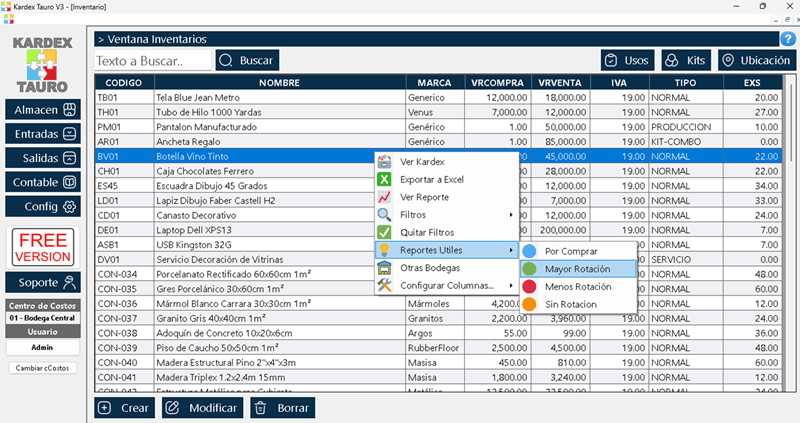
If you want that posting to happen on its own, an inventory and accounting system such as Kardex Tauro builds the ledger from the journal without retyping a single line; what it does not do is choose the account for you.