How to Read the Balance Sheet and the Income Statement Together

How to Read the Balance Sheet and the Income Statement Together
Your accountant hands you two sheets. One says the company earned a profit; the other says how much it holds. Read separately, each answers a different question, and both can be true while you draw the wrong conclusion: profit is not the money in the bank, and a large equity balance does not pay Friday's payroll. This article covers what each statement answers, how profit for the period links them, where the margin breaks, and how to review both in five minutes. The worked example balances: assets of 77.500.000, liabilities of 24.500.000, equity of 53.000.000 and profit of 3.000.000.
What question each statement answers
The balance sheet is a photograph. At a cut-off date it shows what the company owns, what it owes and how much is left for the owners. It does not tell you whether the business is doing well; it tells you where it stands at that instant, with every balance accumulated since it opened. The income statement is a film: what happened between two dates, how much was sold, what the goods sold cost, what was spent and what remained.
The practical difference lies in the kind of question each one enables. The balance sheet answers "can I pay?", "how much do I owe?", "how much is mine?". The income statement answers "am I selling at a margin?", "where does the money go?", "does the operation pay for itself?". Neither question is answered by the other document.
| Statement | Question it answers | Period | What it shows at the end | Basic warning sign |
|---|---|---|---|---|
| Balance sheet | What does the company own and owe at a date? | An instant: the cut-off | That assets equal liabilities plus equity | Liabilities grow faster than assets |
| Income statement | How was the profit or loss of the period generated? | A range: the 1st to the 31st | Profit for the period | Gross margin falls while sales hold steady |
Notice that neither answers the owner's most frequent question: "do I have cash?". That one belongs to the cash flow statement, the third member of the family, which many monthly reports leave out. Without it, comparing profit with the bank balance is done by eye, and it is almost always done wrong.
Assets, liabilities and equity in one sentence
The company owns things, owes things, and whatever is left belongs to the owners. Put into figures, that sentence is the accounting equation: assets equal liabilities plus equity. It is the very definition of equity, which is obtained by subtraction and never by an independent sum.
Assets gather what can produce a benefit: cash, receivables, inventory, machinery, the premises, licences. Liabilities gather the obligations: suppliers, taxes payable, payroll, loans, labour provisions. Equity is the residual: capital contributed, plus retained profits, minus losses and withdrawals.
Hence a warning that is rarely repeated. Equity is not a place where money sits. A company can show 53.000.000 of equity and 700.000 in its current account, because the rest is tied up in a truck, in inventory or in receivables that customers have not paid. When someone says "the company is worth this much according to equity", they are mixing book value with market value, which rarely match.
Revenue, costs and expenses: where the margin breaks
The income statement reads top to bottom, like a waterfall. Revenue comes in, the cost of goods sold is subtracted, and gross profit appears. Operating and selling expenses are subtracted and operating profit appears. Financial expenses and taxes are subtracted and net profit appears. Each step can break on its own.
If gross margin falls, the problem is in price or cost: discounts nobody authorised, freight the company absorbed, returns booked as lower revenue, more expensive purchases, shrinkage charged to cost without review. If gross margin holds and profit falls, the problem is in the expense structure: rent, payroll, utilities, commissions, fees.
There is a third point, less visible and more common than it seems: expenses that do not belong to the business. The owner's personal spending paid with the company card, a family vehicle, a home renovation. All of them reduce profit and none relates to operations. When the month's profit surprises you, review the expense list and not just the total. Cost of sales can also be badly assembled: if inventory cost excludes inbound freight, gross margin is inflated and that pretty profit never reaches the bank.
How they connect: profit for the period flows into equity
The bridge between the two statements is a single line. Profit for the period, exactly as it appears at the bottom of the income statement, is added to equity on the balance sheet. In Colombian accounting that line lives in the temporary result accounts, which stay open during the year and are transferred to retained earnings at closing.
The movement has four steps and only the first is automatic: the income statement is closed; profit is carried to results for the period or to retained earnings; the appropriations decided by the shareholders' meeting are applied —reserves, dividends—; and whatever is not distributed remains as retained profit. If the period closed at a loss, the same bridge runs backwards.
| Step | What happens | Effect on equity |
|---|---|---|
| Result for the period | The income statement is closed | Increases by profit for the period |
| Transfer to retained earnings | Profit is carried to accumulated results | No effect: only the line changes |
| Appropriation of reserves | A portion is set aside by law or bylaws | No effect on the total |
| Payment of dividends | Profit is distributed to the owners | Decreases by the amount paid |
| Loss for the period | It is closed against equity | Decreases by the loss |
One detail that confuses many: capital contributions also increase equity, but they never pass through the income statement. That is why a company can show rising equity and falling profit at the same time. That growth does not come from the business; it comes from the owners' cheque book, and that cheque book has a limit.
One event told by both statements
Take a single invoice from the month: a credit sale of 5.000.000 plus 950.000 of Colombian VAT, with a cost of 3.000.000. The income statement shows revenue of 5.000.000, a cost of 3.000.000 and a profit of 2.000.000. The balance sheet shows three movements: receivables rise by 5.950.000, inventory falls by 3.000.000 and VAT payable rises by 950.000.
The net effect on assets is an increase of 2.950.000, exactly the sum of the new liability (950.000) and the profit (2.000.000). Double entry is the reason both statements always tell the same story from different angles, and the reason a balance sheet that does not balance exposes a recording error.
Now change one condition and watch them separate. If the customer pays cash, the result is identical and receivables never appear; only the bank account changes. Same profit, different cash. That, in one sentence, is the difference between accrual accounting and cash flow, and the source of almost every end-of-month surprise.
The trap of profit without cash
A company can be profitable and still run out of liquidity. It happens when it sells on credit, builds up inventory, buys an asset or repays debt. None of those movements affects profit in the same direction and magnitude as it affects the bank balance.
Selling at 90 days and paying at 30 is the most common combination among Colombian small businesses. Profit is recorded on the invoice date; the money arrives three months later. In between, payroll, rent and suppliers must be paid with funds that never came in. Monthly profit can be 3.000.000 while the bank account is in the red.
Some movements consume cash without touching profit: repaying loan principal, buying machinery, paying dividends, building inventory for peak season. And some produce cash without profit: selling a fixed asset, receiving a loan, collecting old receivables, taking a customer advance.
That is why the bank balance is never compared with monthly profit, but with the change explained by cash flow. The basic reconciliation is a sum: profit for the period, plus depreciation and provisions, minus the increase in receivables, minus the increase in inventory, plus the increase in suppliers. If the result resembles the change in the bank account, the story holds.
How to read both statements in five minutes
A first reading does not require a course, only a fixed order and the same accounts every month.
- Check that the balance sheet balances: assets equal liabilities plus equity. If it does not, stop; there is a recording error and any conclusion will be false.
- Locate profit for the period and confirm it appears in equity, on the results-for-the-period line.
- Compare the bank balance with that profit. If they differ widely, look for the explanation in receivables, inventory or debt, in that order.
- Look at the composition of assets: what share sits in cash, in receivables and in inventory. A large, slow asset does not pay bills.
- Look at liabilities by maturity: what must be paid in the next 30, 60 and 90 days, including loan instalments that are not in suppliers.
- Compare this month's gross margin with last month's and with the same month a year ago. The trend matters more than the single figure.
With those six steps, an owner walks into the meeting with the accountant knowing what to ask. The formal review remains the accountant's job; the business reading belongs to the owner.
The full example: the same company on both sheets
With one month of operations, the company closes as follows. Income statement: revenue of 30.000.000, cost of sales of 18.000.000 and gross profit of 12.000.000. Monthly expenses are rent of 3.000.000 and payroll of 6.000.000, that is 9.000.000. Profit for the period comes to 3.000.000.
On the balance sheet, assets total 77.500.000: bank 71.700.000, inventory 2.000.000 and deductible VAT 3.800.000. Liabilities total 24.500.000: suppliers 18.800.000 and VAT generated 5.700.000. Equity totals 53.000.000: capital 50.000.000 and profit for the period 3.000.000. The check is direct: 24.500.000 plus 53.000.000 equals 77.500.000.
| Income statement for the month | Amount | Balance sheet at closing | Amount |
|---|---|---|---|
| Revenue | 30.000.000 | Bank | 71.700.000 |
| Less cost of sales | 18.000.000 | Inventory | 2.000.000 |
| Gross profit | 12.000.000 | Deductible VAT | 3.800.000 |
| Less rent | 3.000.000 | Total assets | 77.500.000 |
| Less payroll | 6.000.000 | Suppliers | 18.800.000 |
| Profit for the period | 3.000.000 | VAT generated | 5.700.000 |
| Gross margin | 40% | Total liabilities | 24.500.000 |
| Net margin | 10% | Capital | 50.000.000 |
| Check | Liabilities plus equity | 24.500.000 + 53.000.000 | 77.500.000 |
What the joint reading says. The company earned 3.000.000 on sales of 30.000.000: a 10% net margin and a 40% gross margin. It holds 71.700.000 in the bank, but owes 18.800.000 to suppliers and 5.700.000 in VAT. Working capital —assets minus liabilities— is 53.000.000, and current assets cover current obligations a little over three times. Liabilities represent 31.6% of assets: debt is not this company's problem.
Now the part that only appears when you cross the two. Profit of 3.000.000 equals 4.2% of the bank balance. Looking only at the bank invites celebration; looking only at profit invites worry. Both readings are incomplete. The right question is how much of that 71.700.000 is already committed: next month's payroll, suppliers, VAT, and the loan instalment that may not appear in these liabilities because it falls due later.
Deterioration signals you only see together
Some problems show up in neither statement alone and jump out when one line sits next to the other. Watch these six every month.
- Positive profit and falling cash three months running. The business earns on paper and loses in the account. It is almost always uncollected receivables.
- Equity growing through contributions while profit falls. The owners are plugging an operating hole with new money, and the hole is still there.
- Sales growing and receivables growing faster. The company is selling to customers who do not pay, and margin is turning into paper.
- Stable gross margin and falling profit. The expense structure grew faster than the operation; the problem is not price, it is overhead.
- Inventory growing faster than sales. Stock is sitting still, and still stock ages, expires or gets written down.
- Suppliers growing while the bank balance holds. The company is financing itself with supplier terms, and those terms have a due date.
None of these signals is detected with a single document: all of them come from crossing a line of the income statement with one of the balance sheet. When they appear, the question is not how to fix it but since when it has been happening.
Common mistakes
The five most repeated mistakes are not arithmetic, but reading, and that is why software does not catch them.
| Mistake | Symptom | Consequence | Correction |
|---|---|---|---|
| Comparing profit with the bank balance | "We earned 3.000.000 but there is no money" | Spending or distribution decisions with no basis | Compare with cash flow, not with profit |
| Believing high equity means liquidity | Large equity and tight cash | Committing to payments that cannot be met | Look at the composition of assets, not their size |
| Reading only the percentage, not the absolute amount | "Margin went up" on minimal sales | Celebrating an improvement that pays no fixed costs | Always read the percentage and the amount in pesos |
| Reading one statement without the other and without the notes | Correct figures, wrong conclusion | The cause of the change and the hidden risk are lost | Read both statements and the notes in one session |
| Confusing profit for the period with retained profit | "We have 3.000.000 to distribute" | Dividends paid out of profit the company never earned | Separate the period result from accumulated results |
The costliest is the fifth: confusing the two leads to declaring dividends with money the company needs to operate, and that is paid with working capital.
What to check in the notes, not in the figures
Two companies with the same balance sheet can be in opposite situations, and the difference sits in the notes. Receivables of 40.000.000 with customers who pay at 30 days are not the same as the same amount with half of it overdue by 180 days: the number is identical, the risk is not.
Review the receivables policy and impairment, the inventory valuation method and whether obsolete stock exists, off-balance-sheet commitments —leases, guarantees, lawsuits, related-party obligations— and events after the cut-off date. If your company applies full IFRS or the IFRS for SMEs, those notes are not an optional annex.
An honest closing before you decide
This method is for reading, not auditing. One month is not a trend, and a balance sheet without a cash flow statement leaves the cash question half answered. If the business is informal, mixes the owner's accounts with the company's, or the accountant has not closed the period yet, comparisons distort and you should wait for the close.
Nor does it replace the accountant. The business reading lets you arrive at the meeting with concrete questions; the technical answer belongs to whoever signs the financial statements. And if your case is a company in crisis, with overdue debt or open lawsuits, the priority is not margin: it is the next four weeks of cash.
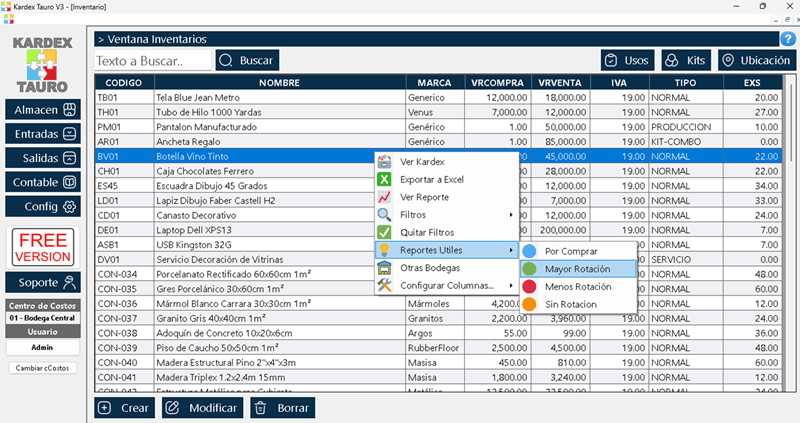
What you can do from today is stop reading one sheet without the other. The two statements read as a single sentence: what was earned, where it ended up and what is owed. Once that sentence becomes a habit, decisions stop depending on intuition. In Kardex Tauro the balance sheet and the income statement come from the same record of transactions, so monthly profit and closing equity tell the same story without extra reconciliation.