Supplier advances: how they are applied against the invoice

Supplier advances: how they are applied against the invoice
Your company transfers 30,000,000 to a supplier so it will reserve the goods. Weeks later the invoice arrives for 71,400,000 and the accounting team records it in full, without deducting the money that already left. The company pays twice and the advance sits idle on the balance sheet for months. An advance is neither an expense nor a commercial favour: it is a right against the supplier that is extinguished when the invoice arrives, not when the payment does.
This is how that right is recorded, how it is applied invoice by invoice and which controls stop it from getting lost, with the full numerical example and the accounts that move at every step.
What an advance is and why it is not an expense
An advance is money paid before receiving the goods or the service. At that moment the economic event that creates the cost has not happened: there is no merchandise in the warehouse, no service performed, no invoice. So it cannot touch the income statement. Only the composition of assets changes: cash leaves the bank and a right to receive goods or to get the money back comes in.
That right is called an advance to suppliers or a purchase advance. It is an asset account with a debit balance, presented as a current asset when it is expected to be applied within the normal operating cycle. If the delivery term exceeds one year, consider presenting it as a non-current asset.
The difference from an expense is one of substance. An expense reduces equity and lowers profit for the period; an advance only swaps one asset for another. If it is recorded as an expense, profit falls for no reason and, when the invoice arrives, the cost is recorded again. Nor is it a payable: a payable arises with the invoice, when the company owes money; the advance arises earlier, when the company has already paid and the supplier owes the goods.
| Concept | When it arises | Nature | What it represents | Where it appears |
|---|---|---|---|---|
| Advance to suppliers | With the payment, before the invoice | Asset (debit) | Right to receive goods or a refund | Balance sheet, current assets |
| Expense or cost | With consumption of the good or service | Profit or loss (debit) | Resource already consumed in operations | Income statement |
| Accounts payable | With the supplier invoice | Liability (credit) | Obligation to pay what was invoiced | Balance sheet, current liabilities |
Advance, progress payment and cash on delivery are not the same
In purchasing these three are used as synonyms and they are not. The advance is paid before the supplier produces or ships. A progress payment is made against a work or production report already executed: there is a verifiable milestone, even if no final invoice exists yet. Cash on delivery is paid when the goods are already in the buyer's hands.
The distinction matters for documentation and for risk. A progress payment requires a signed progress report; an advance requires a purchase order and a payment voucher. And with an advance the company finances the supplier: 50 % of 71,400,000 is working capital tied up, and that must show in the cash flow.
There is a third figure that slips in: the deposit to reserve capacity. If it is refundable and not applied to a specific invoice, it is a separate receivable with its own term, and mixing it with the purchase advance makes it impossible to know what is still outstanding.
When an advance is requested and what must be demanded
An advance appears when the supplier cannot finance production: imports, custom-made orders, seasonal raw materials, new suppliers with no credit line, construction or installation contracts. Also when the buyer wants to lock in price or availability in a fast-moving market.
Before transferring the money there must be three things in writing. An accepted purchase order with description, quantities, unit prices, VAT, delivery term and the conditions for applying the advance. An advance document or billing statement in which the supplier declares it is receiving that money for that specific order. And a refund clause: what happens if it does not deliver, how long it has to return the money and what guarantee backs it.
The clause is not a formality. Without it, recovering an advance through the courts costs more than the advance itself. If the supplier is new or the amount is high, ask for a bank guarantee, a performance bond or a signed promissory note: it is cheaper to negotiate at the start than to chase the supplier afterwards.
The percentage is also defined in advance. 50 % is common on custom-made orders; on catalogue purchases from a known supplier, 20 % or 30 % is usually enough. The practical rule: the advance should not exceed the value the supplier has already invested in the order.
Which documents must stay in the advance file
An advance without support is a payment impossible to defend before a review, an auditor or the DIAN itself. The file must allow the whole history to be reconstructed without calling anyone. If a document is missing, accounting ends up recording the payment as an expense because there is nowhere to classify it, and that is where the problem starts.
The disbursement voucher is the anchor document: it shows date, payee, amount, payment method and the account debited. The purchase order provides the commercial context. The billing statement provides the legal basis. And the journal entry must carry a cross-reference: the purchase order number in the description, to tie the payment to the order.
| Document | What it proves | Who issues it | What it must include |
|---|---|---|---|
| Accepted purchase order | That a specific order and an agreed price exist | Purchasing | Quantities, prices, VAT, term, advance conditions |
| Billing statement or advance document | That the supplier received the money for that order | Supplier | Amount, order number, concept, tax details |
| Disbursement voucher and bank support | That the money left and through which channel | Treasury | Date, amount, payee, account debited, reference |
| Guarantee or bond | That there is backing if delivery fails | Insurer or supplier | Validity, covered amount, coverage clauses |
| Partial receipt report | Which part of the order has been received | Warehouse | Items, quantities, date, signature of the receiver |
How it is recorded: an asset, not an expense
The payment entry is simple and is almost always done wrong: debit advances to suppliers and credit bank, without touching the income statement. If withholding tax on income or VAT applies to the payment, credit the corresponding withholding account; that treatment must be confirmed by your accountant, because it depends on the concept and on the type of supplier.
The subsidiary ledger is what makes the difference. An advance in a single global account, with no detail by supplier and by order, is a balance impossible to reconcile. The account needs a sub-account per third party and the purchase order number in the transaction description: with that, anyone can see how much was advanced and for which order.
Finally, every advance must carry an expected due date, taken from the agreed delivery term. Without a date there is no alert, and without an alert the balance sits on the balance sheet for years until someone writes it off out of boredom.
The invoice arrives and the advance is applied
When the goods arrive and the supplier invoices, the cycle closes. The invoice carries the value of the merchandise and the deductible VAT; the advance stops being a right and becomes part of the payment. The entry has three debits and two credits, and it must balance exactly.
Take the order for 60,000,000 plus VAT of 11,400,000, for a total of 71,400,000. A 50 % advance was agreed on the value of the goods, excluding VAT: 30,000,000. On payment date advances to suppliers was debited for 30,000,000 and bank was credited for the same amount. When the invoice arrives: debit inventory for 60,000,000, debit deductible VAT for 11,400,000, credit advances to suppliers for 30,000,000 and credit suppliers for 41,400,000.
The balance payable is 41,400,000, the invoice total minus the advance applied. The advance account drops to zero for that order. If accounting records the invoice at 71,400,000 and credits suppliers for that same amount, the advance stays alive in assets and the supplier appears to owe 30,000,000 that it has in fact already collected. It is the most common and the most expensive mistake.
| Moment | Account | Debit | Credit |
|---|---|---|---|
| Advance payment (50 %) | Advances to suppliers | 30,000,000 | — |
| Advance payment (50 %) | Bank | — | 30,000,000 |
| Invoice received | Inventory | 60,000,000 | — |
| Invoice received | Deductible VAT | 11,400,000 | — |
| Invoice received | Advances to suppliers | — | 30,000,000 |
| Invoice received | Suppliers | — | 41,400,000 |
| Balance paid | Suppliers | 41,400,000 | — |
| Balance paid | Bank | — | 41,400,000 |
Partial advance, full advance and several orders
The clean case — one order, one advance, one invoice — is the least frequent. Normally the supplier delivers in parts and invoices in parts. There is one rule: the advance is applied in the same proportion in which the goods are received, never in one go.
If 40 % of the 71,400,000 order is delivered, the invoice will be for 24,000,000 plus VAT of 4,560,000, that is 28,560,000. The advance applied must be 40 % of the 30,000,000: 12,000,000. The balance payable is 16,560,000 and 18,000,000 remain as an outstanding right, with its own due date. When the rest arrives those 18,000,000 are applied and the account returns to zero.
The problem appears with several open orders from the same supplier. An invoice arrives, nobody knows which order it belongs to, and the oldest advance is applied by age. The criterion is convenient but arbitrary: it may be applying the advance of order A against the invoice of order B and leaving order A without support. Application must go against the order identified on the invoice, not against the supplier's global balance.
If the advance is 100 %, the invoice creates no balance payable, but it must still be recorded: without it there is no deductible VAT and no support for the cost.
What happens if the supplier does not deliver
The first step is to put it in writing: a formal email or letter with acknowledgement of receipt, demanding performance or refund. That communication proves the company claimed and is the basis for any later collection.
For accounting purposes, the advance does not become an expense just because time passes: it remains a right until there is evidence it will not be recovered. If there is a refund agreement, the money comes in against the advance. If the supplier delivered part, the proportion is applied and the rest is claimed. Only when recovery is no longer probable is impairment assessed, with the documentation that supports that conclusion.
What cannot be done is leaving the advance untouched while the supplier disappears, or charging it to inventory to clean the account. Charging it to inventory is worse than leaving it: it creates a fictitious asset, inflates the margin when the goods are sold and distorts the real cost. If the supplier does not deliver, the problem is collection, not the warehouse.
If the amount is material and the supplier does not respond, the route is legal. That is why the clause and the guarantee are negotiated before the money is transferred. Recovering 30,000,000 through the courts can take years; a well-arranged bond is collected in weeks.
Monthly reconciliation with the supplier
The control that prevents almost every problem is a monthly reconciliation, supplier by supplier. It is not a report for management: it is a cross-check between the accounting ledger and the statement the supplier sends, on the month's transactions, because balances hide the differences.
The procedure has four steps. Extract the advances ledger by third party from the system, with date, amount, purchase order and balance. Ask the supplier for its statement with advances received and invoices issued. Cross-check order by order: what was advanced, what was invoiced, what was applied and what remains. And document the differences, signing the reconciliation when the amount justifies it.
The differences usually have an identifiable cause: the supplier applied the advance to another invoice, the payment was recorded in the wrong month, a credit note was not posted, the same advance was paid twice because of a treasury error. Each one must be left with a name, an amount and an action, not with a ticked "reviewed" box.
Advances in foreign currency and exchange differences
If the supplier invoices in dollars or another foreign currency, the advance is recorded in pesos at the exchange rate of the payment date. That peso value is what stays in the books. The invoice is recorded at the rate of the invoice date, and the difference between the two rates creates an effect that must be recognised.
The correct treatment separates two things. The part already paid does not generate an exchange difference when invoicing: the right is extinguished at the peso value at which it was recorded. The difference appears on the balance payable, which is exposed until the payment date: if the rate rises, the company pays more pesos for the same dollar balance.
There is a practical point that gets forgotten: reconciliation with a foreign supplier is done in its currency, not in pesos. The supplier says "you owe me 12,000 dollars"; the company says "I owe you 48 million pesos". Both can be true on the same day and stop being true the next. The reconciliation must fix the rate and the date, and put them in writing.
Frequent errors and how to detect them
Advance errors are not detected in the income statement: they are detected on the balance sheet, when the account grows without explanation or when a supplier claims a payment the company believes it made. These are the five most common, with the symptom that gives them away.
| Error | Symptom | Consequence | Correction |
|---|---|---|---|
| Recording the advance as an expense for the month | Expenses rise with no supporting invoice and profit falls without explanation | Double cost when the invoice arrives; distorted profit | Reclassify to advances to suppliers and adjust the period |
| Applying it without reconciling against the invoice | The advance is still in assets after the invoice | The company pays twice or loses the right | Cross-check order, invoice and payment; apply the exact amount |
| Losing track with several orders | A global balance that matches no open order | Crossed applications and orders with no support | Ledger by supplier and by purchase order |
| Not separating VAT when applying | Deductible VAT does not match the invoice | Lower deductible VAT and higher inventory cost | Record VAT on the invoice value, not the advance |
| Leaving old advances unclaimed | Balances over a year old with no movement | Unrecognised loss and inflated assets | Claim, document and assess impairment |
The fourth error deserves a separate explanation. An advance does not carry VAT: VAT is triggered by the invoice. When someone tries to apply the advance "VAT included" or to calculate VAT on the advance, the deductible VAT no longer matches the invoice and the inventory cost is wrong. In the example, deductible VAT is 11,400,000, calculated on the 60,000,000 of merchandise, not on the 30,000,000 of the advance.
An honest closing before you decide
An advance is a right collected in goods or in money, and it is controlled with its own ledger, by supplier and by order. If your company pays advances and does not have that ledger, the problem is not the software: it is that nobody can say how much the suppliers owe. Start with a list of balances and one call per supplier.
This article does not replace your accountant. The treatment of withholdings, the presentation under the technical framework your company applies and the impairment assessment depend on each case. If the operation is small and advances are sporadic, a well-kept spreadsheet may be enough; if volume grows, the control has to live inside the system.
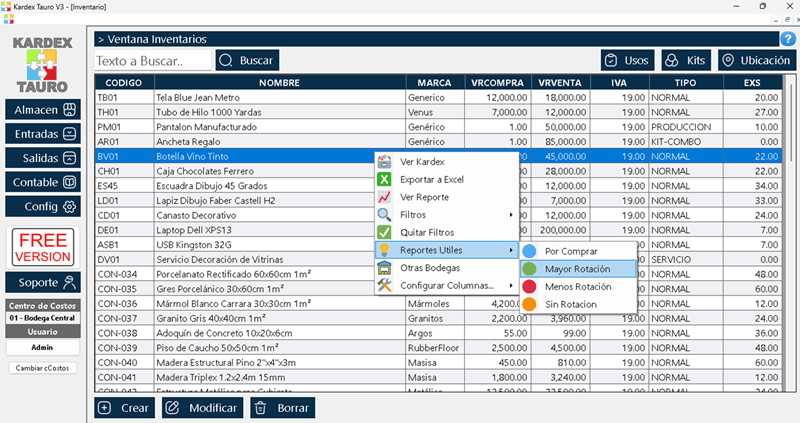
In Kardex Tauro the supplier advance is handled as a document with its own balance, applied against the purchase invoice and reconciled by third party and by order, so the right does not get lost along the way.