Fixed asset inventory: how to maintain and update it

Fixed asset inventory: how to maintain and update it
A fixed asset goes missing in three ways: it breaks, it leaves without a record, or it gets bought twice. When the inventory is out of date, all three look the same on paper: a gap between what accounting says and what is actually in the warehouse. And an unexplained gap turns into suspicion, into an audit nobody wanted, or into a duplicate purchase nobody authorized.
What follows is the full cycle: which data each record carries, how assets are coded, who is accountable, how additions, transfers and disposals are booked, how the count is done and how the register is reconciled with the general ledger. At the end, a case with 120 assets that closes at zero.
Three ways an asset goes missing
The equipment broke and it is still in the register at full value with depreciation running, as if it were in service. The chair moved to the new site and nobody wrote it down. The supplier sold the same barcode scanner twice because nobody could confirm whether there was already one. Three different stories that look identical at year end.
The inventory does not stop an asset from breaking, nor from being taken. What it does is separate the cases: if the asset sits in a record with its tag, its location and its custodian, the shortfall is explained; if it does not, every explanation is a guess. That difference is what lets a company talk about maintenance, an undocumented transfer or a shortfall worth investigating, instead of arguing in the abstract. The control costs a few hours a month; the doubt costs far more.
What each asset record must contain
The record is a line in a register, not a folder. It needs the minimum to identify the item, locate it, value it and hold someone accountable for it. If a field serves none of those four purposes, it is dead weight.
In practice, records are built from whatever the invoice carries and then abandoned exactly in the fields that take work: location, custodian and condition. Those three are the ones that hold the control together.
| Field | What goes in it | Sign that it is wrong |
|---|---|---|
| Code or tag | Unique, visible on the item and in the register | Two assets share the same number |
| Description | Type, brand and model in plain language | It only says "equipment" or "miscellaneous" |
| Serial or identification | Manufacturer serial or vehicle plate | Empty, or repeated across two records |
| Purchase document | Invoice, supplier and date | No supporting document can be found |
| Acquisition value | Price plus freight, installation and fit-out | It is only the invoice amount |
| Useful life and residual value | Set by policy and approved | Every record has a different life for no reason |
| Accumulated depreciation | The figure accounting reports at cut-off | It does not match the ledger |
| Location | Site, floor or area, as a full path | It only says "office" |
| Custodian | First and last name of one person | It says "administration" or "IT" |
| Condition and last count | Good, fair, out of service; date of last check | Never updated |
Two fields almost never show up and should: the condition of the asset and the date of its last count. Without the first, a broken machine keeps depreciating as if it produced. Without the second, nobody knows whether the record was ever verified.
Coding and tags: how to number without repeats
A code works if it is unique, short and readable on a two-centimeter label. The simplest structure that holds up: site, asset type and a running number. BOG-COM-0142 reads as Bogotá site, computer equipment, asset 142, with no need for extra meaning.
- One running number per asset type, not per arrival order. That way the code says something before you open the record.
- Never reuse the code of a disposed asset. A burned number stops an old invoice from pointing at new equipment.
- The physical tag and the register code are the same text. If they split, someone has to translate, and someone will get it wrong.
- The label goes on the item, not on the cable or the box: on the base of the laptop, under the seat, on the side of the oven.
- Low-value items get no individual tag: they are controlled by quantity assigned to an area.
The classic mistake is sequential numbering by arrival, with no type: 0001, 0002, 0003. It works until there are four hundred assets and nobody knows what 0317 is without opening the record. The other mistake is the tag that falls off: paper, adhesive tape, marker. An untagged asset becomes "not located" at the next count.
Location and custodian: the data almost nobody maintains
Location is not "office". It is a path: site, building or floor, area. If the register says "north site" and that site has four floors, the count starts with a phone call. With a full path, the count starts at the door.
The custodian is the person who holds the asset, not the legal owner: the user, for a laptop, or the area manager, for a shared printer. Every asset has a first and last name, and no area owns assets "as a department".
When someone leaves the company, the asset clearance is signed against the register, not against memory; when someone changes roles, a handover record is drawn up. Internal transfers are the movement most often forgotten because there is no invoice: nobody buys, nobody sells, no entry is posted, but the asset changed place and the register did not.
Additions: what to record when you buy and when depreciation starts
An addition begins with the purchase order and ends when the asset is ready to use. The data captured at that point is the data that cannot be rebuilt later: invoice, supplier, date, serial and warranty terms.
Acquisition value is not just the invoiced price. It adds freight, installation, fit-out and the testing needed to put the item to work. A 12,000,000 air conditioner that needed 1,500,000 of installation is recorded at 13,500,000.
Depreciation starts when the asset is available for use, not when the invoice arrives or when it is paid. Equipment bought in December and installed in February starts in February, and a construction in progress is not depreciated until the asset enters service. A donated asset is recorded at fair value on the date of receipt, with a signed record. An asset held under a finance lease is recorded even when legal title belongs to a third party, because control defines the asset, not ownership. Anything below the capitalization threshold in the policy is tracked as low-value inventory, with no depreciation but with a custodian and a location.
The operating rule: book the addition in the same week as the purchase, with the invoice at hand. Waiting for year end is the surest way to lose the serial, the warranty and the trail.
Transfers between sites and between custodians
Every movement leaves a paper trail and, in some cases, an entry. The table summarizes the movements a normal company sees: the first three do not touch accounting, the rest do.
| Movement | What changes in the register | Accounting effect | Support |
|---|---|---|---|
| Addition by purchase | The record is created with tag and custodian | Asset and capitalizable VAT come in | Invoice and receiving record |
| Transfer between areas or sites | Location changes | None | Signed transfer record |
| Change of custodian | The accountable name changes | None | Handover record |
| Temporary exit or external repair | Asset is flagged as off-site | None, beyond the repair | Service order or gate pass |
| Disposal by sale | The record is removed | Gross value and depreciation out; gain or loss on sale | Sales invoice and record |
| Disposal by loss or theft | The record is removed | Gross value and depreciation out; loss | Police report and internal record |
| Disposal by obsolescence or destruction | The record is removed | Gross value and depreciation out; loss | Destruction record with witnesses |
| Donation | The record is removed | Gross value and depreciation out | Handover record to the beneficiary |
For a transfer, the minimum support is a record with date, asset code, origin, destination and two signatures. A signed form works; a message saying "I am taking the monitor" does not.
Disposals: sale, loss, obsolescence and donation
A disposal has two halves that must happen together: removal from the register and the accounting entry. When they split, a ghost asset is born: it stays in the register with no physical existence and inflates the total until someone finds it in a count.
On a sale, the result is the price received minus net book value, that is, gross value minus accumulated depreciation. If the price is higher there is a gain; if lower, a loss. The invoice and the handover record are the support, and the VAT treatment should be confirmed with the accountant.
Loss or theft requires a police report where there was a robbery, an internal record and approval from whoever authorizes disposals: without that, the expense is hard to defend in a review. Obsolescence is documented with a destruction record, photos and witnesses; keeping the machine "just in case" is the most common way to hold a useless asset on the books. A donation is supported by a handover record to the beneficiary.
One rule for all of them: same day, same document, same owner. If a disposal is approved in March and recorded in December, the March inventory lies and so does the December close.
Physical count: how to do it and how often
A count is not a walk through the warehouse. It is comparing a list against reality and documenting every difference. It is done with a list by location, not with the accounting register in hand: if you count with the system list, you only find what you already knew.
- Freeze movements: no additions, disposals or transfers that day, or they are logged separately with a time stamp.
- Print or load lists by location, without values, and count blind.
- Count in pairs: one person reads the tag, the other writes. The counter is not the area manager.
- Mark what has been counted with a temporary label or the date on the record.
- Log what appears and is not on the list, and what is on the list and does not appear.
- Close with a signed record: counted, not located, surplus, location differences and signatures.
A reasonable frequency: a full count once a year and a rotating monthly count by area, with a sample that covers the whole inventory over the year. Plus a mandatory count after a move, when the warehouse manager changes and when reconciliation shows an unexplained difference.
Reconciliation with accounting: gross value and depreciation
The register and accounting are two different bases that must say the same thing. Three totals are compared every month: gross value, accumulated depreciation and net value. The fourth figure, the number of assets, is compared in count months.
The differences have typical causes: an asset in the register that is missing from the ledger because it was written off in accounting and nobody removed it from the register; an asset in the ledger that was never tagged; an improvement capitalized on one side only; and different useful lives between the register and the accounting software.
Reconcile by code, never by description. There are twenty "laptop computers"; there is one BOG-COM-0142. The month closes with a record signed by the register owner and by accounting, listing every reconciling item and its expected resolution date.
The 120-asset count: from 482 to 474 million
A company has 120 assets in its register with a gross value of 482,000,000 Colombian pesos, while accounting shows 480,000,000. The 2,000,000 difference is not a shortfall: it is an asset written off in accounting months earlier that stayed in the register, fully depreciated. The physical count turns up four situations.
| Finding | Quantity | Gross value | Depreciation | Action | Effect on the register |
|---|---|---|---|---|---|
| Assets with no tag, identified by invoice and supplier | 3 | No change | No change | They are tagged | None |
| Assets not located | 2 | 6,000,000 | 2,400,000 | Write-off in register and accounting | Minus 6,000,000; loss of 3,600,000 |
| Ghost asset, already written off in accounting | 1 | 2,000,000 | 2,000,000 | Removed from the register | Minus 2,000,000 |
| Assets with the wrong location | 4 | No change | No change | Field is updated | None |
The register ends at 482,000,000 minus 6,000,000 minus 2,000,000, which equals 474,000,000. Accounting: 480,000,000 minus 6,000,000 equals 474,000,000. Final difference: zero.
The write-off entry removes 6,000,000 of gross value and 2,400,000 of accumulated depreciation, and recognizes a loss of 3,600,000: that is the period loss from missing assets. The ghost produces no loss because its net value is zero; only 2,000,000 of gross value and 2,000,000 of depreciation come out, and the register is left with 117 assets.
Without the count, that 2,000,000 difference would have been treated as a shortfall, and someone would have "recovered" the value with an adjustment that hid the real problem. The count did not create the difference: it made it visible and explained it.
Who signs each movement
An inventory anyone can edit is not a control. Three separation rules: whoever authorizes a disposal does not execute or record it; whoever holds the asset cannot change its own location; and every change keeps user, date and time.
In small companies, where one person does everything, separation is replaced by evidence: a signed record, a photo of the asset with its tag, and a monthly review by someone else, whether the accountant, a partner or the statutory auditor.
Common mistakes
These five show up in almost every review. None of them is a software problem: all of them are process problems.
| Mistake | Symptom | Consequence | Fix |
|---|---|---|---|
| Buying the asset and not recording it until year end | The item exists, the record does not | Serial, warranty and trail are lost; late depreciation | Book the addition in the purchase week, with the invoice |
| Assets with no location or custodian | "Not located" at every count | Shortfalls that cannot be investigated | Full path and one name per asset |
| Writing off in accounting without removing the register record | A difference that grows month after month | A ghost asset inflating the total | Simultaneous removal, with a signed record |
| Counting only what is in plain sight | Untagged surplus and unexplained differences | An inventory that never balances | Blind count by location and logging of surplus |
| Not reconciling the register with the ledger | Two parallel truths | A close with last-minute adjustments | Monthly reconciliation by code |
| Tags that fall off or codes that get reused | Unidentified assets | Transfers and disposals assigned to the wrong item | Durable label and a number that is never repeated |
The pattern is always the same: the register gets updated when there is time, and there is never time. The fix is not a new system, it is a short, fixed routine.
An honest close before you decide
This does not replace the accountant and does not set the tax useful life of your assets: that depends on current regulation and professional judgment. The register is a control tool; accounting and the tax return are something else, and the two must talk without being confused.
Nor does it apply the same way everywhere. A company with ten computers and two offices can run the control on a well-kept spreadsheet; one with three sites, vehicles and machinery needs permissions, change history and codes. Size changes the tool, not the discipline.
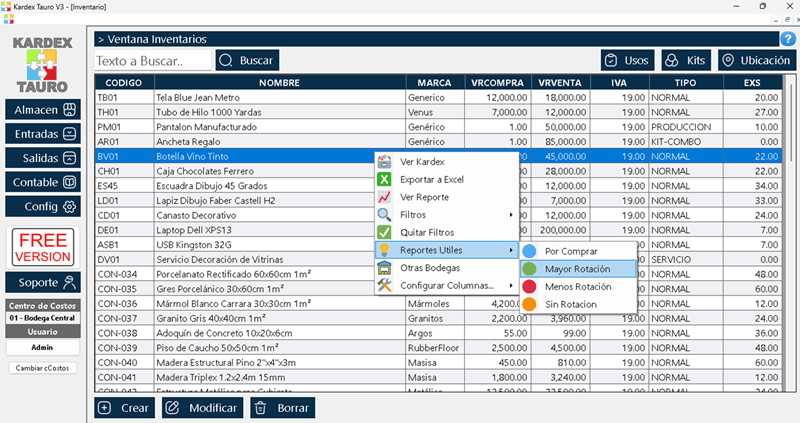
What does apply in every case: one accountable person, a monthly sample count, a signed record for every movement and a reconciliation at close. With that, the gap between what exists and what the books say is explained in one afternoon, and the asset inventory becomes the cheapest anti-corruption control a company has. In Kardex Tauro, fixed assets are handled with the same code and movement logic as the rest of the inventory, in case that integration fits your operation.