Branch and agency accounting: how to separate results

Branch and agency accounting: how to separate results
Once the second location starts selling, the owner's question changes. It is no longer how much the business sells, but how much each location leaves. If the branch is kept in the same accounts as the head office, that question has no answer: rent, merchandise, payroll and the cash that travels between sites all land in a single figure. Here is the method to separate results by location with reciprocal accounts, allocate shared costs and consolidate without inflating assets or doubling sales.
Why separate the books for each location
A branch measured with the head office accounts cannot be evaluated. The consolidated result says the company earns, but not whether the second location pays for its own operation or lives off the first. That difference decides whether a third store opens or the second one closes.
Separating by location solves three things. It shows each location's margin against its own history. It orders municipal obligations: the municipal industry and commerce tax (ICA) is settled on the activity carried out in each jurisdiction, so you must know how much was sold in each municipality. And it makes pricing defensible: the north store charges more because of its own cost, not because of an average that belongs to nobody.
This is not about opening a parallel set of books: the same system records every transaction with the location that originated it, and the total remains one.
Branch, agency and point of sale: what sets them apart
In everyday speech any location other than the main one is called a branch, but the figures are not equivalent and the accounting changes with each.
A branch, under Colombian commercial law, is a place of business opened by an already incorporated company, under the same legal personality, with its own management and some room to contract and invoice. It is not a different company: it is the same one elsewhere, so its books branch off the parent's and its statements are combined, not consolidated in the technical sense.
A commercial agency is another figure: an independent merchant who promotes business on someone else's account. It is not an own location and keeps no branch books; it generates commissions. A point of sale, by contrast, is an operating unit inside one establishment — a register, a counter — and is controlled as a cost centre.
| Figure | Legal personality | Keeps its own books? | What is measured there |
|---|---|---|---|
| Branch | The same as the head office | Yes, segmented, with reciprocal accounts | Own result, capital consumed, municipal obligations |
| Commercial agency | Independent merchant | No; booked as commission | Commission accrued and agent receivables |
| Point of sale or register | The same as the establishment | No; cost centre | Shift sales, cash count, shrinkage |
| Warehouse or distribution centre | The same as the head office | Yes, as a logistics cost centre | Operating cost, service level, inventory |
| Subsidiary | A separate company with its own tax ID | Yes, complete and independent | Own statements, later consolidated |
The costliest confusion is treating a branch as a subsidiary: without a separate company there are no stand-alone statements for third parties, only segmented books for management.
Reciprocal accounts: how they work
Reciprocal accounts are the heart of the matter: a pair of mirror accounts, one at the head office recording what the branch owes it, and one at the branch recording what it owes the head office. Every entry in one must carry the same amount and the opposite sign in the other. If they do not match at closing, something is wrong: goods shipped and not received, a transfer booked twice, or an expense paid by the wrong site.
The mechanics are simple. When the head office hands something to the branch, it debits the reciprocal account — what the branch now owes — and credits the inventory outflow. On receipt, the branch debits inventory and credits its reciprocal account with the head office. Neither records revenue: it is a transfer within the same equity, with no transfer of ownership.
At consolidation those two accounts are eliminated because they represent the same relationship seen from both sides. If they are not, assets are inflated by a receivable the company holds against itself. Numbering depends on the chart of accounts — usually a subaccount under receivables, group 13, mirrored in payables, group 23 — but symmetry cannot change.
| Transaction | Entry at the head office | Entry at the branch | Elimination on consolidation |
|---|---|---|---|
| Goods shipped for 20,000,000 | Debit branch reciprocal 20,000,000 / credit inventory 20,000,000 | Debit inventory 20,000,000 / credit head office reciprocal 20,000,000 | Both reciprocals are offset; balance zero |
| Branch cash remitted to the head office | Debit bank / credit branch reciprocal | Debit head office reciprocal / credit bank or cash | Offset; no receivable or payable remains |
| Supplier paid by the head office on the branch's behalf | Debit branch reciprocal / credit bank | Debit expense or inventory / credit head office reciprocal | Offset; the expense stays with the branch |
| Branch sale to a final customer | No entry | Debit cash or bank 35,000,000 / credit sales 35,000,000 | Not eliminated: revenue from a third party |
Moving goods and cash between locations
Goods transfers need three controls. The first is documentary: an internal transfer note with date, number, origin and destination warehouse, detail and cost, signed by the person who hands over and the one who receives. Without that paper, the reciprocal is a balance with no explanation.
The second is the goods-in-transit account. If the truck leaves on Friday and arrives on Monday, the month-end close finds the goods in neither warehouse. A transit account opened on dispatch and closed on receipt is the only way physical and book inventory count the same.
The third is the decision not to invoice. A transfer between establishments of the same taxpayer is not a sale: there is no transfer of ownership, no VAT and no revenue. If your operation invoices internally for control, that document does not change the nature of the event and inflates group sales; it must be reversed on consolidation, and that reversal is always forgotten.
Cash follows the same logic. The branch collects and remits the surplus; the head office pays suppliers or payroll for it. Every movement goes to the reciprocal, never to revenue or expense. Cash in transit is recorded as such until the other site confirms the deposit.
Revenue, cost and expenses that belong to the branch
One rule: each location records what actually happens in it. If the customer negotiated in the store, took delivery there and paid there, the sale belongs to that location. If the order was taken at the branch but shipped from the central warehouse, set the criterion in writing: the practical choice is to attribute the sale to the location that invoiced it.
Cost is that of the goods actually sold there, valued at transfer cost. If the transfer carries an internal price with a margin, that margin is nobody's profit until the goods leave to a third party; on consolidation it is eliminated as unrealised margin in inventory. This is the most frequent technical error in groups with internal prices.
Own expenses are the ones identifiable without argument: assigned payroll, store rent, utilities with a separate meter, security, cleaning, maintenance and commissions. Head office structure is not an own expense: management, accounting, audit and brand advertising are allocated, not charged.
Shared costs: how to allocate them
No allocation basis is neutral. Allocating by sales punishes the branch that sells most; by square metres it favours the small, high-turnover store; by headcount it only fits people costs. The choice changes each location's result without a single peso of the operation changing.
- Measured consumption: the best basis when it exists. Sub-metered power, metered water, calls by extension.
- Square metres: reasonable for rent, security, cleaning and property insurance.
- Sales or units shipped: acceptable for logistics and billing costs, with the caveat above.
- Headcount: useful for central payroll, recruiting and training.
- Capital invested: the most defensible basis for finance and structure costs.
Three rules keep allocation from becoming a monthly argument. Write it down and communicate it. Keep it stable: changing it every month prevents comparison, and if it must change, apply it forward. Allocate only what cannot be measured; anything measurable goes direct.
Month-end close and consolidation
Closing with branches has an order that cannot be altered. Skip one step and the consolidated figures no longer add up, and nobody knows why.
- Cut off on the same day at every location. Different closing dates produce orphan transfers.
- Reconcile inventory: a physical count, or at least transfer notes shipped against notes received.
- Reconcile the reciprocals entry by entry, not just by balance. Two opposite errors can leave the balance at zero and the account wrong.
- Post adjustments at the location that originated them, never at the head office for convenience.
- Close each location and issue its own income statement.
- Eliminate the reciprocals and, if there is an internal price with a margin, the unrealised margin.
- Issue the combined statement and check: combined assets equal the sum of the locations minus eliminations.
The seventh step is the one almost nobody performs. The combined statement is not the sum: it is the sum minus what the company owes itself and minus profit not yet realised with third parties.
The worked example: 20,000,000, 35,000,000 and 11,000,000
A head office ships goods to its branch for 20,000,000 at cost. At the head office, the branch reciprocal is debited for 20,000,000 and inventory is credited for the same amount. At the branch, inventory is debited for 20,000,000 and the head office reciprocal is credited. Nobody recorded a sale, because there was none.
The branch sells all of that merchandise for cash at 35,000,000 and pays 4,000,000 of its own expenses. Its result is 35,000,000 minus 20,000,000 minus 4,000,000, that is, 11,000,000. The head office has no revenue from the shipment: it was a transfer.
| Item | Head office | Branch | Simple sum | Elimination | Consolidated |
|---|---|---|---|---|---|
| Reciprocal receivable | 20,000,000 | — | 20,000,000 | (20,000,000) | 0 |
| Reciprocal payable | — | 20,000,000 | 20,000,000 | (20,000,000) | 0 |
| Sales | 0 | 35,000,000 | 35,000,000 | 0 | 35,000,000 |
| Cost of sales (deduction) | 0 | (20,000,000) | (20,000,000) | 0 | (20,000,000) |
| Own expenses (deduction) | 0 | (4,000,000) | (4,000,000) | 0 | (4,000,000) |
| Profit for the period | 0 | 11,000,000 | 11,000,000 | 0 | 11,000,000 |
The simple sum shows 20,000,000 of the reciprocal on each side: 40,000,000 of assets and liabilities the company owes itself. Eliminate them and consolidated profit stays at 11,000,000, exactly the branch's, because the head office earned nothing on the transfer. If nobody eliminates, assets are inflated by 20,000,000.
How to judge a branch without punishing it for allocations
A branch is not judged on its final profit, because that figure depends on decisions it did not take: which central costs were charged to it and on what basis. It is judged with a three-step ladder and one measure of capital.
The first step is contribution margin: sales minus cost of goods sold minus own variable expenses. It says whether the store contributes by existing. The second is own result before allocations, adding its identifiable fixed costs. The third is profit after allocations, useful for the consolidated view but poor for evaluation.
The measure missing from most dashboards is the capital the location consumes: average inventory, fixed assets, customer receivables and minimum cash. A branch with 11,000,000 of profit and 40,000,000 of capital returns 27.5%. Another with 8,000,000 and 15,000,000 returns over 50%. The second is the better business even with lower profit, and without the division nobody would see it.
A branch on the parent's tax ID versus a separate company
This decision carries more consequences than any other and is usually settled by habit. A branch has no independent tax ID: it shares the taxpayer's and is identified as an establishment, with its code in the RUT (the tax registry) and its commercial registration at the chamber of commerce of the municipality where it operates. The income tax return is a single one for the whole company; what multiplies is the municipal obligation in each jurisdiction.
Set up a separate company instead and you get its own tax ID, complete books, stand-alone statements and, where there is control, a duty to consolidate under financial reporting standards. Related-party rules also appear, whose application depends on the case and should be confirmed with your accountant before setting internal prices.
For electronic invoicing, each point of sale usually needs its own prefix and authorised numbering range. A store invoicing under another's prefix complicates traceability. Check the municipal registration too: operating in a municipality without registering there exposes you to penalties that stay invisible in the income statement until they arrive.
What to check in your accounting software before the second location
Many branch problems are configuration, not accounting, and they surface late. Before opening the second store, check that the system can:
- Record every transaction with a location or cost centre, without a second set of books.
- Handle reciprocal accounts with an internal third party and inter-location reconciliation.
- Assign an invoicing prefix and numbering per point of sale.
- Control inventory by warehouse, with a transit account between locations.
- Issue income statements by location and consolidated in the same report.
- Close a period for one location without blocking the others.
If any of these needs recurring manual work — a parallel spreadsheet, for instance — the cost is paid every month and grows with each new location.
Common mistakes
These five repeat in almost any operation with more than one location.
| Mistake | Symptom you see | Consequence | Fix |
|---|---|---|---|
| Invoicing the transfer between locations as a sale | Group sales grow with no new customers | Duplicated revenue, non-existent VAT and fake margin | Book the transfer against the reciprocal, with no revenue |
| Not eliminating the reciprocals on consolidation | Assets grow faster than the operation | Inflated balance sheet and misread equity | Eliminate the full pair, not just one side |
| Charging all shared costs to the branch | The branch loses and the head office earns | A profitable location is closed over an allocation | Allocate on a written basis and evaluate before allocating |
| Judging the branch on profit without capital | Two locations compared only on profit pesos | The location consuming most capital gets rewarded | Compute result over capital invested in the location |
| Closing the branch without reconciling reciprocals | An orphan reciprocal balance after closing | Uncollectible receivable and unsupported adjustment | Reconcile and cancel the pair before closing the location |
There is a sixth mistake with no accounting trace: changing the allocation basis in the month the branch was going to look bad. When allocation is tuned to the desired result, the system stops serving decisions and only serves justifications.
An honest close before you decide
None of this replaces your accountant. Segmented books are a management tool: they improve decisions but create no separate tax obligations where the law sees a single taxpayer. If your operation is small, with one store and fewer than ten employees, this can cost more than it delivers; a cost centre and a profit and loss by business line is enough.
It also fails without discipline: reciprocals reconciled every three months, transfers without a note and closings on different dates produce a statement that looks like a financial statement but is not one. Before opening the third location, make sure the second closes clean.
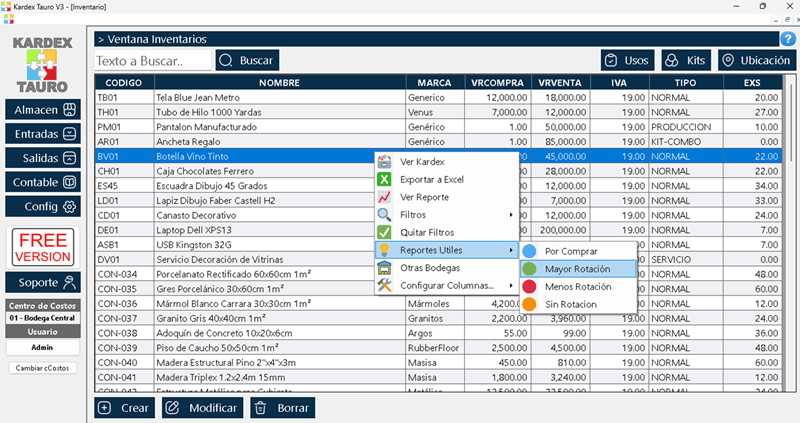
A branch is measured by its own result and the capital it consumes, never by the internal price at which goods are sent to it. If the system records every transaction with its location, keeps reciprocals symmetrical and consolidates by eliminating what the company owes itself, the conversation stops being about figures and becomes about decisions. Tools such as Kardex Tauro let you keep that location-level accounting inside the same system where you already invoice and control inventory.