Chart of accounts: how to build the catalog for a small business
Chart of accounts: how to build the catalog for a small business
The chart of accounts is the list your company uses to classify every transaction: where money comes in, where it goes out, what is still owed and what was earned. When the system ships with a thousand accounts and nobody on the team knows which one to hit, the software is not the problem. The catalog is. This article explains how to trim it to what the business actually uses, how many auxiliary accounts to open, how to record a purchase and a sale with that structure, and how to change it without throwing the balances out of balance.
One warning before we start: the codes in this article are illustrative. The numbering of the Colombian chart of accounts is set by the accounting rules, and your company is not required to use exactly these numbers. What you must respect is the logic of the levels and the meaning of each line item. Before you lock codes into the system, confirm the current version of the catalog with your accountant.
What the chart of accounts is and what the rules fix
The chart of accounts is a coded, ordered structure that classifies a company's assets, liabilities, equity, revenue, expenses and cost of sales. It is not a list of names: every account has a dynamic, meaning a rule about what increases it and what decreases it. Cash goes up when money comes in and down when it goes out. Revenue goes up on the credit side. An expense goes up on the debit side. If the team is not clear on that dynamic, no catalog will save them.
The rules fix the structure down to a certain level and leave an open stretch for each company to add its own detail. That is why two small businesses in the same industry can have different catalogs and both be correct. The obligation is not to record every peso in the most specific account that exists; it is that the balances can be read and reported under the structure the authority requires. Confusing those two things is where most bloated catalogs come from.
It also helps to separate two documents that usually get mixed up: the official catalog, updated by regulation, and the company's internal catalog, the one loaded into the system. The second lives inside the first and can be much shorter. Nobody audits a small business for failing to use an export subaccount it does not have.
The levels: class, group, account, subaccount and auxiliary
The structure reads left to right and each pair of digits adds detail. The class states the nature of the balance. The group gathers accounts from the same family. The account is the line item that ends up on a financial statement. The subaccount breaks that item down. The auxiliary is the last stretch and belongs to the company, not to the rules: that is where you decide whether detail is tracked by branch, by cost center or by type of transaction.
| Level | What it defines | Illustrative example | Who decides it |
|---|---|---|---|
| Class | Nature of the balance | 1 assets | The rules |
| Group | Family of related accounts | 11 cash and banks | The rules |
| Account | Line item on the statement | 1105 cash | The rules |
| Subaccount | Detail of the line item | 110505 general cash | The company, within what is allowed |
| Auxiliary | Operating and control detail | general cash, north branch | The company |
There is a practical consequence people overlook: the deeper you record, the harder it is to consolidate. An entry posted to the wrong subaccount can be reclassified; an entry spread across twenty invented auxiliaries forces you to reconstruct history. The first three levels are the shared language with your accountant and with the authority. The last two are your management system. Do not mix them.
Why you should not use every account in the catalog
A complete catalog does not make a company better, just as a complete dictionary does not make a better writer. Copying everything the system offers has three measurable effects. The first is hesitation: whoever posts the entry stops to search among similar options and picks the one that sounds right. The second is inconsistency: two people classify the same transaction in different accounts and the report stops being useful. The third is the learning cost, which a small business with staff turnover pays every six months.
There is also a silent effect: when the catalog is enormous, people start using the generic account. Everything nobody understands ends up in "other expenses" or in "miscellaneous receivables". The catalog is complete and the information is useless. A plan with eighty accounts everyone understands is worth more than one with a thousand nobody masters.
And there is an internal control argument that rarely gets mentioned: every extra account is a place where an error or a shortage can hide. Reviewing eighty balances is feasible. Reviewing a thousand is not. Brevity is also control.
How to choose a small business catalog in six steps
The method does not start with the catalog; it starts with the operation. Start with the list and you will end up with a list.
- List the real transactions from the last twelve months. Purchases, sales, payments, collections, payroll, taxes, loans, fixed expenses. No theory: what actually happened, and how often.
- Group them by cycle. Cash and banks, receivables, inventory, suppliers, taxes, payroll, revenue, cost of sales, expenses. Almost everything falls into one of those nine.
- Assign each transaction to the lowest level that already distinguishes it. If main cash and petty cash are controlled separately, they go in subaccounts. If nobody reviews them separately, they do not.
- Move up one level anything used less than once a month. An account that moves twice a year does not need detail; it needs to exist at the level where the accountant can find it.
- Open auxiliaries only where someone will read the detail and act on it. If nobody will look at the report, the auxiliary is decoration.
- Test the catalog with three real transactions and with the monthly report. If a transaction does not fit without forcing an account, the catalog is badly built, not the transaction.
In a Colombian trading company the typical result lands between sixty and one hundred active accounts, subaccounts included. A service company drops to fifty or seventy. If your count passes two hundred and the company is not large, something was copied that should not have been.
Auxiliary accounts: how many and what for
The auxiliary is the level where accounting becomes useful for running the business. You open one when there is a question that only that detail can answer: how much each customer owes, how much is owed to each supplier, what each branch costs, what the inventory in each warehouse is worth.
The costliest mistake is opening one auxiliary per customer from day one. In most systems, detail by third party is achieved with the identification field on the transaction — the tax ID or document number — not by creating three hundred auxiliaries. Auxiliaries are reserved for stable, few groupings: banks, cash registers, warehouses, branches, cost centers, revenue types when margin is analyzed by line.
A simple rule: if the list of auxiliaries does not fit on one screen, there is too much detail. Another: if an auxiliary has no movement in the quarter, close it. And a third, the most important: every auxiliary needs one written sentence saying what goes there and what does not. Without that sentence, the auxiliary fills with junk within three months.
Accounts you always need and accounts you don't
There is a core no small business avoids. Cash and banks, customer receivables, inventory if it sells goods, deductible VAT, output VAT, withholding taxes, suppliers, payroll obligations, revenue from the main activity, cost of sales if it trades or manufactures, administrative expenses, selling expenses and financial expenses. With that you can operate, file and apply for credit.
| Operating cycle | Minimum accounts | What the detail is for |
|---|---|---|
| Cash and banks | General cash, petty cash, one account per bank | Reconcile counts and statements |
| Receivables | Domestic customers, customer advances | Know who owes and for how long |
| Inventory | Goods held for sale, raw materials if manufacturing | Value stock and cost of sales |
| Suppliers | Domestic suppliers, sundry payables | Schedule payments, avoid duplicates |
| Taxes | Deductible VAT, output VAT, withholding, municipal turnover tax | Build the return without recalculating |
| Payroll | Wages payable, severance, social security, payroll contributions | Meet payments and provisions |
| Revenue and cost | Revenue by activity, returns, cost of sales | Calculate true margin by line |
| Expenses | Administrative, selling, financial | See where the money goes |
What is left over is easier to list. Accounts for operations the company does not perform: exports, construction, farming, mining. Subaccounts of detail nobody ever queries. Accounts inherited from a previous system, kept out of fear. "Sundry", "other" and "to be classified" accounts, which are not accounts but a drawer. And accounts from closed years, which get deactivated rather than deleted.
A full example: one purchase and one sale with auxiliaries
With the level structure in place, a complete transaction is recorded without ambiguity. Purchase of goods for 2,000,000 plus VAT of 380,000, on credit from the supplier. The invoice total is 2,380,000. Debit inventory for 2,000,000, debit deductible VAT for 380,000 and credit domestic suppliers for 2,380,000. Debits add up to 2,380,000 and the credit matches: the entry balances.
| Transaction | Account | Debit | Credit |
|---|---|---|---|
| Purchase of goods | 1435 goods not manufactured by the company | 2,000,000 | |
| VAT on the purchase | Deductible VAT | 380,000 | |
| Debt with the supplier | 2205 domestic suppliers | 2,380,000 | |
| Cash sale | 110505 general cash | 3,570,000 | |
| Revenue from the sale | 4135 wholesale and retail trade | 3,000,000 | |
| VAT on the sale | Output VAT | 570,000 |
The sale is 3,000,000 plus VAT of 570,000, collected in cash: 3,570,000 comes into cash, revenue of 3,000,000 is recognized and output VAT of 570,000 is booked. The cost of the goods sold goes in a separate entry, debiting cost of sales and crediting inventory; mixing it with revenue is one of the fastest ways to lose your margin. A catalog of eighty accounts covers this whole transaction without opening a single new account.
Both VAT accounts need their own line from day one: deductible VAT is netted against output VAT on the return, and if you merge them into one tax account, every filing turns into archaeology.
How to document and control a change to the catalog
A catalog without documentation is oral tradition, and oral tradition dies with the first resignation. The minimum tool is one sheet per account with five fields: code, name, what goes there, what does not go there, and the fallback account when the case is doubtful. That sheet lives where the team can read it, not in the accountant's inbox.
Changes happen in January, when the period opens, not in May. If there is a strong reason to do it mid-year, the procedure is always the same: create the new account, move the balance with a reclassification entry that leaves a trail, deactivate the old one and note the date and the reason. Never delete an account with movements: deactivate it. Deleting breaks history and leaves gaps nobody can explain later.
It also pays to version the catalog the way you version a contract. A list with an effective date, a record of who requested the change and who approved it, and a test run in a sandbox before touching the live database. In a company with several branches, the change is communicated before it is applied; otherwise the first invoice of the following month goes out with the old account.
Signs that the catalog became too small
The opposite problem exists too, and it is easier to spot than it seems. If the "other" account moves more than once a week, the catalog has nowhere to put what is happening. If an auxiliary has more movements than the account itself, the detail is in the wrong place. If two people classify the same kind of expense in different accounts, a written definition is missing.
Some signals come from outside. The accountant asks for a detail the system does not produce. The manager builds a separate spreadsheet to find out how much was spent on freight. At closing, someone reconciles by hand a balance that should come out on its own. And the most telling one: the expense report by line item exists, but nobody uses it to decide anything.
None of these signals requires rebuilding the whole catalog. Almost always it is enough to open two or three accounts, move one auxiliary up a level and write the definition that was missing. The catalog is fixed by surgery, not demolition.
Common mistakes
The five mistakes that repeat most in Colombian small businesses share a pattern: they are made in the first month and paid for over years. It is worth recognizing them by the symptom, not by the name.
| Mistake | Symptom | Consequence | Fix |
|---|---|---|---|
| Copying the entire catalog | Thousands of accounts, nearly all at zero | Slow, erratic classification | Trim to what moves during the year |
| One auxiliary per customer | Hundreds of auxiliaries with two entries | Unreadable receivables, slow closes | Use the third-party field, not the auxiliary |
| Changing structure mid-year | Balances that no longer tie after the change | Inconsistent financial statements | Reclassify with an entry and leave a trail |
| Generic account for everything | "Other" grows every month | Expense detail is lost | Define what goes in each account and review it |
| No documentation for auxiliaries | Everyone uses their own | Data that cannot be compared month to month | One sheet per account with written criteria |
The first mistake usually comes from good intentions: leaving everything ready for the future. The second, from wanting to control receivables in fine detail without measuring the cost of doing so. The third, from urgency. The fourth, from the rush of closing. The fifth, from trusting that everyone understands the same thing. None of them is fixed with more software.
What changes if your company sells services or only trades goods
The operating cycle decides. A trading company needs inventory and cost of sales kept apart, because its margin is calculated there. If it sells several lines and wants to know which one makes money, it needs revenue and cost by line; without that, total margin is an average that hides the problem. A service company has no inventory: its cost is labor, hours and tools, and the cost center matters more than the type of expense.
If it manufactures, the matter goes one level deeper: raw materials, work in process and finished goods are three different inventories and cannot be merged into one account, because the cost of the month could not be calculated. If it has several branches, an auxiliary per branch is almost mandatory; with a single site, it is noise.
And if the company is mixed, the rule is one: separate revenue by line and cost by line, or the margin will lie to you.
An honest closing before you decide
This method does not replace your accountant. The final catalog is validated by whoever signs the financial statements, and there are cases with less room to maneuver: regulated companies, groups that consolidate, businesses reporting to a parent company or under recurring audit need a more rigid, less trimmed structure than a family-owned small business. If your company is in that group, this does not apply as written: use the frequency criterion, but check every change before making it.
It also does not work if nobody will read the account sheet. A catalog of eighty accounts without written definitions degrades just like one of a thousand, only more slowly. Documentation is half the work and it is the half that almost always gets skipped.
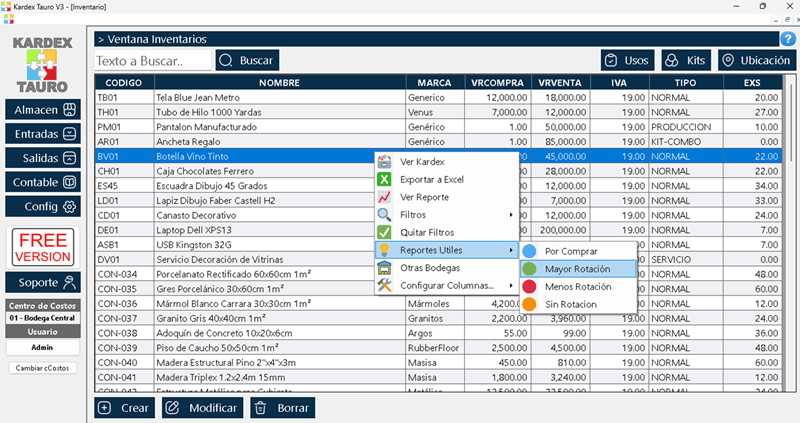
Think of the catalog as the grammar of accounting: it defines what can be said and how. It is adjusted once a year, calmly, looking at what the operation actually did; not every month, in the middle of an urgent invoice. In Kardex Tauro the chart of accounts is loaded once and maintained from the same system where purchases, sales and inventory are recorded, which lowers the risk of accounting and operations speaking different languages.