Occasional gains in Colombia: what triggers them and how to report them

Occasional gains in Colombia: what triggers them and how to report them
Selling a machine, inheriting a property or winning a raffle can all land in the same block of the annual income tax return, yet each case has different requirements and different rates. The expensive mistake is almost never in the form: it is in the label. A one-off inflow that is classified the wrong way makes the company overpay, or leaves it exposed in an audit.
This guide explains which events trigger an occasional gain and which do not, how the tax cost is built, how the gain is reported and what to check before applying a rate. The percentages shown further down are assumptions from a worked exercise and are flagged as such. They are not current rates: the applicable figure must be verified for the tax year being filed.
Which events trigger it and which do not
An occasional gain arises from an inflow that does not come from the ordinary course of business and that also meets a test of time or origin. Colombian law defines it by list: disposal of assets held two years or more, inheritances and legacies, donations, lotteries, raffles and bets, and certain long-term yields. If the event is not on that list, it is not an occasional gain, however large and sudden the inflow may be.
The most common confusion sits in inventory. A delivery company that sells a motorcycle bought four years ago books an occasional gain. The same company selling tyres bought four years ago does not: tyres are inventory, not fixed assets, and their sale is ordinary income. Holding time does not turn merchandise into a fixed asset. What governs is the nature of the item in the business, not the purchase date.
Another frequent misunderstanding: dividends received, interest on a one-year certificate and rent from a warehouse are not occasional gains. They are reported in another block, under other rules. Neither is the margin on a finished product, nor a customer advance.
| Event | Requirement to meet | What to check |
|---|---|---|
| Sale of a fixed asset | Held two years or more and used in operations | Date on the acquisition document and the accounting record |
| Sale of an item that is inventory | Does not apply: always ordinary income | How the item was classified when purchased |
| Inheritance or legacy | Awarded in the estate settlement | Asset inventory and the award deed |
| Donation | Gratuitous transfer of the asset | Transferred value, tax cost and the relationship between the parties |
| Lottery, raffle or bet | Prize paid by an authorised operator | Prize certificate and withholding certificate |
| Sale of goods in the ordinary course | Does not apply: it is operating revenue | That it was not reclassified as a fixed asset without support |
The difference from ordinary income and why it matters
Ordinary income is added to the other income of the year, accepts the costs and deductions of the activity and ends up at a progressive rate for an individual or the corporate rate for a company. An occasional gain goes in a separate block: it is not merged into the general schedule, it does not accept business deductions and it is taxed at a single flat rate, different depending on the taxpayer and on the event that produces it.
That is why the label changes the result. The same peso of profit can pay one rate or three times that, and the gap cannot be fixed later with a deduction. On top of that, occasional losses do not offset ordinary income, and ordinary losses do not reduce an occasional gain. They are two separate buckets. If the accountant mixes them, the return adds up at the bottom but is badly built inside.
Sale of a fixed asset held for more than two years
This is the case that shows up most often in a small business. The van, the packing machine, the premises or the computer equipment that is no longer used goes out the door. The core requirement is time: the asset must have been in the seller's patrimony for two years or more. The count is in months, not accounting periods, and it is proven with the purchase invoice, the deed or the import document.
The second requirement is that it be a fixed asset, meaning an item the company uses to operate rather than to sell. A fleet vehicle is a fixed asset; a vehicle a dealer keeps on the showroom floor is inventory. That distinction is decided at purchase and recorded in the books. If an item was bought to be sold and ended up in use, the reclassification needs support.
The third point is the transfer date. If the asset crosses two years and a day, the profit goes to occasional gain. If it is three months short, it is ordinary income, even when a purchase agreement was signed earlier. What counts is the transfer of ownership, not the negotiation or the deposit. For registered assets, the relevant date is the registration date.
Tax cost: what is subtracted and what is not
An occasional gain is not calculated on the sale price. It is calculated on the difference between the price and the tax cost of the asset, minus the expenses directly tied to the sale. Tax cost is not the price once paid: it is acquisition cost minus accumulated depreciation, plus capitalised improvements and exchange adjustments where they apply.
That detail explains an expensive mistake. An asset bought for 80,000,000 and depreciated by 30,000,000 has a tax cost of 50,000,000, not 80,000,000. Subtracting the full purchase price understates the gain by 30,000,000 and makes the company report less than it owes. Depreciation was already deducted year after year; deducting it again on sale is not possible.
Sale expenses are subtracted, provided they are necessary and documented: brokerage commission, a required appraisal, notary fees, registration tax, transport of the asset. General administration expenses are not subtracted, nor is interest on the loan used to buy the asset, nor the depreciation of the year of sale.
| Item | Included in the calculation? | Why |
|---|---|---|
| Acquisition cost | Adds to the tax cost base | It is the starting point of cost |
| Accumulated depreciation | Subtracts from tax cost | It was already deducted over the asset's life |
| Broker commission | Subtracts as a sale expense | It is a necessary cost of the transaction |
| Notary, registry and transport | Subtracts as sale expenses | They arise from the transfer itself |
| General administration expenses | Not included | They are not attributable to the sale |
| Interest on the purchase loan | Not included | It belongs to another period and another deduction |
| Depreciation of the year of sale | Not included as a sale expense | It is already inside accumulated depreciation |
Inheritances, legacies and donations
In an inheritance, the occasional gain is not generated by the deceased: it is generated by the heir or legatee who receives the asset. The base is not what the deceased paid for it, but the value assigned to it in the estate settlement, following the rules of that settlement. That is why the asset inventory and the award deed are the documents that support the figure.
The law provides exemptions for certain assets, with caps expressed in UVT (the tax value unit). The best known covers the house or apartment used as a residence by the deceased and the heirs, subject to conditions of permanence and use. The cap changes every year with the UVT and the conditions depend on the family relationship: check the value for the year and the current wording before applying it. A wrongly claimed exemption is a classic audit finding.
Donations follow logic similar to a sale: value transferred minus the tax cost of the asset, with specific rules when donor and donee are related parties. Reporting a donation as ordinary income, or not reporting it because "there was no sale", are two ways of getting it wrong. The triggering event is the transfer, not the payment.
Lotteries, raffles and similar
Prizes from lotteries, raffles, bets and games of chance are occasional gains by origin, not by holding period. There is no tax cost to subtract: nobody paid for the winning ticket beyond its price, so the prize is almost pure income. The law assigns them a rate of their own, higher than the rate for the other events, and that rate is the one to confirm for the year.
In practice the operator withholds tax at the moment of payment. The winner receives the net prize plus the withholding certificate. That certificate is the supporting document that goes into the return: if it is not kept, the taxpayer ends up paying twice or arguing over a credit balance it cannot prove.
One detail that surprises people: the prize is reported in full, not net of withholding. If the prize was 100,000,000 and 80,000,000 reached the account, the gross figure goes into the return and the withholding appears as an advance payment. Reporting only what arrived leaves income unexplained and an advance unused.
What happens when the asset sells below tax cost
There is not always a gain. If the sale price is lower than the tax cost plus expenses, the result is a loss and there is no occasional gain to tax. The sale is still reported, with its support, but the effect is different. And the loss is not automatically offset against other income: the offset rules depend on the nature of the asset and on the year.
A typical case: equipment bought for 120,000,000, depreciated by 40,000,000, tax cost 80,000,000, sold for 65,000,000 with expenses of 1,500,000. The result is a loss of 16,500,000. That amount does not reduce the occasional gain from another sale unless the rules allow it, so confirm with your accountant rather than forcing it into the form.
How to report it: form, supporting documents and deadline
An occasional gain is reported in the annual income tax return, in the occasional gains block, separate from the general schedule. For a resident individual there is no separate form: it goes inside the same annual return. For a company it goes in the corporate income tax return, with the same internal separation between ordinary and occasional items.
The minimum support is four documents: proof of the acquisition date, proof of cost (invoice, deed, import declaration), the accumulated depreciation schedule if the asset was depreciable, and the sale document with its expenses. In estates, add the asset inventory and the award deed. For prizes, add the operator's certificate and the withholding certificate.
The deadline is not a single one. The income tax return has a date set by the last digit of the tax ID and by each year's calendar; the estate return has its own term, counted from the deed or the court ruling. Check the calendar for the year: filing late triggers a late-filing penalty, calculated on the tax due and increasing month by month.
Rate applicable to each taxpayer
There is no single rate for everyone. The law separates at least three situations: individual, company, and prizes from games of chance. Within each, the percentage is set by the rule in force for the tax year and can change from one reform to the next. So no figure should be taken from an article, including this one: confirm it in the year's rule or with your accountant.
What is stable is the mechanism. Identify the event, calculate the base, apply the rate for the taxpayer and the event, then subtract withholdings and advance payments. It is also stable that the occasional gains rate is not averaged with ordinary income: it is flat, not progressive, and it does not rise because you have more income of the same kind.
The practical consequence: do not copy last year's rate without checking. A change in the percentage moves the tax without touching the transaction.
Full example with both rates
A company sold a packing machine it had used for three years. Sale price: 90,000,000. Acquisition cost: 80,000,000. Accumulated depreciation: 30,000,000, so the tax cost is 50,000,000. Sale expenses: 2,000,000, split between commission and transport. The transaction closed with an invoice and a delivery record.
Occasional gain: 90,000,000 - 50,000,000 - 2,000,000 = 38,000,000. At an assumed 15 % rate for an individual, the tax would be 5,700,000. If the same asset is sold by a company and an assumed 10 % rate applies, the tax would be 3,800,000. Both percentages are assumptions of the exercise: they are not stated as current.
| Item | Individual (assumed 15 %) | Company (assumed 10 %) |
|---|---|---|
| Sale price | 90,000,000 | 90,000,000 |
| Less tax cost (80,000,000 - 30,000,000) | -50,000,000 | -50,000,000 |
| Less sale expenses | -2,000,000 | -2,000,000 |
| Occasional gain | 38,000,000 | 38,000,000 |
| Occasional gains tax | 5,700,000 | 3,800,000 |
| Comparison: ordinary income at an assumed 35 % | 13,300,000 | 13,300,000 |
| Difference against ordinary income | 7,600,000 | 9,500,000 |
Now the comparison that matters. Had the asset been sold before reaching two years, the 38,000,000 profit would have been ordinary income. At an assumed 35 % rate the tax would be 13,300,000. Against the 5,700,000 of occasional gain, the difference in treatment is 7,600,000. Against the company's 3,800,000, the difference reaches 9,500,000. The sale date moved the tax more than any price negotiation.
Common mistakes
Almost every assessment on occasional gains comes from five decisions taken without support. They are not arithmetic mistakes: they are mistakes of classification and of date. The symptom shows up in the return; the cause sits in the file.
| Mistake | Symptom in the return | Consequence | Correction |
|---|---|---|---|
| Treating as occasional the sale of an asset held less than two years | High occasional gain and low ordinary income | Less tax than owed and an accuracy penalty on audit | Recalculate the profit as ordinary income and amend |
| Subtracting the purchase price without discounting depreciation | A base lower than the real one | Understated gain and a gap against the accounting records | Use acquisition cost minus accumulated depreciation |
| Forgetting the sale expenses | A base higher than the real one | Overpayment and a documented right given away | Add commission, notary, registry and transport |
| Reporting an inheritance as income without selling the asset | Ordinary income for an asset nobody disposed of | Economic double taxation and a dispute with the tax authority | Report it in the occasional gains block, with the award deed |
| Applying the individual rate to a company | Tax that does not match the taxpayer type | Tax difference and a possible penalty | Identify the taxpayer before applying the percentage |
When this does not apply and what to check first
This article is not meant to close a return. It is meant to get you to the conversation with your accountant knowing what to ask. The correct label depends on three concrete facts: what was sold or received, how long it was held and what the documented tax cost is. If one of the three is missing, any calculation is a guess.
There are cases where this does not apply, and it is worth saying so. Goods in the ordinary course of business, transactions between related parties, assets that changed use halfway through, estates holding assets abroad and sales with deferred payments all have rules of their own that do not fit a general guide. In those cases the risk of a wrong label outweighs the saving being chased.
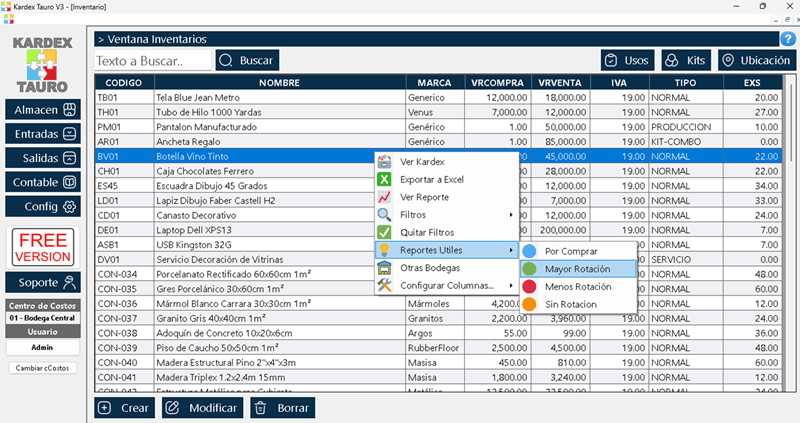
Before signing, check three things: that the acquisition date is documented, that the tax cost includes accumulated depreciation, and that the sale expenses have invoices. With those three in place, a discussion with the tax authority is won or lost in the file, not in the form. Inventory and accounting software that keeps the asset record, its depreciation and its disposal history makes that trail easy to follow; Kardex Tauro keeps it in the same system where the invoice is issued, which saves the last-minute search.