Tax deductions: which ones the DIAN accepts and what support they require

Tax deductions: which ones the DIAN accepts and what support they require
Your accountant shows you a profit of 38 million and the income tax return settles on 92. The expense existed, it was paid and it even has an invoice, but the DIAN did not accept it as a deduction. That gap is not closed with better estimates: it is closed with four proven conditions and a file that survives a review. Here is the test the authority applies, the documents that hold up, a worked example and the real cost of an expense that loses its deduction.
What is deductible and what is only an accounting expense
Accounting and the income tax return answer different questions. Accounting measures the result of the period and records an outflow when equity decreases. The return measures the taxable base, and for that it has its own list of what can be subtracted and what cannot.
Three situations live side by side in the same income statement. An expense can be both book and deductible, such as the rent on the warehouse. It can be book and non-deductible, such as the traffic fine on the manager's pickup. And it can be deductible without being recorded as an accounting expense, such as the tax amortization of an investment.
The book expense lives in the income statement; the deduction, in the costs and deductions line of the return. When the two figures do not match there is no error: there is a reconciliation that someone must be able to explain with documents.
The underlying mistake is treating a deduction as a reward for having spent. It is the recognition of an expense that meets conditions and is also proven. If either half is missing, the return gives the item back and charges for the difference.
The four conditions: causality, necessity, proportionality and support
Article 107 of the Colombian Tax Statute asks for three things before accepting a deduction: a relationship of causality, necessity and proportionality. Support does not appear in that article, but without it the argument is lost anyway, because the rule on supporting documents requires a valid document and a verifiable payment. There are four conditions, and the weakest one decides the outcome.
Causality is the link between the expense and the activity that produces the income. It is not enough for the expense to belong to the business: it has to explain why that business needed it. Necessity asks whether the operation can be sustained without that expense; a useful but dispensable cost is hard to defend. Proportionality compares the amount with the size and nature of the operation: a 40-room hotel pays for advice on a different scale than a 400-room chain.
Support is the proof. A document the rule accepts, a traceable payment and, where applicable, withholding tax actually applied. Without that fourth element, the other three are good intentions.
| Condition | Question it answers | How it is proven in the file |
|---|---|---|
| Causality | How is the expense connected to the activity that generates income? | Contract, corporate purpose, production process and a two-line note explaining the connection |
| Necessity | Does the operation work without that expense? | Process description, frequency, comparison with prior periods |
| Proportionality | Does the amount match the size of the operation? | Quotes, market rates, internal comparables, three bids when the amount is large |
| Support | Is there a valid document and a verifiable payment? | Validated electronic invoice, equivalent document, bank receipt, withholding certificate |
Typical deductions that almost always pass
There is a group of expenses the DIAN accepts with little discussion when the support is complete, because their link to the operation is obvious. Payroll and social security, rent, utilities for the premises, purchases of merchandise, freight, professional fees, commissions, insurance, equipment maintenance, depreciation of assets in use and interest on productive loans.
Almost always does not mean automatically. In payroll, the weak point is the social security filing and the real existence of the employment relationship. In rent, that the property is not the partner's home. In purchases, that a receiving report exists and not only the invoice. In fees, withholding tax. In interest, that the rate is not above market and that debt bears a reasonable relation to equity.
| Deduction | Minimum support | Point that usually fails |
|---|---|---|
| Payroll and social security | Electronic payroll, contribution filing, contract | Relationship with no filing or unclear duties |
| Rent | Contract, invoice or equivalent document, payment | Property used by the partner |
| Utilities | Provider invoice and payment receipt | Account for the partner's home |
| Merchandise purchases | Validated invoice, delivery note, receiving report | Missing receiving report or inventory |
| Fees and commissions | Invoice, contract, withholding certificate | Withholding not applied |
| Freight and transport | Invoice or equivalent document, waybill | Waybill with no origin or destination |
| Maintenance and insurance | Invoice, work order or policy | Asset that does not belong to the company |
| Depreciation and interest | Asset record, loan agreement, payment | Rate or useful life with no backup |
These expenses share one virtue: they explain themselves, and that clarity is what you want to reproduce in the less obvious ones.
The ones that almost never pass and why
The list of rejections is short and repetitive, and it is worth keeping in view before signing.
- Personal expenses of the partner paid by the company: school fees, family trips, groceries, home repairs. There is no causality, and for the partner they are income.
- Fines, penalties and late-payment interest of a tax nature: the law prohibits them outright, so it is not a question of support.
- Income tax and its surcharges: that would be deducting the tax from itself.
- Payments that were subject to withholding and were made without applying it: support fails even if the invoice is flawless.
- Purchases with no invoice or equivalent document, or with an invoice the DIAN rejected during validation.
- General provisions and receivables written off without meeting the requirements the rule sets for each case.
- Donations without the legal requirements, or given to an entity not authorized to receive them.
The pattern repeats: either there is no link to the activity, or there is an express prohibition, or the document is missing. It is almost never an accounting judgement problem; it is a proof problem.
Electronic invoicing and other valid documents
The electronic sales invoice is the base document, and its mechanics are prior validation by the DIAN: the issuer generates it, sends it to the authority's service and only after approval does it become an invoice. An XML file without validation is not an invoice, even if it looks like one.
The requirements sit in articles 617 and 618 of the Tax Statute and in the current invoicing resolution: full identification of issuer and buyer, concept, date, itemized amounts, taxes, payment method and the validation record. The list is updated often, so check the version for the current year before accepting a new format from a supplier.
Where the transaction does not require an invoice, equivalent documents exist: cash register receipts, bank statements for certain collections, utility invoices, insurance policies, transport receipts, the support document for transactions with non-invoicing parties and electronic payroll for wages. All share one condition: they identify who sells, what is sold, when and for how much.
The rule also requires payment through banking channels when the amount exceeds a threshold expressed in UVT (the tax value unit), for the expense to be deductible. Check the value in force for the year: it changes every January with the UVT.
Payments to related parties and to individuals
With related parties the question stops being whether the expense exists and becomes whether the price is a market price. If the company buys from a company owned by the same person, or from an overseas branch, the DIAN can compare that transaction with what a third party would pay. Where foreign economic ties exist and the thresholds set by the rule are exceeded, the obligation to prepare a transfer pricing study with comparables is triggered.
With individuals the risk is different. First, withholding: a payment subject to withholding that was made in full loses its deduction. Second, payments to the partner or their relatives for services that cannot be proven: no contract, no deliverables and no comparable rate, and the DIAN may treat them as a disguised distribution of profits, with a worse tax treatment than a rejected expense.
The way out is not to complicate contracts but to document them as you would with a third party: scope, price, deliverable, payment date and withholding. A contract with the owner's brother that looks like a three-line email will not hold.
Limits and conditions that change every year
Many deductions are not a yes or no but an allowed amount. The legislative technique is to set the cap in UVT, as a percentage of net income or as a ratio between variables. The peso figure therefore changes every year even when the rule does not, and a reform can move the percentage.
- Representation and travel expenses: usually capped in UVT, with conditions on the recipient.
- Donations: the allowed percentage depends on the type of beneficiary entity and the applicable regime.
- Interest and borrowing from related parties: the rule sets a debt-to-equity ratio that limits the deduction.
- Vehicles and related costs: they depend on use in the activity and on the type of vehicle.
- The financial transactions tax: it has partial treatment, not full.
Do not memorize the figures; memorize where they live. A deduction file that cites the article, the UVT for the period and the cap calculation will survive a review. A folder that only says legal limit says nothing.
How a deduction is documented in the file
The file is built per transaction, not per loose invoice. A contract or purchase order that fixes the scope. The validated invoice. The receiving report or delivery note with date, quantity and who received it. The bank payment receipt. The withholding certificate where applicable. And a short note explaining the link to the operation.
The acid test: hand the folder to someone who does not know the business and ask them to explain the expense in one minute. If they cannot, the folder is incomplete.
Digitize with a name you can search by supplier, date and concept, and keep the documents for the term the rule sets. A deduction documented today is the difference between a discussion of judgement and a penalty.
Deduction, cost and expense: three boxes that do not mix
Cost is what is consumed directly to produce what is sold: raw materials, direct labor, inbound freight. Expense is what is necessary but not direct: administration, sales, services. A deduction is the tax label applied to both when they meet the conditions.
Mixing them shifts the result between periods. If an inventory purchase is recorded as an expense, the deduction moves forward and cost of sales comes out short; if an administrative expense is recorded as cost, gross margin is inflated and operating profit stops meaning anything. In a review, the first thing reconstructed is cost of sales.
Colombian VAT has its own box. It is not an expense: it is a deductible input tax when the transaction is taxed and related to the activity, and it is capitalized into cost when it is not. Treating VAT as part of the expense when it was recoverable loses the tax credit and does not improve the deduction: you pay twice for the same mistake.
A worked example: 300 million in revenue and 130 in expenses
A trading company closes the year with revenue of 300,000,000 and book expenses of 130,000,000. Of those expenses, 100,000,000 carry a valid electronic invoice and a clear link to the operation; 20,000,000 are supported by documents that do not meet the requirements; and 10,000,000 are personal expenses of the partner that the company paid from its bank account.
| Item | Amount | Tax treatment | Accepted deduction |
|---|---|---|---|
| Revenue for the period | 300,000,000 | Starting base | Not applicable |
| Expenses with valid invoice and link to the operation | 100,000,000 | Deductible | 100,000,000 |
| Expenses with documents that do not meet requirements | 20,000,000 | Book expense, not deductible | 0 |
| Personal expenses of the partner paid by the company | 10,000,000 | Not deductible and also income for the partner | 0 |
| Total book expenses | 130,000,000 | Accepted deduction: 100,000,000 | 100,000,000 |
Net income is calculated on what was accepted: 300,000,000 minus 100,000,000 equals 200,000,000. With an assumed rate of 35% for this exercise, the tax would be 70,000,000.
Had the company deducted the full 130,000,000, net income would be 170,000,000 and the tax 59,500,000. The advantage to the company at that moment is 10,500,000. That is exactly the figure the review collects later, with penalty and interest on top.
Look at the real cost of the unsupported expense: 30,000,000 of expense, plus 10,500,000 of tax, plus the penalty and interest. The tax alone is an extra 35% on those 30,000,000. A supplier who does not invoice properly does not save you money: it moves a more expensive invoice into next year.
Frequent errors
The errors that repeat are not sophisticated: they are discipline failures.
| Error | Symptom in the return | Consequence | Correction |
|---|---|---|---|
| Deducting personal expenses of the partner | Consumer spending in a company that cannot explain it | Item rejected, higher tax and possible taxable income for the partner | Separate the partner's account and reimburse or treat as a dividend |
| Accepting invoices without requirements out of trust in the supplier | Documents rejected in validation or missing data | Loss of the deduction and of the recoverable VAT | Validate every invoice on receipt and return any that fails |
| Treating VAT as part of the expense when it is recoverable | VAT accumulated in expense accounts | Tax credit lost and no deduction gained | Separate VAT at accrual and review proportionality |
| Filing only the invoice, with no proof of the operation | Purchases with no receiving report or delivery note | The reality of the expense is in doubt during a visit | One file per transaction with receipt, payment and contract |
| Deducting payments to related parties without market terms | Prices that cannot be compared with third parties | Price adjustment, higher income and a study possibly required | Document comparables or prepare the study where applicable |
None of the five needs a brilliant accountant to avoid; it needs a checklist.
What happens when a review rejects the deduction
Rejection does not arrive all at once. It starts with a special requirement in which the DIAN proposes the adjustment and gives a term to respond. If the response does not convince, an official assessment follows, against which a reconsideration appeal is available and, later, the courts. Each stage consumes years and fees.
There is a cheaper path: correct the return. The law allows correction with a reduced penalty if it happens before the authority notifies the requirement or the notice to correct, depending on the moment. After that line, the accuracy penalty applies to the higher tax assessed and late-payment interest accrues daily. Check the rates in force: they are among the figures reforms change.
A defence based on a difference of criteria exists, but it requires complete facts and proof that the operation was real. It is not won with arguments in the response: it is won with the file assembled on the day of the purchase.
An honest close before you decide
This text explains the general test; it does not resolve your case. If your company has transactions with related parties abroad, reorganizations, a regulated sector or a volume that requires technical studies, you need a specialist review before signing. And if the problem is an incomplete file, the answer is not a more aggressive deduction: it is to organize the file and accept that this year you pay what is due.
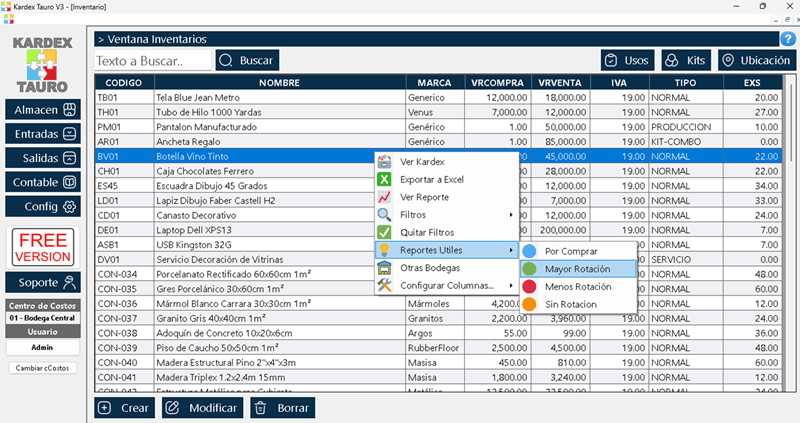
A deduction is built with documents and business logic, not with creative accounting. An inventory and invoicing system that keeps traceability from purchase to receiving report, payment and return, such as Kardex Tauro, saves you the most expensive part of that job: rebuilding by hand what was not filed in time.