Tax Loss Carryforward: How to Use It and When You Lose It

Tax Loss Carryforward: How to Use It and When You Lose It
A company closes the year with a loss and the first impulse is to file the period away as a bad memory. That is an expensive mistake. The loss, if it was properly determined in the income tax return, is a right that is offset against profits in later years and lowers the tax paid later. It is easy to lose: by not filing, by confusing it with the accounting loss, by failing to track the balance, or by assuming it travels untouched when the shareholders change. Here is the mechanism, the numerical example, the minimum control record any small business should keep, and the rules to confirm in the statute for each year.
What a tax loss is and how it differs from an accounting loss
The tax loss is the negative result of subtracting from revenue the costs and deductions that tax law accepts. It is not the profit or loss in the income statement: accounting measures with technical accounting standards, and the return measures with the Colombian Tax Statute. Between one figure and the other there are items that add or subtract, and they rarely match in a business that is growing, that finances with debt, or that carries inventory.
The most common differences are four. Expenses that exist in the books but are not deductible: penalties, fines, payments to related parties that fail a requirement. Provisions and estimates: doubtful receivables are provisioned in accounting, but for tax purposes only what the statute allows is accepted. Depreciation and amortization: useful life and method may differ. And inventory: estimated cost, obsolescence and physical count adjustments do not always receive the same treatment.
Only the tax loss can be offset. A company may show a loss in the balance sheet and still have positive net income on the return, or the other way around. If the accounting team hands over the income statement figure and someone carries it to the return without reconciling, the offset starts wrong and stays wrong for years.
| Item | Accounting loss | Tax loss | Practical effect |
|---|---|---|---|
| What defines it | Accounting standards | Colombian Tax Statute | Both can exist, with different amounts |
| Where it sits | Income statement and equity | Private liquidation of the return | Only the tax loss creates a right to offset |
| Who calculates it | The company's accounting | Return signed by legal representative and accountant | The signature turns the calculation into evidence |
| What it is for | Measuring performance and managing the business | Deferring tax in future years | Two different uses of the same bad year |
| How it is controlled | Trial balance and financial statements | Balance sheet by year of origin | The balance sheet gives no tax control |
How it arises and how it is proven
The path is always the same. Start from total revenue, subtract accepted non-taxable income, subtract costs and deductions, and you reach net income. If the result is negative, there is a loss. Then come the offsets of prior-year losses and, if the result is still negative, the loss of the year remains and is carried forward.
The loss arises in one year, but the right is exercised in the next. That gap in timing explains almost every problem: the bad year is forgotten, the file gets misplaced, and when the good year arrives nobody remembers how much was there. A loss can also arise from the net worth comparison, when net worth moves without explanation by declared income or by contributions; that calculation is technical and deserves review before it is used.
The proof is not the balance sheet, nor the shareholders' minutes, nor the accountant's email. It is the income tax return for the year in which the loss arose, filed, with the private liquidation where the loss was determined. If that year was not filed, there is no title and no offset: the right is lost through the back door, with no debate on the merits. Around the return, three things must be kept: the accounting-to-tax reconciliation with each separating item, the supporting schedules for deductions and non-taxable income, and control over amendments, because if the return was corrected the valid balance is the one in the last valid return.
Offset in later years: the general rule
The rule is simple: the tax loss of one year is offset against net income of the following years, in the return for each of those years. It is not refunded in cash, it does not create a credit balance, it is not transferred to shareholders, and it does not require prior authorization from the tax authority. It is applied in the private liquidation the company signs.
Nor is it an automatic obligation. The company decides how much loss to apply, within the limits of the statute, and that decision stays in the return. If there is an available balance and it is not used, the right does not disappear for that reason alone, but the reason should be documented: in a review, the difference between a planning decision and an oversight matters.
Limits and conditions to check every year
The mechanism has caps, and here precision matters: the figures change with each reform. For years the statute set a maximum period, expressed as a number of years, to use the loss; a later reform removed that time limit and, in exchange, introduced an annual cap calculated as a percentage of net income in the year of the offset. Which wording applies depends on the year the loss originated and the year it is used.
That is why this article does not state deadlines or percentages as current. What the taxpayer must do is identify three facts in the statute for the year: whether the loss has a deadline and what it is, whether an annual cap exists and on what base it is calculated, and whether any income is excluded from the offset. With those three facts the formula is built and applied to the balance.
There are additional conditions: that the loss is determined in a valid return, that no pending discussion could alter it, and that the year in which it is offset has positive net income. Without net income there is nothing to offset against, and the balance keeps waiting.
| Condition | How the mechanism works | What to check in the statute for the year |
|---|---|---|
| Deadline to use the loss | The statute may set a maximum number of years or allow carryforward with no time limit | Whether the balance has a deadline and from which year it counts |
| Annual cap | A limit may exist, expressed as a percentage of net income | The percentage in force, its calculation base and its exceptions |
| Base for offsetting | It offsets against net income, not against presumed income or capital gains | Which components of the liquidation accept the offset |
| Type of taxpayer | Individuals have their own rules for losses from business activity | Whether the case is a company or an individual before calculating |
| Years before a reform | Each layer of loss follows the statute in force when it arose | The year of origin of each balance and its transition regime |
Order of application when several loss years accumulate
When a company accumulates losses from several years, the oldest are offset first. The order is not arbitrary: the old ones are closer to exhausting their deadline or to staying under an earlier regime, and if they are left for last they expire while the new ones are consumed.
With an annual cap, the order has an extra effect. If the limit allows only part of net income to be offset, that portion is used up by the oldest layer, and whatever remains of that layer moves to the next year along with the others. Tracking by layer, rather than by an aggregate total, is the only way to know what is left after each return. A company with three loss years adding up to one hundred million does not have a one hundred million loss: it has three rights with three ages, three regimes and three risks.
Worked example: from a 60 million loss to a 30 million base
Take a company with round figures, in Colombian pesos. Year 1: revenue of 200,000,000 and costs and deductions of 260,000,000. The difference is a tax loss of 60,000,000. That year there is no tax on net income, and the loss is determined in the return.
Year 2: the business improves and net income before offsets is 90,000,000. The 60,000,000 loss is applied. The taxable base becomes 30,000,000. With an assumed rate of 35 percent used only for this exercise, the tax is 10,500,000. Without the offset it would have been 31,500,000 on the 90,000,000. The saving for the year is 21,000,000, exactly 35 percent of the loss used. The closing balance is zero.
| Item | Year 1 | Year 2 with offset | Year 2 without offset |
|---|---|---|---|
| Revenue | 200,000,000 | — | — |
| Costs and deductions | 260,000,000 | — | — |
| Net income before offset | Loss of 60,000,000 | 90,000,000 | 90,000,000 |
| Loss offset | — | 60,000,000 | 0 |
| Taxable base | 0 | 30,000,000 | 90,000,000 |
| Tax at an assumed 35 percent rate | 0 | 10,500,000 | 31,500,000 |
| Loss balance at year end | 60,000,000 | 0 | 60,000,000 |
The variant that shows the carryforward: if net income in year 2 had been 40,000,000, then 40,000,000 is offset, the base drops to zero, no tax is paid and 20,000,000 remains for year 3. That balance keeps the year of origin of year 1, does not become a new loss, and remains subject to the deadline and regime that correspond to the date it arose.
The variant that shows the cap: if the statute for the year, as a purely arithmetic assumption in this exercise, limited the offset to 50 percent of net income, only 45,000,000 could be applied against 90,000,000, the base would be 45,000,000, the tax would be 15,750,000 and the 15,000,000 balance would move to the next year. Tax rises and the balance survives: both effects of the cap in a single calculation. Confirm the percentage in force before taking the exercise into your return.
What happens if the company changes shareholders or business activity
There is no general answer here that can be applied without reading the case. The loss belongs to the company, not to its owners: if the shareholders sell their shares, the buyer acquires a company with a balance and with the rules that apply to that company. What does not happen is that the loss transfers to the selling shareholder, or that the shareholder uses it against personal income.
A change of activity raises another question: whether the company keeps the right when its corporate purpose changes completely. The statute contains no single rule that allows an assumption that the loss travels without conditions, and the tax authority has challenged cases in which the activity that generated the loss disappeared. Mergers and spin-offs have specific continuity rules that must be reviewed in the transaction documents and in the statute for the year.
The practical consequence is about control. Any relevant corporate transaction should come with a memorandum answering three questions: what the balance is at that date, what year of origin each layer has, and which rule supports its continuity after the transaction. If the memorandum does not exist, the loss floats, and in the next review nobody can defend it.
Losses from years before a reform: which regime applies
Each loss follows the statute in force in the year it arose. That means a company can hold, at the same time, layers under different rules: some with a deadline counted from their year of origin, others with no deadline but an annual cap, others with both elements in different versions. There is no single answer for the whole balance.
The typical mistake is applying the current year's rule to an old balance. If the balance arose before a reform, the task is to identify the transition regime: whether the reform respected the original deadline, extended it, or removed it, and from when. That reading is done on the text of the reform and on the year of origin, not on office habit. A balance carried from return to return without supporting schedules is a weak balance, even if the number is right: the authority does not only dispute the figure, it disputes where it came from.
How to control the balance year by year
Control is not a pretty report: it is a sheet with one row per year of origin. For each layer, six data points are recorded: year of origin, loss generated according to that year's return, loss offset in each later year, outstanding balance, number and filing date of the return where it appears, and the statute applied to calculate the limit. With those data the offset becomes arithmetic and stops depending on the memory of whoever keeps the file.
The sheet must reconcile with the return. If the balance on the sheet does not match the line on the return, the error is in one of the two and must be found before filing, not after an information request. It is also worth noting the finality date of each originating return: a balance whose return is still disputing items is a balance at risk, and whoever plans to use it should know that in advance.
Common mistakes
These are the five mistakes that appear most often when a badly applied offset is reviewed. Each one has a visible symptom and a consequence that is paid later.
| Mistake | Symptom on the return | Consequence | Correction |
|---|---|---|---|
| Offsetting the accounting loss instead of the tax loss | The amount offset matches the income statement result | Base below the legal one and an accuracy penalty if detected | Redo the reconciliation for the year of origin |
| Not filing the loss year | No return exists for the year of origin | The entire right is lost, with no debate on the merits | File the return if still possible and assess the regime |
| Offsetting more than the annual limit allows | The offset exceeds the cap calculated on net income | Assessment, penalty and loss of the excess applied | Recalculate with the statute for the year and leave the excess as a balance |
| Losing track of the balance | The opening balance does not match the prior year closing | Double offset or underused balance | Control sheet by year, reconciled with each return |
| Assuming a corporate change preserves the loss | The loss appears after a merger or sale with no support | Rejection of the balance and assessment with interest | Continuity memorandum before the transaction |
All five share one cause: the loss is treated as an accounting data point rather than a right with a title, a deadline and a limit. When it is treated as a right, every step leaves a trace and none of these cases reaches a dispute.
What to check before offsetting, and when this does not apply
Before applying a balance, ask four questions. Is the loss determined in a filed return for the year of origin? What statute governs that year, and what deadline or cap does it set? Does the balance on the control sheet match the last valid return? Does the year in which you will offset have enough net income, and is it free of dispute? If any answer is no, the offset waits.
This article does not replace the accountant or a reading of the statute in force. A case with losses from several years, a corporate reorganization, amended returns or an ongoing authority procedure needs a review of the full file, and general rules are not enough there. It also does not apply the same way to individuals: losses from business activity have their own rules and limits and must be reviewed separately.
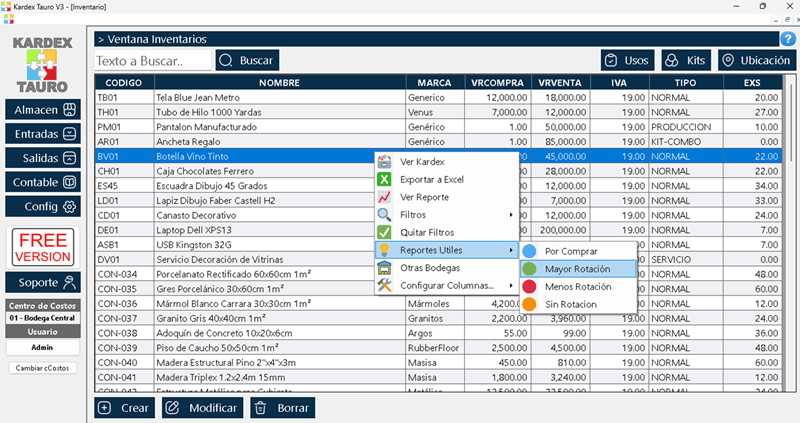
What can be stated without qualification is this: a tax loss is an asset. It is managed with records, reconciliation and a calendar, not with memory. A small business that keeps its balance on a sheet by year, reconciled with the return, preserves a right worth exactly the rate of the year in which it is used. In Kardex Tauro the accounting module keeps that history and reconciles inventory and invoicing data with the return, so the loss rests on data rather than on whoever remembers it.