VAT refunds for exporters: how to file the claim
VAT refunds for exporters: how to file the claim
A company that sells abroad should almost never pay VAT. It buys supplies with VAT, manufactures, exports to a customer who pays no Colombian VAT, and closes the period with more VAT paid than charged. That excess is not an expense: it is the company's own money sitting with the tax authority.
The idea behind this article is simple. The right almost always exists; what fails is the file that proves it. A balance of eighteen million is not lost to arithmetic, it is lost because the invoice does not say what the purchase was for, or because a refund was claimed on a balance that had already been offset.
Why an exporter accumulates a credit balance
VAT taxes consumption. Whoever consumes in Colombia pays it; whoever consumes abroad does not pay it here. That is why exports are not treated as an exempt sale but as a sale taxed at the zero percent rate, and that difference is what makes a refund possible.
In an exempt sale the company charges no VAT and cannot deduct the VAT on its purchases either: that VAT becomes a higher cost. In a zero-rated sale it also charges no VAT to the foreign customer, but it keeps the right to deduct. The result is a credit balance with nothing to offset it against.
That is where the balance is born. The company buys raw materials, packaging, freight and services with VAT, and sells everything abroad without VAT. At period end, input VAT exceeds output VAT and the difference stands as a credit balance. It is not a reward: it is the return of a tax the exporter should not bear, and while it waits it finances the state for free.
Exporting services follows the same logic when the service is performed and used outside the country, but the proof is different: contract, invoice and evidence of delivery, with no customs document.
Credit balance, amount payable and carried-forward balance
The amount payable appears when output VAT exceeds deductible VAT: it is paid with the return and there is nothing to claim. The credit balance is the opposite, but it is not automatically refundable: the law only allows a cash refund on the portion tied to exports. The carried-forward balance is the credit that was neither claimed nor applied and moves to the next period as an opening balance. It is not lost, but it sits still: carrying it forward six periods in a row is lending that money for free.
| Balance situation | What the return shows | What applies | What to check |
|---|---|---|---|
| Output VAT higher than deductible VAT | Amount payable | Pay with the return | That no earlier credit balance was misapplied |
| Deductible higher, all tied to exports | Refundable credit balance | File for a refund | Purchase-to-export link documented invoice by invoice |
| Deductible higher, mix of exports and domestic sales | Mixed credit balance | Refund of the attributable portion; the rest carried forward or offset | Allocation criteria and the apportionment calculation |
| Balance already claimed or already offset | Available balance at zero | Nothing to claim on that balance | Filing number and decision that closed the earlier claim |
| Balance from earlier periods, unused | Carried-forward balance | Claim within the term, or keep carrying it forward | Term in force for claiming on that period |
| Balance arising from purchases unrelated to the business | Not deductible | Amend the return | Support for the expense and its link to the operation |
Which part of the balance can be claimed and which cannot
The question that decides everything is not how much VAT was paid, but how much of that VAT supports the export. The answer comes from splitting purchases into three groups.
Directly attributable: the raw material for the order, the packaging for that reference, the freight to the port. Its VAT is allocated in full to the export and is the strongest portion of the file.
Shared: plant energy, warehouse rent, security, administration, accounting software. They support domestic sales and exports at the same time, so their VAT is split in proportion to the volume of each destination.
Unrelated to the business: expenses outside the company's purpose or expressly excluded by the law. That VAT is not deductible, and if it went into the return, the return must be amended before anything is claimed.
The classic mistake is to take the whole balance and claim all of it. If the company also sells at home, that claim includes VAT belonging to domestic sales, and the authority spots it by comparing the declared balance with sales by destination.
Requirements for filing the refund claim
Consistent registration. The export activity must be reflected in the single tax registry and in the claimant's details. An exporter who never updated its registration, or changed its legal name without recording it, starts with a mismatch that has to be explained later.
Return already filed. The claim rests on a VAT return already filed, with the balance determined there. You cannot claim on an undeclared period, or on a return later amended without updating the annex.
Balance actually free. It cannot be committed to another claim in progress or applied in the following return. If the balance was carried forward and then claimed for a refund on the same amount, that is duplication and the claim is rejected.
Complete file, filed through the official channel. Documents go in the format and through the channel the authority requires at the time of filing. An incomplete file does not fix itself: it is returned, and the clock on the term restarts when it comes back complete.
Confirm with your accountant which additional requirements apply to the specific case. The rules change in points of form — formats, annexes, filing channels — and a requirement that was valid two years ago may have been repealed.
The documents that build the file
The file is not a folder: it is a chain of proof. Each document answers a different question, and if one is missing, the chain breaks at that point.
| Document | What it proves | What usually goes wrong |
|---|---|---|
| VAT return for the period | That the credit balance exists and is declared | Return amended without updating the annex |
| Purchase invoices | That the VAT was paid and is deductible | Invoices that do not identify the good or service |
| Export document | That the goods left the country under a covered operation | One shipment's document is missing |
| Certification of the operation | That the exported value matches what was declared | Value differences between invoice and customs document |
| Commercial invoice | Who the customer is and on what terms the sale was made | Customer details inconsistent with the transport documents |
| Transport documents | That the cargo moved and reached its destination | Waybills with no container number or shipment date |
| Purchase schedule and allocation | How each invoice links to the export | A manual schedule that does not match the declared total |
| Bank certification of the beneficiary | That the money reaches the right account | Account different from the one on the claimant's registration |
Two recommendations: archive export documents with the same naming logic as the purchase invoices for the order, because the reviewer will look for that match; and take the purchase schedule from the accounting system, not from a parallel spreadsheet.
How purchases are linked to the export
The link is not declared in a sentence: it is proven by the product's trail. The shortest route is the production order that generated the purchase, the batch that shipped and the export document covering it.
For shared purchases the criterion is proportion. Take the value of export sales and total sales for the period, compute the share and apply it to the VAT on common purchases. The result is the portion attributable to exports; the rest belongs to domestic sales.
The proportion must be computed on a stable base and explained in the annex. If the company changes criteria every period — by sales, by costs, by volume — the file loses coherence even when each individual calculation is defensible.
There is a normal timing gap: purchases in one period may support exports documented in the next, through goods in transit, cargo at port or supplier advances. It is not a problem when it is explained; it looks suspicious when it looks like an adjustment to inflate the balance.
Worked example: credit balance and file
A company that exports almost all of its output and had a smaller volume of domestic sales. Round exercise figures.
Exports for the period: 400,000,000, VAT-free. Deductible VAT on purchases and supplies: 30,000,000. Output VAT on domestic sales: 12,000,000. Round exercise figures.
The credit balance is the difference: 30,000,000 minus 12,000,000, that is 18,000,000.
Now the link filter. If 2,000,000 of those purchases cannot be tied either to the export or to the domestic sale, that VAT supports no operation and drops out of the calculation. The amount claimed falls to 16,000,000: 18,000,000 minus 2,000,000. The figure you claim is not the one from the first subtraction, but the one that survives the documentary filter.
| Item | Amount | How it is obtained or what supports it |
|---|---|---|
| Exports for the period | 400,000,000 | Export invoices and customs documents for each shipment |
| Deductible VAT on purchases and supplies | 30,000,000 | Electronic purchase invoices for the period |
| Output VAT on domestic sales | 12,000,000 | Domestic sales invoices for the period |
| Credit balance for the period | 18,000,000 | 30,000,000 - 12,000,000 |
| VAT on non-attributable purchases | 2,000,000 | Invoices with no proven destination in exports or domestic sales |
| Amount claimed as a refund | 16,000,000 | 18,000,000 - 2,000,000 |
A third route remains: if the company claims nothing and leaves the balance for the next period, it avoids the procedure but ties up 18,000,000 for as long as it takes to be used. On tight margins, that money is usually worth more in the bank than the comfort of not filing.
The file for this example has four parts: the return showing the balance, the purchase invoices with their allocation schedule, the export documents for the period and the certifications of the operation.
Deadlines and how the clock is counted
The law sets two different terms, and confusing them is a classic source of surprises.
The term to claim runs against the taxpayer and counts from the filing of the return or from the moment the law specifies. If it passes, the balance does not vanish: it remains available to carry forward, but it no longer turns into cash for that period. Decide early whether you want the money or prefer to use it against VAT in later periods.
The term to decide runs against the authority and counts in business days from filing in due form. That phrase is the most underestimated: while the file is incomplete, the claim is not considered filed and the clock does not move. The company believes it is waiting for an answer when it is waiting for its own missing document.
Two mechanisms move the clock: a request for additional information suspends the term while the company answers, and if it does not answer within the granted term the claim may be left without support. There is also deemed approval, with the scope the law in force gives it. Do not plan your cash flow around it: it is a safety net, not a plan.
Terms are not memorized, they are verified. Before filing, confirm the term in force for the year and count from the actual date of complete filing, not from the day you sent the first email.
Refund, offset or carry forward: how to choose
With the balance cleaned up, three routes remain and none is always the best.
A refund turns the balance into cash. It requires a file, time and follow-up, and it exposes the company to review. It makes sense when the balance is large relative to the cost of managing it. In a pure exporter it is the natural route most periods.
An offset applies the balance against other obligations, as the law allows. It saves the cash procedure but generates no liquidity: it swaps one debt for another.
Carrying forward moves the balance to the next period. It is the least effort and the most expensive financially, because the money stays out of the bank. It works when the balance is small, when a period with VAT payable will consume it quickly, or when the file cannot yet stand up.
A useful test: compare the balance with the cost of building and maintaining the file. If the refund is small, the procedure can cost more in accountant hours than it returns.
Common grounds for rejection
Rejections rarely happen because the balance does not exist. They happen because the claim fails to prove what it asserts.
The link is not proven. The company says the purchases are for export, but the annex does not let anyone follow it: no production order, no batch, no match between invoice and shipment.
Unrelated invoices were included. Office purchases, entertainment expenses, goods for personal use. They show up in the total without justification and drag down the credibility of the whole file.
The balance was already used. A refund was claimed on an amount already applied in the next return, or on an amount with another claim in progress. It is the most avoidable error, because an internal check catches it.
Export documents are missing. One shipment in the period has no customs document, or has one with a value different from the invoice. With one broken link, the whole chain is in dispute.
The file is filed incomplete on purpose. Some companies file hoping to complete later, once the authority asks for what is missing. The effect is the opposite: the clock does not move and the case goes cold.
The beneficiary details do not match. Account, legal name or tax identification different from the registration. A point of form with a substantive effect: the refund cannot be paid and the process stops.
Frequent mistakes
The five mistakes below most often turn a legitimate balance into a lost procedure.
| Mistake | Symptom | Consequence | Fix |
|---|---|---|---|
| Claiming with no link between purchases and exports | The annex lists invoices but does not explain where each one went | Rejection for lack of proof of the right | Build the link from the production order and the shipment |
| Including unrelated purchases | Administrative or personal expenses appear in the total | The whole file is questioned, not just that invoice | Clean it before filing and amend the return if needed |
| Claiming a balance already offset | The balance matches the amount applied in the next period | Rejection and risk of a duplication inquiry | Cross-check the balance against earlier returns and filings |
| Not keeping the export documents | One or more shipments have no support | The operation is not proven and the balance shrinks | One archive per order: invoice, transport and customs document |
| Filing incomplete and waiting for the request | The claim sits suspended with no visible progress | The clock does not move and the case goes cold | A closed checklist before filing |
The pattern behind all five: the problem shows up at review, not at calculation. The fix is not to check the arithmetic at the end, but to record properly from the start.
An honest closing note before you decide
This article explains the mechanism; it does not replace your accountant. The refundable balance depends on the share of export sales and on how shared purchases are treated. If your company exports a small part of its output, the refundable portion may be far smaller than the total balance suggests.
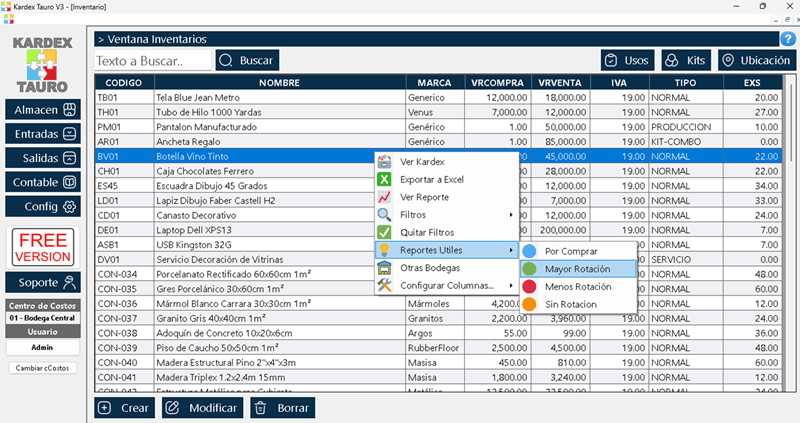
If the balance is recurring and large, turn the refund into a periodic process rather than an annual emergency: a standardized purchase schedule, export files per order and a balance check before every return. That is where the traceability the file demands is the same traceability an inventory and invoicing system integrated with accounting, such as Kardex Tauro, already records.
Before filing, ask three questions. Is the balance actually free? Does every invoice have a provable destination? Does the file stand up without verbal explanations? If any answer is no, the problem is not the form: it is how the previous months were recorded.