Transport allowance: when it is paid and how it is calculated

Transport allowance: when it is paid and how it is calculated
The transport allowance is paid on the same payroll as the salary, but it does not behave like salary. It is excluded from the contribution base for health insurance and pensions, it is included in the base for severance and the service bonus, and it stays out of the vacation base. That is the origin of almost every difference that surfaces months later, when someone reviews a final settlement. This guide covers who qualifies, how it is prorated, and how it should be recorded.
What it is and why it exists
The transport allowance is a monthly sum an employer pays to cover the worker's commute between home and the workplace. It is not a discretionary bonus: it is a benefit with its own rules, an amount set by the government, and an eligibility limit tied to salary.
The logic is simple. Commuting has a fixed cost, and that cost weighs far more on a low salary than on a high one. That is why the rule creates the allowance for the lowest pay levels and withdraws it once the salary can absorb the commute.
If the employer provides transport directly — a company bus, a contracted route, an assigned vehicle — the cash allowance does not accrue. The obligation is to make the commute possible, not to pay a sum. When transport is provided in kind, document it; without support, the cash payment becomes claimable again in any review.
It is not a reimbursement either: it is not settled against receipts and it does not adjust to what the worker actually spent. It is a fixed sum per full month of service, with the proportions explained below.
Who qualifies and who does not
Every dependent employee whose salary does not exceed the statutory limit receives it. The key word is dependent: there is an employment contract, subordination, and a salary. A contractor under a civil services agreement has no transport allowance, because there is no salary.
Several situations are resolved through proration rather than exclusion: part-time work, joining mid-month, days not worked. The right remains; what changes is the proportion.
Three cases generate discussion. Someone working from home receives the allowance if the contract is dependent and the salary is within the limit, unless there is a written agreement that no commute exists. Someone who lives at the workplace has grounds for it not to be paid, but the decision must be documented before the claim. And apprentices under a learning contract are covered by a maintenance stipend, which is a different concept.
| Situation | Allowance due? | What to check |
|---|---|---|
| Dependent employee within the limit | Yes | Salary does not exceed the year's threshold. |
| Salary above the limit | No | The threshold is measured on salary, without the allowance. |
| Employer provides transport | No | Evidence of the service. |
| Joining or leaving mid-month | Yes, prorated | Days settled. |
| Part-time or hourly | Yes, prorated | Proportion of the schedule. |
| Services contractor | No | No contract, no salary. |
| Apprentice | Different concept | Maintenance stipend. |
The salary threshold
Access does not depend on the worker's need but on a number: the monthly salary compared with a cap expressed in current legal minimum wages. It is defined that way so it updates automatically each year, when the minimum wage is adjusted.
The first practical consequence: the limit is not a fixed figure in pesos, and neither is the allowance amount. Both change every year, so no table of values works for two different years. Before running January payroll, confirm the year's amount and how many minimum wages define the cap; that figure is published by decree.
The comparison is against salary, not against the total the person receives. If someone earns exactly the cap and also receives the allowance, the allowance does not push them out of range. This avoids excluding a worker because the total payment landed a few pesos above the line.
With variable pay — commissions, overtime, surcharges — the comparison uses the month's ordinary salary. Define the criterion in writing for months when the variable part rises or falls; if it changes without explanation, the worker has grounds to object.
How it is paid: monthly, prorated, or by days
With a full month of service, the allowance is paid in full. It is a monthly sum, not a daily one: a 30-day month and a 31-day month pay the same. It is not multiplied by calendar days and it is not divided to pay only working days.
When the month is incomplete, it is paid in proportion to days actually worked. The usual formula divides the monthly amount by 30 and multiplies by the days. That is a payroll convention, not a universal mathematical rule: what matters is applying it the same way every month and writing it into the procedure.
Proration shows up in four scenarios: joining mid-month, leaving early, contract suspension, and unpaid absences. In all four, settle the proportional part, never the full amount.
Part-time work has its own proportion: if the schedule is half the maximum, the allowance is reduced accordingly. Paying the full amount for a partial schedule is the employer's choice, not an obligation, and doing it for some workers but not others becomes an internal equity problem.
- Confirm the monthly amount in force for the year.
- Check that the month's salary does not exceed the cap.
- Count days actually worked and paid.
- Apply the proportion and record the item separately.
- Support the calculation in the payroll change record, not only on the payslip.
It is not salary for contributions
This is where most errors happen. The transport allowance is not part of the contribution base for health insurance, pensions, or workplace risk insurance. Contributions are calculated on salary, and the allowance is not salary for that purpose.
The consequence is direct: if the worker earns the cap of the range and also receives the allowance, the filing reports the salary as the contribution base, not the sum of both. Adding it inflates the contribution, raises payroll cost for no reason, and creates a difference that is hard to reverse because the filing has already been paid.
Parafiscal contributions follow the same base as social security, so the allowance does not enter there either. The pension solidarity fund contribution is calculated on the same base, with the same logic.
Keep a quick test handy. If the payslip shows the worker's health deduction equal to the legal rate applied to the total paid rather than to salary, the base is wrong. It is the most visible signal and the easiest to audit.
It is part of the severance and bonus base
Here the allowance changes character. For severance (cesantías) and the service bonus it is treated as part of remuneration, and therefore added to salary when calculating both benefits.
Both benefits aim to protect the worker's real income, and the allowance is part of that monthly income even though it is not salary for social security. The rule separates bases by purpose.
The effect is measurable. Someone receiving the allowance accrues more severance and more bonus than someone earning the same without it. If the company excludes it from those bases, every month leaves a small shortfall that accumulates and appears in full at final settlement, when nothing can be offset against it.
It shows up more in the final settlement, because severance is calculated on average earnings and the proportional allowance of recent months enters that average. That is where a badly configured payroll becomes visible.
| Calculation base | Includes the allowance? | Why |
|---|---|---|
| Health (contributions) | No | Not a salary factor. |
| Pension (contributions) | No | Same base as health. |
| Workplace risk insurance | No | Calculated on salary. |
| Parafiscal contributions | No | Follow the contribution base. |
| Severance (cesantías) | Yes | It is remuneration. |
| Interest on severance | Yes, by extension | Calculated on the severance balance. |
| Service bonus | Yes | Same base as severance. |
| Vacation | No | Salary only. |
A full example with contributions and benefits
The figures below are an exercise, not current values: a salary of 1,500,000 and an allowance of 200,000 flagged as an example amount, with assumed rates. The real allowance and salary cap must be confirmed for the year being settled.
The worker receives 1,700,000 for the month: 1,500,000 in salary plus 200,000 in allowance. That is the money that arrives. It is not, however, the number everything is calculated on.
Health contributions: base 1,500,000 at an assumed total rate of 12.5%, which is 187,500. Of that, 4% is paid by the worker (60,000) and 8.5% by the employer (127,500). Pension: 16% of 1,500,000, or 240,000, with 4% from the worker (60,000) and 12% from the employer (180,000). Parafiscal contributions, if applicable: 9% of 1,500,000, which is 135,000.
Severance and bonus: the base is 1,700,000. Monthly severance is 1,700,000 divided by 12, equal to 141,667. The bonus for the month accrued follows the same logic: 141,667. Interest on severance is provisioned on that balance, about 1,417 per month at an assumed 12% annual rate.
Vacation: the base is 1,500,000 again. The monthly provision, based on 15 working days per year, is 62,500. Had 1,700,000 been used by mistake, it would come out at 70,833: 8,333 of excess per month turning into a silent liability.
The worker's net pay is 1,700,000 minus 60,000 for health and 60,000 for pension: 1,580,000. The allowance is not deducted because it generates no contribution. Total employer cost, adding salary, allowance, employer contributions, parafiscal contributions and provisions, is 2,489,750 in the exercise.
| Item | Base | Calculation | Amount |
|---|---|---|---|
| Salary | — | Exercise input | 1,500,000 |
| Transport allowance | — | Example amount | 200,000 |
| Health, total | 1,500,000 | 12.5% | 187,500 |
| Health, worker | 1,500,000 | 4% | 60,000 |
| Health, employer | 1,500,000 | 8.5% | 127,500 |
| Pension, total | 1,500,000 | 16% | 240,000 |
| Parafiscal contributions | 1,500,000 | 9% | 135,000 |
| Severance for the month | 1,700,000 | Divided by 12 | 141,667 |
| Bonus for the month | 1,700,000 | Divided by 12 | 141,667 |
| Interest on severance | 141,667 | 12% annual | 1,417 |
| Vacation for the month | 1,500,000 | 15 days per year | 62,500 |
| Worker's net pay | — | 1,700,000 − 120,000 | 1,580,000 |
What happens with vacation, disability leave, and paid leave
During vacation the allowance is still paid. The worker is on paid rest, the relationship continues, and the commute still exists on return. Most practice pays it in full in the vacation month; anyone deciding to prorate it needs clear support.
For general illness disability leave the criterion is not uniform. One approach settles only days worked, another maintains the allowance during the leave. What is enforceable is consistency: if the company prorates in one case, it must prorate in all of them, with the criterion written down.
Maternity and paternity leave work similarly. The practical criterion is to keep the allowance when the leave is paid and the relationship remains active, and to prorate when the absence generates no remuneration from the employer.
During unpaid leave and contract suspension there is no allowance for those days: no service, no associated pay. Unjustified absences carry no allowance either, and the change should be recorded so the deduction is supported.
One case often forgotten is departure mid-month. The final settlement must include the proportional allowance for those days, not only salary and benefits.
How it is recorded in payroll
The allowance should have its own line on the payslip, its own item name, and its own cost center if the company runs several. Mixing it into base salary is the original error: once it sits in the salary field, contributions are wrong, the vacation provision is wrong, and fixing it means recalculating several months.
In the chart of accounts keep it as a personnel expense, separate from wages and from social benefits. That way the labor cost report shows how much is being paid for commuting, a useful figure when evaluating sites or shifts.
Before accruing the first month, check three things in the setup: the item is not flagged as a salary factor for contributions, it is included in the severance and bonus bases, and it is excluded from the vacation base. If the system allows only one flag for everything, the item stays out and the severance and bonus bases are adjusted with an additional rule.
On the social security filing the allowance is not reported as the contribution base: the salary is. If an export file is used, verify the allowance is not being added to that column before submitting.
Common errors
The five most frequent errors share one root: the allowance is treated as salary for everything, or as salary for nothing. Both simplifications cost money.
| Error | Symptom | Consequence | Fix |
|---|---|---|---|
| Including it in the contribution base | Health deduction exceeds the rate on salary | Monthly overcost and filing above what is due | Separate the item and recalculate |
| Excluding it from severance and bonus | Provision does not match earnings | Accumulated gap that surfaces at settlement | Include it and re-settle |
| Paying it above the cap | High salaries receiving the allowance | Payment with no basis, hard to recover | Check against the year's cap |
| Paying in full despite absences | Amount unchanged despite days not worked | Repeated overpayment and unequal treatment | Prorate and document |
| Including it in the vacation base | Provision grows with no explanation | Inflated liability and wrong hourly cost | Exclude it and adjust the provision |
A sixth error is procedural rather than arithmetic: paying the allowance without checking the year's cap. Because the limit moves with the minimum wage, someone inside the range in December can fall outside in January if their salary is adjusted. The annual check is not optional.
How to detect and correct differences already paid
If the company has handled the allowance one way for years, start with a consistency test: take three workers with the same salary and the same allowance and compare their accrued severance. If the figures differ, there is a setup or data entry error.
The second step is comparing the contribution base of the last twelve months against salary. When the reported base includes the allowance, a constant difference appears, almost always equal to the allowance times the contribution rate.
Correcting upward, paying what was missing in severance and bonus, is relatively simple: re-settle the period, record the adjustment, and pay. Correcting downward, when too much was contributed, is harder because the filing is already paid and the refund process has its own path.
Before re-settling, document what is being corrected, from which period, with what support, and who approves it. A re-settlement without a record is a new problem, especially if an external review follows.
An honest closing before you decide
The allowance is small on the payslip and large in the structure, because it changes nature depending on the base: not salary for contributions, salary for severance and bonus, not salary for vacation. Treating it as a single concept leaves differences on all three fronts at once.
The values in this guide are exercises and the rates are assumptions. Before running payroll, confirm the allowance amount and salary cap for the year, and validate with your accountant the cases of apprentices, interns, and variable pay, where the answer depends on the type of relationship. If the company has a single site and everyone sits in the same salary range, the risk is lower, but it still exists in severance.
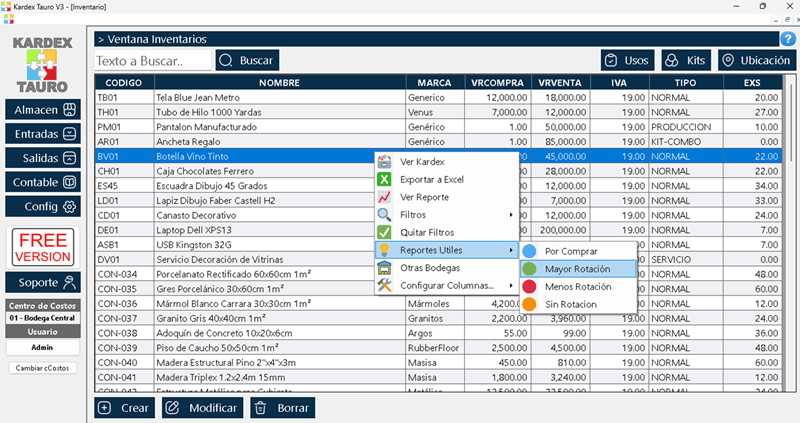
The way to stop returning to this problem is keeping the allowance as a separate item in payroll and in the chart of accounts, with its bases declared explicitly. In Kardex Tauro payroll items are configured separately and each carries its own base rule, so the allowance can stay out of contributions and inside severance without manual calculations.