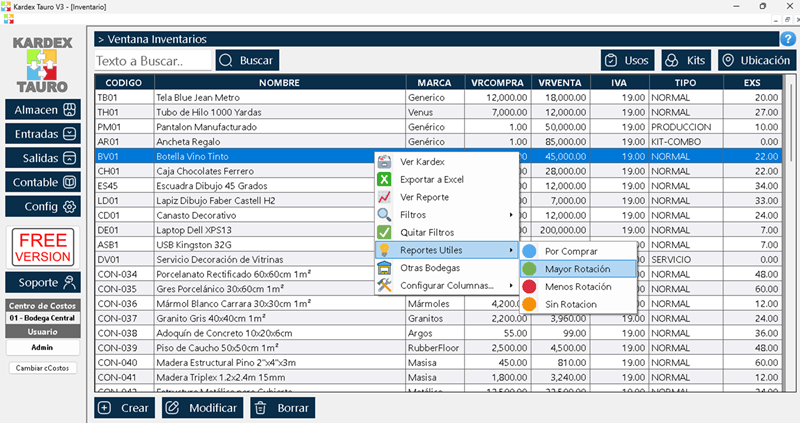
What is inventory?
What is inventory?
If your business sells products, stores raw materials, or prepares orders, you have probably heard the word "inventory" more times than you can count. But do you really know what inventory is and why it matters so much to the health of your company? In this article we explain it in a clear and practical way, from its accounting definition to the types that exist and its relationship with the stock ledger card. In simple terms, inventory is the set of goods that a company keeps on hand to sell, transform, or consume in its operations. It is the answer to a very concrete question: what do I have today in my warehouse, store, or stockroom? And answering that question well takes more than looking at the shelves: it takes an organized, detailed, and valued record of every product.Inventory definition in business and accounting terms
From an accounting point of view, inventory is a detailed and valued record of a company's stock at a given point in time. This definition has three parts worth understanding separately. It is a record, meaning an ordered and organized list, not a single loose quantity. It is detailed, because it identifies each product, its reference code, its unit of measure, its quantity, and its location within the warehouse. And it is valued, because a monetary value is assigned to every item, usually its purchase or production cost. On the balance sheet, inventory is part of current assets, that is, the assets the company expects to turn into cash in the short term. For a retail business, inventory is usually the largest asset and the one that ties up the most resources. For a manufacturing company, inventory includes raw materials, work in process, and finished goods. In both cases, poor inventory management shows up directly as lost money: capital tied up in products that do not sell, stockouts that cause lost sales, or shrinkage that is never detected. Let us use a generic example: a hardware store keeps screws, paint, tools, and plumbing supplies. Its inventory is the complete list of all those items with their exact quantity and their value. Without that list, the owner cannot know how much stock is missing to fill a large order, how much money is invested in the back room, or whether someone is walking out with merchandise that was never paid for.What is inventory for?
Keeping a well-managed inventory is not a boring formality that only matters to accountants. It is a management tool that answers key questions in the day-to-day running of the business:- Knowing what is available: knowing at any moment how many units of each product are on hand and whether they are enough to fulfill pending orders.
- Knowing what your stock is worth: knowing the total value of the goods allows you to calculate indicators such as inventory turnover and avoids having money tied up in products that do not sell.
- Detecting what is missing: comparing what should be there with what is actually there reveals shortages caused by errors, wrongly recorded returns, or theft.
- Preventing theft and losses: inventory with periodic controls discourages internal theft and helps identify shrinkage caused by expiration, damage, or poor storage.
- Making better purchasing decisions: with reliable data you buy the right quantities, at the right time, and without overbuying.
- Staying compliant with accounting and taxes: inventory is the basis for calculating the cost of sales and for reporting correctly to the authorities.
Types of inventory
There are several ways to classify inventories. One of the most common is based on when it is carried out and on how movements are recorded. Under this classification we find the following types:- Opening inventory: the one carried out at the beginning of an accounting period. It corresponds to the stock with which the company starts the year or its operating cycle.
- Closing inventory: the one carried out at the end of the accounting period to know exactly the stock with which it ends. This figure feeds the financial statements.
- Periodic inventory: the system in which the company does not record every entry and exit individually, but determines its stock through a count at the end of the period.
- Perpetual inventory: the system in which every entry and exit is recorded immediately, so the accounting balance always reflects the stock available. It is also called continuous inventory.
- Physical inventory: the process of directly counting, checking, and valuing all the goods that are actually in the warehouse or stockroom.
Table: types of inventory and their description
| Type of inventory | Description |
|---|---|
| Opening inventory | Stock with which the company begins an accounting period. |
| Closing inventory | Stock determined at the end of the period for the financial statements. |
| Periodic inventory | System that calculates stock through a count at the end of the period, with no permanent record of movements. |
| Perpetual inventory | System that records every entry and exit and keeps the balance updated at all times. |
| Physical inventory | Direct count and check of the actual goods in the warehouse. |
Types of inventory by the nature of the goods
Another way to classify inventory is by the type of goods it contains. This classification is especially useful for industrial companies:- Raw materials: the inputs a company buys to turn them into finished products, such as wood for a furniture workshop or fabric for a clothing factory.
- Merchandise: the finished products that a commercial company buys to resell without transforming them, such as the items on a store's shelves.
- Work in process: goods that have already started their transformation but are not yet ready for sale.
- Finished goods: products that have completed their production process and are ready to be sold or shipped.