How to Control Expiration Dates in Inventory

How to Control Expiration Dates in Inventory
In a pharmacy, a drugstore, a small grocery store or any food business, an expired product is not just a package to throw away: it is lost money, a health risk for the customer and, when medicines or food are involved, a problem with health authorities. That is why controlling expiration dates is not one more administrative chore: it is one of the tasks that saves the most money in a small business. It can be achieved with simple rules: record lots and dates from the moment goods arrive, dispatch using the FEFO method, review what is close to expiring and write off in time what can no longer be sold.
The Real Cost of an Expired Product
When a product expires, the loss is bigger than it seems. You lose the purchase value of every unit, the space it occupied in the warehouse or on the shelf, the time spent storing it and, if the expired item went unnoticed, also a customer's trust or the cost of a fine. In regulated businesses such as pharmacies, an expired medicine that reaches a patient can lead to a serious complaint or a report to the health authority. Expiration shrinkage is also the most avoidable kind of loss: it is almost never caused by the product, but by the fact that nobody looked at the calendar in time.
In small businesses this control usually fails for three reasons: more is purchased than sold, new merchandise is placed in front of older stock, and there is no reliable list of what expires and when.
Record Lot and Expiration Date from the Moment Goods Arrive
Expiration control starts on the day the goods reach your business, not when a product is about to expire. Every time you receive an order, check the information printed on the packages and record it before placing the merchandise on the shelf:
- Lot number: the identifier printed by the manufacturer. For control purposes, two boxes of the same product with different lots are two different products.
- Expiration date: it must be recorded together with the lot, because the date is what decides the order in which goods go out.
- Units per lot: knowing how many units belong to each lot lets you decide what to do with each group and when.
Recording only the total stock is not enough to control expirations. If you have forty units of a product spread over three lots with different dates, you need to know how many units expire on each date. Hence the value of a system that groups units by lot or serial number and stores the expiration date together with each lot.
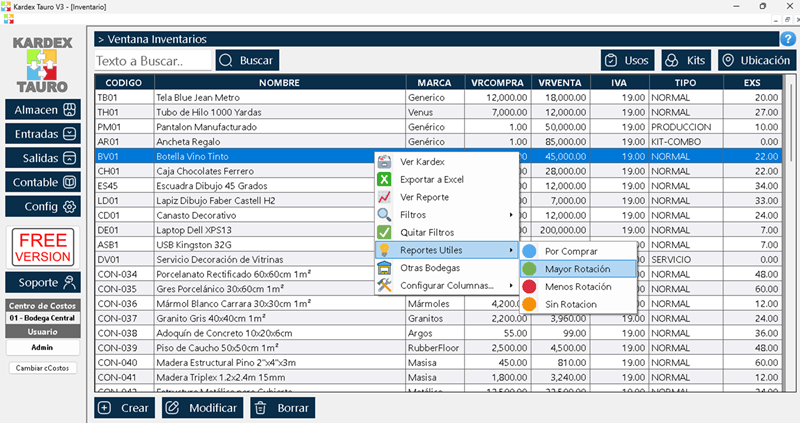
That is exactly what batch management in Kardex Tauro does. When goods are received for a product configured with lots or serials, the system opens a capture screen for each unit, where the lot can be recorded and, as an additional field, the expiration date. Units are grouped automatically by lot for reports and traceability, and the quantity received is calculated from the records captured, so the same data is never typed twice and the total is never miscounted.
FEFO: First Expired, First Out
FEFO stands for First Expired, First Out, and it is the dispatch rule that every business selling dated products should apply: out of the available stock, the items that expire first always go out first, even if they arrived later. When products do not expire, the FIFO method (First In, First Out) is enough, but when dates are involved, FEFO is the only safe rule.
Putting FEFO into practice has two parts. The first is physical: when storing, place the lot that expires first at the front and lots with later dates at the back; when dispatching or restocking the sales floor, always take from the lot closest to expiration. The second part is about records: when a product managed by lots is sold, the system must show which lot went out. In Kardex Tauro, selling a product with lots or serials is not just a matter of typing a quantity: you must select the units or the specific lot being delivered, so the inventory always shows which lots remain and with which expiration date.
A Lot-Based Control Chart
With lot records up to date, keep a control chart like the one below, with one row per lot and product. Review it once a week, ideally on the same day you walk through the warehouse:
| Lot | Product | Expiration date | Stock | Status / action |
|---|---|---|---|---|
| L-2204 | Pain reliever tablets | 15/03/2027 | 60 | Valid: store at the back |
| L-2211 | Flu syrup 120 ml | 15/11/2026 | 24 | Close to expiring: prioritize dispatch (FEFO) |
| L-2215 | Powdered milk 400 g | 20/10/2026 | 12 | Critical: offer at a discount or return |
| L-2218 | Oat cereal 500 g | 25/08/2026 | 8 | Expired: remove and write off as shrinkage |
In the example, the syrup goes out before the pain reliever tablets even though it arrived later, and the powdered milk needs a decision this week. The expired oat cereal must be removed from the shelf immediately and recorded as shrinkage: selling it, even at a discount, is not an option once the date has passed.
Routine Checks for Upcoming Expirations
A control chart only works if it reflects what is actually on the shelves. Set aside a fixed time every week or every two weeks for the expiration walk: go through the warehouse and the sales floor, check every dated product and pay special attention to items that are less than sixty days away from expiring.
- Move them to the front of the shelf and tell the sales staff to offer them first.
- Consider a promotion or a discount to sell them before the deadline.
- If the supplier accepts returns for near-expiry products, process the return in time: in many businesses it is the option that recovers the most value.
- If there is no possible way out, schedule the write-off as shrinkage so the expired product never mixes with valid stock.
Use the walk also to verify that the recorded dates match the packages. If you find a mistyped date or a misidentified lot, correct it in the record right away: wrong data in the system leads to wrong decisions in the warehouse.
Expired-Product Shrinkage: Record It, Do Not Hide It
When a product expires and has no possible way out, the right thing is to remove it from the shelf and write it off from inventory. Throwing it away without recording it is a double mistake: the inventory keeps showing stock that no longer exists, and the loss becomes invisible forever. In Kardex Tauro, a shrinkage or decrease document formalizes the permanent removal of products due to expiration, damage or other causes: you state the cause, the system validates that the units exist and, when the document is finalized, it automatically deducts the stock and records the movement in the product's Stock ledger. If the product is managed by lots, the written-off units remain identified by their lot.
Recording expiration shrinkage with its cause has an extra benefit: it produces useful data. If at the end of the month most expiration losses are concentrated in certain items, the conclusion is clear: you are buying too much or rotating that product poorly, and you can adjust the purchase quantity or reinforce FEFO in that line.
Checklist to Avoid Losses
- Buy according to real sales and do not fill the warehouse just because the supplier offers volume discounts.
- Record lot and expiration date for everything that arrives, on the same day it is received.
- Apply FEFO when storing and when dispatching, without exceptions.
- Check upcoming expirations at least every two weeks, with an updated control chart.
- Train the staff to offer first what expires first and never to hide an expired product.
- Write off expired products as shrinkage as soon as you find them, so the inventory reflects reality.
- Review shrinkage reports by expiration and adjust purchases and rotation accordingly.
Expiration Control Is a Matter of Method
Controlling expiration dates does not require big investments: it requires recording from the moment goods arrive, dispatching under a clear rule and reviewing with discipline. A well-configured inventory system supports this method: it groups stock by lot or serial from the moment it enters, stores the expiration date in each lot's record and formalizes the shrinkage of expired products with its cause. With those pieces in place, an expired product stops being a routine loss and becomes the exception that is detected in time.
