How to Classify Products by Importance

How to Classify Products by Importance
In any warehouse there are products worth a lot and products worth very little, and in almost every case it is the few that concentrate most of the money invested. A business may carry four hundred references in its catalog, but if you add up the balances you will find that ten or twenty of them represent most of the inventory value. The rest, even though it takes up floor space, shelving and counting hours, weighs very little on the balance sheet.
Classifying products by importance serves precisely that purpose: knowing which references are critical and treating each item according to what it really contributes to the business. With a good classification you can decide with sound criteria where to count more often, which products deserve strict control, where to concentrate purchasing money and which ones can be managed with simple controls. This article explains the most widely used method to achieve it, the ABC classification, step by step and with a complete numeric example.
What the ABC classification is and why it is useful
The ABC classification sorts the inventory into three groups according to economic importance, measured by the annual value that each product represents for the business. The underlying idea is simple and holds true in almost every warehouse, regardless of size: few products concentrate most of the value.
- Class A: few products, but high value. In a typical inventory they concentrate close to 80 % of the annual value with only a small share of the references. They demand the greatest care of the business.
- Class B: an intermediate group, usually representing around 15 % of the annual value, deserving periodic control.
- Class C: most of the references, but of low value: barely 5 % of the annual value. They are controlled with the least possible effort.
Those percentages —80, 15 and 5— are not an exact law but a reference guide that each business can adjust. The important thing is to understand that the attention a product receives should be proportional to the money it represents: a mistake in a class A product costs far more than a mistake in a class C one. The method exists to concentrate control resources where they pay off the most.
Step by step: how to classify the products
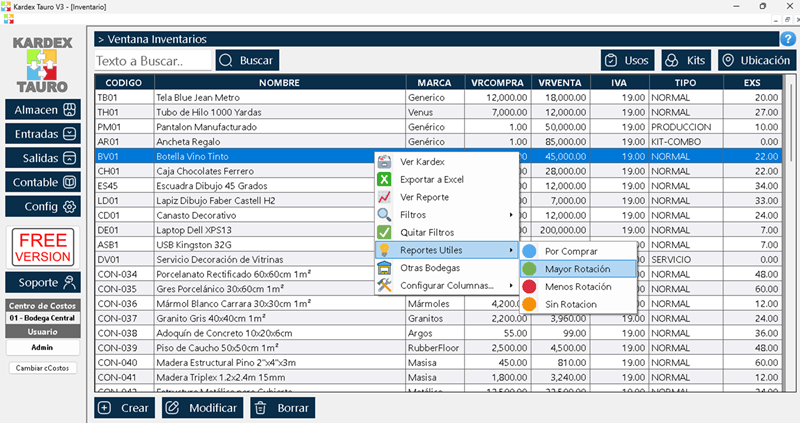
To run the classification you need a list of products with their movements of the last year. If the business uses Kardex Tauro, that information is already organized: the system records the stock levels and the movements of each product, and lets you group items into groups or categories to work with the list by lines. With that data, follow these steps:
- Calculate the annual value of each product. Multiply the quantity sold or dispatched during the year by its unit acquisition cost. For example, if 300 units of a reference were sold during the year and each unit costs 50,000, its annual value is 15,000,000.
- Sort the list from highest to lowest according to that annual value, so that the most important products end up in the first positions.
- Calculate the accumulated percentage. Add up the values of all products to find the total, work out what percentage of the total each one represents, and then accumulate the percentages from the first to the last item on the list.
- Set the cut-off points. Products that accumulate up to 80 % of the value are class A; those that follow up to 95 % are class B; the rest, up to 100 %, are class C.
- Review the classification regularly, every quarter or every semester, because products change class as sales and costs change.
A numeric example of an ABC classification
Let us take a small distributor that handles ten product lines. At the end of the year, using the recorded movements, the annual value of each line was calculated and the lines were sorted from highest to lowest. The total value of the merchandise moved during the year was $100,000,000. The table shows the result:
| Product | Annual value | Accumulated % | Class |
|---|---|---|---|
| Power tools | $50,000,000 | 50.0% | A |
| Paints and enamels | $30,000,000 | 80.0% | A |
| Cables and extension cords | $8,000,000 | 88.0% | B |
| Hardware items | $5,000,000 | 93.0% | B |
| Screws and anchors | $2,000,000 | 95.0% | B |
| Drill bits and cutting discs | $1,800,000 | 96.8% | C |
| Sandpaper and abrasives | $1,200,000 | 98.0% | C |
| Cleaning supplies | $800,000 | 98.8% | C |
| Packaging and bags | $700,000 | 99.5% | C |
| Office supplies | $500,000 | 100.0% | C |
The result is revealing: two lines, barely 20 % of the products, concentrate 80 % of the annual value, exactly the proportion announced by the rule. Three more lines add another 15 % of the value, and the remaining five, half of the list, contribute barely 5 %. If the business paid the same attention to counting power tools as to counting office supplies, it would be wasting its time and leaving its money unprotected.
What to do with each class
Class A: strict control and frequent counts
Class A products are the ones that move the most money and demand the most attention. For them, we recommend:
- Frequent counts, weekly or biweekly, to detect any difference as soon as it appears.
- Up-to-date movement records and a review of every important issue, with its supporting document.
- Watched safety stock and planned purchases with reliable suppliers, because running out of a class A product immediately affects sales and cash flow.
Class B: periodic control
Class B products deserve monthly or bimonthly follow-up: they are counted less often than class A, but their rotation and balances are watched to confirm they behave as expected. A mistake in them is not catastrophic, but it is worth correcting in time.
Class C: simple control
Class C has many products and little value, so the goal is to spend as little time as possible on them:
- Semiannual or annual counts, or sampling when required.
- Large and infrequent orders, to avoid constant purchases dedicated to them.
- Simple stock checks, without investing working hours in items that barely weigh on the balance sheet.
How to apply the classification to counts and purchases
The practical value of the classification appears in two everyday decisions. For counts, it allows you to set up a cycle counting program: class A is counted every week or every two weeks, class B every month, and class C once or twice a year. In this way, the most valuable money in the inventory is verified constantly and errors are corrected early, without having to shut down the warehouse for a full count.
For purchases, the classification guides how much to order and how often. For class A products it is better to buy in quantities that do not tie up too much capital and to keep close control of the reorder point. For class C, instead, place large and spaced orders that reduce the time spent on them. Class B is handled in the middle, with periodic replenishment according to its rotation.
A classification that stays alive
The ABC classification is not a one-time job: products move in and out of classes over time, so it is worth recalculating every so often with the real movements of the business. Kardex Tauro makes that maintenance easier, because it lets you group products into groups or categories, keep the stock and the movements of each one always up to date, and recalculate the annual value whenever needed. Classifying products by importance is not a paperwork chore: it is the way to make sure inventory control focuses on where the money actually is.
