How Does the FIFO Method Work?

How Does the FIFO Method Work?
Anyone who buys and sells goods eventually runs into an uncomfortable question: if the same product was purchased twice at different prices, what is the cost of the goods being sold? The first purchase's price, the second one's, or a mix of both? The answer changes the value of the inventory, the cost of sales and, in the end, the profit of the business.
The PEPS method —known in English as FIFO, first in, first out— answers that question with a simple rule: what arrived first at the warehouse is what must leave first, valued at the cost of the oldest lot still available. In this article we explain how it works, how to apply it in a stock ledger and which businesses benefit from using it.
What PEPS Means
PEPS is an inventory valuation method. Its job is not to say how many units there are, but to assign a cost to every issue and to keep the balance properly valued when the purchase price changes from one order to the next.
The idea is easier to grasp with a picture: imagine a row of boxes in a warehouse. If the business ships in the same order in which it received the goods, the first ones in will be the first ones out. That is exactly what PEPS proposes: inventory flows in arrival order, and each issue is valued with the oldest lot that still has units.
PEPS is not the only method that exists. The weighted average cost mixes all lots and calculates an average cost for each issue, while LIFO (last in, first out) does the opposite. Each one produces different figures, and that is why the choice matters: it is not a minor accounting detail, but a decision that affects how much inventory the business reports and what profit it shows.
How the Cost of Issues Is Calculated with PEPS
The calculation rule is strict and is applied lot by lot, in this order:
- Identify the oldest lot that has units available in the stock ledger.
- Take from that lot the units the issue requires.
- If the oldest lot does not cover the whole issue, continue with the next oldest lot, and so on.
- The cost of the issue is the sum of the units taken from each lot, multiplied by that lot's unit cost.
A short example: suppose the stock ledger still has 100 units from a purchase at $8 and 200 units bought at $10 arrive. If 150 units are sold, with PEPS the 100 oldest units leave first, valued at $8, and the remaining 50 come out of the new lot at $10. The cost of the issue is 100 × $8 + 50 × $10 = $1,300, and the balance is left with 150 units of the recent lot, valued at $10.
An issue can take units from several lots when the oldest one is not enough, but the oldest lot is always exhausted first.
Complete Numerical Example in the Stock ledger
Let us see the method applied to a concrete product: the cooking oil sold by a neighborhood grocery store. The business keeps its stock ledger during March and records two purchases at different prices and one sale. The table summarizes the movement:
| Date | Detail | Receipts | Issues | Balance |
|---|---|---|---|---|
| Mar 2 | Purchase | 100 units × $8 = $800 | — | 100 units at $8 = $800 |
| Mar 9 | Purchase | 200 units × $10 = $2,000 | — | 300 units (100 at $8 + 200 at $10) = $2,800 |
| Mar 15 | Sale of 150 units | — | 100 units at $8 + 50 units at $10 = $1,300 | 150 units at $10 = $1,500 |
Let us go through it row by row. On March 2, 100 units come in at $8 and the balance is $800. On March 9, 200 units come in at $10: the balance adds up to $2,800, but there is no longer a single cost: there are 100 units from the $8 lot and 200 from the $10 lot, and the stock ledger must keep that separation so PEPS can be applied later.
On March 15, 150 units are sold. With PEPS, the issue is valued like this: the 100 units from the $8 lot leave first and are worth $800; the 50 units still needed are taken from the $10 lot and are worth $500. The cost of the sale is $1,300 and the balance ends with 150 units, all from the $10 lot, valued at $1,500.
The final check of the balance is shown in this second table:
| Lot | Units in balance | Unit cost | Value |
|---|---|---|---|
| March 2 purchase | 0 | $8 | $0, fully issued in the sale |
| March 9 purchase | 150 | $10 | $1,500 |
| Total | 150 | — | $1,500 |
If the business had sold each unit at $15, the revenue of that sale would have been $2,250 and the gross profit, with PEPS, $950 ($2,250 - $1,300). With the weighted average cost, the unit cost would have been $9.33 ($2,800 / 300) and the cost of the 150 units about $1,400, leaving a lower profit. The same movement produces two different results: that is why it is wise to choose one method and apply it consistently.
Advantages and Disadvantages of the PEPS Method
Advantages
- It reflects the real physical flow when goods are shipped in arrival order, as happens with food, beverages and seasonal products.
- The balance is valued with the most recent costs, which brings the inventory value closer to replacement cost.
- It forces the oldest goods out first, reducing spoilage, expirations and obsolete stock piling up.
- It is easy to explain, understand and review: anyone keeping the stock ledger can follow the rule lot by lot.
Disadvantages
- It requires identifying lots: every purchase must be recorded with its date and its cost, which demands more administrative discipline.
- When prices rise, the accounting profit tends to be higher, because issues are valued with older, lower costs.
- It does not work when goods cannot be distinguished by lot, such as bulk products, mixed liquids or items that get mixed together in the warehouse.
Which Businesses Should Apply PEPS?
PEPS makes sense in businesses where old goods lose value or spoil if they stay in the warehouse. That is typically the case with perishable products —fruit, vegetables, dairy, bread, meat— where shipping the oldest first is not an accounting preference but a necessity. It also fits clothing and fashion stores, where every season leaves garments that are worth less over time, and pharmacies and drugstores, where medicines have expiration dates and what expires first must rotate out first. Food distributors, bakeries and small supermarkets apply the same criterion every day, even if they do not always give it a name.
PEPS loses its meaning, on the other hand, when lots cannot be told apart: coal, sand, bulk liquids or products mixed in the same tank or silo have no first or last receipt. For those cases, the weighted average cost is usually more practical.
PEPS versus Other Methods
With PEPS, the balance keeps the most recent costs. With the weighted average, every purchase recalculates an average cost that smooths out price changes, and it is the natural option when lots are not identified. With LIFO, the newest goods would leave first and the balance would be left with old costs; it is the least used method and the one furthest from the real replacement value. For most small businesses, the practical decision comes down to PEPS or weighted average, and it must stay consistent: switching methods in the middle of the year without justification only makes it harder to compare periods.
How to Keep PEPS in the Stock ledger
The stock ledger is the format where the business records, product by product, every receipt, every issue and the balance that remains. Applying PEPS to the stock ledger does not require complicated formulas: it is enough to record every purchase with its date and cost, keep track of which lot is the oldest and value every issue against that lot, exactly as was done in the March example.
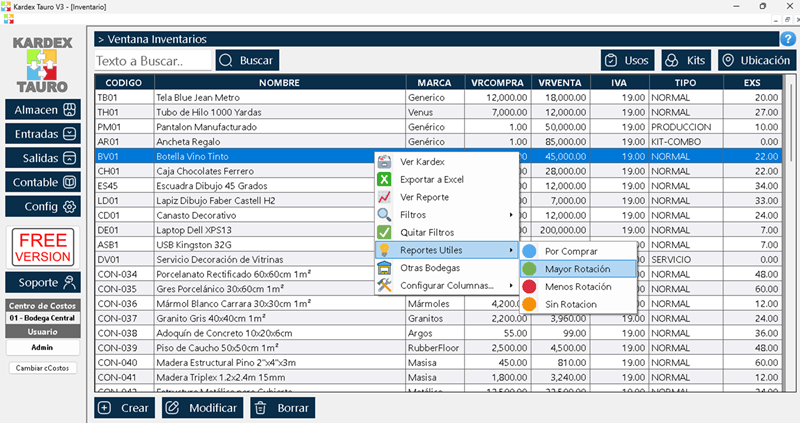
Kardex Tauro is useful support for that record keeping: the program records receipts and issues in the stock ledger and updates the average cost when purchases are registered, so the information is always up to date. The PEPS method does not apply itself: the business applies it when it decides how to value its issues, and the stock ledger of Kardex Tauro is the document where that decision is studied, applied and checked month after month.