Accounting in the medieval Islamic world: diwans, souks and treatises
Accounting in the medieval Islamic world: diwans, souks and treatises
When people talk about the history of accounting, they usually picture the ledgers of Renaissance Italian merchants or the clay tablets of Mesopotamia. Yet between the seventh and the fifteenth centuries the Islamic world built one of the most sophisticated administrative and commercial systems of the Middle Ages: government offices that recorded income and expenditure, inspectors who verified weights, measures and quality in the souks, arithmetic treatises written to make calculation easier, and a network of routes linking the Mediterranean with India and China. This article tells that story through its three great stages: the diwans, the souk and the treatises.
Inheriting two empires: Byzantium and Persia
Islam did not start from scratch. Within a few decades of the seventh century, Muslim armies conquered the territories of the Byzantine Empire in the Near East and of the Sasanian Empire of Persia: two states with seasoned fiscal bureaucracies that collected taxes, paid soldiers and had kept written records for centuries. Rather than dismantling that machinery, the emerging Islamic administration adopted it, translated its documents into Arabic and adapted it to its own needs.
From that synthesis came the diwan, a Persian term that originally meant register or roll and eventually came to name the office itself. Historiographical tradition credits Caliph Umar ibn al-Khattab (634-644) with creating, around 636, a register of the stipends ('ata) paid to Muslim warriors, ranked by precedence and merit in the community; it was modelled on the Sasanian administrative practice found in Iraq and Persia. That was the origin of the diwan al-jund, the army register: in essence, a structured and audited payroll.
From register to government office: the fiscal diwan
That first register grew into a network of specialised offices. Under the Umayyads (661-750), whose capital was Damascus, Caliph Mu'awiya added the diwan al-kharaj, the land-tax bureau, which would become the fiscal heart of the state: provincial revenues converged there and were recorded before reaching the treasury. It was joined by the bureau of correspondence (al-rasa'il), which drafted and filed official documents, and the bureau of the seal (al-khatam), which kept copies of everything that left the chancery as a document-control mechanism.
Under the Abbasids (from 750) the machine reached full maturity. From Baghdad, founded in 762, the caliphate administered a territory stretching from the Atlantic to the Indus with a central chancery and a treasury, the bayt al-mal, the house of money, which kept the state's accounts of revenue and expenditure, in cash and in kind. The diwan al-kharaj registered the land tax (kharaj), the poll tax on non-Muslims (jizya) and the legal alms (zakat); every province kept branches of the central offices, and control departments (zimam) acted as comptrollers, reviewing the accounts of the other diwans and reporting to the vizier. The kuttab, professional scribes, formed a class whose expertise —calculation, calligraphy, fiscal law— was handed down from master to pupil and codified in secretarial manuals such as the Book of the Land Tax (Kitab al-Kharaj), written in the tenth century by the Abbasid official Qudama ibn Ja'far.
One nuance is in order: these offices did not practise double-entry bookkeeping, which would flourish centuries later among the merchants of Mediterranean Europe. They kept simple but rigorous accounts: periodic, orderly records of collections, payments, stocks and payrolls in ledgers (dafatir) that had to balance, with cross-checks between offices and backup copies. That discipline of recording and verifying is precisely the seed of modern public accounting.
The muhtasib: quality control in the souk
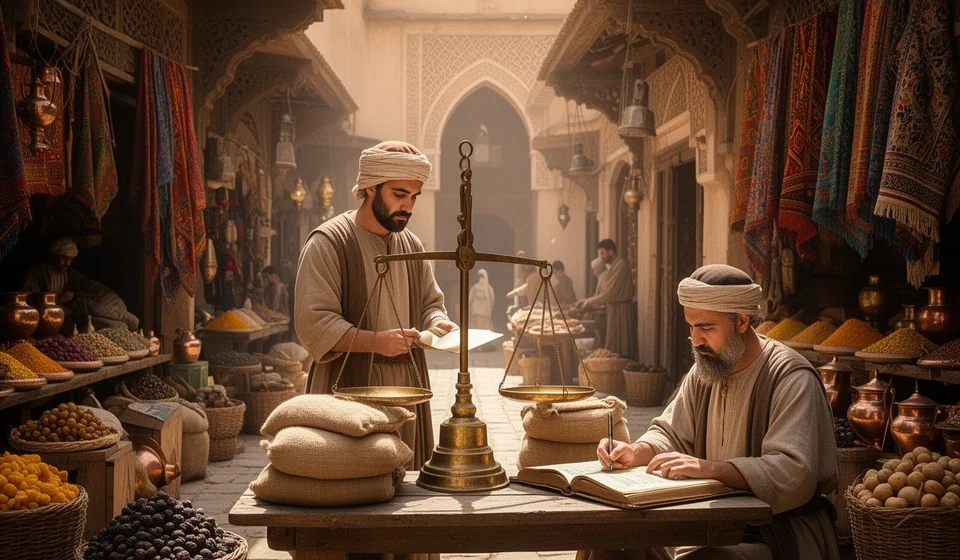
Outside the palaces, control had another protagonist: the muhtasib, the official market inspector appointed by the authorities, whose institution is known as hisba. His office shares a root with hisab, the Arabic word for calculation or reckoning: his task was to make sure that the market's accounts —weights, measures and prices— were fair.
The muhtasib walked the souk checking that scales were calibrated against official standards, that bread had its regulated weight, that cloth was not sold by deception (such as hiding flaws under a fine finish) and that nobody hoarded grain to speculate on the price. He inspected the quality of the crafts, settled minor disputes between buyers and sellers and could punish cheats with fines or public exposure. In essence, he carried out quality control and a kind of public audit over everyday commercial activity.
That practice generated a literary genre of its own: the hisba treatises, manuals describing the inspector's duties, the typical frauds of each trade and the standards he had to enforce. Notable among them are the work of Abd al-Rahman al-Shayzari, Nihayat al-Rutba fi Talab al-Hisba (twelfth century), the treatise of Ibn Abdun of Seville and the extensive Egyptian manual Ma'alim al-Qurba fi Ahkam al-Hisba by Ibn al-Ukhuwwa (d. c. 1329). Read today, they are an extraordinary source on prices, business practices and the economic life of medieval Islamic cities.
Calculating and recording: numerals, algebra and paper
Keeping records requires calculation. For centuries, officials and merchants across the Islamic world relied on Indian mathematics: a positional decimal numeral system that included a sign for emptiness, the zero, which Arabic called sifr (the ancestor of our words zero and cipher). Its diffusion owes much to the mathematician Muhammad ibn Musa al-Khwarizmi, active in Baghdad in the first half of the ninth century under the patronage of the House of Wisdom. Around 825 he wrote his celebrated algebra treatise, whose title contained the words al-jabr and al-muqabala, restoration and reduction: from al-jabr comes the word algebra, and from the author's own name, transcribed in the West as Algoritmi, comes the word algorithm.
These texts, designed to solve practical problems of inheritance, commerce and distribution, spread across the Islamic world and, from the twelfth century, translations made in Iberia carried them to the schools of Europe. Decimal notation made it possible to calculate quickly on a dust board (takht) and to set down the results in the records. A decisive change of support followed: paper. Invented in China, its technique reached the Islamic world after the battle of Talas (751); within a generation a mill was working in Samarkand and around 794 another was set up in Baghdad under Caliph Harun al-Rashid. Paper was far cheaper than papyrus and parchment: price studies suggest that Egyptian papyrus in the ninth century cost about five times as much as the paper that replaced it. Records, archives and books suddenly became affordable. From the Islamic world the craft spread to al-Andalus and then to Europe: the mill of Játiva (Spain), documented from 1151, is among the first on the continent of which we have evidence.
Long-distance trade: caravans, contracts and letters
Accounting in the medieval Islamic world was not only a state affair: above all, it was mercantile. Straddling three continents, the caliphate articulated a trade linking the Mediterranean with the Indian Ocean, the Persian Gulf and the Red Sea; overland, caravans crossed the Sahara, Central Asia and the silk routes as far as China. Merchants from Baghdad, Cairo, Damascus, Cordoba or Samarkand moved goods —textiles, spices, metals, paper— across thousands of kilometres.
From that activity we have an exceptional documentary treasure: the Cairo Geniza, the storeroom of the Ben Ezra synagogue in Fustat, where the Jewish community kept for centuries, out of religious respect, every writing in Hebrew or Arabic that bore the name of God, including contracts and business letters. The hundreds of thousands of recovered fragments, studied above all by the historian Shlomo Dov Goitein, reveal the practical bookkeeping of merchants between the tenth and thirteenth centuries: partnership contracts, payment orders, letters from agents in other cities and account notes.
To move money over distances without exposing it to unsafe roads, merchants used instruments such as the suftaja, a payment order handed to a correspondent in another city so that he would pay a third party: an early ancestor of the bill of exchange. Payment documents called sakk also circulated, which historians link to the modern cheque. Accounts were kept in simple registers —records of debts, stocks and commissions— administered by a trusted agent (wakil) in each port or city.
Qirad and mudaraba: financing trade
Long-distance trade demanded capital, and capital demanded legal forms of partnership. The Islamic world developed the qirad, called mudaraba by several legal schools: a contract by which one party contributed the capital and the other the work, the management and the journey. Profits were shared in a proportion agreed in advance; if the venture lost money, the investor bore the capital loss and the manager lost his time and effort. Because interest (riba) was prohibited, religion pushed the economy towards these profit-sharing instruments, which not only financed maritime and caravan trade but also distributed risk.
The qirad bears an astonishing resemblance to the European commenda, documented in the Italian cities from the twelfth century; economic historians such as Abraham Udovitch consider it very likely that the commenda was inspired by or derived from the qirad and the mudaraba, although this cannot be proved with certainty. Jurists examined it in detail: the scholar al-Sarakhsi (d. 1090) devoted extensive chapters of his great legal compendium to it. The same figure, under the name of mudaraba, remains one of the foundations of modern Islamic finance today.
Summary table: institutions, functions and contributions
The table below summarises the institutions and practices described, their function and their contribution to the history of accounting.
| Institution or practice | Function | Contribution to accounting |
|---|---|---|
| Diwan | State office and register | Orderly recording of revenue, expenditure and payroll; origin of the word aduana (customs) |
| Diwan al-kharaj and bayt al-mal | Land tax and treasury | Central concentration and control of public funds |
| Muhtasib and hisba | Market inspection | Verification of weights, measures, prices and quality: public internal control |
| Indo-Arabic numerals and algebra | Written calculation | Positional decimal notation: fast and accurate calculating and recording |
| Paper | Writing support | Cheap, durable and replicable records and archives |
| Qirad and mudaraba | Trade financing | Capital-labour partnership; forerunner of the European commenda |
A legacy that crosses centuries
The medieval Islamic world did not invent accounting, but it moved it forward where it mattered most: in the systematic records of the state, in the everyday control of the market, in mathematics applied to calculation and in the legal forms of long-distance trade. Its vocabulary survives in our languages: the Spanish word almacén (warehouse) comes from the Arabic al-makhzan, the storehouse where goods were kept and controlled —the same word that reached English through French as magazine, originally a storehouse; albarán, the Spanish delivery note, goes back to al-bara'a, the receipt acknowledging a delivery; and aduana (customs) traces back, through Andalusian Arabic, to diwan, the office that recorded what entered and left the country.
Recording what comes in, what goes out and what remains, verifying weights and quality, leaving a written trace of every operation and rendering accounts: that discipline of the clerks of Baghdad, of the inspectors of the souk and of the merchants of the Geniza is the same one any business needs today. The support has changed —from the ledger book to software— but the logic remains. An inventory system such as Kardex Tauro digitises that old discipline: every entry and exit is recorded, controlled and available to anyone who must render accounts, just as the diwan's scribe noted it in his daftar, only with the speed and accuracy that decimal calculation, paper and centuries of practice made possible.