Benedetto Cotrugli: the treatise that preceded Pacioli (1458)
Benedetto Cotrugli: the treatise that preceded Pacioli (1458)
When people talk about the origins of modern accounting, the story usually comes down to a single name: Luca Pacioli, the friar who published his Summa de arithmetica in Venice in 1494 with its famous chapter on double-entry bookkeeping. Far less known is the story of the man who got there first. Thirty-six years before that book went to press, a merchant and diplomat born in Ragusa (today's Dubrovnik) finished a treatise already describing, with order and judgement, the double-entry system of keeping accounts. His name was Benedetto Cotrugli, and his work bore the title Della mercatura e del mercante perfetto, that is, on commerce and the perfect merchant.
The work was written around 1458, but it was not printed until 1573. That gap of more than a century between pen and printing press explains much of its fate: while the manuscript circulated in a handful of copies among friends and acquaintances, Pacioli's book travelled across Europe in printed editions. Fame chose the man who reached the presses, not the one who reached the idea first. This article follows Cotrugli's life, his treatise, the mercantile world of the fifteenth-century Mediterranean and why he deserves to be remembered as the great precursor of accounting literature.
A merchant between two worlds: who was Benedetto Cotrugli
Benedetto Cotrugli, whose family name is also written de Cotrugli or Cottrugli, and in Croatian Kotruljević, was born around 1416 in Ragusa, on the Dalmatian coast of the Adriatic, capital of the merchant republic that bore the same name. He came from a family of traders and learned the craft on the docks, in the warehouses and in the trading houses of a city that lived from the exchange between East and West. According to his biographers, he rounded off that practical training with studies in philosophy at the University of Bologna, an unusual combination that foreshadows the humanist-merchant ideal he defended in his writing.
Around 1451 he settled in Naples, where he lived for nearly two decades, until his death. Naples was then the capital of the kingdom ruled by the Crown of Aragon, and there Cotrugli worked as both businessman and diplomat: he represented Aragonese interests, took part in court life and joined the debates typical of Renaissance humanism. He died in 1469 in L'Aquila, leaving a short work of enormous documentary value. Trained as a merchant and a writer by vocation, Cotrugli belongs to that generation that began to treat commerce as an art worthy of study and teaching.
Ragusa and the Mediterranean: the school that formed him
To understand Cotrugli's treatise, one must understand his city. Ragusa, today Dubrovnik, was the capital of a small aristocratic republic which, between the fourteenth and sixteenth centuries, became one of the Adriatic's busiest trading hubs. Lacking both territory and an army, the republic made up for its size with two assets: a respected merchant fleet, whose name gave English the word argosy for a large trading ship, and a network of deals, consulates and agents stretching from Italy's coasts into the Ottoman domains.
That Ragusan world was Cotrugli's world. Its merchants traded cloth, salt, Balkan silver, spices and eastern goods, moving between the Venetian orbit, the kingdom of Naples and the ports of the Levant. Competition with Venice was relentless, and survival depended on reputation, careful calculation and trustworthy records. In that environment, accounting was a daily management tool: whoever mastered it held the advantage at every fair and every settlement of accounts. Cotrugli grew up watching that practice and, years later, turned it into the subject of a book.
Della mercatura e del mercante perfetto: a manual with the soul of a portrait
Cotrugli wrote his main work around 1458, during his years in Naples. The original manuscript is known as the Libro de l'arte de la mercatura, though it went down in history under the title of its first printed edition, Della mercatura e del mercante perfetto. Despite its later fame, it is not an accounting manual: it is a general treatise on the merchant's craft, arranged in four parts that move from the professional to the personal. The first deals with the origin, form and essence of the merchant; the second with his religious commitment; the third with moral virtues and rules of conduct; the fourth with the administration of the household, the family and economic affairs.
The heart of the book is the portrait of the perfect merchant. For Cotrugli, a good merchant is above all an honest man: he must keep his word, weigh his promises, pay his debts and deal fairly with customers, partners and authorities alike. He must be prudent, patient and hard-working, able to rise early and keep his accounts up to date, and he must also be a man of letters: able to write correctly, express himself clearly, know the laws and customs of the places where he trades and behave with diplomatic tact. The treatise is also a defence of commerce against those who regarded it as a lesser activity: the merchant, Cotrugli insists, serves the community by moving goods and creating wealth and employment, and deserves respect for it. That elevation of the craft, written by a practitioner rather than a theorist, is one of the most modern features of the work.
The chapter that beat Pacioli: double entry in writing
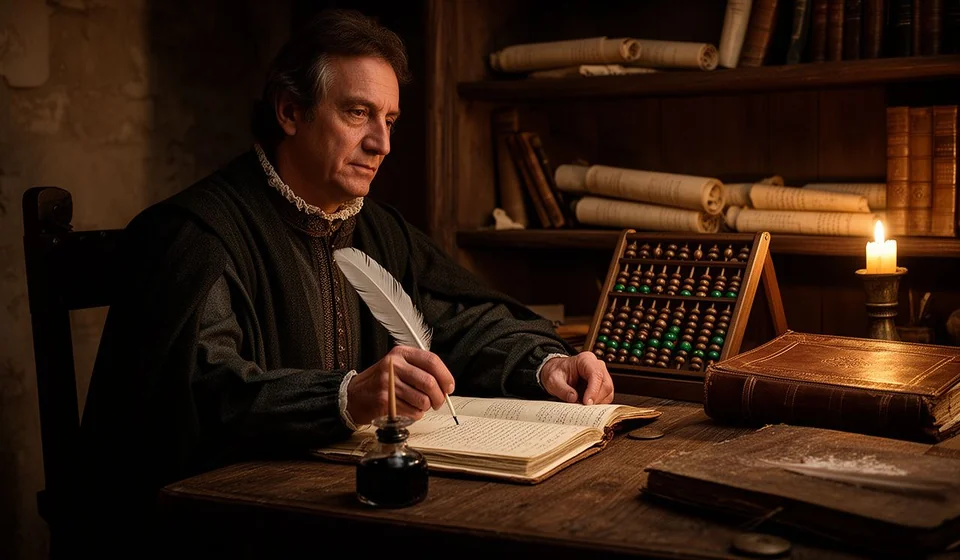
The historical interest of the treatise is concentrated in the thirteenth chapter of the first part, headed in the language of the time Del hordine de tenere le scripture con ordine mercantile, that is, on keeping records in mercantile order. In a few pages, Cotrugli describes the double-entry system that Italian merchants already practised: a method in which every transaction is recorded twice, once on the debit side and once on the credit side, so that the books can be checked against one another and the balancing of accounts stands as proof of good management. He also describes three principal books: the memorial or waste book, where each transaction is noted as it happens; the journal, where entries are set down by date; and the ledger, where accounts are classified by debtor and creditor. And he warns of the importance of writing figures clearly, without corrections that might cast suspicion on the merchant.
It is worth being precise about the scope of that passage. Cotrugli did not invent double entry: the Venetian method had long been practised in Italy's mercantile cities, and real double-entry account books survive from earlier periods. His merit lies elsewhere: he appears to have been the first to set down in writing, as an ordered and teachable description, a system that until then lived mainly in the practice and memory of merchants. Cotrugli himself was aware of the challenge: writing about these matters, he warned, can be very long, because without a master's living voice it can scarcely be learned at all. Hence his text is not an exhaustive manual with numbered examples, but a treatise that explains the method and its rationale. The date of the manuscript, 1458, makes it the oldest known written description of double-entry bookkeeping, three and a half decades before Pacioli's Summa. The text also came with an appendix containing an inventory of goods and numerous journal entries: practical material designed to illustrate the method.
A manuscript that took 115 years to reach the printing press
If the treatise was written around 1458 and the world had to wait until 1573 to read it in print, the reason lies in the way knowledge circulated in the fifteenth century: from hand to hand, in handwritten copies. The oldest surviving copy of the text dates from 1475 and is kept in the National Library of Malta; another early copy, from the end of the fifteenth century, is held by the Marciana Library in Venice. Those few hand-penned copies were the only vehicle for a work readers discovered through personal recommendation.
The first printed edition appeared in 1573, in Venice, under the hand of the publisher Franciscus Patricius, already bearing the title Della mercatura e del mercante perfetto. A second edition was published in the same city in 1602, and in 1613 a French translation came out in Lyon under the title Le parfait négociant. But the press arrived late and not entirely faithful: researchers who compared the editions with the manuscripts found that the printed text shortened and altered the accounting chapter, obscuring part of the original content. When the work finally spread, it did so abridged, too late to play the role it deserved decades earlier.
Cotrugli and Pacioli, side by side
Comparing the two works helps explain why history divided the glory so unevenly.
| Work | Year written | Year printed | Circulation | Impact |
|---|---|---|---|---|
| Della mercatura e del mercante perfetto (Cotrugli) | Around 1458 | 1573 | Handwritten copies and late editions, with the accounting chapter abridged | Pioneering description, but of limited influence in its own time |
| Summa de arithmetica (Pacioli) | 1494 | 1494 | Printed editions spread throughout Europe | Standardised and popularised the method; foundation of modern accounting teaching |
The table sums up the contrast. Pacioli's Summa was not the first description of the method, since Cotrugli preceded it by 36 years, but it was the first to reach readers on a mass scale. The chapter Pacioli devoted to accounting, known as the Particularis de computis et scripturis, explained double entry in detail, with the order of the books and worked examples, designed so a trader could learn it without a master. The printing press did the rest: within a few decades the text circulated through Italy, Germany, France, the Low Countries and England, and became the reference against which generations of bookkeepers were trained.
Why fame chose Pacioli
The short answer is that the history of accounting was not written in the order in which ideas appeared, but in the order in which books reached the hands of readers. Pacioli published in 1494, at the height of the printing revolution, and his work was a compendium of applied arithmetic that served as a textbook; the accounting chapter travelled inside that great book and was quoted, copied and taught in the abacus schools and trading houses. Cotrugli, by contrast, wrote for a small circle, in a manuscript that barely left Naples and Ragusa, and when it was finally printed, in 1573, the method had already been spreading for decades under Pacioli's name. By then the friar of Sansepolcro had become the symbol of the Venetian method, and posterity gave him the title history recognises: the father of modern accounting.
That attribution is not unfair if it is understood as a tribute to the populariser who turned a workshop practice into a teachable discipline. But it becomes unfair if it makes people forget that double entry was not born with the Summa, nor even with its author's pen: it came from Italian mercantile practice and had already found, decades before, a Ragusan merchant willing to explain it in writing. Cotrugli did not win the fame, but he won the race on paper: his 1458 manuscript is, as far as is known, the first text to describe double-entry bookkeeping. The history of accounting thus has two founding dates: a silent one, 1458, and a celebrated one, 1494.
The legacy of a precursor
For centuries, Cotrugli was a footnote for specialists. In recent decades, historical research has reclaimed him: studies of his accounting chapter, such as those by Professor Basil Yamey, confirmed the antiquity of the description, and his figure has received public honours. The Croatian state minted a commemorative silver coin in 2007 in his honour, and a business school in the region bears his name. In 2016 the critical edition of his manuscript, prepared by Vera Ribaudo, was published in Venice; in 2017 the first complete English translation of the treatise appeared, and a year later a popular Italian edition brought him to new readers under the evocative title Arricchirsi con onore, getting rich with honour.
That title sums up Cotrugli's lesson well: mercantile wealth is not at odds with honesty, and order in the books is the best proof of both. His portrait of the perfect merchant, honest, prudent, hard-working, cultivated and meticulous with his accounts, remains, five centuries on, a valid description of the good manager.
From the fifteenth-century ledger to the digital inventory
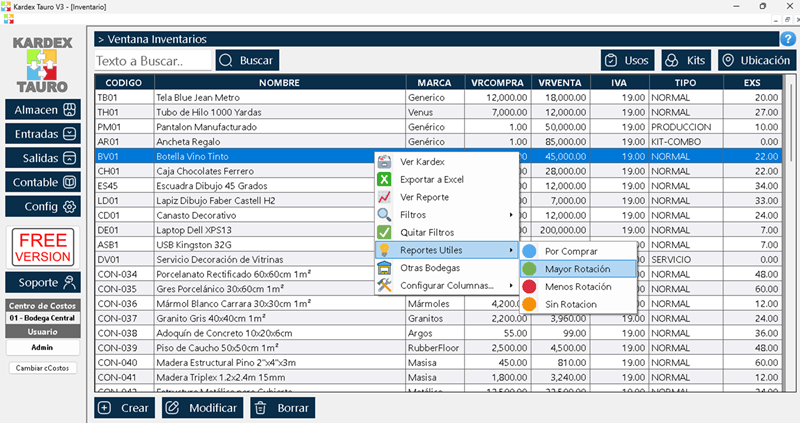
Accounting has changed its medium, but not its spirit. Cotrugli's merchant wrote down every transaction by hand, in the memorial, the journal and the ledger, so as to know at all times what he owned, what he owed and what was owed to him; today's manager needs that same certainty about merchandise, stock and movements, only the books are no longer kept by hand. Keeping the orderly records Cotrugli demanded of the perfect merchant is a task tools such as Kardex Tauro handle in a practical way. The next time an inventory balances without surprises, remember that this discipline began in the ports of the Mediterranean, passed through the pen of a Ragusan merchant in 1458, and lives on in every well-kept set of books. Knowing that story does more than honour its protagonists: it helps us value the order Cotrugli's perfect merchant already demanded of his books.
