Inventory adjustments and how to record them in accounting

Inventory adjustments and how to record them in accounting
The stock ledger keeps track of what should be there: the entries, the exits and the balance that results from applying them one by one. But what should be there does not always match what actually is. A physical count that finds fewer units than the records show, a box found broken in the storeroom, an expired batch that nobody removed from the shelf, or goods received but never recorded are situations that pull the paperwork away from reality. When that happens, accounting does not simply wait: it adjusts. This lesson covers the step that follows the finding, recording the adjustments, that is, the journal entry that brings the inventory back to the truth, case by case.
In the lesson about physical counts you already saw how the count is performed and how the book balance is compared with the actual stock to detect differences. That comparison is the starting point, not the finish line: once the difference has been identified and measured, someone has to decide what caused it and leave a proper accounting record of the correction. That decision is what you study here. This is not about repeating how each difference arises, but about understanding which account should receive the other side of the entry when inventory is adjusted.
Why the stock ledger balance drifts away from reality
Differences between the stock ledger and reality fall into three broad groups. The first is recording errors: a quantity typed incorrectly, an entry posted twice, or an invoice issued for goods that never left the warehouse. The second is internal events that happen without a journal entry: a theft, damage during handling, expired goods still sitting on the shelf, a spill, or a donation delivered with no document. The third is the effect of time on value: products that became outdated, that nobody buys anymore, or whose selling price fell below their cost. Each cause leaves a different mark on the stock and, as you will see in this lesson, requires a different account on the other side of the entry.
One point should be clear from the start: an adjustment is not a punishment and it is not bad news for accounting. It is the normal mechanism by which the books go back to telling the truth. A company that never adjusts is not a perfect company: it is a company that probably has its inventory overvalued or undervalued without knowing it, and that will make decisions based on wrong figures.
The sequence that protects the adjustment
An inventory adjustment is never recorded just because someone feels like it. Behind every entry there must be a sequence that supports it, because inventory is one of the most sensitive assets a company has, and a badly made adjustment can hide a theft or inflate a profit. The recommended sequence is this:
- Physical count of the stock, or evidence of the internal event (damage report, police report, expiry log).
- Comparison against the stock ledger to measure the difference: how many units are missing or extra, and at what unit cost.
- Count record or incident report, with quantities, product references, the likely cause and the date.
- Approval by the responsible person according to company policy: manager, administrator or accountant, depending on the amount.
- Recording of the adjustment with its supporting document, so the movement stays identified by its reason and its responsible person.
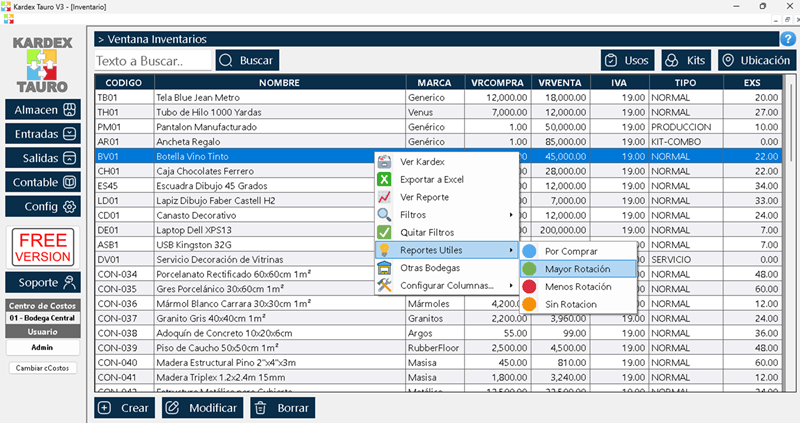
The rule can be summed up in one sentence: nobody adjusts without support. An inventory entry without a count record and without approval is more dangerous than the difference it tries to fix, because it breaks trust in all the information coming from the warehouse. In Kardex Tauro, inventory adjustments are recorded as movements that affect the product's stock ledger and stay linked to their document and reason, so the trail of the adjustment can be reviewed later without relying on anyone's memory.
Adjustment 1: inventory surplus
A surplus happens when there is more merchandise than the stock ledger shows. Typical causes are findings of products that were thought to be lost or sold out, donations received but never documented, customer returns that came back into the warehouse with no entry, or recording errors that understated a receipt. The effect is clear: actual stock is greater than the book balance and the asset appears undervalued.
The entry for a surplus has a fixed shape:
Entry for the surplus Debit: Merchandise inventory, for the value of the surplus. Credit: Miscellaneous income (inventory surpluses) or a specific surplus account.
The credit account has two usual options: a miscellaneous income account or a dedicated account called "surpluses". Which one to use depends on the company's chart of accounts and the accountant's judgment, because some policies prefer not to mix surpluses with other occasional income and create an exclusive account so they can be identified in the income statement. What matters is the nature of the record: the surplus did not come from a sale, so it is not operating income; it is occasional income that improves the profit of the period in which it is discovered.
A small example fixes the idea. A warehouse finds 25 units of a spare part that the stock ledger showed as sold out. The unit cost of the part is $8.000, so the finding is worth $200.000. The entry debits inventory for $200.000 and credits miscellaneous income for $200.000. After the record, the stock ledger balance matches the units that are actually on the shelf again.
Adjustment 2: shortage from theft or recording error
A shortage is the opposite case: there is less merchandise than the stock ledger shows. Its most frequent causes are theft, internal or external, and recording errors that inflated an entry or failed to deduct an exit. In both cases the inventory on the balance sheet is overvalued: it says there are assets that no longer exist or never existed.
The nature of the shortage defines the other side of the entry:
- If the shortage is explained by a recording error with clear evidence, for example an exit posted twice or a duplicated receipt, the natural solution is to correct the movement instead of recognizing an expense.
- If the shortage comes from theft or from a disappearance with no explanation, the other side is an expense or loss account, such as "shortage expenses" or "loss from theft", depending on the chart of accounts and the accountant's judgment.
The general entry for a shortage is this:
Entry for the shortage Debit: Inventory shortage expense (or loss from theft). Credit: Merchandise inventory, for the value of the shortage.
Notice the difference in substance with the surplus: here the asset goes down and the other side is a negative income statement account. The shortage stops being hidden inside inventory and shows up for what it is: a loss for the period. If the company carries theft insurance, the portion covered by the policy is treated as a receivable from the insurer and only the uncovered portion stays as an expense, but that detail depends on each policy and on the company's accounting policy.
Adjustment 3: shrinkage from damage or expiry
Shrinkage is the physical loss of quantity or usability of merchandise: breakage, spills, evaporation, loss of weight during handling, damage from poor handling, or expiry of perishable products. Unlike theft, shrinkage does not necessarily mean someone took the goods: many times the product still exists, but it can no longer be sold or it weighs less than it should.
The accounting key to shrinkage lies in telling normal shrinkage apart from abnormal shrinkage. Normal shrinkage is what the operation expects and tolerates: the small percentage of breakage that any warehouse suffers when receiving, storing or dispatching goods. Abnormal shrinkage is what escapes the expected: a fire, a flood, a serious handling accident or the massive contamination of a batch.
The distinction is not arbitrary: it defines whether the record goes against cost or against expense.
Normal shrinkage Debit: Cost of merchandise (higher cost of the sellable inventory). Credit: Merchandise inventory.
Abnormal shrinkage Debit: Expense for abnormal inventory loss. Credit: Merchandise inventory.
The general principle, which has as its conceptual reference the international accounting standard on inventories (IAS 2), states that the normal losses of the operation are part of the cost of the stock that is actually sold, while abnormal losses are recognized as an expense of the period in which they occur. This material presents the principle in its general form as a recording guide; the in-depth treatment of shrinkage, with its classes and its measurement, was studied in the lesson dedicated to that topic, and the entry you see here is its practical application.
Adjustment 4: impairment and obsolescence
There is a fourth case in which merchandise is physically intact and still worth less: impairment of value. It happens when a product became obsolete, when its packaging was damaged, when it belongs to a discontinued line, or when its reasonable selling price fell below its cost. The inventory did not disappear, but the money it cost can no longer be recovered, and prudent accounting does not wait for the sale to recognize that loss: it recognizes it the moment it is detected.
The conceptual reference is the same inventory standard mentioned for shrinkage: stock is measured, in principle, at the lower of its cost and the value expected to be recovered from it. When that recoverable value is lower than the carrying amount, the difference is recognized as a loss of value.
Entry for impairment Debit: Inventory impairment expense. Credit: Merchandise inventory (direct write-off) or allowance for inventory impairment.
The choice between crediting the inventory directly or crediting an allowance depends on company policy and the accountant's judgment. If the merchandise is going to be destroyed or discarded, the usual path is the direct write-off of the inventory. If the merchandise still exists and only its expected value changed, many companies prefer the allowance, a contra account that reduces inventory on the balance sheet without erasing the units from the stock ledger. The detail of this measurement was developed in the lesson on impairment; here the point is the entry and its logic: an expense for the period against the value of the inventory.
How to choose the entry according to the event
The following table summarizes the four types of adjustment and the account that receives the other side of the entry in each case. It is the quick reference tool for the moment of recording.
| Event | Effect on stock | Accounts of the entry | Nature of the record |
|---|---|---|---|
| Surplus from a finding or an unrecorded donation | There is more merchandise than recorded | Debit to inventory and credit to miscellaneous income or to the surplus account | Occasional income for the period |
| Shortage from theft | There is less merchandise than recorded | Debit to shortage expense or loss and credit to inventory | Expense or loss for the period |
| Shortage from a recording error | The difference is explained by a wrongly posted movement | Correction of the movement, or debit to expense if the difference cannot be traced | Correction or expense, depending on the evidence |
| Normal shrinkage (breakage and expiry within expectations) | Physical loss inherent to the operation | Debit to cost of merchandise and credit to inventory | Cost of the sellable inventory |
| Abnormal shrinkage (fire, flood, serious accident) | Extraordinary physical loss | Debit to expense for abnormal loss and credit to inventory | Expense for the period |
| Obsolescence or impairment of value | The merchandise exists, but it is worth less than it cost | Debit to impairment expense and credit to inventory or to the impairment allowance | Expense for the period from loss of value |
Worked example: a $600.000 shortage from theft
Let us take the concepts into a complete numerical case. A trading company closes the month with an inventory balance in its books of $12.000.000 according to its stock ledger. For the closing, a physical count of the warehouse is performed and the real result is $11.400.000 in merchandise. The difference is $600.000 and, after reviewing the movements of the period and ruling out recording errors, the investigation concludes that merchandise was stolen internally.
The procedure goes like this: the count record is prepared with the difference found, the investigation report concluding the theft is attached, the responsible person approves the adjustment and the accountant proceeds to record it. There is no entry without those documents. The record is the following:
| Account | Debit | Credit |
|---|---|---|
| Inventory shortage expense (loss from theft) | $600.000 | |
| Merchandise inventory | $600.000 | |
| Totals | $600.000 | $600.000 |
After the entry, the inventory balance on the balance sheet stands at $11.400.000, which is exactly the real value of the merchandise in the warehouse, and the $600.000 loss shows up in the income statement as an expense for the period. Notice the full effect: before the adjustment the balance sheet said there was $12.000.000 in inventory when there was really $11.400.000, meaning the asset was overvalued and the loss was hidden. After the adjustment, the inventory tells the truth and the month's result reflects the cost of the theft.
What to review after adjusting
Recording the adjustment closes the accounting chapter, but it opens a question of internal control: why it happened and what will be done so it does not happen again. Recurrence is the most valuable piece of data an adjustment leaves behind:
- If theft shortages keep happening, the problem is not accounting but custody: it is worth reviewing who has access to the warehouse, how exits are controlled, and whether the storeroom should stay locked under the responsibility of a single person.
- If normal shrinkage exceeds what is expected, the problem may lie in handling, storage conditions or inventory turnover times.
- If impairment and obsolescence show up often, the company is buying more than it sells and should review its purchasing policies.
- Periodic physical counts, announced or not, are the best defense: a newborn difference is easy to investigate; a difference that is six months old no longer has witnesses.
The adjustment record must also stay visible for future review: with the document, the reason and the responsible person linked to the movement. In Kardex Tauro the adjustment is recorded as a manual movement that affects the product's stock ledger, so the item's history shows the correction next to purchases, sales and the other movements, and any later review finds the adjustment explained by its supporting document.
Conclusion
Adjusting is not window dressing for the books: adjusting is recognizing the truth of the inventory inside the accounting records. The four cases in this lesson, surpluses, shortages, shrinkage and impairment of value, are solved with the same discipline: verified event, difference measured against the stock ledger, documented and approved support, and an entry whose other side reflects the nature of what happened. A surplus is occasional income, normal shrinkage is cost, and the shortage, abnormal shrinkage and impairment are expenses or losses for the period. When that discipline is followed, the balance sheet goes back to telling the truth and management can make decisions on reliable figures.
The exact names of the accounts depend on each company's chart of accounts and on the judgment of its accountant, and the application of accounting standards must be checked against the version in force in each country. This material presents general principles for educational purposes; for a specific case, consult your accountant to confirm the applicable account and treatment.
Downloadable template: Adjusting entries template in Excel — the Excel template that goes with this lesson.