Bank accounts and bank reconciliation

Bank accounts and bank reconciliation
Welcome to a new lesson of our accounting manual for small businesses. In previous lessons we talked about accounts, about the accounting equation and about double-entry bookkeeping: the rules a business uses to record what it owns, what it owes and what others owe it. Today we will talk about an account that every shop knows very well: the Bank account, which is the money the company keeps at a financial institution. And with it we will look at the tool that prevents most mistakes, overdrafts and surprises with that money: the bank reconciliation.
What the Bank account records
In accounting, the Bank account represents the money the business keeps deposited in checking accounts, savings accounts or other banking products opened in its name. It is an asset account, because that money is a resource that belongs to the company. That is why it works the opposite of what many owners imagine: when the business makes a deposit or receives a transfer, the Bank account is debited and its balance increases; when the business pays by check, sends a transfer or the bank charges it something, the account is credited and its balance decreases. The normal balance of the Bank account is a debit balance, and it simply means how much money the bank owes the business for the funds it holds on deposit.
In practice, the Bank account records every transaction the business carries out with its bank. The most common ones are:
- deposits and consignments, both in cash and in checks received from customers;
- checks issued to pay suppliers, employees, rent or any business expense;
- transfers sent and received, between the business's own accounts or to third parties;
- cash withdrawals from an ATM or over the counter to feed the business cash register;
- automatic payments and debits for utilities, installments or authorized commitments;
- debit notes and credit notes that the bank issues against the account, such as fees or interest.
Each of those transactions must be recorded in the bank ledger, or bank subsidiary account, on the very day it happens or on the day the business learns about it. That timely record keeping is the foundation of everything else: a ledger that is up to date can be reconciled in minutes, while a ledger that is weeks behind turns the reconciliation into a puzzle.
The bank statement and the business ledger
The bank, for its part, keeps its own record of the same account: the bank statement. That document summarizes every transaction the bank recognized during a period, usually one month: deposits credited, checks paid, transfers, fees charged, interest earned and the balance left in the account at the end of the period.
Here is the key to this lesson: the business ledger and the bank statement record the same account, but from two different points of view and at two different moments. The business writes down the check on the day it issues it; the bank only deducts it on the day the payee presents it and cashes it. The bank charges the fee on the day it applies it; the business finds out when it reads the statement. The deposit the business makes on a Friday afternoon appears in its ledger that same day, but the bank may not credit it until the following Monday. That is why the ledger balance and the statement balance are almost never equal on the same day, and that alone does not mean there is an error.
Why the two balances almost never match: the reconciling items
Each difference between the ledger and the statement is called a reconciling item. Reconciling items appear because a transaction is always recorded first on one side and only later on the other. The most frequent ones are these:
- Outstanding checks: checks already issued but not yet cashed. The business deducted them from its ledger on the day it issued them, but the bank has not paid them yet because the payee has not cashed them. Because of this item, the statement looks higher than the ledger.
- Deposits not yet credited by the bank. The business made a deposit, especially on the last day of the month or after the statement cutoff date, and already added it to its ledger, but the bank has not credited it yet. Because of this item, the statement looks lower than the ledger.
- Bank debit notes. Account maintenance fees, returned customer checks, charges or authorized collections: the bank has already subtracted them from the balance, but the business has not recorded them in its ledger yet.
- Bank credit notes. Interest earned on the account balances, yields or credits in favor of the business: the bank has already added them, but the business has not recorded them yet.
- Errors on either side. A check recorded in the ledger for a different amount than the one issued, a deposit credited twice by the bank, or a transaction posted to the wrong account. Errors can live in the business ledger or in the bank's records.
Notice that these items fall into two very different groups. The first two are timing differences: they resolve themselves when the payee cashes the check or when the bank credits the deposit, and in the meantime they require no adjustment in the ledger. Debit notes, credit notes and errors made by the business, on the other hand, are real differences: the ledger balance is incomplete or miscalculated and must be corrected with journal entries. If the error belongs to the bank, the ledger is not touched: the business files a claim with the supporting document and waits for the bank to correct it.
The following table summarizes when each item sits on each side and when it requires a ledger adjustment:
| Reconciling item | Is it in the business ledger? | Is it on the bank statement? | Is the ledger adjusted? |
|---|---|---|---|
| Outstanding check (issued, not yet cashed) | Yes | No | No |
| Deposit not yet credited by the bank | Yes | No | No |
| Bank fee charged by the bank | No | Yes | Yes |
| Interest earned credited by the bank | No | Yes | Yes |
| Customer check returned by the bank | No | Yes | Yes |
| Bank error recording a transaction | No | Yes | No |
The rule is simple: the ledger is adjusted only when the item is already on the statement but the business had not recorded it, or when the business recorded it incorrectly. Items that are only in the ledger because the bank has not processed them yet do not generate a journal entry: they are noted on the reconciliation and checked again next month.
The reconciliation process, step by step
Reconciling means comparing the bank ledger against the bank statement, explaining every difference and bringing the ledger up to date. This is how it is done:
- Get the statement for the period and gather the bank ledger, the list of checks issued and the deposit receipts for the month.
- Compare the transactions one by one: every deposit, check, transfer or note on the statement must find its match in the ledger. Check amounts and approximate dates, because the bank may record a transaction one or two days after the business does.
- Mark as reconciled everything that matches on both sides. Whatever is left without a match is a difference that must be explained.
- List the differences and classify them: is it only in the ledger, like an outstanding check or a deposit not yet credited? Is it only on the statement, like a fee, interest or a returned check? Is it an error made by either side?
- Adjust the ledger: record journal entries for the debit notes, the credit notes and the business's own errors. Timing differences are not recorded; they are noted on the reconciliation to be verified next month.
- Check that it balances: the ledger balance after the adjustments must equal the statement balance after adding or subtracting the timing items.
- File the reconciliation together with the month's statement: it is the supporting document that explains the changes in the ledger and leaves evidence for the accountant or for a future review.
Some people prefer to balance the two balances first with the timing items and make the journal entries at the end; others record the entries first and balance afterwards. Both paths lead to the same result. What matters is to work methodically, with the statement at hand and without leaving any difference unexplained.
The journal entries that come out of the reconciliation
The reconciliation does not end when the numbers balance: it ends when the ledger is up to date. Every item that is on the statement but not in the ledger requires its journal entry, because the money has already moved and the accounting must reflect it. The three most common cases are these.
The first case is bank fees and charges. When the bank charges the account maintenance fee or a service commission, the business has a new expense that has not been recorded yet. The journal entry debits the bank fees expense account and credits the Bank account: the ledger goes down by the amount of the fee and ends up level with the statement.
The second case is interest earned. If the bank credited interest on the account balances, the business received financial income that has not been recorded yet. The journal entry debits the Bank account and credits the financial income or interest earned account: the ledger goes up.
The third case is returned customer checks. When the business deposits a customer's check and the bank returns it because of insufficient funds, the bank charges that amount back to the account. The journal entry debits the customer's accounts receivable, or reverses the payment that had already been applied to the customer's invoice, and credits the Bank account. The customer's debt becomes active again and the business must pursue the collection through another channel.
If the error was made by the business, for example a check recorded in the ledger for a different amount than the one issued, it is corrected with a journal entry that moves the difference between the affected accounts. And if the error belongs to the bank, no entry is made: the business files the claim with the supporting document and records the adjustment once the bank confirms it. A golden rule closes this point: every journal entry that comes out of a reconciliation must have its supporting document, whether it is the statement, the bank's note or the receipt, just like any other accounting record. The reconciliation does not authorize making up adjustments to force the balance.
A complete numerical example
Let us look at a reconciliation with numbers, because that is the best way to understand it. At the end of the month, the owner of a business reviews the checking account. According to the bank ledger, the balance is $4,500,000. The statement sent by the bank shows a balance of $5,000,000. There is a difference of $500,000, and it must be explained before taking anything for granted.
Comparing the transactions one by one, four items appear. First: the business issued checks for $800,000 in the last days of the month and the payees have not cashed them yet, so the bank has not paid them and its balance looks higher. Second: the business deposited $250,000 on the last business day and the bank has not credited that deposit yet, so its balance looks lower. Third: the statement shows a $100,000 account maintenance fee that the business had not recorded. Fourth: the bank credited $50,000 of interest earned, which is also missing from the ledger.
The reconciliation is summarized in the following table. The maintenance fee is subtracted from the ledger balance and the interest is added to it. The outstanding checks are subtracted from the statement balance and the pending deposit is added to it:
| Item | Ledger balance | Bank statement balance |
|---|---|---|
| Balance before reconciling | $4,500,000 | $5,000,000 |
| Less: outstanding checks (issued, not yet cashed) | - | -$800,000 |
| Add: deposit not yet credited by the bank | - | +$250,000 |
| Less: bank fee not recorded in the ledger | -$100,000 | - |
| Add: interest earned not recorded in the ledger | +$50,000 | - |
| Reconciled balance | $4,450,000 | $4,450,000 |
Both sides reach $4,450,000: the reconciliation balances. Two journal entries were recorded in the ledger, one for the fee and one for the interest, and the timing differences were noted on the reconciliation to be verified next month. When the supplier cashes the check and the bank credits the deposit, those two items will disappear from the statement on their own and the balances will agree again.
Good practices with the Bank account
The reconciliation is one of those tasks that only cause problems when they are not done. With these practices it becomes fast and reliable:
- Reconcile at least once a month, before closing the accounting for the period. Monthly frequency is the recommended minimum; if the business issues many checks or moves a lot of money, do it every two weeks or every week.
- File the statement and the reconciliation of every month, on paper or digitally, so that the accountant or a future review can reconstruct what happened with the account.
- Investigate items that grow old: an outstanding check from three months ago or a deposit that never appeared deserves a phone call to the bank or to the payee.
- Record transactions in the ledger on the day they happen: it is impossible to reconcile over incomplete records or loose receipts kept in a drawer.
- Reconcile every bank account the business has, including the savings account: each one requires its own reconciliation.
- When the size of the business allows it, separate responsibilities: the person who reconciles should not be the same person who authorizes checks and handles the funds.
Monthly frequency should be as fixed as paying rent or payroll. A business that reconciles every month knows, with certainty, how much money it has in the bank; the one that does not reconcile discovers the problems when they are already expensive to solve.
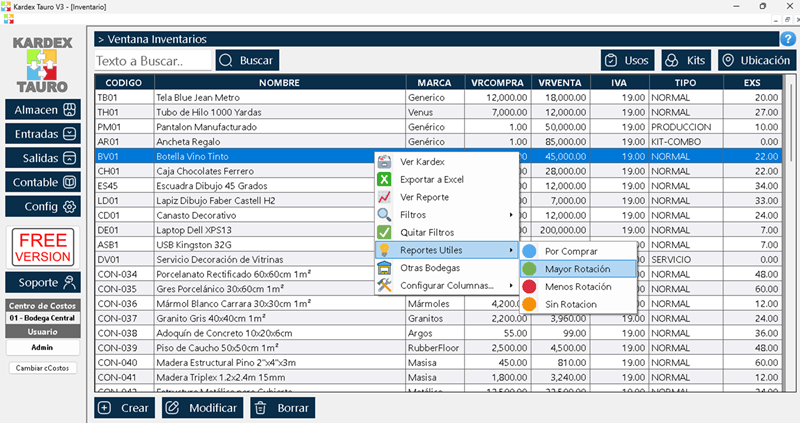
This closes the lesson: the Bank account holds the business cash that sits at the bank, and the bank reconciliation is the compass that confirms that balance is real. Mastering this habit prevents overdrafts, double payments, wrong financial statements and arguments with the bank. And remember that the money in the account and the merchandise in the inventory are the two great treasures of a commercial business: while the reconciliation protects the first, an orderly inventory control protects the second, and that control can rely on a good program such as Kardex Tauro, which records every merchandise entry and exit with its cost, up to date and without depending on anyone's memory.
Downloadable templates: Bank book template in Excel and Bank reconciliation template in Excel — the Excel templates that go with this lesson.