Fixed assets and depreciation
Fixed assets and depreciation
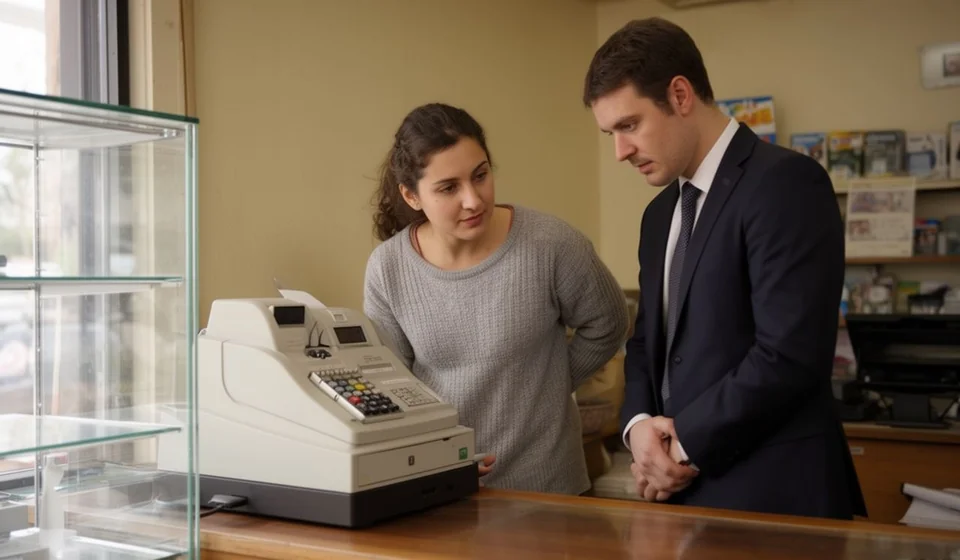
A business that sells merchandise does not only buy goods to resell: it also buys the cash register it uses to charge customers, the display case where it shows its products, the computer where it keeps its books, the vehicle that delivers orders and, in many cases, the machinery that prepares or transforms what it sells. All these items have something in common: they are not bought to be sold but to be used for several years. This lesson explains what a fixed asset is, why buying one is not an expense of the month, how the purchase is recorded in the accounts, and what depreciation is, that is, the way the cost of the asset is spread over the years in which the business uses it.
What is a fixed asset
A fixed asset is a tangible item that the business acquires to use in its daily operations and expects to keep using for more than one accounting period. Typical examples are the cash register, the display case or shelving of the store, the computer and the printer, the delivery vehicle, machinery, refrigeration equipment, major tools and the furniture used to serve customers. The word fixed does not mean that the item cannot move: a vehicle moves all day long and is still a fixed asset. What is fixed is its role within the business: it stays working as a business tool instead of leaving the business as sold merchandise.
Three characteristics help to recognize a fixed asset. First, it is used: the business needs it to produce, serve customers, administer or sell, so it is not meant for resale. Second, it lasts: its useful life is measured in years rather than weeks, so its wear is spread over many periods. Third, it represents a significant investment: a low-cost durable item can be treated as an expense of the period without much trouble, but an item of significant cost deserves its own record and control, because its information will affect the statements of the business for many years.
The key difference: inventory and fixed assets
The most important classification in this lesson separates inventory from fixed assets, because the path that cost follows in the accounts depends on it. Inventory is made up of the items that the business buys with the intention of selling them or consuming them within the services it charges for: merchandise, raw materials, packaging and spare parts delivered to the customer. Fixed assets, on the other hand, are made up of items bought to be used: they do not enter an ordinary sale and they stay with the operations for years.
The difference is not in the name of the item or in what it costs, but in the purpose the business gives it: was it bought to be sold or to be used? The same item can be inventory in one business and a fixed asset in another. The display case that the store buys to show its merchandise is a fixed asset of the store; the same display case made by a carpenter shop to sell it is inventory of the carpenter shop. The following table summarizes the typical cases of a trading business.
| Case | Inventory or fixed asset? | Why |
|---|---|---|
| Merchandise bought to be sold | Inventory | It is bought to be resold and its cost becomes cost of sales when it is sold. |
| Cash register | Fixed asset | It is bought to be used when charging and recording sales, not to be sold. |
| Business computer | Fixed asset | It is used every day in the operations or in administration for several years. |
| Spare parts sold or installed in services the business charges for | Inventory | They leave the business with each job and their cost is passed to the customer as cost of sales. |
| Display case or shelving | Fixed asset | It is used to display merchandise for many years and is not resold. |
Notice the spare parts case: if the business sells them or installs them within a service it charges for, they are inventory, because they leave the business with every job. If, instead, they are parts used to maintain the business's own equipment, they are not sold or charged, and they are treated as a maintenance expense of the period. What decides the classification is always the use the business will give to the item.
How the purchase of a fixed asset is recorded
When the business buys a fixed asset for cash, it delivers money from Cash or Bank and receives an item it will use for years. That exchange is not an expense of the month: the expense does not exist yet, because the item is complete and still working. It does not go to inventory either, because it will not be sold. For that reason the entry is a change of one asset for another: the fixed asset account is debited, that is increased, and the Cash or Bank account is credited, that is decreased.
Suppose the business buys a cash register for cash at a price of 2,400,000. The entry on the day of the purchase is:
- Debit: Fixed asset, cash register equipment, for 2,400,000: the assets of the business increase.
- Credit: Cash or Bank, for 2,400,000: the available money decreases.
No expense appears in this entry and the profit of the month is not reduced by the purchase: the money simply became an item the business will keep using. If the purchase is on credit, only the second line changes: instead of Cash or Bank, the account Suppliers or Accounts payable is credited, because a debt is born, and the fixed asset is recorded for the same amount. When that debt is paid later, the payment is not an expense either: it is the settlement of an obligation that was already recorded at the time.
The cost of acquisition
For how much is the fixed asset recorded? Not only for the price on the invoice. Everything the business must pay to have the item bought, delivered and ready to run is part of the acquisition cost: the price of the item, the freight and transport to the store, installation and assembly, start-up tests and initial adjustments. All those amounts add to the asset and none of them is an expense of the month, because without those payments the item would not be working in the business.
Suppose the business buys a machine for its workshop or for the production area of its location. The invoice shows a price, but having the machine running cost more:
| Item of the payment | Amount |
|---|---|
| Purchase price of the machine | 8,300,000 |
| Freight and transport to the location | 350,000 |
| Installation and assembly | 250,000 |
| Start-up and testing | 100,000 |
| Total acquisition cost of the fixed asset | 9,000,000 |
The fixed asset is recorded for 9,000,000 and not for 8,300,000, and that is the figure that will be depreciated over the useful life. If the business expensed the freight and the installation at once, the asset would be recorded for less than it really cost and the depreciation of the following years would be lower than it should be.
Useful life and residual value
Useful life is the time, usually expressed in years, during which the business expects to use the asset under normal working conditions. There is no universal list that sets it: it depends on the type of asset, the intensity of use, the maintenance it receives and the plans of the business itself. The accountant helps to choose a reasonable basis and to apply it consistently every year. The central idea is that useful life is the business's own estimate of how long the asset will serve it, and not a number copied without thinking.
Residual value is the part of the cost that the business expects to recover at the end of the useful life, for example by selling the used asset or taking advantage of its parts. Because that part is expected to be recovered, it is not depreciated: only the difference between cost and residual value is spread. With the machine of the example, if the business estimates that after five years it will recover 1,000,000 by selling it used, what is spread as expense is 9,000,000 minus 1,000,000, that is 8,000,000.
Straight-line depreciation: formula and example
Depreciation is the distribution of the cost of a fixed asset as an expense over its useful life. The simplest way, and the most used in small businesses, is straight-line depreciation: the same amount of expense is recognized every year, because the asset is assumed to provide a similar service in every period. The formula is: annual depreciation equals the difference between the acquisition cost and the residual value, divided by the useful life in years.
With the machine of the example it works like this: cost of 9,000,000, residual value of 1,000,000 and a useful life of five years. The base to depreciate is 8,000,000 and, divided by five years, it gives an annual depreciation of 1,600,000. That amount is about 133,333 per month, because 1,600,000 divided by twelve months is approximately 133,333. Each full year of use therefore generates 1,600,000 of depreciation expense.
The following table shows what happens to the machine year after year: the depreciation of the year is added to the accumulated depreciation, and the net book value, which is the cost minus the accumulated amount, goes down period after period until it reaches, at the end of the fifth year, the estimated residual value of 1,000,000.
| Year | Depreciation of the year | Accumulated depreciation | Net book value |
|---|---|---|---|
| 0, year of purchase | 0 | 0 | 9,000,000 |
| Year 1 | 1,600,000 | 1,600,000 | 7,400,000 |
| Year 2 | 1,600,000 | 3,200,000 | 5,800,000 |
| Year 3 | 1,600,000 | 4,800,000 | 4,200,000 |
| Year 4 | 1,600,000 | 6,400,000 | 2,600,000 |
| Year 5 | 1,600,000 | 8,000,000 | 1,000,000 |
At the end of the fifth year the machine has no base left to depreciate: the whole cost, minus the residual value, has become expense. If the business keeps using the machine after that year, it simply stops recording depreciation, or reviews with the accountant whether it is convenient to update the useful life estimate.
The periodic depreciation entry
Depreciation is not recorded once when the asset is bought: it is recorded in every period, month after month, while the asset is in use. In each recording the business recognizes the expense of the period and, at the same time, accumulates the value the asset has consumed. The monthly entry for the machine of the example, for about 133,333, is:
- Debit: Depreciation expense, for 133,333: it recognizes the expense of the month.
- Credit: Accumulated depreciation, for 133,333: it accumulates the value consumed from the asset.
Two details matter in this entry. First, the credit does not go to Cash or Bank: depreciation is not an outflow of money, because the money already left when the asset was bought. Depreciation recognizes that the asset is being consumed by use, even though nobody is paying anything at that moment. Second, the account Accumulated depreciation is not an expense: it is an account that subtracts from the asset, which is why it is called a valuation account or a contra account. The depreciation expense, on the other hand, does reduce the profit of the period, just like salaries expense or utilities expense do.
The asset on the balance sheet: net book value
On the balance sheet a fixed asset is not presented at its purchase cost but at its net book value, which is the cost minus the accumulated depreciation. With the machine of the example, at the end of the third year the balance sheet will show the fixed asset at its cost of 9,000,000, subtract the accumulated depreciation of 4,800,000 and present a net book value of 4,200,000.
That figure does not claim to be the market price of the asset: if the machine were sold that same day, the business might obtain more or less than 4,200,000. The net book value says something else: how much of the original cost still remains to be turned into expense through the future use of the asset. It is the information the business needs to know which part of its investment has already been consumed, how much it still has to recover with the work of the asset, and when it is convenient to start planning its replacement.
Common mistakes with fixed assets
Handling fixed assets well is not difficult, but three mistakes repeat themselves in small businesses and distort the accounting information for years.
- Expensing the whole asset in the year of purchase. If the machine of 9,000,000 is taken to expenses all at once, the profit of that year looks very low and the profit of the following years looks very high, because the business keeps using an asset whose cost already disappeared from the books. The purchase only changes one asset for another; it is the annual depreciation of 1,600,000 that turns the cost into expense, year after year.
- Depreciating inventory. Merchandise is not depreciated: its cost becomes cost of sales when it is sold. If it were depreciated as well, the expense would be counted twice and the cost of sales would become disordered.
- Not keeping a record of the fixed assets. If the purchase is recorded as an expense or is not recorded at all, the business loses track of its investment, does not calculate depreciation and the balance sheet remains incomplete. For each asset it is convenient to note its purchase date, its total cost, where it is and who uses it.
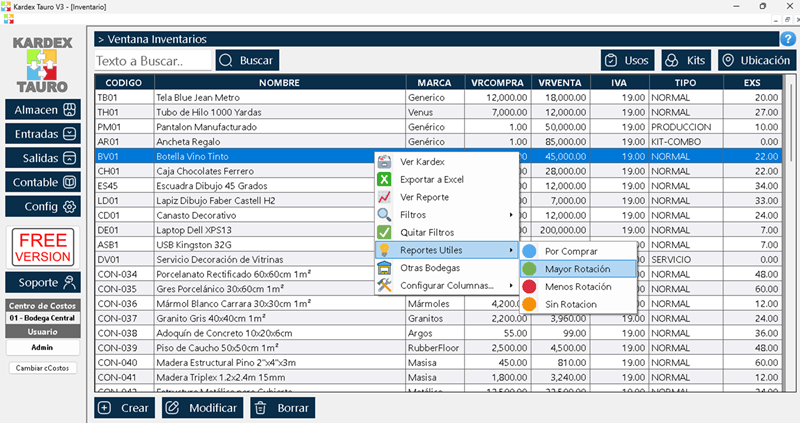
The good news is that classifying every purchase correctly from the beginning does not demand more work but more method: when the business records its documents in order and every operation is identified by its nature, the accountant receives the information ready to review and the closing of every month becomes faster. A business that keeps its daily operations organized with a system such as Kardex Tauro and applies the ideas of this lesson knows, at any moment, how much it still has to depreciate from its equipment and how much its expenses of the period really represent.
Downloadable template: Fixed asset depreciation template in Excel — the Excel template that goes with this lesson.