The balance sheet: where an inventory business stands
The balance sheet: where an inventory business stands
After learning how to record purchases, sales and the profit of the period in the previous lessons of this accounting manual, the moment has come to bring everything together in a single document. When the owner of a hardware store wants to know how the business looks at the end of the month, it is not enough to look at how much was sold: he needs to see, on one page, what the business owns, what it owes and how much is left for him. That document is the balance sheet, also called the statement of financial position, and it is the snapshot of the business on a specific date. In this lesson we are going to build it piece by piece with the same hardware store from the previous lesson, item by item, and we are going to learn how to read it with simple questions.
The balance sheet answers three questions that every owner of a trading business should be able to answer at any moment: what do I own, what do I owe and how much is really mine? The first thing the balance sheet shows is the list of the goods and rights of the business, which we call assets; then it shows the debts owed to third parties, which we call liabilities; and finally it shows the difference, which is the owner's equity. That difference is not a number that someone invents: it is exactly the amount that makes the accounting equation we studied in the early lessons of the manual hold true: assets equal liabilities plus equity. If that equality does not hold, something has been recorded incorrectly.
A snapshot, not a movie
It is worth remembering the difference between the two most important statements of a business. The income statement from the previous lesson is like a movie: it shows what happened during a period, how much was sold, how much the merchandise sold cost and how much profit was earned between the first and the last day of the month. The balance sheet, in contrast, is a snapshot: it shows the situation of the business at one exact moment, usually at the close of a day, when the cash drawer is locked and everything that remains is reviewed. That is why the balance sheet always carries a date, and that date is the answer to the question of which moment is being pictured.
Because it is a snapshot, the balance sheet changes every day: each sale changes cash or accounts receivable and reduces inventory, each purchase increases inventory and may create a debt with the supplier, and each payment reduces both money and debt at the same time. What the balance sheet shows is the accumulated result of all those operations up to that instant. That is why accountants say the balance sheet is the final summary of everything recorded in the books, and that the income statement explains why equity changed during the period.
Assets: everything the business owns
Assets are the list of everything the business owns that can bring it benefit: the cash in the register, the money in the bank, what customers owe, the merchandise on the shelves and also the furniture and equipment it works with. To keep that list in order, the balance sheet separates assets into two large groups according to how quickly each item turns into money: current assets and non-current assets.
Current assets bring together the items that are expected to be turned into cash, sold or used up within the normal operating cycle of the business, which in a trading business is usually one year or less. In the hardware store of our example, current assets are made up of cash, bank accounts, accounts receivable from customers who bought on credit, and the merchandise inventory. All these items have something important in common: they are in constant motion, coming into and leaving the business.
Within current assets, inventory deserves special attention, because in a trading business it is almost always the most important item. Merchandise bought to be sold is a current asset for a very clear reason: the business expects to sell it in the short term and turn it back into cash. That journey, which goes from money to merchandise and from merchandise back to money, is called the operating cycle, and it is the heart of a business with inventory: you buy to sell, you sell to collect, and you collect to buy again. While the merchandise is on the shelves it is an asset; the moment it is sold it stops being inventory and becomes the cost of sales, as we saw in the lesson about profit.
Non-current assets bring together the items the business uses for a long time and that are not meant to be sold: the shelves, the display case, the cash register, the delivery van and the tools in the warehouse. On the balance sheet these items do not appear at their full purchase cost but at their net book value: the original cost minus the accumulated depreciation we studied in the lesson about depreciation. Accumulated depreciation recognizes that these items wear out with use, and subtracting it from the original cost shows how much the fixed asset is really worth on the date of the balance sheet.
Liabilities: everything the business owes
Liabilities are the list of the debts of the business to third parties, that is, to people or entities other than the owner: the suppliers who delivered merchandise on credit, the government for the taxes generated in the period, the bank for a loan and the other creditors for pending obligations. Just like assets, liabilities are separated into current and non-current according to how much time remains to pay each debt.
Current liabilities group the debts that must be paid within the operating cycle: the pending invoices to suppliers, the taxes payable that will be settled in the coming months, and short-term obligations such as the part of a loan that matures within the year. Non-current liabilities, on the other hand, bring together debts with a longer term, such as the remaining balance of a loan that will be paid over several years. This separation by term is not a technical detail: it is what allows you to know, at a glance, how much of the money of the business is committed to payments that are close at hand.
Equity: the owner's share
After listing what the business owns and what the business owes, the balance sheet shows equity, which is the part of the assets that truly belongs to the owner. If the business sold all its assets and paid all its liabilities, the money left over would be exactly the equity. That is why equity grows when the business earns profits and does not withdraw them all, and shrinks when the owner takes money out of the business or when there are losses, as we saw in the lesson about equity.
On the balance sheet, equity usually shows two things: the contributions the owner made at the beginning or at some point along the way, and the accumulated profits that have been earned and kept working in the business. The profit of the latest period, calculated in the previous lesson, also appears here, because when the month closes that profit increases equity: what the business earned already belongs, in good part, to the owner. With these three pieces, assets, liabilities and equity, we can now build the complete balance sheet of the example.
The hardware store's balance sheet at month end
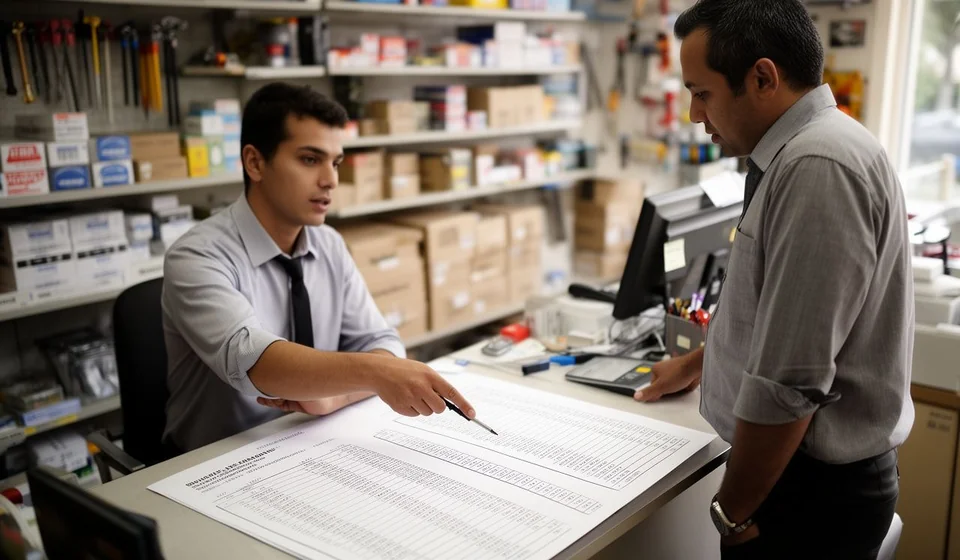
To build the balance sheet in practice, let us use the same hardware store from the previous lesson, at the close of the last day of the month. The accountant reviewed the cash book, the bank statements, the pending invoices for collection and payment, the stock record of merchandise, the register of fixed assets with their depreciation and the calculation of the profit for the period. With all that information he put together the following snapshot of the business on that date. Notice how each item appears on the side that corresponds to it: on the left, everything the business owns; on the right, everything it owes and what belongs to the owner.
| Assets | Amount | Liabilities and equity | Amount |
|---|---|---|---|
| Cash | 1,200,000 | Suppliers | 2,800,000 |
| Bank accounts | 2,800,000 | Taxes payable | 1,200,000 |
| Accounts receivable | 1,500,000 | Short-term obligations | 500,000 |
| Merchandise inventory | 6,500,000 | Total current liabilities | 4,500,000 |
| Total current assets | 12,000,000 | Long-term debt | 3,000,000 |
| Furniture and equipment | 10,000,000 | Total liabilities | 7,500,000 |
| Less: accumulated depreciation | (2,000,000) | Owner's contributions | 10,000,000 |
| Net fixed assets | 8,000,000 | Profit for the period | 2,500,000 |
| Total non-current assets | 8,000,000 | Total equity | 12,500,000 |
| TOTAL ASSETS | 20,000,000 | TOTAL LIABILITIES AND EQUITY | 20,000,000 |
Look at the table carefully. On the left, the hardware store owns twenty million in assets: twelve million in current assets and eight million in fixed assets net of the accumulated depreciation of the furniture and the equipment. On the right, it owes seven and a half million: four and a half million in the short term, between suppliers, taxes and near obligations, and three million in the long term. The difference between what it owns and what it owes is twelve and a half million of equity, which includes the owner's contributions and the profit of the period calculated in the previous lesson.
Check the equation: total assets, twenty million, is exactly equal to total liabilities, seven and a half million, plus total equity, twelve and a half million. Twenty equals seven and a half plus twelve and a half. That equality is not a coincidence: it is the same accounting equation from the early lessons of the manual, now with the real numbers of the hardware store. If the two sides do not balance when you build your own balance sheet, it is a sign that a record is missing, another one is left over or there is an error in some item; finding it is part of the accountant's work.
How to read the balance sheet: simple questions, no complicated formulas
Building the balance sheet is half of the work; the other half is reading it. For a business owner, the best way to read the balance sheet is not to memorize formulas but to ask simple questions and look for the answer in the items. Each line of the balance sheet exists to answer a concrete question about the business, and once you know which question each item answers, the document stops being a grid of numbers and becomes a diagnosis.
| Balance sheet item | Question it answers |
|---|---|
| Cash | How much money do I have available today to pay expenses and immediate debts? |
| Bank accounts | How much money do I keep in the business bank account? |
| Accounts receivable | How much do customers owe me for the credit sales of the period? |
| Inventory | How much merchandise do I have on the shelves to sell and turn into money? |
| Suppliers | Whom do I owe, and how much, for merchandise bought on credit? |
| Taxes payable | How much must I pay the government for the taxes generated in the month? |
| Long-term debt | Which obligations must I pay over terms longer than one year? |
| Equity | How much of the business is truly mine after paying everything I owe? |
One of the most useful questions you can ask the balance sheet is about short-term debts: can the business pay what it owes in the coming months with what it has at hand? To answer it you do not need any complex formula: it is enough to compare the total of current assets with the total of current liabilities. In the hardware store of the example, current assets add up to twelve million and current liabilities to four and a half million, so the business has more than twice as much in liquid and almost liquid resources as in near debts. That is a healthy sign: the hardware store could pay its short-term obligations without having to sell its fixed assets or ask for an urgent loan.
If current liabilities were larger than current assets, the reading would change completely: the business would have more near debts than resources to pay them, and it would depend on selling the inventory very quickly, collecting soon or finding financing so it does not run out of liquidity. The comparison does not predict the future and does not replace a detailed analysis, but it is a very powerful first filter that any owner can apply in a minute with the calculator on the phone, looking at only two totals on the balance sheet.
High inventory and low cash: money sleeping on the shelves
Now look carefully at the relationship between two items of the current assets of the hardware store: inventory and cash. On the balance sheet of the example, the merchandise on the shelves is worth six and a half million, while the money in cash and in bank accounts totals four million. What does that combination say? That a very large part of the money of the business is turned into merchandise, waiting to be sold. Inventory is an asset, no doubt, but it is an asset that does not produce money yet: it produces money only when it is sold and collected.
When inventory is high and cash is low, the accountant says the business has money sleeping on the shelves: there is wealth, but it is not available to pay wages, utilities or immediate debts. This is not necessarily a mistake, because in a trading business it is normal to keep a level of merchandise to serve the customers; the problem appears when the sleeping money grows without control, because it stops being used to buy more merchandise, to take advantage of supplier discounts or to cover unexpected expenses. In the next lesson we are going to study in detail how inventory turns into cash and how that conversion is controlled, so for now keep this idea: on the balance sheet, inventory is an asset that dreams of becoming money.
Ideas to remember
- The balance sheet is the snapshot of the business on one date: it lists what it owns, what it owes and how much is left for the owner.
- Assets are ordered into current and non-current; in a trading business, inventory is almost always the most important current asset.
- Inventory is a current asset because it is expected to be sold and turned into cash within the operating cycle.
- Liabilities are also separated by term: current for near debts and non-current for long-term ones.
- Equity is the difference between assets and liabilities, and it grows with the profit of the period.
- The balance sheet always balances: assets equal liabilities plus equity; if it does not balance, there is a record to review.
- To read the balance sheet, simple questions are enough: can I pay my near debts with what I have? How much merchandise do I have to sell?
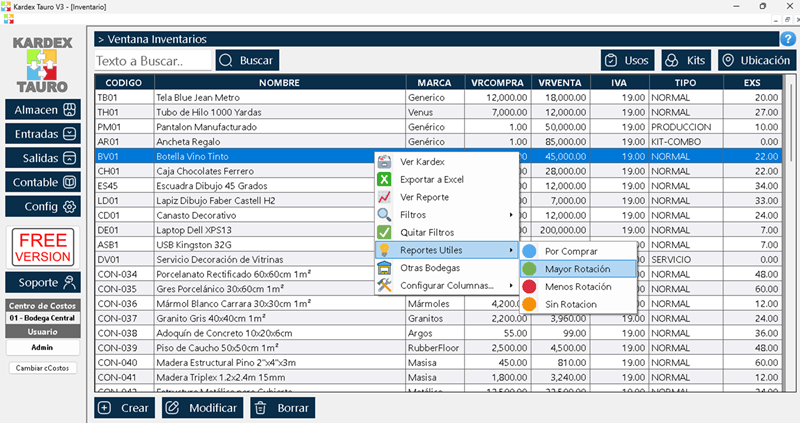
With the balance sheet built and read, the owner of the hardware store already has the complete snapshot of his business on one date: he knows what he owns, what he owes and how much belongs to him. In the coming articles of the manual we will keep completing the picture with the tools the accountant uses so that the snapshot is always faithful to reality. And if you want to practice building balance sheets with your own numbers, remember that Kardex Tauro accompanies you lesson after lesson with clear explanations and examples from the real life of the business.
Downloadable template: Balance sheet template in Excel: assets, liabilities and equity — the Excel template that goes with this lesson.