Simple power of attorney template for Word (free download)
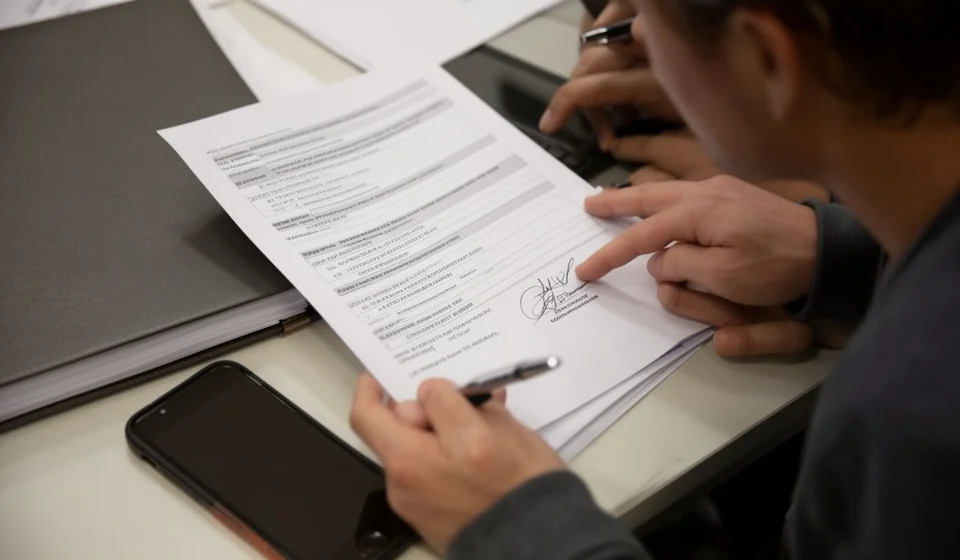
Simple power of attorney template for Word (free download)
Some errands cannot wait for a free morning: the counter opens exactly when you are at work, your trip clashes with the deadline, or the document has to be collected in person in a city where you no longer live. What gets you out of that corner is not a solemn power, but a clearly written sheet in which one person gives another the authority to handle one specific errand. That sheet is a simple power of attorney, and this template leaves it ready to fill in Word.
People use it every day. An employee authorises a brother to collect a certificate from the personnel office; a mother authorises her eldest son to file an application at the town hall; a shop owner authorises a trusted employee to pick up an order at the supplier's warehouse; a traveller asks someone to sign the delivery sheet for a parcel. In almost every case the situation is the same: an ordinary errand, specific and short, that someone else can handle for you as long as they carry a written and signed authorisation.
The pages below show the real blocks of the template, the details worth having on the table before you write a single line, the step-by-step to fill it in without leaving loose ends, and the mistakes that make the letter lose value exactly when you need it most. It is a general guide for personal use: it does not replace advice from your own adviser, and each organisation may have requirements of its own.
⬇ Download simple power of attorney (.docx)
What a simple power of attorney is
A simple power of attorney is a private document, written in letter form, in which one person — the principal — authorises another — the agent — to carry out one specific errand in their name. It is called simple because it does not go through a notary: the signature of the person granting it and the acceptance of the person receiving it are, in principle, all that errand needs.
The template words the grant as a special power: you write your name and identification, the agent's name and identification, and above all the errand you are authorising. The word special is the key to the whole document. It is not a general power to deal with every matter a person may have, but an authorisation limited to one matter and one period. That limit is an advantage for both sides: it makes clear how far the agent's authority reaches and keeps anyone from acting beyond what was asked.
It is also worth saying plainly: the simple power of attorney works for ordinary errands before companies and public bodies. If the errand requires a notarised power of attorney, this letter does not replace it. Before signing, and before your agent turns up at the counter, confirm with the organisation which document it requires; that single step saves you a whole day in a queue.
What it is used for: concrete cases
- Collecting documents, certificates, statements or mail held in someone else's name.
- Filing applications, requests or replies before a public body or a private company.
- Signing delivery sheets and receipts that belong to the authorised errand.
- Claiming orders, parcels or products at a pickup point, a warehouse or a shop.
- Receiving notices and following the outcome of the errand so the principal can be told.
- Standing in for a relative or a colleague in a straightforward administrative errand.
Details to have at hand before you fill it in
The letter takes ten minutes to complete when the details are on the table. When they are not, an identification number is mistyped or a bracket is left unreplaced, and the agent finds the mistake already at the counter. This is the short list:
| Detail | What it is for and where to get it |
|---|---|
| Full name and identification of the principal | They appear in the header and in the granting paragraph. Take both from the identity document and not from memory. |
| Address and city of the principal | They appear in the general details and in the closing statement. They serve to locate the person granting the authorisation. |
| Phone and email of the principal | They let the organisation or the agent clear up any doubt before acting. |
| Full name and identification of the agent | They are repeated in the grant and in the acceptance. If one digit is wrong, the authorisation does not match the person who turns up. |
| Phone and email of the agent | They stay in the header so the organisation can reach that person on the day of the errand. |
| Exact errand and organisation | This is the heart of the document. Write the verb and the object precisely: claim, file, collect or sign, and before whom. |
| Start and end dates | The template asks for a first date and a last one. Think of the real day of the errand and leave a reasonable margin. |
| Place where the copy will stay | The copy line tells you where the document was filed. The principal should keep a signed copy. |
What the template includes
The file is a one-page letter with the blocks that organisations recognise at once. This is the real structure:
| Section | What is written there |
|---|---|
| Centred title | The words simple power of attorney, so that any clerk identifies the document at a glance. |
| Details of the principal | Full name, identification, address, phone, email and date. This is the block of the person granting the authorisation. |
| Details of the agent | Full name, identification, phone and email of the person who will act on your behalf. |
| Granting of the power | The central paragraph: who authorises whom, for which errand and before which organisation. |
| Validity and scope | A paragraph with the first date, the final date and the concrete limit of the errand. |
| Faculties | The paragraph that allows the agent to submit and receive documents linked to the errand and to report the outcome. |
| Statement | The closing sentence with the city and the date of signature. |
| Signatures | The spaces for the signature of the principal and of the agent. |
| Acceptance by the agent | A short section where the agent accepts the appointment and undertakes to act within the authorised scope. |
| Copy and final notice | The copy line and the warning that a simple power works for ordinary errands and does not replace a notarised power when one is required. |
How to fill it in, step by step
- Download the file and open it in Word. Check that the date in the header is the day you will sign; if you are signing tomorrow, correct it now and not later.
- Replace every bracket with real information. None should survive in the final document: neither the empty gaps nor the words in brackets that tell you what to write. When you finish, read the whole letter looking for leftovers.
- Describe the errand precisely in the granting paragraph. Instead of a vague phrase about handling some paperwork, write to claim and collect the employment certificate, or to file the replacement application. The exact verb is the one nobody argues with later.
- Set the validity period. Write the date from which the authorisation applies and the date on which it stops applying. An authorisation with no final date is an open door; one that expires before the errand forces you to start again.
- Limit the scope. Spell out in one sentence what is left out: changing conditions, receiving money, signing commitments or authorising different deliveries. The template keeps a space for that limit, and it is worth using it.
- Fill in the agent's details and ask that person to read the letter before signing. If something does not match what they understand the errand to be, it is better to fix it there than at the counter.
- Have the principal sign, and have the agent sign in the acceptance section, with the identity documents at hand. Write the city and the date in the closing statement and check that they match the header.
- Keep a copy before handing over the original. Write on the copy line where the document is kept and, if the organisation stamps a receipt, keep that stamped copy as well: it is the proof that the errand was filed.
Common mistakes and what to check before signing
- Leaving a bracket or a blank space. A letter with the agent's name still unreplaced is worthless, and the mistake is usually found too late.
- Writing a name or an identification number without checking it against the identity document. One different digit means the authorisation does not belong to the person who turns up.
- Drafting a scope that is far too general. Phrases about every possible errand are usually refused and, if they are accepted, they leave the principal with no control over what was done in their name.
- Leaving out the validity dates, or writing a date that has already passed. Both force you to start again on the very day of the errand.
- Dates that do not match between the header, the closing statement and the agent's signature. A document with three different dates raises fair doubts.
- Handing over the original without keeping a copy, or failing to confirm with the organisation which document it requires. On many errands the answer is a notarised power, and it is better to know that before the queue than after it.
When it is worth moving to a system
A simple power of attorney handles well what happens now and then: one errand, two people, one day. Once authorisations become routine, the problem moves elsewhere. If at a warehouse or a shop there are three or four people authorised to collect goods every week, holding the letter is not enough: you need to know what each authorisation moved, what left the inventory, who answered for that collection and how it all ended. That control no longer comes from a signed sheet but from an orderly record of entries, exits and stock. That is where Kardex Tauro makes sense: the letter remains the document that gets filed and the system takes care of the movement and the balance. While the volume stays low, the template is enough and nothing else is needed.
Before closing, it is worth repeating the warning that comes with the file itself: this template is a general guide for personal use; review it with your adviser and confirm with the organisation which document it requires for the specific errand. If they ask for a notarised power, this letter does not replace it.