How to Request a Quote from a Supplier, Step by Step
How to Request a Quote from a Supplier, Step by Step
A quote is the price of a purchase written down before the order is committed: whatever is agreed here is what you can hold to afterwards. It matters in daily operations because a quote is not finished while it stays open, and an open quote is still editable: anyone can change units or amounts until the document is finalised. Closing it is not paperwork, it is the move that turns a draft into a firm price and lets you see the quote as it would be printed.
This guide walks through the nine screens of the process as it runs in the application, with the meaning of every numbered red box. The example quotes 10 units of product MAN-EN01 (ERGONOMIC CHAIR USER MANUAL EN) from supplier 001 — Default Supplier in cost center 01 - Bodega Central, until the quote «01-CTZC-7» sits in status CLOSED and opens in the «Report Viewer».
Before you start
- Permission to open stock-in documents in the relevant module.
- The right cost center active: it is shown at the top and is changed with «Change Cost Center».
- The supplier code to hand: the header comes loaded with 001 by default, and you change it by typing it or looking it up with the magnifier.
- The product already created in that cost center, and the units decided before you build the line.
Step by step
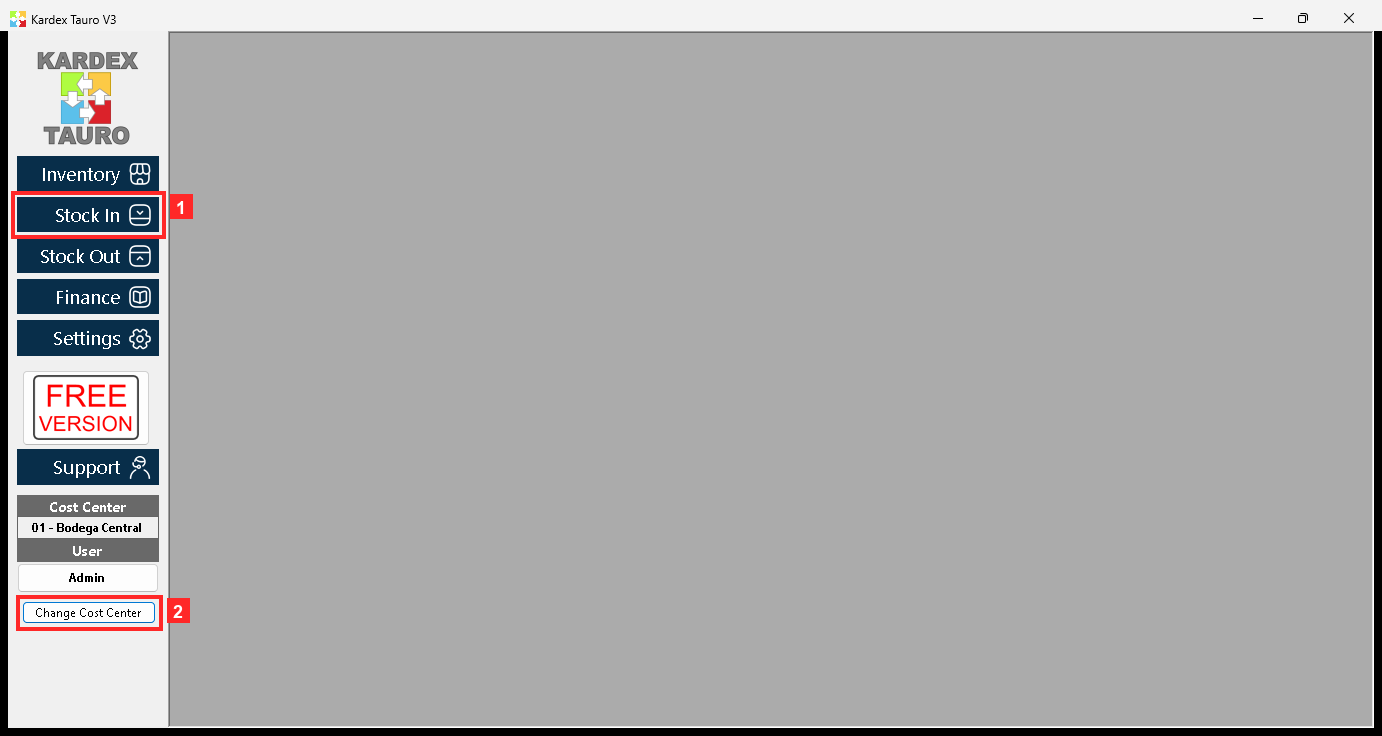
Step 1 — The main window
KardexTauro V3 opens in this window. The modules are on the left and the active cost center is at the top («Change Cost Center» changes it). This quote is made in cost center 01 - Bodega Central.
In the image:
- 1) Button «Stock In»: stock-in module (supplier quotes).
- 2) «Change Cost Center»: active cost center (01 - Bodega Central).
Texts on screen: «Stock In», «Inventory», «Stock Out», «Finance», «Change Cost Center»
Action: The side buttons open each module; these steps are done in «Stock In».
Step 2 — The stock-in menu
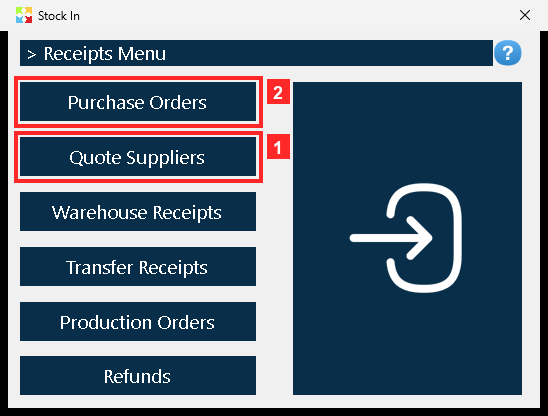
Pressing «Stock In» opens the menu of stock-in operations. «Quote Suppliers» is the supplier-quote option; the others are different stock-in documents.
In the image:
- 1) Button «Quote Suppliers»: opens the supplier quotes.
- 2) «Purchase Orders»: purchase orders (another document).
Texts on screen: «Quote Suppliers», «Purchase Orders», «Warehouse Receipts», «Production Orders», «Refunds»
Action: Press «Quote Suppliers» to open the quote list.
Step 3 — The quote list
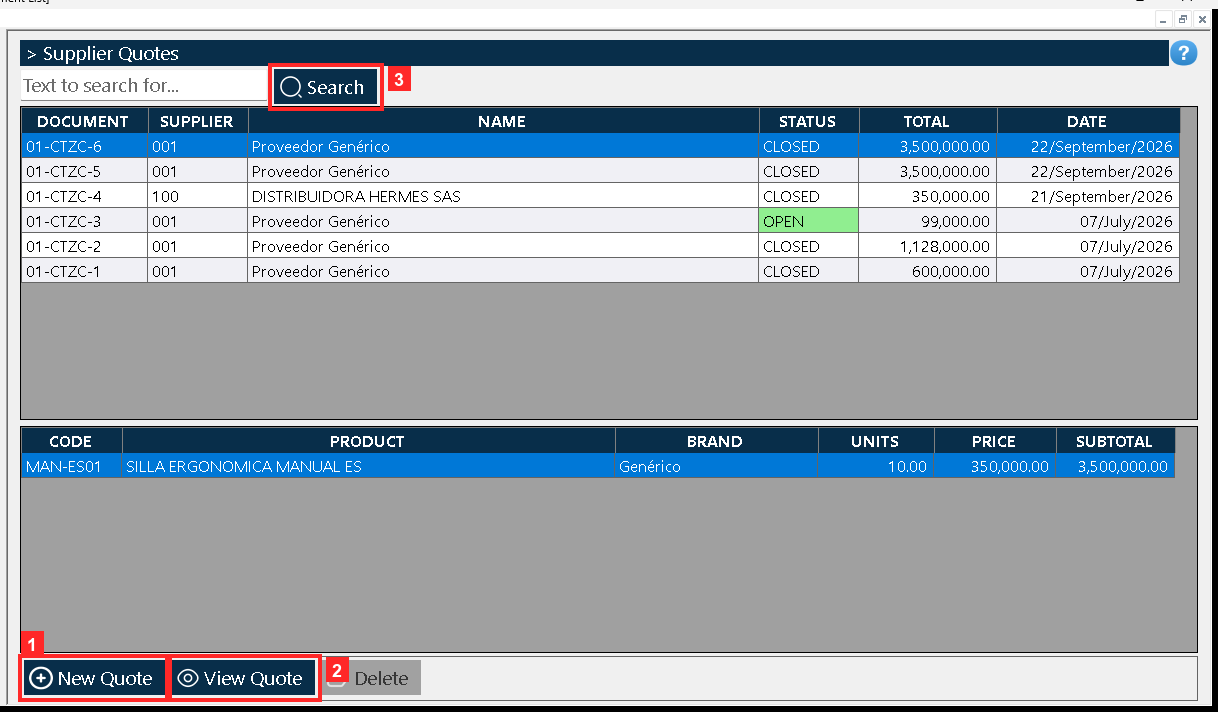
«Document List» opens: every row is a quote with its reference, the supplier, the STATUS (open or closed) and the total. The search box is on top and the buttons act on the selected row.
In the image:
- 1) Button «New Quote»: opens a blank quote.
- 2) «View Quote»: opens the selected quote.
- 3) «Search»: refreshes the list.
Texts on screen: «New Quote», «View Quote», «Delete», «Search»
Action: Press «New Quote» to create a new quote.
Step 4 — The document: the supplier
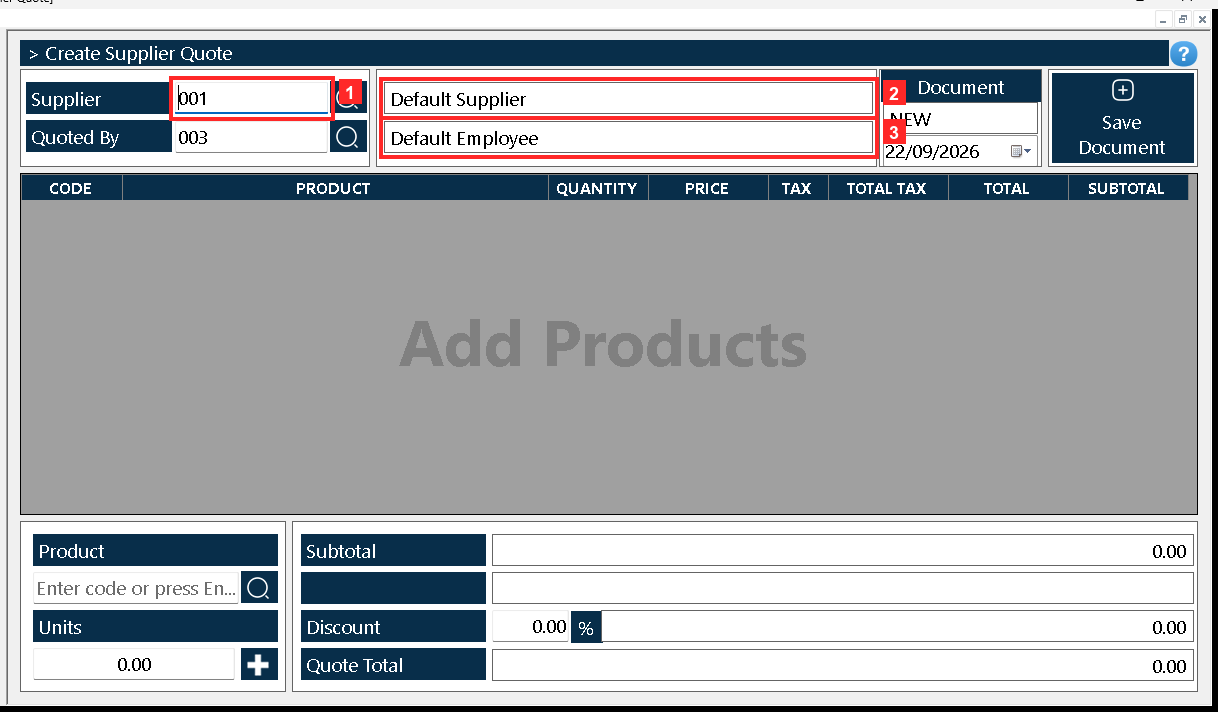
The document «Supplier Quote» opens. In the header, «Supplier» comes with the default supplier (001 — Default Supplier) and «Quoted By» with the employee who quotes it (Default Employee). «Document» is the document number.
In the image:
- 1) «Supplier»: supplier code (001).
- 2) Supplier name (Default Supplier).
- 3) «Quoted By»: quoted by (Default Employee).
Texts on screen: «Supplier», «Quoted By», «Document»
Action: Type the supplier code in «Supplier» (or look it up with the magnifier button).
Step 5 — The document: the product and the units
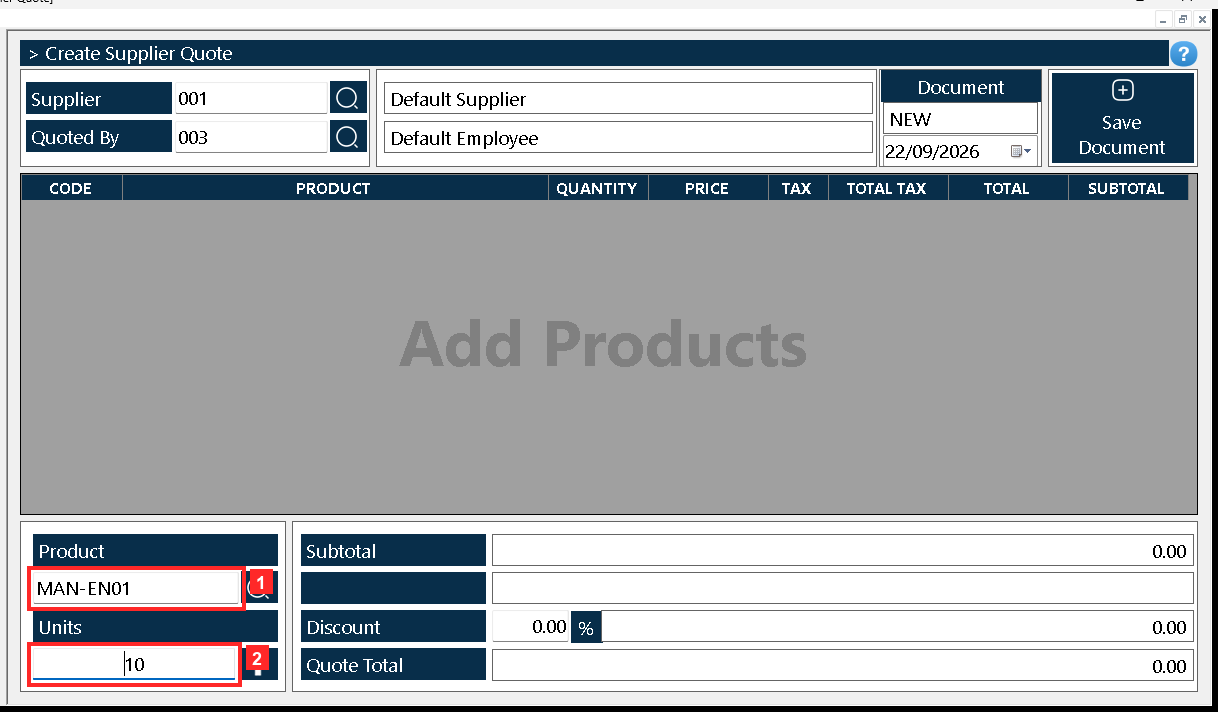
The body of the document holds the list of what is being quoted: «Product» is the product code and «Units» the quoted quantity. Next to them is the button that adds the line to the grid.
In the image:
- 1) «Product»: product code (MAN-EN01).
- 2) «Units»: quoted quantity (10).
Texts on screen: «Product», «Units»
Action: Type the product («MAN-EN01») and the units («10») and press the add button: the line appears in the grid.
Step 6 — The line added to the grid
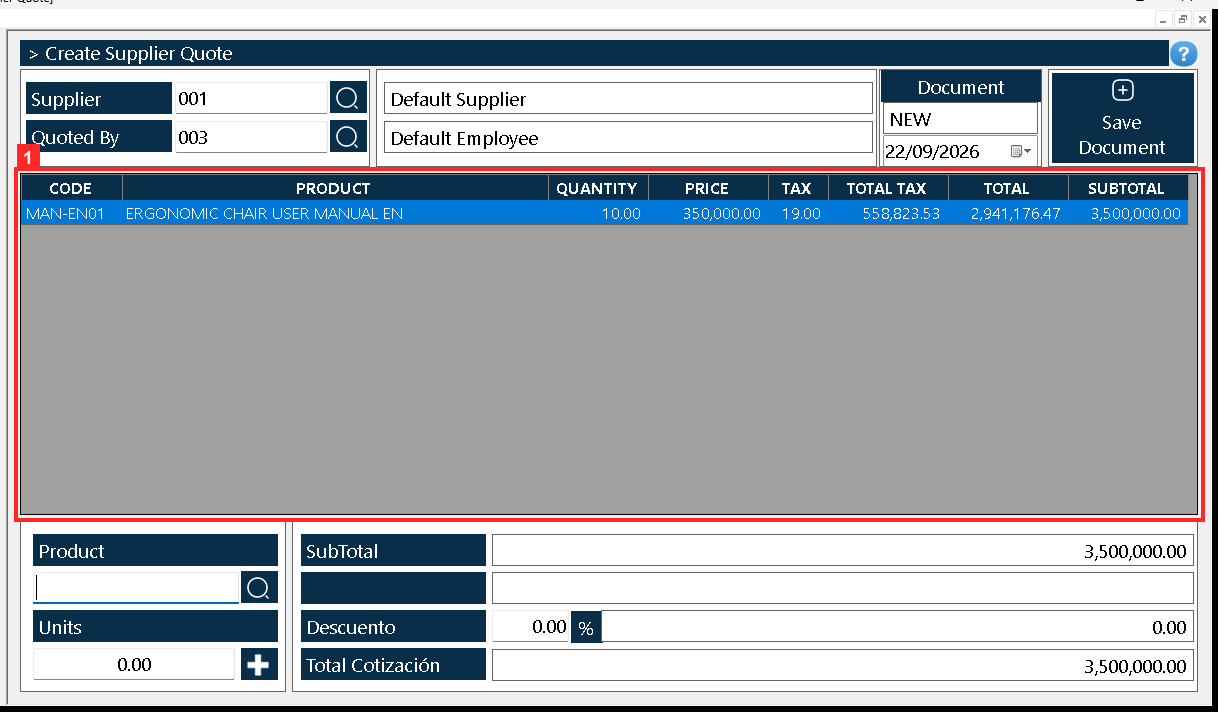
The grid shows the line with the product, the units, the unit price, the tax and the total. «Total Cotización» summarises the value of the quote (3,500,000.00).
In the image:
- 1) Grid: the added line (MAN-EN01 | ERGONOMIC CHAIR USER MANUAL EN | 10.00 | 350,000.00 | 19.00 | 558,823.53 | 2,941,176.47 | 3,500,000.00).
Texts on screen: «SubTotal», «Descuento», «Total Cotización»
Action: Check the line (product, units and price) before saving the document.
Step 7 — Saving: the finish dialog
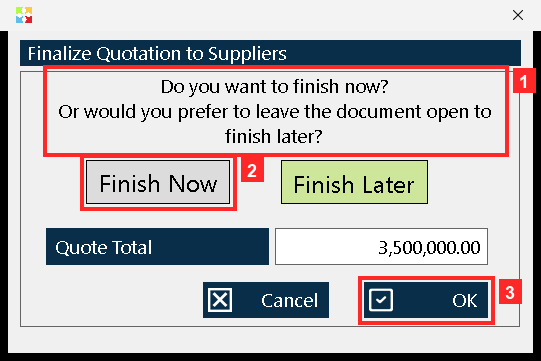
When you press «Save Document» the program does NOT save yet: it asks «Do you want to finish now? Or would you prefer to leave the document open to finish later?» and offers two options, «Finish Now» (saves and closes the quote so it can be printed) and «Finish Later» (leaves it open to keep editing). The quoted total is shown in «Quote Total»: Quote Total.
In the image:
- 1) «Do you want to finish now? Or would you prefer to leave the document open to finish later?»
- 2) Option «Finish Now».
- 3) Button «OK»: applies the chosen option and saves.
Texts on screen: «OK», «Finish Now», «Finish Later», «Quote Total»
Action: Choose «Finish Now» and press «OK»: without «OK» nothing is saved.
Step 8 — The saved quote, ready to print
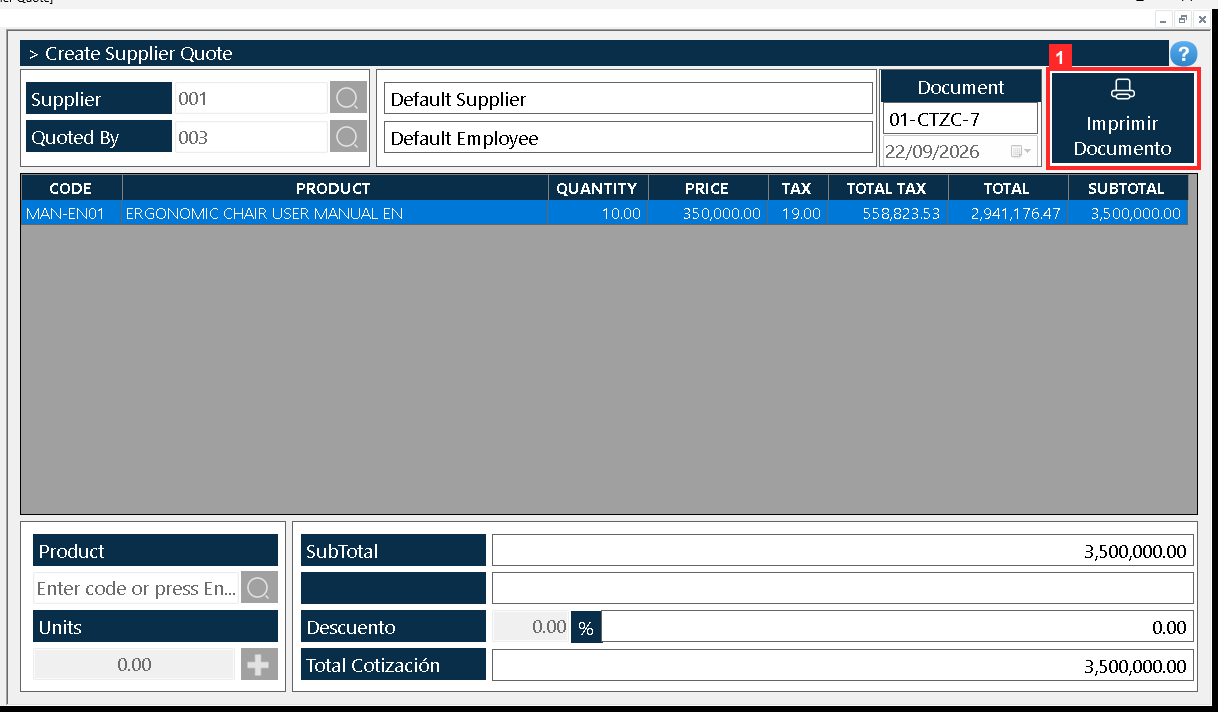
The program reports «Document processed successfully»: the quote was registered as «01-CTZC-7» with the status CLOSED. The document is still open but in read-only mode, and its save button is now labelled «Imprimir Documento»: that is what you press to see it before printing.
In the image:
- 1) Button «Imprimir Documento»: opens the preview of the quote.
Texts on screen: «Imprimir Documento»
Action: Press «Imprimir Documento» to open the print preview.
Step 9 — The quote before printing
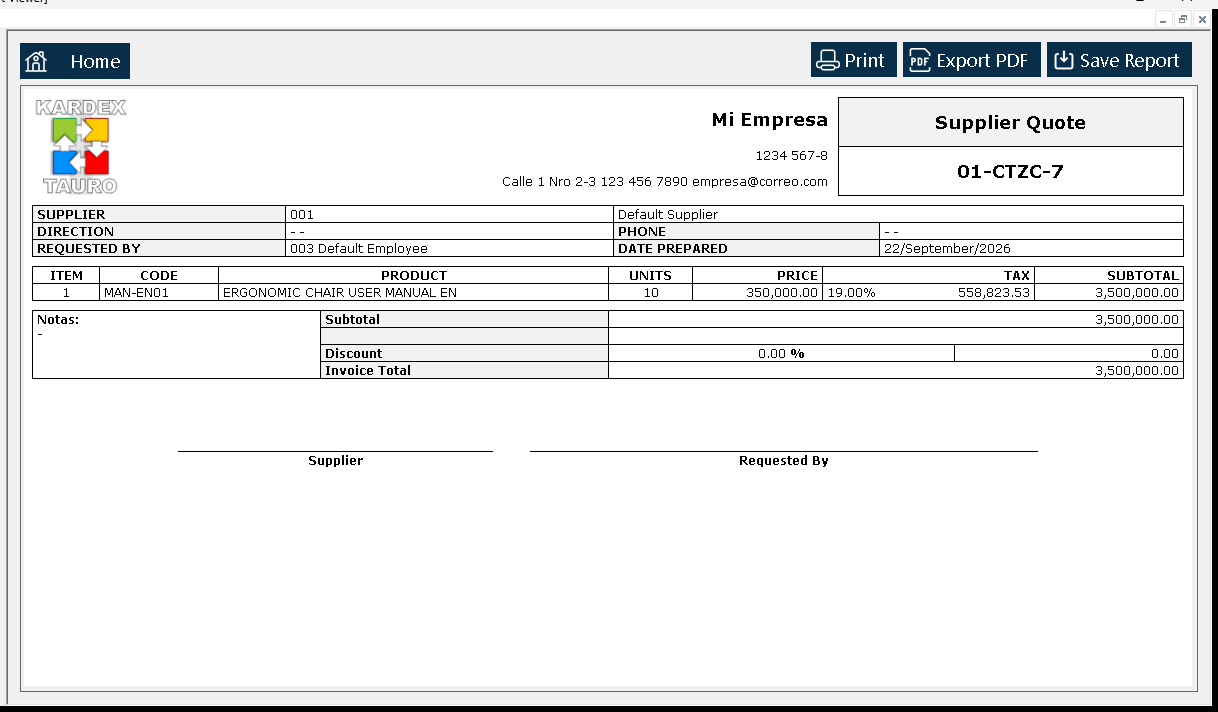
The «Report Viewer» opens with the quote exactly as it would be printed: header, supplier, the quoted line and the totals. Its top bar offers «Print, Export PDF, Save Report».
Action: Check the quote and use those buttons if you want to print or save it.
Result
The program reports «Document processed successfully»: the quote was registered as «01-CTZC-7» with the status CLOSED and a total of 3,500,000.00, and the document stays open in read-only mode with its save button relabelled «Imprimir Documento». The check was made by reading the program database (kardex.db), not just the screen.
Best practices
- Confirm the cost center before opening the quote: it is the one shown at the top of the window, and the document is booked against it.
- Check the supplier in the header as soon as the document opens: it comes loaded with 001 by default, and a quote built on the wrong supplier is worth nothing.
- Go over the grid line (product, units, unit price, tax and total) before saving: fixing it after the quote is closed costs more than looking once.
- Close the quote with «Finish Now» and «OK»: while it stays open it is still editable, and without «OK» nothing is saved.
Frequently asked questions
Why was nothing saved after I pressed «Save Document»?
Because that button does not save straight away: it opens the dialog asking whether you want to finish now or leave the document open, and nothing is stored until you pick an option and press «OK».
What is the difference between «Finish Now» and «Finish Later»?
«Finish Now» saves and closes the quote so it can be printed; «Finish Later» leaves it open so you can keep editing it.
How do I see the quote before printing it?
With the «Imprimir Documento» button, which appears once the quote is closed: it opens the «Report Viewer» with the quote exactly as it would be printed, and its top bar offers «Print, Export PDF, Save Report».
This article is part of the Kardex Tauro V3 User Manual, which gathers every process in the system, explained step by step.