How to Record a Sales Return, Step by Step
How to Record a Sales Return, Step by Step
When a customer brings goods back, the warehouse is holding physical units the system does not recognise yet: file the paperwork on its own and the physical count and the inventory in the program drift apart, so every later sale leans on a balance that is wrong. This document exists for exactly that: it puts the units back into stock and posts the matching stock ledger entry, valued at sale price, so that the stock and the accounts tell the same story.
This guide walks through all nine screens of the process on the real application, from the stock-in module to the print view, with one screenshot per step and the meaning of every numbered red box. The example returns 2 units of MAN-EN01 (ERGONOMIC CHAIR USER MANUAL EN) from customer 100 — DISTRIBUIDORA HERMES SAS in cost center 01 - Bodega Central: it is saved as 01-RNT-6 and stock goes up from 20.0 to 22.0.
Before you start
- Permission to register sales returns in the «Stock In» module.
- The sales invoice behind the return identified: a customer return is the counterpart of that invoice.
- The code of the customer handing the goods back (100 — DISTRIBUIDORA HERMES SAS in the example).
- The right cost center active (01 - Bodega Central), shown at the top and changed with «Change Cost Center».
Step by step
Step 1 — The main window
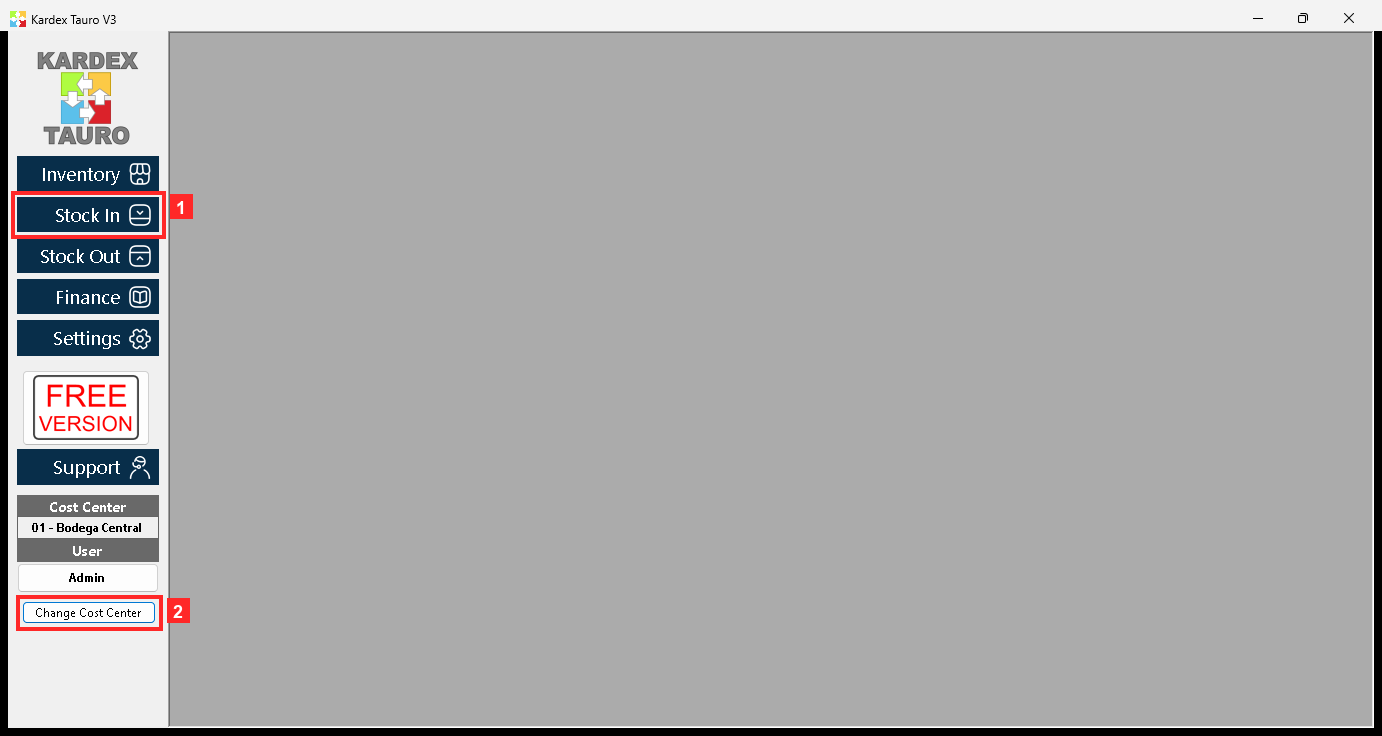
KardexTauro V3 opens in this window. The modules are on the left and the active cost center is at the top («Change Cost Center» changes it). This refund is registered in cost center 01 - Bodega Central.
In the image:
- 1) Button «Stock In»: stock-in module (purchases, refunds).
- 2) «Change Cost Center»: active cost center (01 - Bodega Central).
Texts on screen: «Stock In», «Inventory», «Stock Out», «Finance», «Change Cost Center»
Action: The side buttons open each module; these steps are done in «Stock In».
Step 2 — The stock-in menu
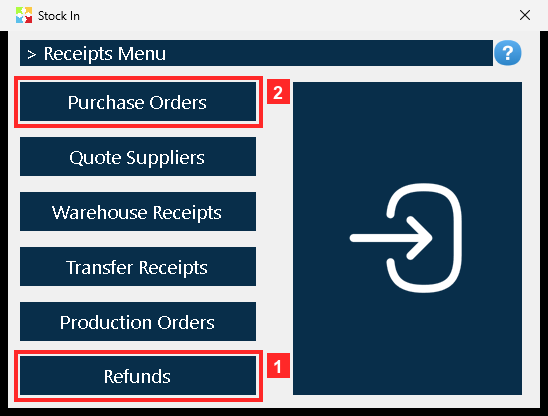
Pressing «Stock In» opens the menu of stock-in operations. «Refunds» is the SALES REFUNDS option: it registers the goods a customer brings back after a sale (they return to the warehouse). It is the counterpart of the sales invoice.
In the image:
- 1) Button «Refunds»: opens sales refunds.
- 2) «Purchase Orders»: purchase orders (another document).
Texts on screen: «Refunds», «Purchase Orders», «Warehouse Receipts», «Quote Suppliers»
Action: Press «Refunds» to open the refund list.
Step 3 — The sales refund list
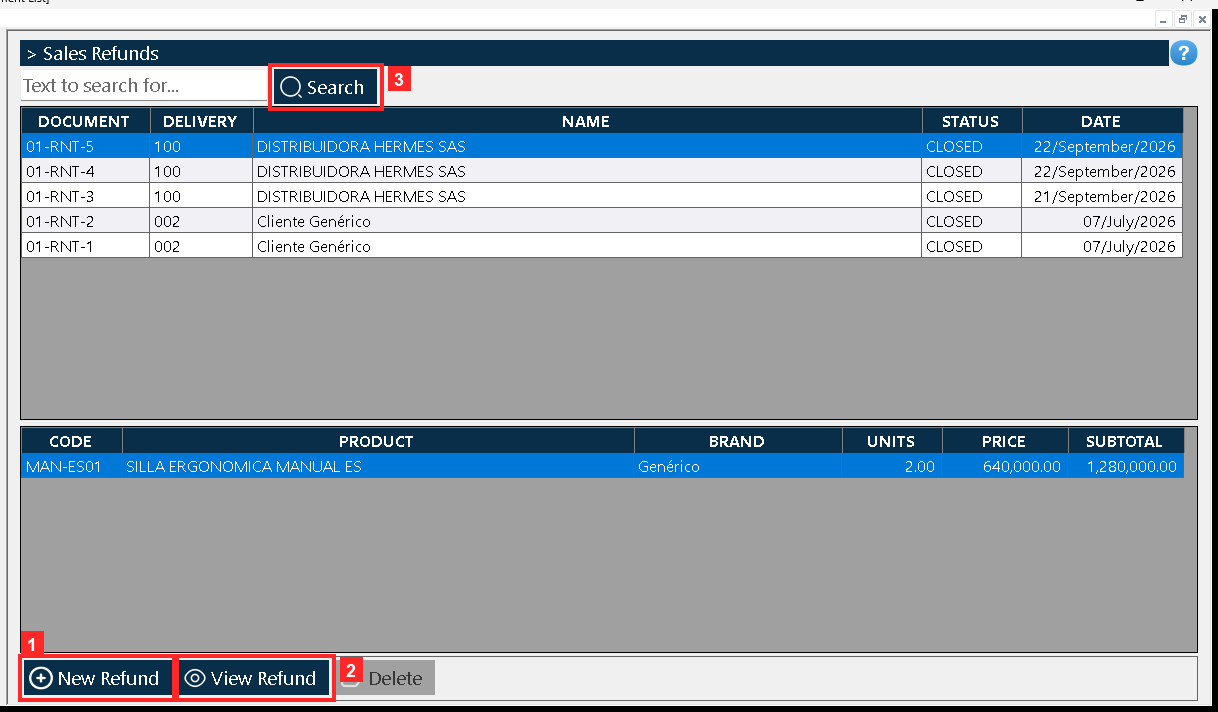
«Document List» opens. The master grid on top lists every document with its reference, the partner, the STATUS (CLOSED); the first row reads: (01-RNT-5 | 100 | DISTRIBUIDORA HERMES SAS | CLOSED | 22/September/2026); below, the detail grid shows the lines of the selected document. The search box and the buttons are on the right.
In the image:
- 1) Button «New Refund»: opens a blank refund.
- 2) «View Refund»: opens the selected document.
- 3) «Search»: refreshes the list.
Texts on screen: «New Refund», «View Refund», «Delete», «Search»
Action: Press «New Refund» to register a new refund.
Step 4 — The document: who delivers and who receives
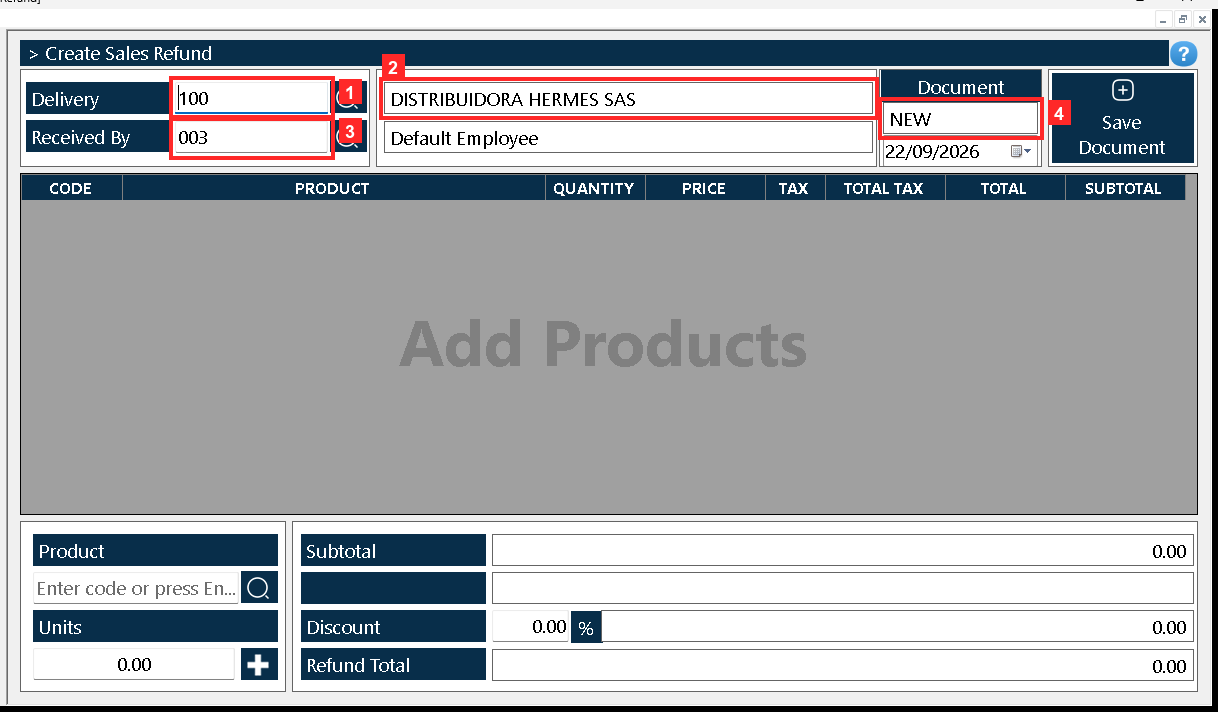
The document «Sales Refund» opens. In the header, «Delivery» is the partner delivering the goods back (the customer returning them: 100 — DISTRIBUIDORA HERMES SAS) and «Received By» who receives them in the warehouse (003). «Document» shows the number («NEW»: it is assigned when saving) and the date is on the right (22/09/2026).
In the image:
- 1) «Delivery»: the customer returning (100).
- 2) Name (DISTRIBUIDORA HERMES SAS).
- 3) «Received By»: who receives (003).
- 4) «Document»: refund number (NEW).
Texts on screen: «Delivery», «Received By», «Document», «Delivery»
Action: Type the customer code in «Delivery» (or look it up with the magnifier).
Step 5 — The document: the product and the units
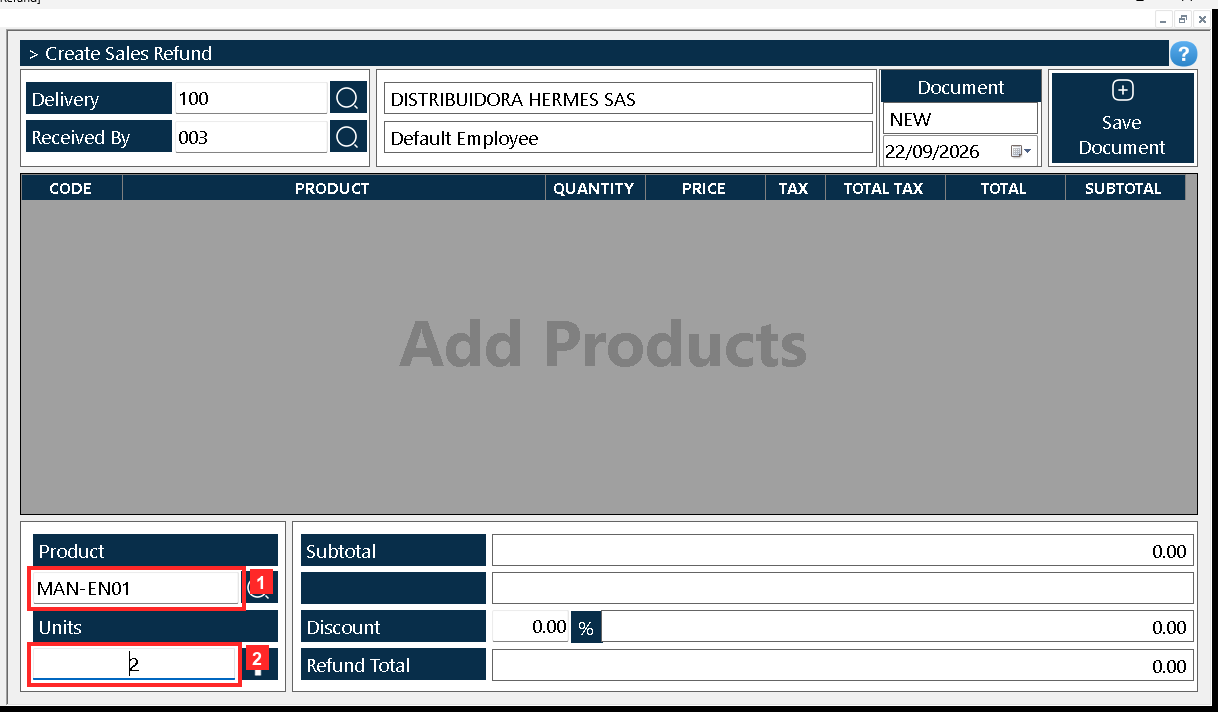
The body of the document holds what goes back to the warehouse: «Product» is the product code and «Units» the quantity the customer returns. Next to them are the product search and the button that adds the line.
In the image:
- 1) «Product»: product code (MAN-EN01).
- 2) «Units»: quantity coming back (2).
Texts on screen: «Product», «Units»
Action: Type the product («MAN-EN01») and the units («2») and press the add button: the line enters the grid.
Step 6 — The line added and the total
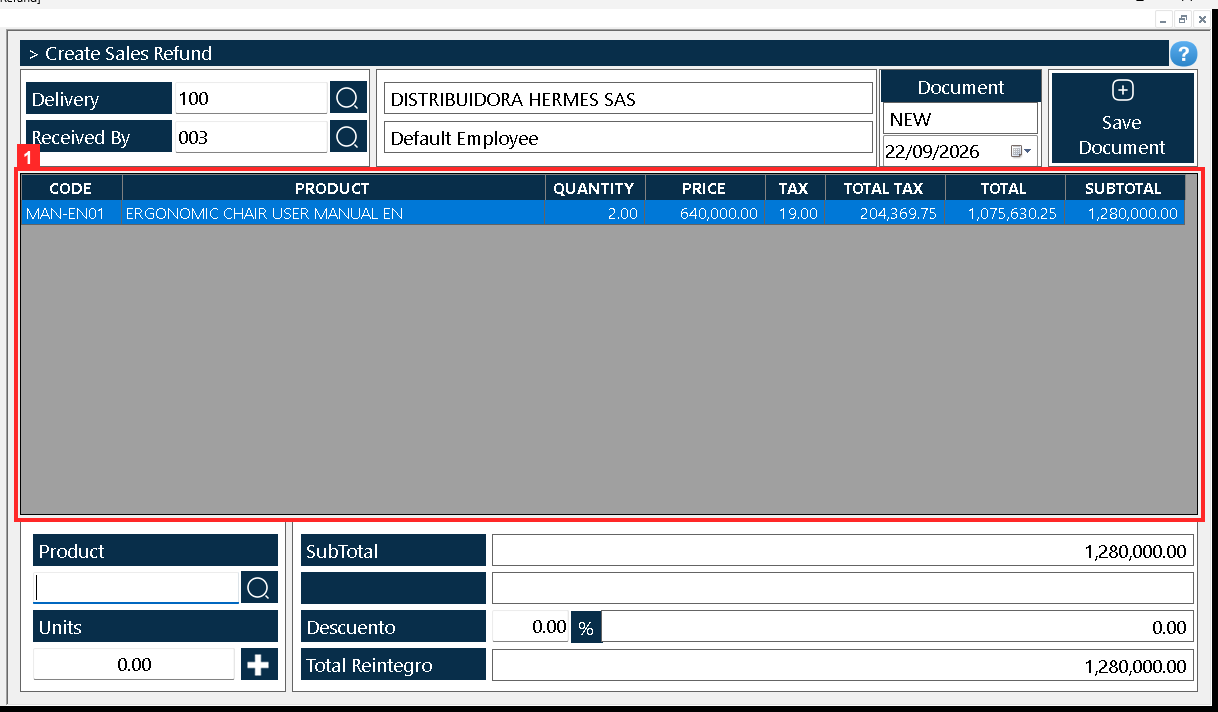
The grid shows the line with the product, the units, the value, the tax and the subtotal. The refund values the goods at SALE PRICE. «Total Reintegro» summarises what comes back: 1,280,000.00.
In the image:
- 1) Grid: the refund line (MAN-EN01 | ERGONOMIC CHAIR USER MANUAL EN | 2.00 | 640,000.00 | 19.00 | 204,369.75 | 1,075,630.25 | 1,280,000.00).
Texts on screen: «SubTotal», «Descuento», «Total Reintegro»
Action: Check the line and the total before saving.
Step 7 — Saving: the finish dialog
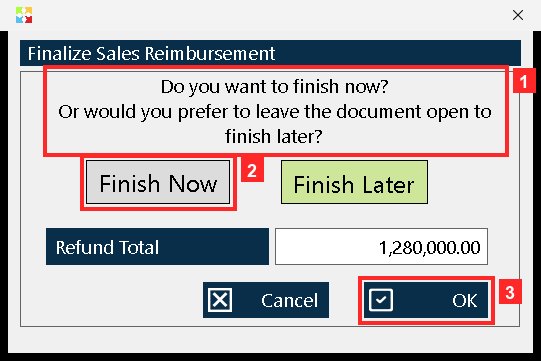
When you press «Save Document» the program asks to finish the refund: it asks «Do you want to finish now? Or would you prefer to leave the document open to finish later?» and offers «Finish Now» (saves and closes it so it can be printed) or «Finish Later» (leaves it open to keep editing). «Refund Total» is shown above: 1,280,000.00. This dialog does not ask for a payment method: the refund registers the customer return and the goods go back to the warehouse.
In the image:
- 1) «Do you want to finish now? Or would you prefer to leave the document open to finish later?»
- 2) Option «Finish Now».
- 3) Button «OK»: applies the chosen option and saves.
Texts on screen: «OK», «Finish Now», «Finish Later», «Cancel», «Refund Total»
Action: Choose «Finish Now» and press «OK»: without «OK» the refund is not saved.
Step 8 — The saved refund, ready to print
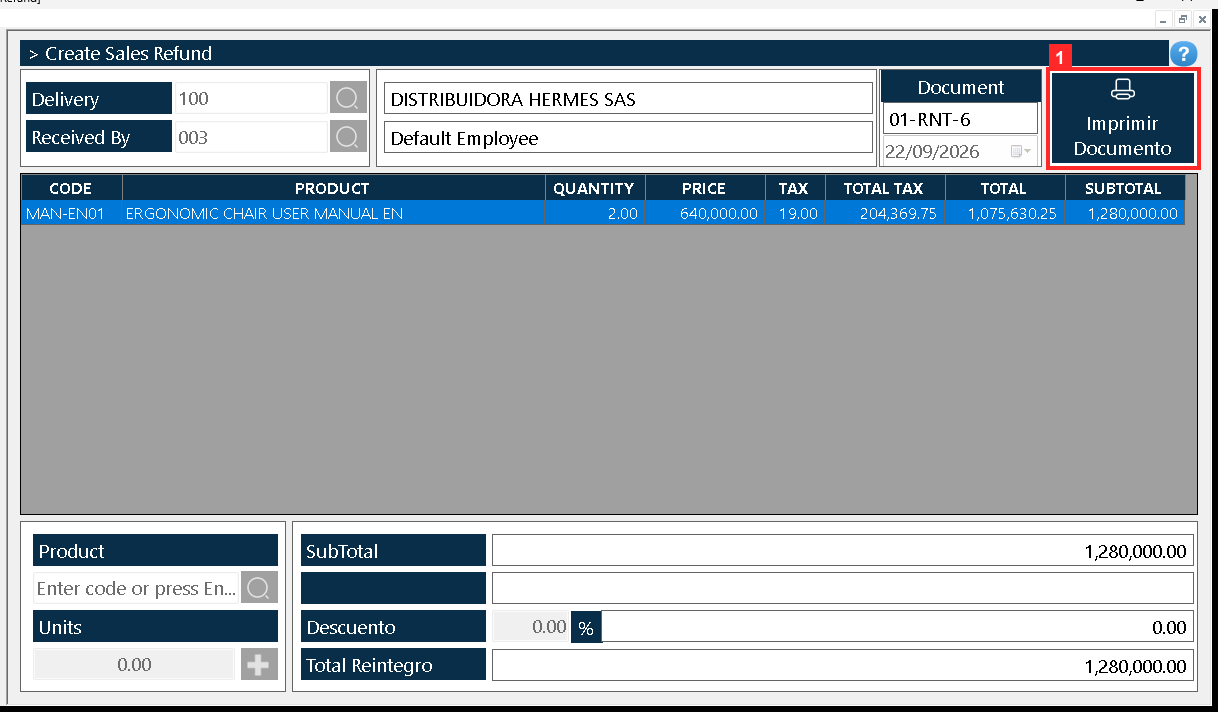
The program reports «Document processed successfully»: the refund was registered as «01-RNT-6» and the stock of MAN-EN01 went UP from 20.0 to 22.0; the stock ledger posted «+RESTOCK 01-RNT-6 · entra=2.0 · sale=0.0 · saldo=22.0». The document is still open, now in read-only mode, and its save button is labelled «Imprimir Documento».
In the image:
- 1) Button «Imprimir Documento»: opens the print view of the refund.
Texts on screen: «Imprimir Documento»
Action: Press «Imprimir Documento» to open the print view.
Step 9 — The print view
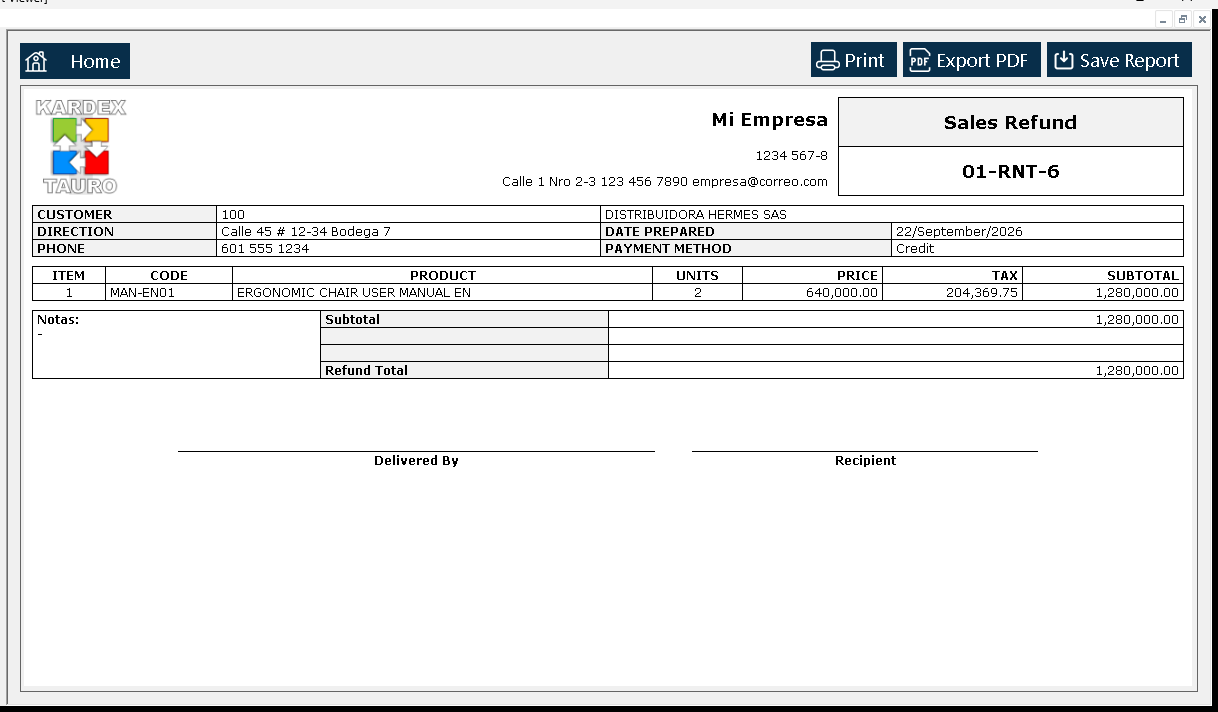
The «Report Viewer» opens with the refund exactly as it would be printed: header, the customer, the line coming back and the totals. Its top bar offers «Print, Export PDF, Save Report».
Action: Check the document and use those buttons if you want to print it, export it to PDF or save the report.
Result
The return was saved with the reference 01-RNT-6 and the program reported «Document processed successfully». The real check is in the stock figure: MAN-EN01 moved from 20.0 to 22.0, because 2.0 units came in and none went out, and the stock ledger posted the matching entry with a closing balance of 22.0. On a customer return the stock goes UP, never down. The figures were confirmed by reading the program database (kardex.db), not just the screen.
Best practices
- Always tie the return to the sales invoice behind it: it is the counterpart of that invoice and the reference is what lets you tell them apart later.
- Register the return the same day the goods reach the warehouse: until it is saved those units exist on the floor but the system does not recognise them.
- Check the line and the total before saving: the return values the goods at sale price, so a wrong price goes straight into the amount handed back.
- Finish the document with «Finish Now» and print it or export it to PDF from the print view, so the customer leaves with proof of what was returned.
Frequently asked questions
Does a customer return push stock up or down?
Up. In the example the stock of MAN-EN01 moved from 20.0 to 22.0 because 2.0 units came in and none went out, which is why this window sits in the «Stock In» module and not in the stock-out one.
At what price are the returned goods valued?
At sale price. The grid line shows the value, the tax and the subtotal, and the total for the example is 1,280,000.00.
Does the return ask for a payment method?
No. The finish dialog does not ask for one: the customer return records the goods going back to the warehouse, not a payment.
This article is part of the Kardex Tauro V3 User Manual, which gathers every process in the system, explained step by step.