Job order costing: how to calculate the cost of each order
Job order costing: how to calculate the cost of each order
A workshop delivers two orders in the same month: one of 200 simple units and another of 80 with more material and less assembly. If at month end you divide total cost by the 280 units, you get a comfortable and wrong number. The order that made a profit and the one that sold cheap are melted into the same average.
Job order costing does not average: it accumulates. Each order has its own cost sheet, with direct material, direct labor and manufacturing overhead (CIF, the Colombian acronym for costos indirectos de fabricación) charged to that order and to no other. When the order closes, the total divided by good units gives the unit cost. Here is how the sheet is built, what goes in each box, a worked example with two orders and the mistakes that make an order “win” without winning.
When cost is accumulated by order and when it is not
The system applies when production is identifiable by order or by batch: custom furniture, printing, garment making, construction, machine shops, special machinery. The test is simple: if you can say “this table belongs to order 001 and used these boards,” cost can be accumulated.
It does not apply when the product is indistinguishable. A plant filling the same bottle all day cannot trace bottle number forty thousand back to an order: there cost is accumulated by process and spread over equivalent units. Forcing a cost sheet into that setting only produces folders full of numbers nobody uses to decide.
The commercial signal helps: if the customer asked for something specific and the price was quoted before producing, there is an order; if the market sets the price and the company competes on efficiency, there is a process. Mixed companies exist, with a standard line and a specials area. What matters is not to mix the two calculations in the same number.
| Signal | Job order costing | Process costing |
|---|---|---|
| Product | Different in every order | Homogeneous, the same all period |
| Unit that accumulates cost | The production order | The process or department |
| Unit cost | Order cost divided by good units | Process cost divided by equivalent units |
| When it is known | When the order closes | At period close |
| Examples | Custom furniture, printing, garment making, construction, special machinery | Continuous production of a single item |
The cost sheet: the document that holds everything together
Three accumulations and an order number: the whole logic of the system fits there. Direct material, direct labor and overhead. Every document charged in —a requisition, a time card, an overhead application— must carry the order number; if it does not, that cost is lost and ends up punishing every order equally.
The sheet follows the order, not the accounting month. If the order starts on the 24th and ends on the 12th of the following month, the sheet crosses both months and the month-end cutoff shows what has accumulated, not a zero. That continuity is what lets you see whether the job is going well before it ends.
An order without a cost sheet has no cost: it has a guess. And a guess cannot be audited or compared with the quote. The sheet is filled in while production happens, not afterwards: rebuilding it at the end is guessing with extra steps.
Direct material: from the requisition to the order
Direct material enters through a warehouse requisition: a quantity is requested, the order is identified and the material leaves inventory toward that order. The requisition is what turns a stock issue into a traceable cost. Without it, consumption exists physically but not in the books.
The criterion for separating direct from indirect is identifiability, not value. The wood in a custom piece is direct because you know how much it takes. Glue, lacquer or screws on a small order are rarely measured precisely: if the effort costs more than the data, they are treated as overhead. What is not acceptable is charging them to general inventory and forgetting them: either they go to the order as direct, or they enter the overhead pool, but they do not disappear.
Two cheap disciplines prevent almost every mismatch. First: value the issue with the same criterion used to value inventory; if the warehouse works with a weighted average, the requisition does too. Second: if material is left over and returns to the storeroom, it goes back with a credit note to the order. Otherwise the order carries material that is sitting on the shelf.
Direct labor: hours, rates and the record almost nobody keeps
Direct labor is charged by hours or man-hours recorded on the order, multiplied by a rate. It sounds trivial and it is where the system breaks most often, because the hour record is the first thing dropped when there is pressure.
If the shop writes “Juan worked eight hours” but not on which order, that cost cannot be assigned and ends up spread by eye. The fix does not require an expensive system: one card per worker per order, with start and end time, signed at the end of the shift.
The rate matters as much as the hours. If you use gross pay per hour, the order cost comes out short, because the real cost of a hired hour includes social benefits and employer contributions. Charging salary alone produces orders that look profitable and a company that does not reconcile: the difference shows up later, in payroll, when the price can no longer be fixed.
Indirect labor —supervision, warehouse, maintenance, plant cleaning— is not charged to the order: it goes to overhead. If the supervisor spends half a shift on order 001, that half shift is still overhead, because the cost does not vary with the job; mixing it into direct labor inflates direct cost and distorts the rate.
Overhead: the part nobody knows how to assign
Manufacturing overhead is real, large and has no owner. Plant rent, energy, supervision, machine depreciation, maintenance, consumables. None of it can be billed to order 001 without an argument: the plant's electricity does not say which order used it.
Yet order 001 cannot wait for month end to learn its share of rent. It is quoted and sold before the power bill arrives. That is why overhead is not charged at actual cost but through a predetermined rate, calculated before the period and applied to each order as it moves forward.
That is the deal: a reasonable estimate during the month and an adjustment at the end. It is not gratuitous imprecision; it is the only way to have a unit cost before the month is over.
The predetermined rate and the allocation base
The formula is a division: budgeted overhead for the period divided by the budgeted base. The base can be labor hours, machine hours or labor cost. With budgeted overhead of $18,000,000 and 3,000 budgeted labor hours, the rate is $6,000 per hour.
The base is chosen for cause, not convenience. If the shop is machine intensive, machine hours explain overhead better than operator hours. If the process is manual, labor hours are the natural base. A base with no relation to actual consumption spreads cost in a pretty and wrong way: labor-heavy orders get overloaded and automated ones get subsidized.
Two rules of use. The rate is set for a defined period —normally the year— and is not changed halfway because one month came out expensive. And it is reviewed when the structure changes: a new machine, an extra shift or a renegotiated lease invalidates the previous base. Changing the rate every month is having no rate at all.
Full example: order 001 of 200 units
The figures in this exercise are round and belong to the example, not to market prices; amounts are in Colombian pesos. Order 001 produces 200 units. It consumes $4,000,000 of direct material, 100 hours of direct labor at $20,000 per hour and overhead applied at $6,000 per labor hour.
| Item | Basis | Calculation | Amount |
|---|---|---|---|
| Direct material | Order requisitions | Valued consumption | $4,000,000 |
| Direct labor | 100 hours | 100 × $20,000 | $2,000,000 |
| Overhead applied | 100 labor hours | 100 × $6,000 | $600,000 |
| Total order cost | 4,000,000 + 2,000,000 + 600,000 | $6,600,000 | |
| Good units | 200 | ||
| Unit cost | 6,600,000 divided by 200 | $33,000 | |
| Selling price | $50,000 | ||
| Gross margin per unit | 50,000 − 33,000 | $17,000 (34%) |
Total cost is $6,600,000 and unit cost is $33,000. With a selling price of $50,000, gross margin per unit is $17,000, that is 34% of the price. That 34% excludes administrative and selling expenses: it is gross margin, the figure that lets you compare orders with each other.
Order 002 and why the average would have lied
Order 002 produces 80 units with more material and less labor: $3,300,000 of material, 50 hours at the same rate and overhead on those 50 hours. Total cost drops to $4,600,000, but it is spread over far fewer units.
Unit cost is $57,500, well above the $33,000 of order 001. The difference is not in the shop's efficiency: it is in the mix. Order 002 carries $41,250 of material per unit against $20,000 for 001, and only $12,500 of labor against $10,000. It is a different product, made a different way.
Now the average: $11,200,000 of total cost over 280 units gives $40,000 per unit. If the workshop had quoted order 002 with that number, and with the same $50,000 list price, it would have believed it was making $10,000 per unit. It actually loses $7,500 on each one.
Be precise about one thing: total profit does not change by averaging, because revenue and cost are the same. What changes is that you do not know which of the two orders sustains the business. With the average, both appear to leave 20%; with the cost sheet, one leaves 34% and the other loses 15%. The first can be repeated; the second must be requoted or dropped.
| Item | Order 001 | Order 002 | Average of the two |
|---|---|---|---|
| Good units | 200 | 80 | 280 |
| Direct material | $4,000,000 | $3,300,000 | $7,300,000 |
| Labor hours | 100 | 50 | 150 |
| Direct labor | $2,000,000 | $1,000,000 | $3,000,000 |
| Overhead applied | $600,000 | $300,000 | $900,000 |
| Total cost | $6,600,000 | $4,600,000 | $11,200,000 |
| Unit cost | $33,000 | $57,500 | $40,000 |
| Selling price | $50,000 | $50,000 | $50,000 |
| Unit margin | $17,000 (34%) | −$7,500 (−15%) | $10,000 (20%) |
Work in process, finished goods and cost of sales
Cost does not become an expense when it is produced: it moves. While the order is open, what has accumulated lives in work in process inventory. When it ends, it moves to finished goods. When it is sold, it goes to cost of sales. Each step is a transfer, not a new expense.
Month-end cutoff is the critical moment. If order 001 carries $4,000,000 of material, 60 of the 100 hours and the overhead of those 60 hours, the accumulation is $5,560,000 and that amount goes to work in process. It is not cost of sales, even if the order has weeks of work behind it: none of it has been sold.
The opposite mistake also exists: closing the order and sending everything to cost of sales the same day. If the job is finished but not shipped, the cost belongs to finished goods inventory. Recording it as an expense brings the loss forward and leaves physical inventory with no accounting support.
Underapplied or overapplied overhead: the adjustment you cannot skip
During the period a rate was applied; at close the actual overhead is known. If actual overhead was $19,200,000 and $18,600,000 was applied —3,100 hours at $6,000— there are $600,000 underapplied: order cost came out short and must be increased.
If the difference runs the other way, overhead was overapplied and orders carried more than the plant actually cost. Either way the adjustment is made at close and is not ignored, because ignoring it leaves a margin that does not exist. If the amount is small against the period's cost, it goes to cost of sales; if it is material, it is prorated across work in process, finished goods and cost of sales, in proportion to the overhead each one received.
That materiality judgment is signed by the accountant, not the production manager. What cannot be done is leaving the difference in a “for now” bridge account for months: that is where the trail of real margin is lost.
Good units, damaged units and scrap: the divisor that changes everything
Unit cost is calculated on good units, not on units started. If order 001 had produced 205 units and 5 came out damaged with no recovery, the $6,600,000 cost would be spread over 195 units and unit cost would rise to $33,846. The order did not spend more; it produced less of what is usable.
That is why the order closes with three counts: good units, damaged units and scrap. Damaged units with recovery value —sold as scrap or reworked— generate income credited to the order and lower the cost of the good ones. Those with no recovery stay in cost, because someone has to pay for them.
Dividing by units started is the most common shortcut and the most expensive: it makes unit cost look better than it is and the next quote come out low. When the customer repeats the order, the difference shows up as profit loss with no explanation.
Mistakes that make an order “win” without winning
None of these mistakes shows up in the month's income statement. All of them show up in the next order, when the price is already signed.
| Mistake | Symptom | Consequence |
|---|---|---|
| Charging material without a requisition | Inventory drops and nobody knows why | Cost spread by eye and orders that cannot be compared |
| Labor rate based on gross pay only | The margin looks comfortable | The order wins on paper and loses in payroll |
| Not applying overhead, or applying last month's | Unit cost jumps from one month to the next | Prices that rise and fall with no explanation |
| Dividing by units started | Unit cost looks low | Every damaged unit is paid for in the next quote |
| Quoting with the average cost | Every order “leaves” the same | The losing line gets repeated |
| Ignoring underapplied overhead | The close “balances” | Inflated margin and a surprise adjustment next year |
| Leaving orders open forever | Work in process that only grows | Unsupported inventory and understated cost of sales |
An honest close before you quote
Job order costing does not fix a company that does not keep records. If the shop does not require a requisition, does not log hours and does not close orders, the cost sheet becomes a form filled in at the end with invented numbers. The system works when recording is part of the job, not an extra Friday task.
It does not apply to continuous, homogeneous production either: there cost is accumulated by process and this article is not the path. And it does not replace the accountant: the sheet feeds the books, but inventory policy, the materiality of the adjustment and final valuation are decisions signed with professional judgment and the current standard in hand.
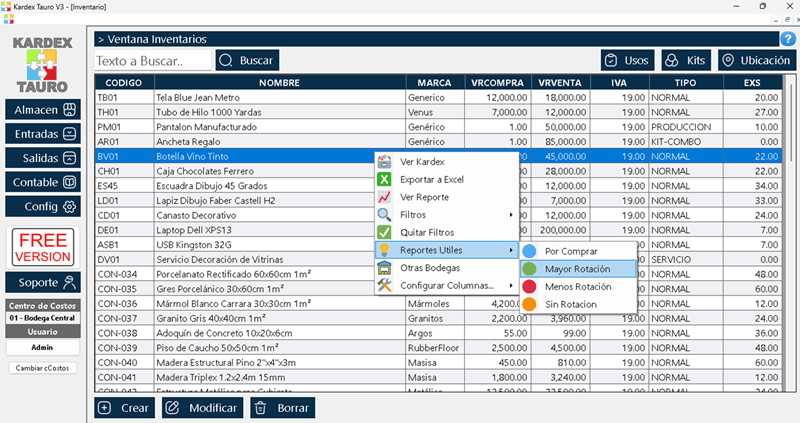
If your company produces to order, the sequence to start is this: requisition with an order number, hours logged by order for one month, an overhead rate calculated on the year's budget and the first complete sheet. With two closed orders you already have something to compare. When inventory, invoicing and accounting live in the same system —as with Kardex Tauro—, the requisition and the cost sheet stop being separate files and cost can be checked while the order is still open.