The Colombian financial transactions tax (GMF): what it is, what it costs and how to record it

The Colombian financial transactions tax (GMF): what it is, what it costs and how to record it
Every withdrawal, transfer and payment that leaves the company bank account carries a small charge almost nobody checks: the GMF, the Colombian financial transactions tax, better known as the 4 per 1,000. On a single transaction it looks like loose change; over twelve months it stops being loose change. A company moving $400,000,000 a month pays $19,200,000 a year just to move its own money. Here is what triggers it, what is exempt, how much is deductible and how to record it so the bank reconciliation closes without unexplained differences.
What the 4 per 1,000 is and where the name comes from
The GMF is a national tax of 4 per 1,000: 0.4% of the value of the financial transaction. The nickname comes from there, four pesos for every thousand. It applies to withdrawals, transfers, payments and certain movements in bank accounts.
Three features set it apart from the charges it is usually confused with. It is triggered at the moment of the transaction, not at month end. The financial institution collects it: you do not calculate or file it separately, the bank debits it. And it carries no VAT and is not a withholding at source: it is a tax whose counterpart is an expense.
That last point explains almost every mistake. A withholding is offset against a tax liability and ends up netting out; the GMF is money that leaves and does not come back. Only part of it can be deducted from income tax, and that reduces the taxable base, it does not return the cash.
Which movements trigger it and which ones deserve a closer look
The basic rule: if the money leaves the account, there is GMF. It is charged on the value of the transaction, not on the balance and not on profit. That is why two companies with the same revenue can pay very different amounts: the one that moves the money several times pays more.
| Movement | Typical effect | How it shows on the statement | What to confirm |
|---|---|---|---|
| Cash withdrawal | Triggers GMF | Withdrawal debit plus the tax charge | Whether the account carries an exemption flag |
| Transfer to suppliers | Triggers GMF | Transfer debit and a separate charge | Whether the charge lands in the same cut-off |
| Payroll paid from the account | Triggers GMF on the batch total | Batch debit plus the tax charge | Whether the account is flagged as a payroll account |
| Payment of utilities and obligations | Triggers GMF | Individual debit with its charge | How the bank separates tax from fee |
| Deposits and collections | The tax is charged on money going out | Credit with no related charge | Specific cases, with the bank |
| Transfer between own accounts | Depends on the transaction and the product | A debit in each account, each with its charge | Whether both ends are exempt |
Transfers between accounts of the same company also cost: moving payroll to the savings account and back every fortnight means two 0.4% charges, one at each end.
It is also worth separating the GMF from bank fees: two charges, two accounts and two treatments that the statement shows together. The GMF has a recognisable proportional rate; the fee is a fixed amount per transaction or per package. If the reconciliation lumps the whole debit under "bank charges", neither can be controlled.
When it hits the statement and why it does not match the cut-off
The tax is triggered by the transaction but recorded when it appears on the statement. Almost always that is the same day; on month-end transactions or interbank transfers it can land in the next cut-off. That gap explains why the statement total does not match the sum of the transactions you authorised.
The practice that avoids arguments: record by statement date, not by transaction date. If the bank debited on the 2nd and the transfer was ordered on the 30th, the entry belongs to the month in which the charge exists. That keeps the book balance following the bank balance and settles the reconciliation with documents.
At year end this matters: a December GMF that falls in January shows up as an unexplained shortfall in both months. The answer is not to adjust by eye, but to leave the charge where the bank recorded it.
Exemptions: what has to be confirmed with the bank
Exemptions are limited. The best known are flagged payroll accounts and certain specific operations, but the scope depends on the institution and on the rule in force. The practical consequence is uncomfortable: it cannot be assumed. An account the company uses to pay payroll is not exempt because of that use; it has to be flagged, and the flag has conditions.
- Which of our accounts are flagged as exempt, and since when?
- Does the exemption cover withdrawals only, or transfers and payments too?
- Does it apply per account, per holder or per product type?
- What happens if the account changes number, branch or type?
- Does the bank warn when the flag is lost?
- How is the GMF that was actually charged identified on the statement?
The last question is the most useful. If the bank does not separate the charge, the only way to measure it is to rebuild it by applying the rate to the movements, and that always leaves room for error.
Two warnings. Using the exempt account for the entire operation can break the condition that made it exempt. And a change of account number or a product upgrade can remove the flag without notice: the first symptom shows up a month later, on the statement.
What it really costs over a year
The calculation is a multiplication, but the base is often picked wrong. It is not the average balance, nor revenue, nor profit: it is the sum of taxable movements. A company billing $400,000,000 and moving it twice — collections in, payments out — has a base larger than its revenue.
At the 0.4% rate, every million moved costs $4,000 and every $10,000,000 costs $40,000. That sounds small until it is multiplied by the real volume of the account.
| Monthly movement | GMF for the month | GMF for the year | 50% deductible | Estimated saving at 35% |
|---|---|---|---|---|
| $100,000,000 | $400,000 | $4,800,000 | $2,400,000 | $840,000 |
| $250,000,000 | $1,000,000 | $12,000,000 | $6,000,000 | $2,100,000 |
| $400,000,000 | $1,600,000 | $19,200,000 | $9,600,000 | $3,360,000 |
| $700,000,000 | $2,800,000 | $33,600,000 | $16,800,000 | $5,880,000 |
Two observations. The expense is proportional and carries no VAT, so there is no way to recover it through another route. And it is paid in cash, not out of profit: a company closing the year at a loss still paid the full GMF.
There is an effect that never reaches the income statement: the GMF makes every peso the company moves slightly more expensive, including internal transfers that generate no revenue. In thin-margin businesses such as distribution or low-value-added trade, that 0.4% can be a visible slice of the margin per transaction.
The 50% income tax deduction
Half of the GMF paid is deductible for income tax, and here is the detail many overlook: it applies regardless of whether the transaction that generated it is deductible or not. If the payment was an accepted expense, half the GMF is deductible. If it was a capital movement, a non-deductible payment or an internal transfer, it is deductible too.
The other 50% is not deductible and there is no way to convert it. It is a permanent difference: it does not reverse in later years and creates no deferred tax asset.
The arithmetic on the annual example: $19,200,000 of GMF, 50% deductible = $9,600,000. At the 35% rate, the tax saving is $3,360,000. The net cost after that shield is $15,840,000. It is help, not a refund: the cash left in full.
Three conditions for the deduction to be real. The GMF has to be paid. It has to be recorded as an expense, with the statement as support. And the company has to be an income tax payer with a taxable base to offset it against: if it is running losses, the deduction does not turn into money.
That is why order matters: first you record, then you deduct. A GMF that never entered the books cannot be supported, and in a review the whole deduction falls, not just half.
How to record it without overcomplicating it
It is recorded as an expense when it appears on the statement, in a financial expense or tax account, depending on each company's chart of accounts. What matters is not the exact name but that it is an identifiable income statement account: measurable, separable by bank and supportable.
The rule that prevents most differences: record the transaction at its gross value and the GMF on a separate line. Never net it. If the transfer was $30,000,000 and the bank debited $30,120,000, the entry takes $30,000,000 to the relevant account and $120,000 to GMF expense. Recorded net, the book balance drifts from the statement by the amount of the tax, and the error repeats every month.
There is one exception: when the transaction is capitalised. If the movement financed a machine, the construction of an asset or inventory to be costed, the tax may be added to the cost of that asset and depreciated with it. It requires judgement and support, and it does not apply when the transaction is a running expense.
For companies with several accounts, a sub-account per bank or, at minimum, a cost centre per account. Without that split, monthly analysis is impossible and the conversation with the bank stays at the level of impressions.
A full example: the $400,000,000 month and its journal entry
A company makes twelve supplier transfers of $30,000,000 each and two withdrawals of $20,000,000 for petty cash. Total taxable movements: $400,000,000.
GMF per transfer: $30,000,000 × 0.4% = $120,000. Twelve transfers: $1,440,000. GMF per withdrawal: $20,000,000 × 0.4% = $80,000. Two withdrawals: $160,000. GMF for the month: $1,440,000 + $160,000 = $1,600,000. Over a year at the same pace: $1,600,000 × 12 = $19,200,000.
| Account | Debit | Credit | Source |
|---|---|---|---|
| Suppliers and accounts payable | $360,000,000 | — | Twelve transfers of $30,000,000 |
| Petty cash or expenses to be substantiated | $40,000,000 | — | Two withdrawals of $20,000,000 |
| Financial expenses – GMF | $1,600,000 | — | Tax charges for the month |
| Bank – current account | — | $401,600,000 | Total debited by the bank |
The consolidated monthly entry looks like this, with the transaction detail in the sub-ledger. If the statement shows a single debit of $401,600,000, the three debit lines must add up to exactly that. When they do not, the difference is usually an unrecorded bank fee or a month-end GMF that fell into the next cut-off.
GMF and bank reconciliation: the line that throws the balance off
In the reconciliation, the GMF is a classic item. If it is not recorded, the book balance sits above the statement balance by exactly the amount of the tax. With the example above, the books show $1,600,000 more than the bank at month end; over a year the accumulated difference reaches $19,200,000.
That difference has a recognisable signature: it is rarely a round number, it usually equals a percentage of the movements, and it grows month after month. When an accountant sees a recurring shortfall that matches no invoice, the first thing to check is the GMF for the period.
The closing procedure has three steps. Take the total taxable movements for the month. Multiply by 0.4%. Compare with the sum of recorded GMF charges. A small difference is a month-boundary transaction; a large one means unrecorded movements or an account being used to shift money without control.
There is an internal control detail: the GMF needs no approval, goes through no committee and generates no invoice. That is why silent errors pile up there, and measuring it per account every month is the cheapest way to catch them.
How to reduce it without slowing the operation
The rate is not negotiable: the law sets it. What you control is the base, meaning the volume of taxable movements. That is where the real levers are.
- Consolidate treasury into a single operating account. Every transfer between own accounts costs 0.4% at each end and generates no revenue.
- Stop "walking" the money: if a balance moves between accounts every week chasing yield, the cost of the move can exceed the benefit.
- Review with the bank the payroll account flags and the scope of the exemptions.
- Pay once: duplicates and refunds generate GMF twice on the same money.
One myth worth dismantling: "if I consolidate payments into one batch, I pay less GMF". False. The tax is proportional to value, not to the number of transactions. Merging three payments of $10,000,000 into one of $30,000,000 leaves the GMF unchanged: $120,000. What falls are the fixed fees, which are a different line.
And there is an honest limit: moving everything to cash to avoid the 4 per 1,000 swaps a visible cost for a larger risk in cash handling, security and traceability. For most small and mid-sized companies the saving does not compensate.
Three numbers to track every month
No complex dashboard is needed. Three numbers per account catch almost everything: total taxable movements, GMF actually charged, and the ratio between them. If the ratio drifts away from 0.4% consistently, something needs checking: a lost exemption, an unrecorded charge or an internal transfer that grew.
The second number is cumulative GMF against budget. Because it is proportional to volume, it can be budgeted: expected movement times the rate. A large deviation almost always means treasury changed behaviour.
The third is GMF per account. With four or five accounts, the most expensive one is rarely the one moving the most money; it is usually the one with the most small transactions or the one used to shift balances.
Common mistakes
These come up again and again when accounts are reviewed, with their symptom and their consequence.
| Mistake | Symptom in the books | Consequence |
|---|---|---|
| Recording the transfer at its net value | The statement never reconciles, by a small recurring amount | Accumulated difference adjusted against results |
| Not recording the GMF because "it is tiny" | Book balance above the statement | Unsupported expense and a deduction lost on review |
| Dumping it into a generic expense account | It cannot be measured by bank or by month | Control is lost and the bank conversation has no figures |
| Treating it as a withholding or as VAT | A credit balance that does not exist on the return | A badly built return and a difference to fix later |
| Assuming the payroll account is exempt | A small, steady charge every month | The tax is paid all year without anyone noticing |
| Recording the 50% deductible as a receivable | An asset that grows and is never recovered | Fictitious asset and overstated profit |
| Measuring GMF against revenue | The expense looks smaller than it is | Cost is underestimated when internal transfers are heavy |
| Moving everything to cash to avoid it | Less GMF and more cash-handling expense | Operating risk larger than the saving |
The common pattern: almost none of these is caught in the month it happens. They surface at closing, when someone tries to reconcile the bank, or in a review, when the deduction has to be supported.
An honest close before you decide
This is not tax advice. The rate, the exemptions and the scope of the deduction depend on the rule in force and on the specific case; confirm with your accountant and your bank. If your company moves little money each month, the full analysis will not change your life: record the GMF, keep it apart from fees and move on. The problem appears with high volume, many accounts or frequent internal transfers.
What is worth doing at any size: record the tax on a separate line, measure it per account every month and check once a year whether the exemptions still hold. Three low-cost habits that prevent the classic difference and let you talk to the bank with figures in hand.
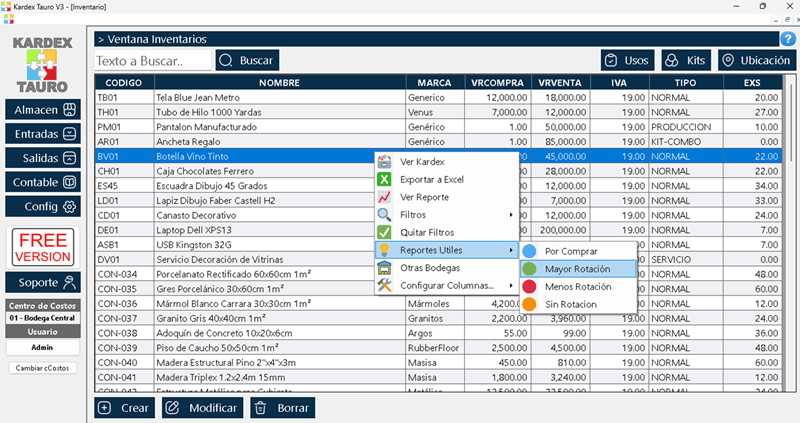
If the operation also carries inventory and invoicing, accounting software that records the GMF when it appears on the statement — Kardex Tauro does this inside its accounting module — saves the monthly hunt and leaves the expense measured from the first month.