Group 2 and Group 3 in Colombia: which accounting framework applies to you

Group 2 and Group 3 in Colombia: which accounting framework applies to you
Group 3 is not Group 2 with less paperwork. It is a different accounting framework, with its own measurement rules and its own limits. A microenterprise that treats it as permission to keep loose books ends up with financial statements that do not survive a review; one that meets the requirements and does not use them pays the cost of a framework it did not need.
This article explains what separates the two groups, how to read the three thresholds between them, what the simplified framework really simplifies and what it does not remove, when a move to Group 2 is due, and how to put the classification in writing so it is not argued about later. Threshold values change every year: they are explained as a mechanism, with the warning to check the value in force.
The classification is not chosen, it is determined
The first confusion is one of language. People talk about "opting into" Group 3 as if it were a voluntary regime, and it is not. The applicable framework is determined by objective criteria about the size and activity of the company. If those criteria place it in a group, that is the framework it must apply, whether or not there is a formal declaration on file.
Hence the most uncomfortable consequence: staying in a group without meeting the requirements is a classification error, not a prudent position. And it is not fixed with a footnote. It is fixed by preparing the information again under the framework that applied, with the adjustments and disclosures that framework requires.
Entities with a public accountability obligation fall outside this discussion: their framework is a different one and is not settled by size thresholds.
Group 2: IFRS for SMEs and everything it brings with it
Group 2 applies IFRS for SMEs. It is the framework for companies without a public accountability obligation that exceed the limits of Group 3.
"IFRS for SMEs" sounds like a lighter version and it is not: it is a complete body of standards. It requires defined accounting policies, measurements that are consistent over time, comparative statements, and notes that explain what the figures do not say. The burden is not in the volume of paperwork but in consistency. Every criterion adopted has to hold period after period and apply to all similar items.
For a mid-sized company that is healthy. It forces inventories, receivables, provisions and fixed assets to be looked at through the same lens every year, and makes statements comparable across periods. The cost is real too: someone has to write those policies, someone has to sustain them, and someone has to answer when a reviewer asks why an item was measured that way.
Group 3: simplified accounting, with rules of its own
Group 3 is the simplified accounting framework for microenterprises. It has reduced rules and reduced disclosures, and that reduction is deliberate: it is designed for a small economic unit, where the owner and the accountant are two people who see each other every day and information travels by word of mouth.
Simplified does not mean informal, and it does not mean "no framework". It means measurement rests on historical cost and notes are limited to the essentials. The company is still required to keep accounting records, keep supporting documents and produce financial statements; what changes is the level of detail with which it explains them.
That is the boundary many cross without noticing: a set of statements with no notes, no policies and no comparatives is not "Group 3". It is incomplete accounting.
The three thresholds that separate the groups
Moving from one group to another depends on thresholds for revenue, assets and employees, expressed in UVT (the Colombian tax value unit) or in minimum wages. They are not three independent exams passed separately: they are conditions met as a set. If one of the three stops being met, the company leaves the simplified group.
| Variable | What it measures | How it is expressed | Why it is reviewed |
|---|---|---|---|
| Revenue | The size of the operation during the year | UVT or minimum wages | It is the threshold that breaks first when there is growth |
| Assets | The weight of the balance sheet, not profit | UVT or minimum wages | It can grow without selling more: equipment purchases, property, accumulated receivables |
| Employees | The staffing structure | Number of workers | A headcount that rises because of one large contract changes the group even if sales do not |
All three are expressed in units that are updated every year. That is why a company can "shrink" without doing anything: if the thresholds rise with the UVT or the minimum wage and sales stall, the same business fits better where it was. And the reverse: growing barely above inflation can push it out.
How to calculate the thresholds without getting it wrong
The calculation looks trivial, and that is where most mistakes happen. First, fix the unit: the UVT and the minimum wage of the year being measured, not of the year in which the calculation is made. A classification done in March with last year's UVT starts out wrong.
Second, fix the period. Revenue is measured over the year, not over a quarter or over the last twelve rolling months. A December spike is not offset by a weak January; the full year is compared against the full-year threshold.
Third, fix the criterion for each variable and apply it the same way every year. Assets, for example, are taken from the balance sheet at the cut-off date, not from the average for the year. Employees are counted according to headcount at the cut-off date, with a written rule on how to treat temporary staff and apprentices. If that rule changes from one year to the next, the comparison stops being useful.
Fourth, put the calculation in writing: input data, unit used, date and source. In front of a reviewer, "we have always been in Group 3" is not an answer.
What Group 3 simplifies and what does not go away
It is worth separating two things that usually get mixed together: what the simplified framework lets you do differently, and what the company must keep doing the same.
- It simplifies measurement. The basis is historical cost. There is no need to go through a fair value exercise for every item, with its assumptions and supporting documentation.
- It reduces disclosures. Notes are limited to the essentials. Fewer pages, fewer annexes, fewer policy explanations.
- It does not remove bookkeeping. The obligation to keep books, records and accounts remains in force. The framework changes the detail, not the existence of the record.
- It does not remove supporting documents. Every transaction needs its document: invoice, voucher, contract, minutes. An expense without support is no expense at all, in any group.
- It does not remove record retention. Papers and files are kept for the period the rules require, even if the software no longer shows them on screen.
- It does not remove comparison. Statements are presented with the prior period alongside. Without a comparative there is no way to read a trend.
The left-hand list saves work. The right-hand list is what holds the company up when someone looks at it from outside. Confusing the two is the source of almost every classification problem seen in practice.
When you have to move to Group 2
The trigger is concrete: the company grows above the cap. When that happens it must move to Group 2, and the move is not a change of membership. It brings adjustments and disclosures, because the new framework requires measuring and explaining things the previous one did not.
The classification is reviewed every year, and the jump is detected by comparing the closed year against the thresholds in force. A company that crosses the cap cannot wait for things to "settle": a jump in sales can change the group.
Two situations are often confused. The first is real growth: more customers, more volume, more plant. The second is growth on paper: one large sale to a single customer invoiced in December, or the purchase of financed equipment that inflates assets without improving the operation. Both count toward the threshold, because the threshold does not distinguish quality from quantity. What changes is the conversation with the bank, not the calculation.
What changes in the financial statements
The applicable framework determines which statements are presented and with what detail. That is why classification is not a formality: it changes the deliverable.
| Element | Group 3 | Group 2 |
|---|---|---|
| Measurement basis | Historical cost | Policies defined under IFRS for SMEs |
| Accounting policies | Simplified | Documented and applied consistently |
| Notes | Reduced disclosures | Notes explaining criteria, assumptions and movements |
| Comparatives | Prior period | Prior period, on consistent criteria |
| Closing effort | Lower | Higher: reconciliations, support for balances, policy review |
The most expensive change is not the one in the first column. It is the one in consistency: under Group 2 you have to be able to explain why an inventory is measured this way and not another, and sustain that explanation over time. That requires information many microenterprises have but have never organized.
What banks and partners ask for
Here a tension appears that is worth understanding before a third party raises it. Banks and partners often ask for statements under IFRS even when the company is in Group 3. That request does not change the mandatory framework: the company remains classified where it belongs. What changes is the information it is worth preparing.
The practical way out is not to reclassify in order to please the bank. It is to prepare the additional package: statements under the mandatory framework, plus a reconciliation to the criteria the third party expects, plus notes explaining the differences. A bank that understands the difference between frameworks accepts that reconciliation. A bank that does not receive it tends to answer the application with more requirements or a worse rate.
With partners it works much the same. A partner about to come in wants to see the operation on criteria comparable to other investments. If the company is in Group 3, the honest answer is "we are on simplified accounting and here is the additional detail"; the dishonest one is presenting a simplified statement as if it were full IFRS.
How to document the classification
Documenting is not filling in a form. It is leaving a trail another person can follow without asking the accountant on duty anything. Five elements cover the essentials: the cut-off date, the three input figures, the unit of measure used with its value for the year, the result of the comparison, and the conclusion with the group assigned.
That document is signed, filed and kept alongside the statements for the period. When the review comes, the discussion stops being about interpretations and becomes about figures. Documenting the classification and the threshold calculations prevents arguments with reviewers and authorities, and prevents the worst scenario: discovering in the middle of a credit application that the company has spent two years in the wrong group.
Example: a microenterprise that grows
Take a garment company with three machines, rented premises and eight employees. In year one it closes with revenue of $800,000,000, assets of $500,000,000 and 8 workers. The exercise uses example thresholds, purely illustrative: revenue up to $1,000 million, assets up to $800 million and up to 10 employees for Group 3. The ones in force are checked each year in UVT or minimum wages.
With those three figures the company meets all three conditions and qualifies for Group 3. Its simplified accounting is correct: historical cost, short notes, a comparative against the prior year. Nothing to fix.
In year two it signs a contract with a retail chain and invoices $2,200,000,000. Assets rise to $900,000,000 because of two new machines and the new receivables. Headcount goes to 14 employees. All three indicators left the range at the same time, which is usual when growth is real and not on paper.
| Figure | Year 1 | Year 2 | Reading |
|---|---|---|---|
| Revenue | $800,000,000 | $2,200,000,000 | Exceeds the example cap of $1,000 million |
| Assets | $500,000,000 | $900,000,000 | Exceeds the example cap of $800 million |
| Employees | 8 | 14 | Exceeds the example cap of 10 |
| Group that applies | Group 3 | Group 2 | The move is mandatory, not optional |
| What gets prepared | Simplified accounting | Policies, comparatives and notes | The deliverable changes, not just the label |
The fine point is in year two. The company cannot present the same set of statements from year one with updated figures. It needs written policies, comparative statements on consistent criteria, and notes explaining the criteria applied. And it needs to explain the effect of the change: what was adjusted, why, and how the comparison with the prior period stands.
That is the real cost of growing: rebuilding year one on year two's criteria so the comparison makes sense.
Transition checklist for Group 2
If the company has already crossed the threshold, the order of the steps matters. Doing them backwards forces rework.
| Step | What is done | What it produces |
|---|---|---|
| 1 | Confirm the crossing with the three figures for the closed year and the unit in force | The decision stops being a suspicion |
| 2 | Write the accounting policies of the new framework | A document applied the same way every year |
| 3 | Review inventory, receivables, fixed assets and liability balances | Identification of what has to be adjusted |
| 4 | Prepare the prior-period comparative on the new criteria | Statements that can be read as a trend |
| 5 | Draft the notes and the explanation of the change | Disclosures that support the figures |
| 6 | File the calculation, the minutes and the signed statements | Support for reviewers, banks and partners |
Step two is the one most often skipped and the most expensive. Without written policies, step four turns into an internal argument about how each item was measured, and step five into a note that says a lot and explains little.
Classification mistakes that show up often
The mistakes are not in the arithmetic. They are in assumptions nobody reviewed for years.
- Confusing simplified with exempt. Symptom: books behind, supporting documents in boxes. Consequence: the company cannot prove its figures and the bank asks for what it does not have.
- Staying in Group 3 out of habit. Symptom: five years on the same framework with sales that multiplied. Consequence: a classification error with statements prepared under the wrong framework.
- Looking at only one threshold. Symptom: revenue is reviewed while assets and employees are ignored. Consequence: the jump is detected late, when two periods are already misclassified.
- Documenting nothing. Symptom: the classification exists only in the accountant's head. Consequence: when that person leaves, the company loses the explanation of its own framework.
An honest closing before you decide
This article explains the mechanism, it does not settle your case, and it is not accounting advice. The specific thresholds, the unit in force and the application date depend on the rules for the year, and there are borderline situations — companies right at the limit, corporate groups, mixed activity — that a general rule does not resolve. Confirm that with your accountant before moving any figure.
If your company sits comfortably inside one group and has not grown, there is probably nothing to do beyond documenting the calculation and filing the support. If it is close to the limit, review all three indicators every year with the same discipline used for receivables. The framework is not a label chosen once: it is a consequence re-verified each period.
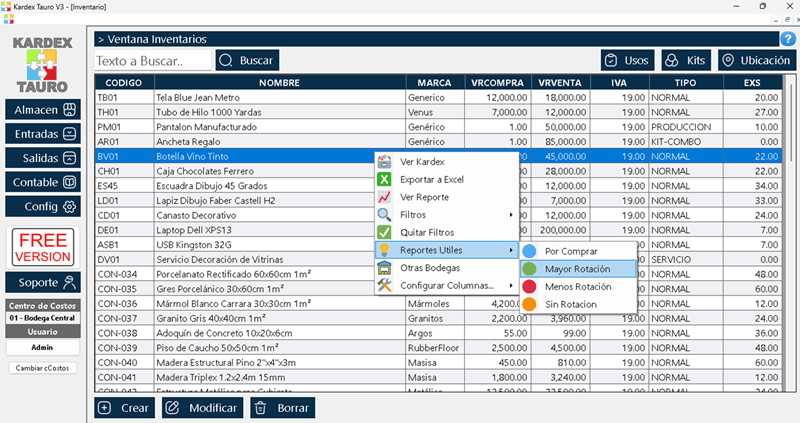
And if the underlying problem is that the classification lives in a loose spreadsheet, with no traceability and no backup, it is worth fixing that first: an inventory, invoicing and accounting system such as Kardex Tauro helps keep the figures that feed the calculation in one place and able to withstand a reviewer.