Selling price: how to set it without giving away your margin
Selling price: how to set it without giving away your margin
When the question of what to charge comes up, the most common answer in a Colombian small business is to add a percentage to the cost. Two months later the company is selling more and profit is not growing: that percentage was not the margin, and the cost used as a base was not the full cost either.
Setting a price is a decision with three inputs: the real cost per unit, the margin the operation needs to cover expenses and earn something, and what the customer is willing to pay against the alternatives. If one is missing, the number comes out wrong. This article calculates all three with an example you can replicate.
Why price is not cost plus a percentage
Adding a percentage to cost is fast, which is why it is used so much. It is also the reason many companies sell more and earn the same.
The first flaw: the percentage is applied to an incomplete cost. The last purchase is taken as the base, leaving out inbound freight, packaging, shrinkage and the share of fixed expenses that item carries. The second: historical cost is used; if transport or the exchange rate moved the replacement value, the price was born old.
The third: the calculation ignores the customer. A product can cost little and solve a lot, and another can cost a lot and be replaceable around the corner. The same percentage leaves money on the table on the first and loses sales on the second.
The fourth: the percentage is chosen by habit. Nobody knows where the thirty percent came from, but it has been applied for years. The right order is different: cost sets the floor, the market sets the ceiling and the margin the business needs says where to sit.
Margin on price and markup on cost: the confusion that costs points
Margin is calculated on the selling price; markup is calculated on cost. They are two percentages with different bases, and in daily conversation they are used as if they were the same.
Margin = (price − cost) ÷ price. Markup = (price − cost) ÷ cost. A product with a cost of 60,000 sold at 100,000 has a 40% margin and a 66.7% markup: the same 40,000 profit counted two ways.
The damage appears when someone asks for "forty percent" and the person in charge of pricing applies forty percent on cost. The result does not leave a 40% margin: it leaves 28.6%. Eleven points disappear without anyone noticing, because the price fell inside what looked normal.
| Markup on a cost of 60,000 | List price | Profit per unit | Real margin on price | Gap against the expected 40% |
|---|---|---|---|---|
| 25% | 75,000 | 15,000 | 20.0% | 20 points below |
| 40% | 84,000 | 24,000 | 28.6% | 11.4 points below |
| 66.7% | 100,000 | 40,000 | 40.0% | No gap |
The conversions fit in two formulas: margin = markup ÷ (1 + markup); markup = margin ÷ (1 − margin). A 30% markup equals a 23.1% margin, and a 30% margin requires a 42.9% markup.
The fix is vocabulary: define that in every meeting, price list and system, "margin" means on selling price. Half a dozen badly calculated prices on the fastest-moving products explains an entire year of weak profit.
Real unit cost: direct, indirect and the cost of serving the customer
The cost that serves pricing has three layers, and almost every business calculates only the first.
Direct cost is assigned to a unit without argument: raw material, direct labor, packaging, inbound freight. Indirect cost sustains the operation: rent, utilities, administration, depreciation, shrinkage. It is allocated with a driver —machine hours, square meters, orders— and the driver changes the answer: by units it punishes the cheap fast-moving item; by meters, the bulky one.
The cost of serving the customer is the third layer and the most forgotten. Selling does not end at delivery: there is outbound freight, commission, collection costs, returns, receivables financing and after-sales service. Two customers buying the same product can leave very different margins.
| Cost layer | What it includes | How it is allocated | Typical mistake |
|---|---|---|---|
| Direct | Raw material, direct labor, packaging, inbound freight | Per unit, with purchase documents | Using the last invoice instead of replacement cost |
| Indirect | Rent, utilities, administration, depreciation, shrinkage | With a driver: machine hours, meters, orders | Allocating everything by units and punishing the cheap item |
| Serving the customer | Outbound freight, commission, collection, returns, receivables | Per order, customer or channel, based on real behavior | Treating it as overhead instead of part of the margin |
| Financial and inventory | Tied-up money, obsolescence, insurance | By inventory days and item value | Ignoring it when the product moves slowly |
An example with the third layer. A product with a total cost of 60,000 sells at 100,000. Each shipment costs 4,000 in freight, the agreed commission is 3,000 per unit and 1,000 is provisioned for returns and receivables, 1% of the list price. Gross margin is still 40,000, but the real net margin is 32,000: 32%, not 40%.
How much margin the business needs so it is not working for free
Margin is not chosen by ambition but by arithmetic. The contribution margin of each sale must cover fixed expenses, financial expenses, taxes and the profit the owner expects. What is left over is gain; what is missing is loss, even if the bank account does not show it yet.
The calculation runs top-down. With fixed expenses of 18,000,000 a month —rent, administrative payroll, utilities, loan installments— and a target profit of 6,000,000, there are 24,000,000 that must come out of contribution margin. At a 35% average margin, required sales are 24,000,000 ÷ 0.35 = 68,571,429. Exercise figures: the procedure is what matters.
Margin alone is not enough. A product with a 20% margin that turns twelve times a year returns 2.4 times its inventory cost; one with 45% that turns twice returns 0.9. And averages mislead: a portfolio at 35% may have a family at 12% that takes half the warehouse.
Taxes and final price: what goes inside the price and what stays outside
In Colombia the list price can be stated with Colombian VAT included or excluded, and confusing the two wrecks any calculation. VAT is not revenue: it is collected for the tax authority. If margin is calculated on a VAT-inclusive price, the percentage comes out inflated.
The rule is simple: cost without VAT against price without VAT. The tax is added at the end, for the invoice, and removed at the start, for the analysis. Consumption taxes follow the same logic: they are part of the price, not of the margin.
Two clarity mistakes are expensive: calculating sales commission on the invoiced total including taxes, and applying the discount to the VAT-inclusive amount, which cuts the margin further than it looks.
Withholdings do not change margin, but they do change cash. A customer who withholds part of the payment is not paying less: it is paying later, and that gap carries a financial cost that belongs in the cost of serving.
Price from the market: perceived value, competition and willingness to pay
Cost says how low you can go. The market says how high you can go. That second limit lives in the customer's head.
The useful question is not "how much would you pay?", because almost nobody answers that well. The question is what the customer would do if the product were not available: buy elsewhere, buy something different, postpone the purchase or drop the task. Each answer shows the cost of not having it, and that cost is the real ceiling.
In business-to-business sales value can be quantified: hours saved, shrinkage avoided, returns that do not happen, inventory days freed. If it avoids 200,000 in losses a month, a price of 80,000 is an easy conversation. If the customer cannot name the benefit, the cheapest option wins.
Competition is a reference, not an answer. The neighbor's price says nothing about that competitor's cost structure: it may be liquidating inventory, have a lower cost from volume or charge separately for services this business includes.
Two practical tools: compare price per unit of use rather than per package, because the customer compares performance while the business compares sacks; and arrange the portfolio in three tiers —entry, intermediate and specialized— with prices that truly differ.
Discounts: how much volume it takes to make one back
A discount does not cut profit by the same percentage as the price: it cuts it by much more, because cost does not fall. The calculation almost nobody makes is how many extra units are needed to leave the same profit in pesos.
The formula is direct: units needed = profit per unit without discount ÷ profit per unit with discount. If profit per unit falls from 40,000 to 30,000, you must sell 1.33 times what you sold: 33% more units, with the same fixed cost.
| Discount on list price | Selling price | Profit per unit | Margin on price | Units to match the profit of 1,000 | Increase required |
|---|---|---|---|---|---|
| No discount | 100,000 | 40,000 | 40.0% | 1,000 | — |
| 5% | 95,000 | 35,000 | 36.8% | 1,143 | +14.3% |
| 10% | 90,000 | 30,000 | 33.3% | 1,333 | +33.3% |
| 15% | 85,000 | 25,000 | 29.4% | 1,600 | +60.0% |
A 10% discount does not ask for 10% more sales: it asks for a third more. If the business has neither the capacity nor the market to grow a third, the discount is not a volume strategy but a donation.
Worse when the cost of serving is added. With the same 8,000 per unit shipped, net margin at 90,000 falls to 22,000, that is 24.4%: net profit per unit drops 31% on a 10% discount.
Volume discounts make sense when the extra volume lowers unit cost: more units per shipment, better freight terms, fewer visits per peso sold. If volume lowers nothing, the tier only transfers profit to the customer.
Prices by channel and by customer: when the difference is legal and when it is a risk
Charging the same price in every channel sounds fair and is usually an economic mistake. The cost of serving differs, and if the price is identical, the most expensive channel subsidizes the cheapest.
- Counter sales: low cost of serving, small transaction, customer sensitive to the visible price.
- Wholesaler: demands a discount and buys volume, but imposes logistics, payment terms and returns.
- Institutional: long terms, guarantees and paperwork; financial cost weighs more than price.
- Online: collection fees, individual packaging, freight per order and more returns.
Differences between channels are legitimate when they reflect a real difference in cost or service. In Colombia, freedom to set prices is the rule, with exceptions: regulated goods and conduct that competition law sanctions, such as unjustified discrimination between competing customers. With a dominant position, consult a lawyer.
There is also a practical obligation: the displayed price must match what is charged, and promotions must be announced with clear conditions and validity. To keep the difference under control: a base list per channel, documented discounts and approval of exceptions beyond a threshold.
How to review prices without losing customers
Reviewing the entire list on the same day concentrates the impact in a single conversation and leaves eleven months of eroded margins. A system of triggers works better.
The first is cost: when the replacement cost of an item rises beyond a defined threshold, that item goes to review without waiting for the calendar. The second is margin: a monthly report by family shows which items drifted from target. The third is the market: when a competitor moves the price of a comparable product, review before reacting.
With those triggers, review becomes routine. Customers are not told "we are raising everything"; they are told about the change on the item that affects them, with a date and a reason. Fixed-price contracts usually set notice periods: honoring them is compliance.
Before the adjustment, three decisions. Segment, because customers do not react the same way and the largest are not always the most profitable. Stagger by product groups on different dates. And review the portfolio: sometimes the problem is a slow-moving item taking up warehouse space.
How to communicate the adjustment and what to answer when the customer objects
Price communication is part of the decision, not later paperwork. An adjustment explained with data is easier to accept than one announced as a business need.
The structure that works has four parts: the fact, the reason, the scope and the alternative. The fact is the date and the specific change. The reason is verifiable: freight went up, replacement cost went up, the tariff changed. The scope is specific: it applies to this item. The alternative is real: another delivery condition, another package, another frequency.
What does not work: explaining the increase with the company's situation or apologizing for charging. Nor negotiating on the spot: if the customer asks for an exception, answer with a date and decide with the cost structure in front of you.
Common mistakes
The five mistakes that destroy the most margin in a small business are not fine calculation errors: they are failures to review. Each one has a symptom visible in the income statement and a concrete correction.
| Mistake | Symptom | Consequence | Correction |
|---|---|---|---|
| Setting price with the unit cost of the highest-volume month | Margin looks fine in peak season and falls the rest of the year | Prices that only cover costs in the best month | Use cost at normal capacity and replacement cost |
| Applying discounts without recalculating break-even | Sales up, cash and profit flat or falling | Growing without earning, with more operating load | Calculate required units before approving |
| Ignoring the cost of serving | Large customers with apparent high margin and low profit | Cross-subsidy between channels and customers | Allocate freight, commission, returns and receivables per order |
| Matching the competitor's price without knowing their structure | Prices that do not cover your own cost | Competing under someone else's rules and failing under your own | Compare value and cost of serving, not just the number |
| Reviewing prices once a year, all at once | Big adjustments, hard conversations, customers leaving | Margins eroded for eleven months and a sudden jump | Triggers based on cost, margin and market |
An honest closing before deciding
None of this replaces the accountant. The cost structure, tax treatment and cash flow of each company have particularities an article cannot resolve, and decisions with impact on contracts should be reviewed with one.
There are also cases where the method only partly applies. If the price is regulated, the room to maneuver is different. If the product is generic with no differentiation, the market rules and the only real lever is cost. If you bid on a closed-price tender, the decision is made earlier, when you decide whether bidding is worth it.
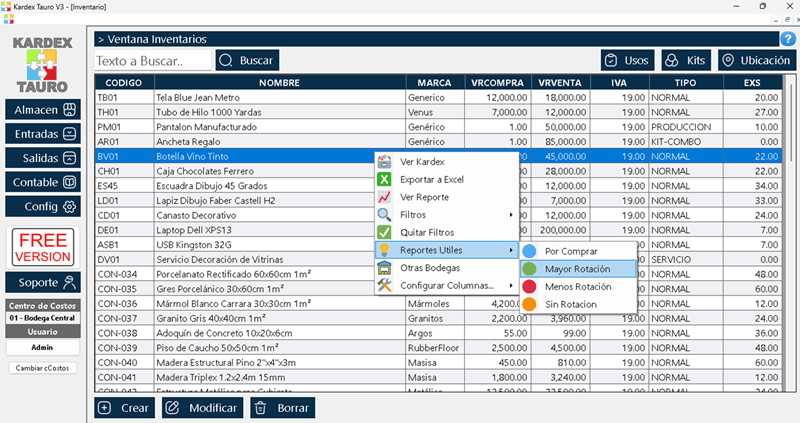
And there is a prior condition that is usually the real bottleneck: the method needs data. Reliable replacement cost, fixed expenses separated from variable ones, cost of serving per order. That is why the first step is rarely the price list but getting the kardex, purchases and returns in order.
Price is a repeatable decision, not a number you set once and forget. Every change in cost, channel or competition means looking at the list again, and that only works with a cost you can explain and defend: Kardex Tauro exists for that. The business that understands this stops arguing about percentages and starts arguing about margins with numbers.