Performance reviews: how to make them useful instead of a formality

Performance reviews: how to make them useful instead of a formality
In most small and mid-sized companies the performance review ends up in a folder. The employee signs, the manager files it away, and by the next cycle nobody remembers what was agreed. That exercise measures nothing: it only produces a document that proves a document exists. A review is worth something when it leaves three concrete things behind: criteria you can verify with facts, a conversation the person actually understands, and consequences with a date attached. If any of the three is missing, the process eats the manager's hours and wears down the team's trust. This guide shows how to build one inside a small company, without consultants, without new software and without turning the meeting into a trial.
What it is for and what it is not for
It serves three decisions: agreeing what a role is expected to deliver, keeping evidence of how that is going, and deciding with criteria on pay, promotion, a role change or an exit. It also reveals training needs and shows which manager needs support.
It is not for motivating someone who has been demotivated for months, and it is not for justifying a dismissal that was decided before the meeting. It does not replace weekly follow-up either: if the manager only talks about performance in November, the review becomes an ambush.
There is a simple test. In the month after the review, did anything change? A priority, a coaching routine, a review schedule, a recognition, a collection plan. If the answer is "nothing changed", the exercise was paperwork with a layout.
Observable criteria: results, behavior and competencies
A criterion is observable when two different managers, looking at the same evidence, reach the same score. "Has a good attitude" is useless; "closes the cash count before 6:30 p.m. with every difference explained" works.
Keep three families apart and do not blend them into a single grade. Results are the numbers for the period: quota attainment, margin, inventory accuracy, dispatch time, overdue receivables, invoicing errors. Behavior is how the work gets done: keeping commitments without being reminded, leaving a record, treating the difficult customer well. Competencies only belong here if the role truly requires them; otherwise they are a list of virtues nobody can verify.
Weight changes with the role. A salesperson lives or dies by the result; an administrative assistant lives by quality and detail. The table below is a starting point for discussion, not a recipe.
| Role | Results | Quality of work | Team and conduct | Internal customer |
|---|---|---|---|---|
| Field salesperson | 50 % | 20 % | 30 % | — |
| Warehouse manager | 35 % | 35 % | 20 % | 10 % |
| Administrative assistant | 20 % | 50 % | 20 % | 10 % |
| Customer service lead | 30 % | 25 % | 25 % | 20 % |
| Accounting analyst | 25 % | 55 % | 15 % | 5 % |
Two warnings. The weights add up to 100 % and are written before the period starts, not once you already know who did well. And if a criterion carries 30 %, the manager must be able to show evidence for that 30 %; otherwise the weight is decorative and the score is decided by likability.
Rating scales: why the five-point scale is misused
The 1-to-5 scale is the most common and the worst used. Without descriptors, "4" means "good" to one manager and "met expectations" to another: scores cannot be compared across areas and calibration turns into a negotiation of perceptions.
The fix is not a new scale, it is anchoring every level to a verifiable fact. The rule that works best in small companies: 3 means delivering exactly what was agreed, no more and no less. If the whole team scores 4 and 5, the scale has drifted and the manager is grading his own peace of mind.
| Level | Observable descriptor | What it means for the consequence |
|---|---|---|
| 1 | Does not meet the minimum of the role. Work is returned, redone or finished by someone else. | Immediate improvement plan and a review in 30 days. |
| 2 | Falls short of what was agreed on a key criterion. Needs frequent supervision to close. | Improvement plan with weekly follow-up. No increase. |
| 3 | Delivers what was agreed, on time and at the agreed quality. Holds the role without drama. | No automatic increase. A development path if the person wants to grow. |
| 4 | Consistently exceeds what was agreed without creating rework for others. | Enters the cycle's salary review. Candidate for a bigger role. |
| 5 | Sets the standard for the area: raises the bar and others learn from the practice. Sustained over several periods. | Salary review and succession plan. Requires evidence, not admiration. |
A five should be rare. If 60 % of the team scores five, you do not have an exceptional team: you have a scale without meaning. At the end of the cycle, look at the distribution.
Who evaluates: manager, peers, self-assessment and internal customer
The direct manager is the main source, because he sees the daily work and answers for the area's result. But the manager does not see everything: he does not know how that person behaves in the warehouse meeting or whether she helps a new colleague. Peers see that, and at the same time they have their own scores to settle.
Self-assessment is not there to grade: it is there so the person arrives with her version, her numbers and her arguments. Used well, it reduces surprise; used as a vote, it produces inflated scores and arguments about who is more generous.
The internal customer —warehouse, collections, service, any area that receives the work— brings hard data that is hard to argue with: how many times the order arrived late, how many errors had to be corrected. It is the most underused source in small companies.
Rule of thumb: do not turn the review into a vote. Three sources are enough (manager, self-assessment and one peer or internal customer), and the manager decides, explaining why he departed from the other voices. Under thirty people, that scheme is enough.
The bias that always shows up: halo, leniency and recency
The halo is letting one quality cover everything else. The person who is well liked or puts out fires gets a good score on criteria that have nothing to do with it. The antidote is scoring criterion by criterion, with the evidence on the table, instead of one overall impression.
Leniency is putting everyone at 4 to avoid discomfort; it shows up when the manager has no evidence and prefers a lukewarm average. Its cousin is severity: lowering the grade to "show character". Both are born from the same lack of records.
Recency is the quietest one: the last fifteen days weigh more than the first ten months. One bad year-end erases eleven good months; one brilliant quarter hides two weak ones. The defense is a dated record of facts, written through the year and not the week before the meeting.
The conversation: how to give feedback people can act on
Forty well-used minutes are enough: five for context and the score, fifteen for the person to explain her numbers, fifteen to agree what changes and five to write it down. If the meeting goes into justifying the past, there is no time left for next month.
Useful feedback has three parts: the fact, the effect and the request. "On March 12 you released the order without the delivery signature; the customer denied receiving it and we shipped it again. From now on, no signature means the order stays open." That can be executed. "You lack commitment" cannot: it does not say what to do on Monday.
Two delivery mistakes ruin the conversation. The sandwich —praise, hit, praise— makes the person remember the praise and forget the hit. And talking about the person instead of the work changes everything: "you are messy" cannot be fixed; "the file has three versions of the same order" can.
The conversation is private, scheduled and without an audience: feedback in front of the team is a spectacle and achieves the opposite effect.
An improvement plan with dates and owners
An improvement plan is not a wish list. It has three fields per action: what changes, how it is measured and when it is reviewed. And a named owner, who may be the manager: if the plan requires coaching, that coaching also has a date.
Three actions maximum and ninety days. A plan with eight fronts is abandoned in week three. And if the problem is structural —the role is badly designed, the tool does not work, the target is impossible— no individual plan fixes it: say so in the same meeting.
Example of a well-written action: "Collections coaching: the manager reviews the receivables list with the salesperson every Monday at 8:00 a.m. for eight weeks. Measured by the overdue receivables ratio at each month end. Owner: sales manager." There is an action, a measure, a frequency and an owner.
How to document evidence without filling out forms
You do not need a twenty-page template. One file per person with five lines a month is enough: date, fact, decision, commitment and who follows up. That record feeds the review and protects the manager from his own memory.
Evidence matters for two reasons. One: it lets you recognize in time the person holding the team together. The other, less pleasant: in Colombia, during a disciplinary process or a dispute over termination, whatever is not documented with dates becomes one manager's word against one worker's. A review does not replace the legal procedure, but an orderly record keeps the company from improvising.
The employee signs the minutes as proof of being informed, not as an admission of fault. Explain that before asking for the signature; it changes the person's disposition entirely.
How it connects to pay, promotion and termination
The golden rule is that the consequence is announced before the period, not after. If a score of 4 opens the salary review, everyone should know that in January. Announcing it in November, once the result is known, guarantees that nobody trusts the process.
For promotion, the criterion is not "was a good salesperson" but "can do the next role's job". An excellent salesperson can be a bad sales manager, and promoting on performance is one of the most expensive ways to lose a good salesperson.
For termination, the review is an input, not the only proof. In Colombia ending a contract has its own rules, and a low score does not replace the procedure or the assessment of cause. If the case is delicate, confirm it with your accountant and a labor lawyer.
And there is a cost that rarely makes it onto the scale: replacing a salesperson costs six to nine months of salary once you count recruitment, training and the pipeline that goes cold. On a salary of $4,000,000, losing one person is worth between $24,000,000 and $36,000,000.
A full example: two salespeople, scores and calibration
Two salespeople from the same team, with the weights from the first table: quota 50 %, receivables 20 %, team 30 %. A 1-to-5 scale with the descriptors above. All figures are worked examples.
Salesperson A, northern territory. Reached 92 % of quota; by the descriptor that is 3 (close, but short). Overdue receivables at 8 % against a 5 % target: 2, because it is far outside the tolerance. On team, 4: covered twice for a colleague on sick leave and left the procedure in writing. Calculation: 3 × 0.50 + 2 × 0.20 + 4 × 0.30 = 1.5 + 0.4 + 1.2 = 3.1 out of 5.
In the first draft the manager had written 4 for receivables "because the customer in that territory is difficult". That is a clear case of leniency: the criterion does not say "difficult", it says overdue receivables ratio. With the system report on the table, the score drops to 2 and the total lands at 3.1, not 3.5.
Salesperson B, central territory. Reached 104 % of quota; the manager wrote 5 because she closed a big deal in December. The year says 104 %, which maps to 4: recency inflated the grade. Overdue receivables at 3 %, better than target: 5. Team, 4. Calculation: 4 × 0.50 + 5 × 0.20 + 4 × 0.30 = 4.2 out of 5. Before calibration it was 4.7.
| Item | Salesperson A | Salesperson B |
|---|---|---|
| Quota attainment | 92 % → 3 | 104 % → 4 |
| Overdue receivables (5 % target) | 8 % → 2 | 3 % → 5 |
| Work with the team | 4 | 4 |
| Manager score before calibration | 3.5 | 4.7 |
| Adjustment based on evidence | Receivables 4 → 2, per the ageing report | Quota 5 → 4, recency |
| Final score | 3.1 | 4.2 |
| Agreed consequence | No increase. Collection plan with weekly follow-up for 90 days. | Enters the cycle's salary review and takes over a mid-sized key account. |
A's plan carries a written exit condition: if overdue receivables fall to 5 % by the end of the quarter, that criterion moves from 2 to 4 and the score rises to 3.5 (3 × 0.50 + 4 × 0.20 + 4 × 0.30 = 1.5 + 0.8 + 1.2), which puts him in the salary review. That turns the review into a target with a date, not a verdict. Note also that B, at 4.2, gets no automatic increase: she enters the review, which is different.
What to do when the person does not improve after the plan
If the ninety days passed, the coaching was real and the criterion did not move, the conversation changes topic: it is no longer about the plan, it is about the fit between the person and the role. Before deciding, check three hypotheses: the role is badly designed or the target is impossible, a tool or a decision from another area is missing, or the person performs better in another function.
Only after ruling those out do you talk about an exit, and you talk about it with the procedure in hand. An improvement plan that was half executed, with no records and no coaching, proves nothing; it only makes the company lose an argument.
Common mistakes
These six repeat in almost every company. Each has a symptom visible before the meeting and a consequence you pay for afterwards.
| Mistake | Symptom | Consequence | Fix |
|---|---|---|---|
| Rating results only | Good numbers with burnt customers and an exhausted team | You reward what destroys the operation in the medium term | Add a behavior criterion with real weight |
| Scale without descriptors | Every manager grades differently and nobody knows what a 4 is | Scores that cannot be compared and calibration that is impossible | Anchor every level to a verifiable fact |
| Reviewing without prior conversation | The employee hears the score in the meeting | It feels like an ambush and trust is lost | Monthly documented follow-up during the period |
| Putting everyone at 4 | 80 % of the team lands on the same level | The review stops distinguishing and stops guiding | Demand evidence per criterion and review the distribution |
| Promising and not delivering | An increase or promotion is announced and never arrives | Credibility is gone for the next three cycles | Promise only what is approved and written |
| Reviewing once a year | The only feedback day is signature day | Problems surface when they are already expensive | Short monthly check-in plus a formal half-year review |
An honest close before you decide
This does not replace your accountant or a labor lawyer, and it does not fix a leadership problem: if the manager cannot say "this was wrong" without attacking, no template will save him. Nor does it work the same in a company of eight people, where follow-up is a daily conversation, as in one of two hundred, where you need calibration across areas so that scores mean the same thing.
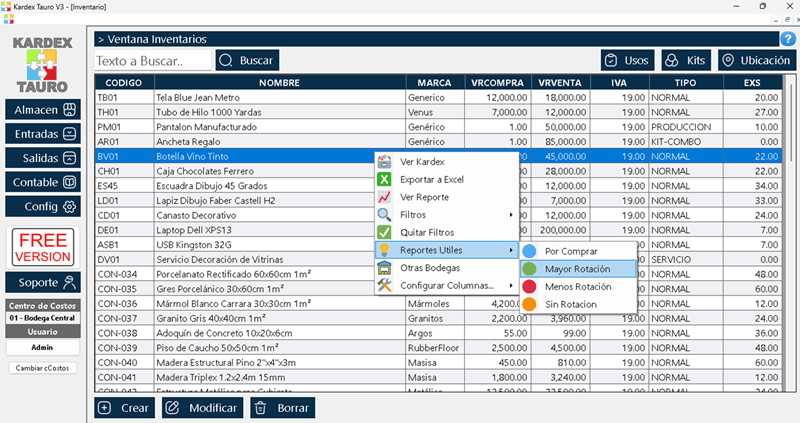
What is universal is the definition: a review is a conversation with evidence and a date, not a form. If the document does not change a decision next month, it was not worth the time it cost. In Kardex Tauro, the history of sales, receivables and inventory for each period stays available so that conversation rests on data rather than impressions.